HIPAA compliant texting: What you can send patients & how to communicate securely
HIPAA compliant texting is possible when a text holds no protected health inform...

Last Updated: Oct 16, 2026

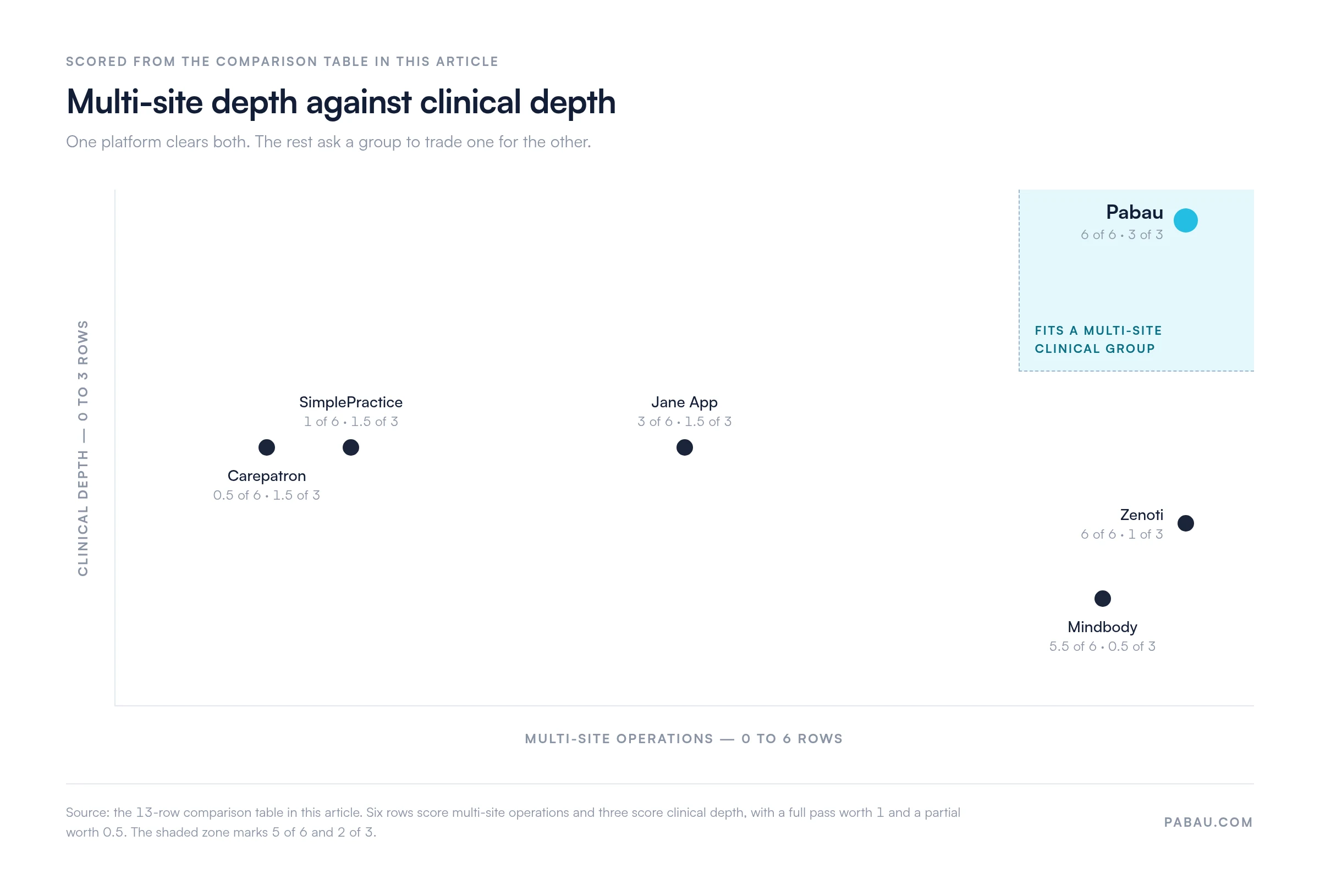
Pabau is the only platform in this comparison that combines multi-location operations with medical-grade clinical documentation in one dashboard.
Zenoti suits large beauty and wellness chains, and Mindbody fits fitness-first businesses. Neither is built for regulated clinical care.
Jane App earns the highest Capterra score here, but its integrations are built for North America rather than the UK and EU.
SimplePractice and Carepatron are designed for solo or small-group practitioners, so they lack consolidated multi-site reporting.
Centralized reporting, site-level staff permissions, and cross-branch inventory are the three capabilities that decide which platform fits your group.
The location-count tipping point lands at the third site, where centralized reporting, site-level permissions, and consolidated billing stop being optional. Every published price is in the tables below.
The best clinic management software for multi-location practices is Pabau, which runs scheduling, clinical records, permissions, and group reporting for every branch from one dashboard. Zenoti fits large beauty and wellness chains. Jane App suits North American allied health practices.
Pabau is the practice management platform we build, so treat our verdict accordingly and check it against the tables. This comparison scores all six on multi-site depth, clinical documentation, staff permissions, reporting, integrations, and published pricing. Zenoti, Mindbody, Jane App, SimplePractice, and Carepatron make up the rest. Readers who want a broader starting point can compare the best medical software for clinics and private practices generally.
Two answers sit below that a feature list will not give you. One is a published starting price for every platform that publishes one. The other is the location-count tipping point, which is the site count where centralized reporting, site-level permissions, and consolidated billing stop being conveniences. For most groups that lands at the third site.
One of the six clears every row here, and each of the others fails at least two. A platform that fails an entire row is one you can drop early. The bottom two rows carry the published starting price and the site count each platform was built for.
Score those rows and the ranking below falls out of them. Six of them measure multi-site operations and three measure clinical depth. The reviews that follow run in that order.
Pabau is the one platform here that pairs multi-site operations with medical-grade clinical records.
Pabau is built for groups working across aesthetic, medical, wellness, and hybrid disciplines. One dashboard carries scheduling, clinical documentation, staff management, inventory, and revenue reporting for every branch. An owner who wants appointment utilization across five sites at 9am on a Monday gets it without running an export.
The multi-site feature set covers per-branch and cross-branch scheduling, plus multi-location management of client records across every site. Permissions are set per location, so access follows the role and the address. Groups migrating from per-location tools report their biggest time saving in reporting and cross-branch client management.
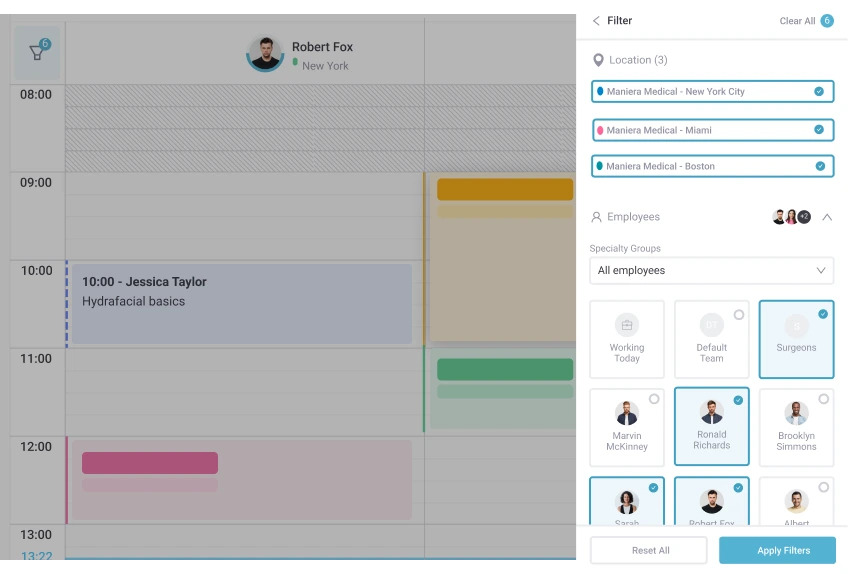
Clinical depth is where Pabau separates itself from booking-led competitors. Digital consent forms, customizable treatment notes, before-and-after photo management, injection plotting, and prescribing tools are all built in. They sit in the same interface as scheduling and reporting, so clinical staff never move between systems to finish a client journey.
For groups in regulated environments, that integration decides how much manual work compliance costs. A client treated with Botox at one branch and a skin treatment at another carries one record across both visits. The treating clinician at either site can see it, subject to the permissions you configured.
Pabau’s unified records support GDPR compliance in the UK and EU, and HIPAA compliance in the US.
Pabau Scribe, our AI scribe, drafts clinical notes from the consultation. Prescription management, lab ordering, and automated pre- and post-care messages round out the clinical side. These reflect a platform designed for clinical work rather than one adapted from a booking tool.
Multi-site management from one dashboard is the foundational strength. Owners see appointment utilization, revenue, staff schedules, and stock levels across every branch at once. Consolidated reporting is part of the core platform, which is the kind of visibility that usually needs separate business intelligence tooling.
Insights Plus, an additional analytics add-on, is not live yet and currently has a waitlist. When it arrives it will layer deeper analysis over the reporting already in the platform.
Clinical documentation is the second differentiator. The consent forms, treatment notes, photo management, injection plotting, and prescribing tools cover aesthetic, medical, physiotherapy, mental health, and multi-specialty work. Compliance workflows are designed with CQC, GDPR, and HIPAA requirements in mind, which matters when one policy has to hold across several sites.
Stock is the third. Cross-branch inventory management tracks consumables against treatment records, so a group stops reconciling stock counts by spreadsheet. Staff access is handled the same way, through team management software that sets permissions per location rather than per account.
Reviewers back this up. On Capterra, Pabau holds 4.7 out of 5 from 647 verified reviews. Recurring themes are the ease of multi-site setup, the depth of clinical documentation, and support quality.
The breadth of the platform creates a learning curve, especially for teams coming from paper or a single-purpose tool. Onboarding is structured and supported, but the initial configuration still takes time. Some reviews note slower performance on very large datasets, and a few integrations need manual setup rather than one click. Factor that into your implementation timeline.
| Plan | Price | Users | Key inclusions |
|---|---|---|---|
| Solo | $62 / month | 1 user | Full platform, unlimited patients |
| Team | Quoted on user count | 2–3 users | Full platform, priced per location |
| Medium | Quoted on user count | 4–5 users | Full platform, priced per location |
| Group | Quoted on user count | 6–15 users | Full platform, priced per location |
| Enterprise | Quoted on user count | 16+ users | Full platform, multiple sites covered |
Every plan includes the full platform, with no features held back for higher tiers. Locations are priced per site until Enterprise, which covers several sites in one agreement. Solo is the only tier with a published figure, and the four above it are quoted on user count.
Zenoti runs a large beauty or wellness chain well, and is heavy for a mid-market clinical group.
Zenoti is an enterprise platform built for multi-site beauty, wellness, and medical spa chains. The architecture was designed for large-scale multi-site operation from the start, with centralized reporting, loyalty program management, and marketing automation. For a chain running dozens or hundreds of locations, those capabilities are substantial.
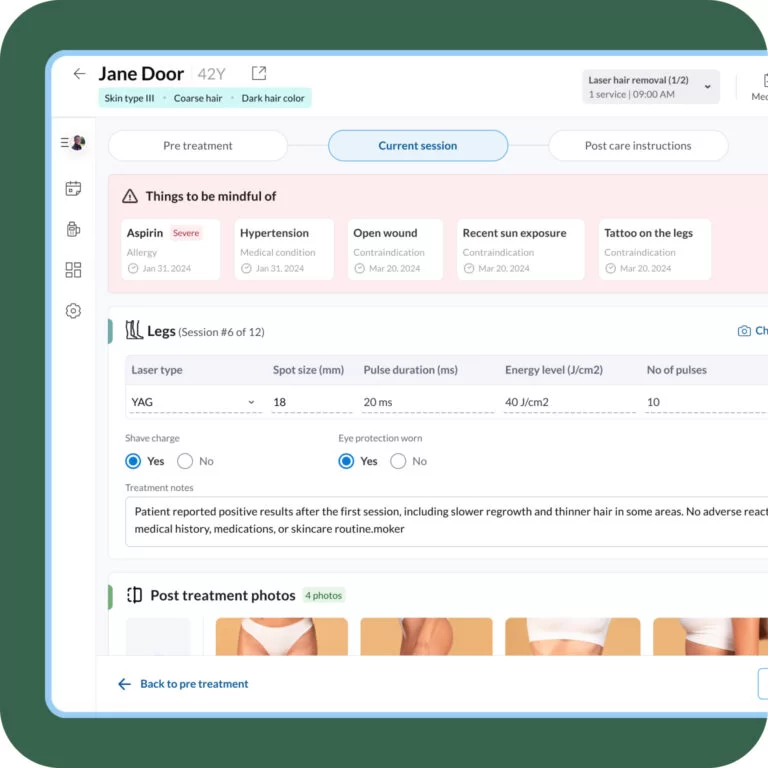
Multi-site operational infrastructure is the core strength. Centralized reporting, cross-location inventory, enterprise loyalty and marketing tools, and an architecture built for large brands give it a credible enterprise proposition.
On Capterra, Zenoti holds 4.4 out of 5 from 1,285 reviews, with praise focused on analytics and reporting depth. For an operator running dozens of sites, that feature set can justify a longer implementation.
Zenoti’s market is beauty, spa, and wellness at enterprise scale rather than regulated clinical care. Zenoti does include treatment notes, digital forms, and workflows suited to spas and med spas. Deeper clinical documentation and healthcare-specific compliance frameworks are not the product’s focus.
A group offering injectables, GP services, or physiotherapy alongside wellness services will find those clinical capabilities thinner than a healthcare-first platform’s. Pricing is quoted per deployment, which tends to run expensive for a group with a handful of sites. Its G2 score is 4.3, and reviews there repeatedly flag a complex, lengthy setup.
| Plan | Price | Users | Key inclusions |
|---|---|---|---|
| Core platform | Contact sales | Not published | Not published |
| AI Plus package | Contact sales | Not published | Not published |
Zenoti publishes no prices at all. Its own pricing page says multi-location pricing is customized to your footprint, so a mid-market group cannot build a budget without a sales call.
Mindbody is a strong wellness booking platform with no clinical documentation at all.
Mindbody is one of the most recognized names in wellness business management, with a large base across fitness studios, yoga centers, spas, and beauty businesses. Its consumer marketplace gives member businesses genuine discovery potential, especially in urban markets where the app has strong penetration.
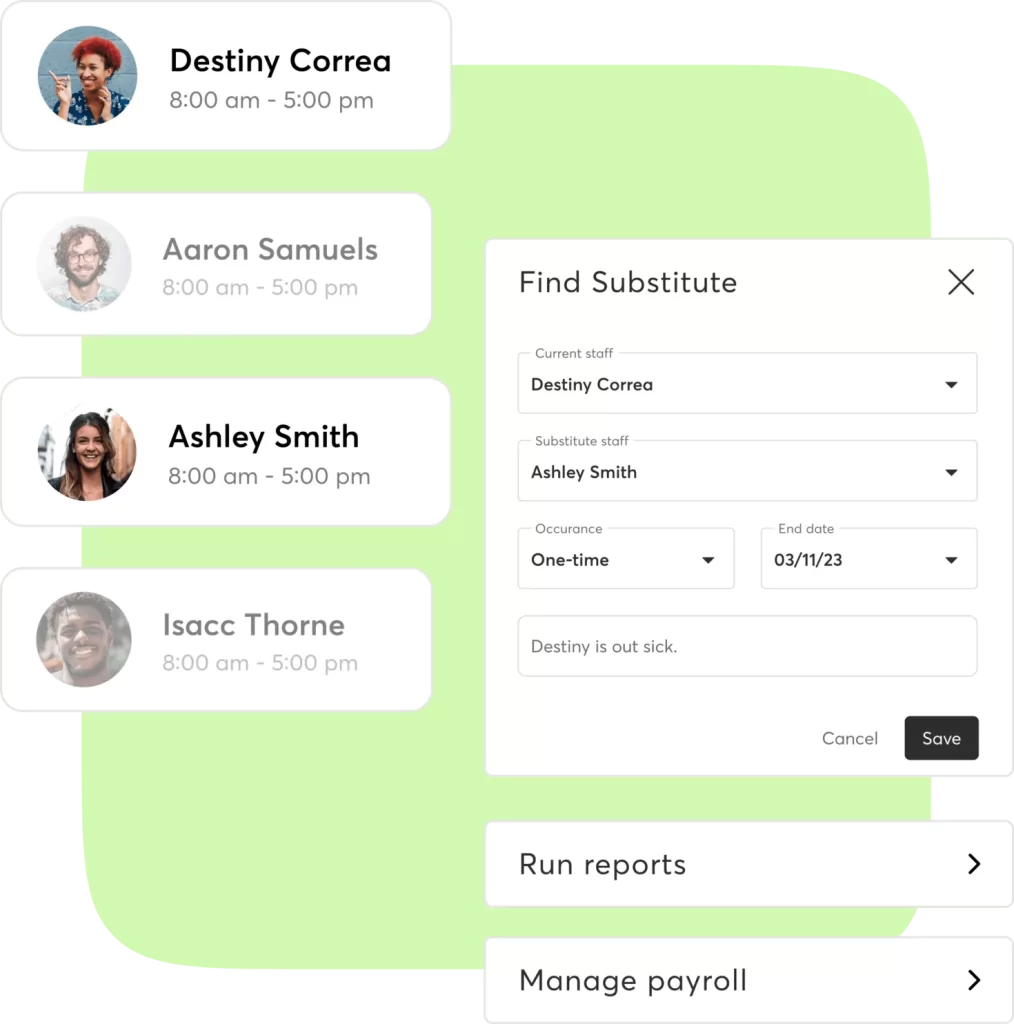
The consumer-facing marketplace is a genuine differentiator for businesses that benefit from discovery traffic. A yoga studio chain or day spa group appears in front of active searchers who would not otherwise find it.
Membership and package management is also handled well, with recurring billing, class passes, and promotional tools in the core product. Its Capterra score is 4.0 out of 5.
Mindbody includes no clinical documentation. Treatment notes, consent forms, before-and-after photos, injection plotting, and prescribing are all absent. The absence is structural rather than a backlog item, because Mindbody’s product strategy points at wellness and fitness rather than regulated care.
Any group offering aesthetic treatments, GP services, or physiotherapy needs a clinical record system Mindbody does not provide. Reviews on Trustpilot average 4.4 out of 5 across 2,179 reviews, with recurring complaints about price increases and support response times. Both are worth weighing on a multi-year platform decision.
| Plan | Price | Users | Key inclusions |
|---|---|---|---|
| Starter | Contact sales | Not published | Not published |
| Accelerate | Contact sales | Not published | Not published |
| Ultimate | Contact sales | Not published | Not published |
Mindbody names three tiers and publishes no price for any of them. Its own pricing page adds that your total depends on the extras you add and the fees tied to how you take payment.
Jane App is excellent for a North American allied health practice, and thinner once you add sites.
Jane App has a strong reputation among North American allied health practitioners, particularly in Canada and the US. Its charting tools, clean scheduling, and responsive support have earned consistently high satisfaction scores. For a physiotherapy, chiropractic, or psychology practice in those markets, it is genuinely competitive.
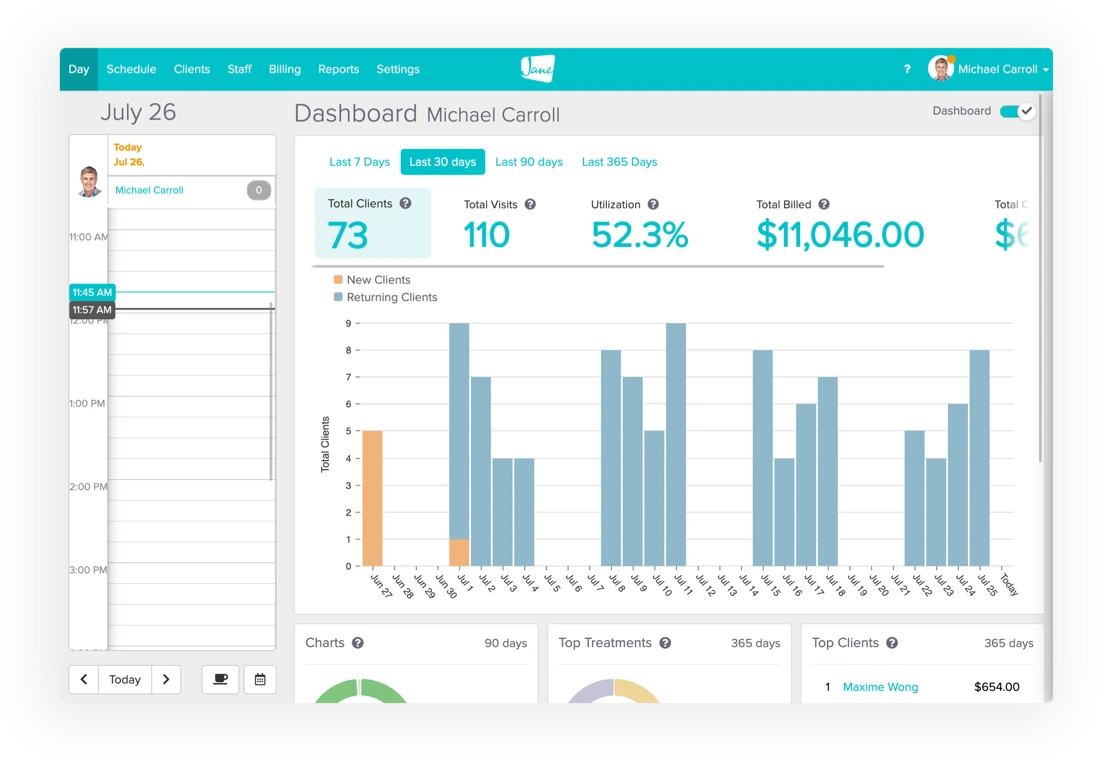
User experience is Jane App’s standout strength. Users describe the interface as intuitive and well designed, which cuts the training burden for new clinical staff. Charting is a core feature rather than an afterthought, with customizable templates for a range of allied health disciplines. On Capterra, Jane holds 4.8 out of 5, one of the highest scores in the category.
Jane’s multi-site capability is less mature than its single-site experience. Groups report that cross-location reporting and centralized client records take more manual effort than they would on an enterprise-first platform. Adding a location adds a subscription, not a shared operating layer.
The integration ecosystem is built around North American billing. That means Canadian provincial health billing and US insurance claims. Depth for UK and EU groups working under GDPR is limited by comparison.
For an aesthetic or medical group in Europe, that geographic orientation is a practical constraint rather than a detail. Jane’s G2 score sits at 4.0, with reviews drawn almost entirely from North American practices.
| Plan | Price | Users | Key inclusions |
|---|---|---|---|
| Balance | CAD $54 / month | 1 practitioner | Core features, 20 appointments a month |
| Practice | CAD $79 / month | 1 full-time practitioner | Core features, extra practitioners charged |
| Thrive | CAD $99 / month | 1 full-time practitioner | Everything in Practice |
Jane publishes prices per location, so a five-site group pays five subscriptions plus each extra practitioner. Insurance billing, payroll, and its AI scribe are priced separately on top.
SimplePractice fits a US therapy practice on one site, not a group spread across several.
SimplePractice is well established among mental health practitioners, therapists, and solo clinicians in the US. Scheduling, telehealth, billing, and clinical notes in one place have made it a default choice for individual practitioners building a private practice.
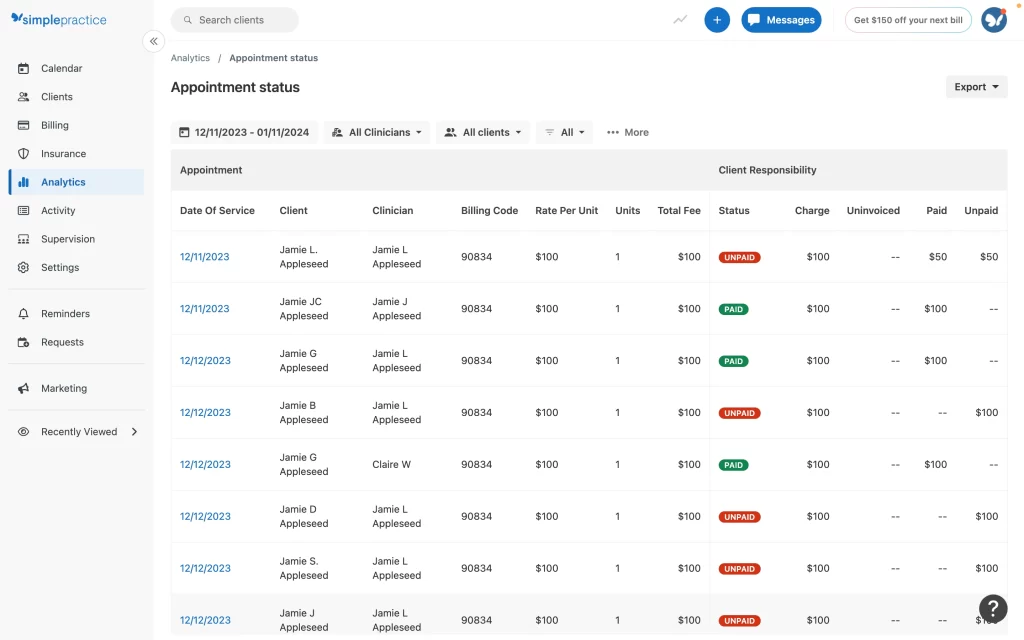
For a solo therapist or a small US group, telehealth, insurance billing, and note templates cover most of the job without extra software. The interface is clean and consistent. Its US insurance billing and superbill generation are well developed for both private pay and insurance-accepting practices. On Capterra, it holds 4.6 out of 5. Delivering a thorough telemedicine physical exam over that same telehealth link still depends on the clinician’s technique, not just the software.
Reporting and operational architecture are built for individual practitioners rather than group operators. Consolidated reporting across locations, cross-branch scheduling, and site-level permissions are not native. A manager running three therapy sites treats each as a separate entity in the platform, then reconciles the group view by hand.
The US-centric design covers billing tools, insurance integrations, and regulatory framing. SimplePractice is therefore a poor fit for UK and EU groups working under GDPR and different billing frameworks. Reviews reflect solo and small-group US mental health use, which is exactly the market it was built for.
| Plan | Price | Users | Key inclusions |
|---|---|---|---|
| Starter | $49 / month | Per clinician | Core features |
| Essential | $79 / month | Per clinician | Core features plus add-ons |
| Plus | $99 / month | Per clinician | Highest published tier |
All three tiers were half price for the first three months when we checked. Care Aide, note taking, and ePrescribe are separately priced add-ons, and ePrescribe carries a one-time setup fee.
Carepatron serves a solo practitioner well, and was never built for a group.
Carepatron markets itself as a free-to-start practice management tool, which lands well with solo practitioners and very small teams. Its scheduling, billing, and documentation cover what one clinician at one address needs. Self-serve onboarding means a new user can be working the same afternoon.
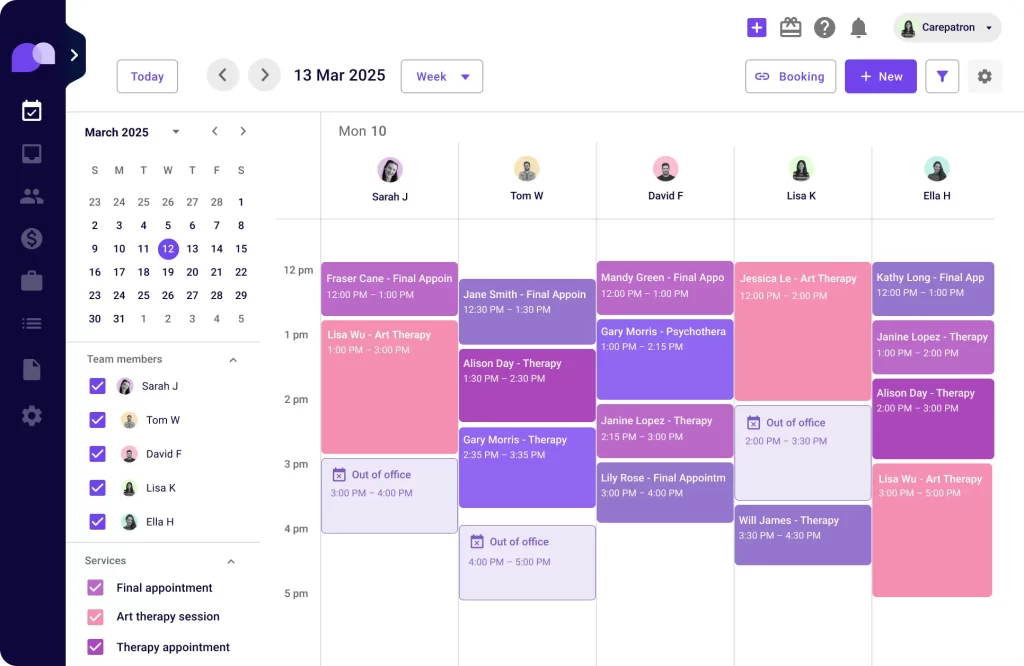
The freemium model is its most distinctive advantage. A solo practitioner with no software budget can run scheduling and basic documentation at no cost. The interface is clean and needs almost no training, which suits small teams with no time for onboarding. Reviewers most often praise how quickly they got set up.
The architecture is built for individual practitioners, not groups. Multi-site management, consolidated cross-branch reporting, and site-level permissions are not capabilities Carepatron was designed to support. A manager who wants utilization across three addresses cannot get it natively, and neither can an owner tracking stock between branches.
Self-serve onboarding is a strength for one user and a liability for a group migration, where implementation support usually decides whether the move lands. Carepatron is a credible choice for a solo practitioner or a very small single-site practice. The platform is not a fit for a growing group.
| Plan | Price | Users | Key inclusions |
|---|---|---|---|
| Free | $0 / month | Per user | Scheduling and basic notes |
| Plus | $31 / month | Per user | Adds automation and integrations |
| Advanced | $39 / month | Per user | Adds team collaboration tools |
Carepatron was running a half-price promotion for six months when we checked, which brings Plus down to about $15.50 per month. Budget against the regular prices above, because the promotional rate expires long before a platform decision does.
The location-count tipping point is the site count where centralized reporting, site-level permissions, and cross-branch inventory stop being conveniences and start deciding the purchase. For most groups that point arrives at the third site.
Two sites are still reconcilable by hand. One person opens two accounts, exports two sets of numbers, and pastes them into a spreadsheet before the owner’s first question. At three sites that job stops fitting into a morning. In the groups we onboard, the Monday export routine is what breaks first.
Cost crosses over at roughly the same place. Below the tipping point, per-user pricing wins, because Carepatron at $31 and SimplePractice at $49 per clinician undercut a per-location subscription. Above it, the admin hours spent merging per-site numbers outweigh the monthly difference between any two platforms here.
The first capability is one login that shows every branch, so staff never switch accounts to answer a question. The second is role-based permissions granular enough to set access per site. A manager at one branch should not see another branch’s finances unless you grant it.
That is where a practice-management platform separates from a staffing tool. Hospital employee scheduling software handles shifts, coverage, and overtime rules well. Those tools hold no client record and issue no invoice. A group needs the permission model and the clinical record in the same system.
The third capability is consolidated reporting that pulls appointment utilization, revenue, stock, and staff performance into one view. Without it, someone spends every Monday morning stitching per-location exports together. A single practice management app has to carry all three, or your team ends up patching around it.
Cloud-based practice management software runs from one central system that every location logs into, so no branch maintains a server of its own. For a group the operational difference shows up in three places.
All six platforms here are cloud-based, so the distinction that matters is what the central system holds. Carepatron and SimplePractice centralize one practitioner’s caseload. Pabau and Zenoti centralize a group’s operations.
Four of the six platforms publish a starting price, and two do not. That split matters more than the numbers. A published tier lets you model the cost of your fourth and fifth site before you commit; a custom quote makes every expansion a negotiation.
The unit of pricing matters just as much. Jane charges per location, so cost scales with addresses. Carepatron and SimplePractice charge per user, so cost scales with headcount. Pabau prices per location up to Enterprise, which then covers several sites in one agreement. Map your own growth plan onto each model before you compare headline figures.
Implementation time belongs in the same budget. Carepatron and SimplePractice are self-serve, so a single practitioner can be working the same afternoon. Zenoti reviewers consistently describe a long, complex rollout that needs a dedicated internal team.
Pabau runs structured onboarding rather than a trial, and a multi-site rollout moves through set stages. The onboarding team migrates client records, appointment history, and stock, with a dedicated client coordinator on the account.
Customer Success then configures booking rules, forms, permissions, and payment flows for each site. Most groups launch one location first, settle that configuration, then copy it to the rest. Budget the configuration stage properly, because rushed setup is what strands a group halfway.
Add up what you already pay for scheduling, clinical notes, marketing, billing, and reporting. Groups running four or more separate tools often find one platform costs less in total. It also removes the manual reconciliation that separate tools create every month.
Integration depth and compliance posture decide more of this than a feature comparison shows. A platform that schedules well but cannot reach your accounting system, payment processor, or marketing tools creates friction that grows with every location you add.
Accounting is where multi-site integration usually breaks first. Pabau connects to Xero, so your accounting software receives invoices from every branch without a manual export. Pabau also reaches payment processors, marketing platforms, and an open API for custom workflows.
Check the direction of that link before you sign. Accounting software for a medical practice should receive invoices, credit notes, and refunds, not only a nightly revenue total. Pabau supports practices in the UK, EU, and US, with infrastructure aligned to GDPR and to HIPAA-compliant data handling.
Jane App’s integration depth outside North America is limited by comparison. Its Canadian provincial insurance billing and US claims processing connections are mature and well maintained. A UK aesthetic group is likely to find that Jane does not reach the tools it already runs on.
Zenoti’s integrations are substantial for large chains, covering POS systems, loyalty platforms, and the marketing tools beauty franchises use. Configuration is complex enough to need dedicated implementation support. Dedicated support is a fair trade for a 50-site chain and meaningful overhead for a group of three to eight.
Mindbody and SimplePractice both point their ecosystems at their core markets, which leaves little for a multi-disciplinary group.
For groups operating in the UK or EU, GDPR applies to every location you run. UK GDPR requires data processing agreements, clear documentation of where data lives, and auditable consent records for all patient data. A platform that cannot evidence those three is a compliance risk across the whole group, not just at one site.
Pabau’s GDPR and HIPAA frameworks are documented and available for review. Data processing agreements, consent management, and clinical documentation workflows are built to support them across jurisdictions.
SimplePractice and Carepatron are designed primarily for US HIPAA compliance, and their GDPR readiness for UK or EU groups is less clearly documented. Jane App’s data infrastructure is oriented toward North America, which a European group should verify carefully before signing.
Review scores are a useful signal for how each platform behaves in daily operation. Read them alongside review volume and geography, because both vary widely across these six.
Pabau holds 4.7 out of 5 on Capterra from 647 verified reviews, one of the larger bases in this category. Positive themes cluster around multi-site setup, the depth of clinical documentation, and support responsiveness. The most cited criticism is the learning curve during initial configuration, which reviewers usually frame as a one-time cost. On G2, Pabau also holds 4.7.
Zenoti holds 4.4 out of 5 on Capterra from 1,285 reviews, with positive sentiment around enterprise analytics and loyalty tools. The most consistent criticism is the complexity and length of onboarding, which belongs in any implementation timeline you build. Its G2 score is 4.3, and those reviews come from large beauty and wellness chains rather than clinical operators.
Jane App earns the highest satisfaction scores in this comparison. Capterra reviewers give it 4.8 out of 5, with standout marks for user experience and support responsiveness. Its G2 score is 4.0. The review profile is almost entirely North American allied health. Those scores describe an experience that may not transfer to a UK or EU group.
Mindbody’s profile is mixed. Capterra reviewers give it 4.0 out of 5, while Trustpilot averages 4.4 across 2,179 reviews. Trustpilot captures billing and support friction more directly than the software review sites do, and price increases dominate those complaints.
SimplePractice earns 4.6 on Capterra, with reviews reflecting high satisfaction among US solo and small-group mental health practitioners. Carepatron holds 4.4 from 858 Capterra reviews, and the praise there centers on how quickly a new user gets started. Both scores describe single-site experiences rather than group operations.
The right platform follows from your clinical environment, site count, regulatory context, and growth plan. Three questions get most groups to a single answer, and the diagram below runs through them in order. The site-count question is the location-count tipping point in diagram form.
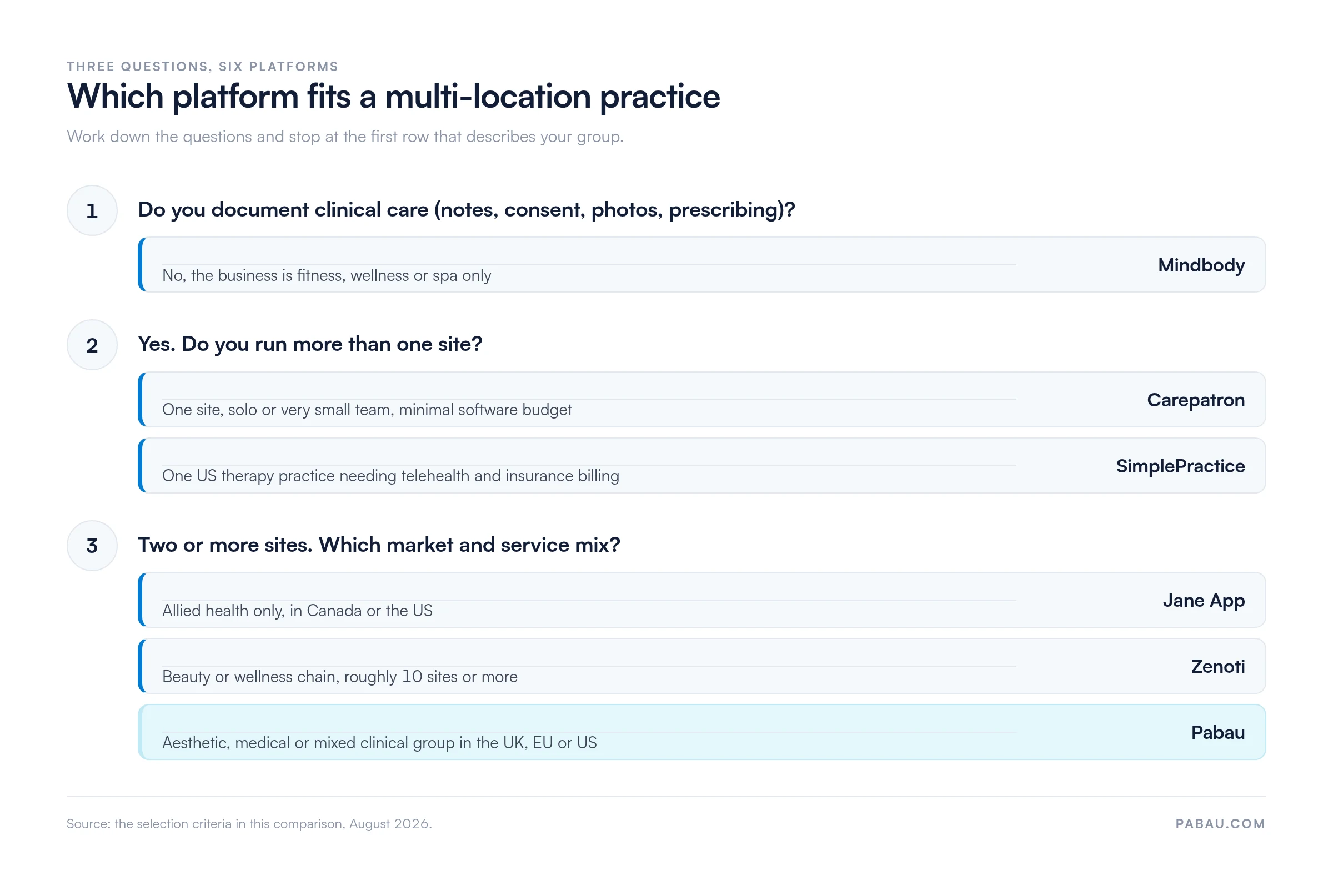
Choose Pabau if you run a multi-site group across aesthetic, medical, wellness, or multi-specialty disciplines. Pabau fits when you need medical-grade documentation, GDPR-aligned infrastructure in the UK or EU, or HIPAA-aligned workflows in the US. Pabau also suits a single-site practice that plans to add locations, because the operating model does not change when you do.
Choose Zenoti if you run a large beauty or wellness chain, typically 10 sites or more. Zenoti fits when you have a dedicated implementation team and no regulated clinical work. Its enterprise analytics and loyalty tools are genuinely strong at that scale.
Choose Mindbody if your business is fitness, wellness, or spa work with no clinical documentation or medical compliance requirement. Mindbody gives studios, gyms, and wellness centers solid scheduling, membership management, and client engagement tools.
Choose Jane App if you run a multi-practitioner allied health practice in Canada or the US. Jane App fits when you value user experience and support above operational breadth, and your integrations stay inside North American billing systems.
Choose SimplePractice if you are a solo therapist or a small US mental health practice. SimplePractice fits when you need strong telehealth and US insurance billing, and work from one site.
Choose Carepatron if you are a solo practitioner or a very small single-site practice on a minimal budget. Carepatron fits when you need no multi-site management and no consolidated reporting.
Feature lists rarely capture what running several sites costs in practice. These four scenarios show how the platform choice plays out at different stages, in different disciplines, and on either side of the location-count tipping point.
A UK aesthetic group expanding from two sites to five needs a platform that absorbs that transition without a replacement at each stage. Cross-branch appointment management matters most here, so staff can book a client at whichever site suits them.
Pabau is built for exactly this shape. Zenoti could technically support it, and would be over-engineered and over-priced for five aesthetic sites. Jane, Mindbody, SimplePractice, and Carepatron would miss the documentation and consolidated reporting requirements.
A group offering physiotherapy, sports medicine, and aesthetic treatments across three sites faces a harder problem. Documentation differs by discipline, because physiotherapy SOAP notes and aesthetic consent forms share almost no fields. Permissions have to be granular too. A physiotherapy administrator should not reach aesthetic client records without explicit authorization.
Reporting then has to span all of it, giving the owner one view of utilization and revenue across every service and site. Pabau’s multi-industry architecture handles that combination from one platform. No other option here matches that mix of disciplines with equivalent documentation depth and multi-site management.
A longevity and functional medicine practice opening a second site needs to replicate its workflows rather than rebuild them. IV therapy protocols, intake processes, lab management, and marketing automation all have to arrive at the new address intact. The platform decides how much of that replication is automatic and how much costs staff hours.
Pabau supports those workflows with built-in lab management, cross-branch stock control, and automated client communications. A second-site launch inherits the operating setup of the first instead of starting from a blank configuration.
The best software for managing multi-location wellness practices is Zenoti for large non-clinical chains, and Pabau once any location performs regulated treatments.
A six-site day spa group sells memberships, retails product, and runs retention campaigns across every branch. Membership billing has to recognize a client at any location. Stock has to move between branches without two people counting the same shelf.
Zenoti and Mindbody both handle that commercial layer well. Mindbody adds marketplace discovery, and neither records a treatment note. The moment one site adds injectables, microneedling, or IV therapy, the wellness stack stops covering the clinical record.
That is the location-count tipping point arriving through service mix rather than site count. Pabau carries memberships, retail stock, and marketing alongside consent forms, treatment notes, and photo management. A wellness chain adding a medical arm keeps one client record instead of two systems.
Most groups reach us running one system per site, or one system plus four side tools. Monday morning means logging into each location, exporting yesterday’s numbers, and pasting them into a spreadsheet before anyone can answer a simple question. Client records live wherever the client first walked in, so a cross-site visit starts with a phone call.
Pabau replaces that with one account covering every branch. Scheduling, clinical records, consent forms, stock, and reporting all sit behind the same login, with permissions set per site so staff see only their own. Group reporting is a view, not a monthly assembly job. A clinician at any location opens the client’s full history, if you have granted that access.
The outcome is fewer admin hours per site and a compliance position you can evidence in one place. Every subscription includes every feature, so adding a fifth location changes your bill and not your capability. That is the difference between software that tolerates a group and software that was built for one.
Pabau is the best integrated clinic software for multi-site groups, because scheduling, clinical records, billing, and reporting run from one login rather than stitched-together tools.
Integration usually means two products exchanging data on a schedule. A booking tool pushes appointments to a records system overnight, and someone fixes what did not match. Inside Pabau the appointment, the note, the consent form, and the invoice are one record from the start.
That matters most across sites. A client booked at one branch and treated at another leaves one timeline, not two files to merge later. Pabau’s 30-plus native integrations are included in every subscription, so the reach does not depend on your tier.
Yes, Pabau consolidates billing, revenue reporting, and compliance tracking for every practitioner and every site into one dashboard, replacing per-site reconciliation. Revenue breaks down by practitioner, by service, and by location in the same view. An owner can see which injector at which branch is running below utilization.
Compliance works the same way. Consent forms, treatment notes, before-and-after photos, and prescribing records attach to the client rather than the site. Pabau’s GDPR and HIPAA frameworks then apply as one policy across the group, so an audit at any address pulls from the same evidence.
Billing consolidates in the same place. Invoices, deposits, refunds, and card payments from every branch land in one ledger that feeds your accounting system. For multi-practitioner clinics needing billing and reporting in one place, that removes the five-account month-end close. Practices that struggle to convert billed amounts into payment often need a sharper plan for improving their collection rate.

Pabau consolidates scheduling, clinical records, staff permissions, and reporting across all your sites. Your team stops exporting data and switching accounts to answer a simple question.

No platform here is right for every group, and the decision comes down to what you document and how many addresses you document it at. Carepatron and SimplePractice serve their single-site markets well. Jane App earns its satisfaction scores in North American allied health. Zenoti delivers substantial enterprise capability to large beauty and wellness chains.
The trade-off worth remembering is that most of these platforms ask you to choose between clinical depth and multi-site operations. Groups that pick one end of that trade spend the next two years closing the difference with spreadsheets and manual reconciliation. That cost never appears on a pricing page.
For a group combining clinical practice with several sites, Pabau is the one option here that answers both sides at once. If you are shortlisting now, work out where your location-count tipping point sits before you look at price. Book a demo to see how Pabau runs scheduling, clinical records, and group reporting across all of your locations.

Comparing how platforms schedule across sites? Multi-location scheduling software explains the calendar and routing differences that start to matter past your first site.
Weighing a group structure against staying solo? Group practice vs private practice sets out the operational and financial trade-offs of each model.
Need group-level numbers your owners will trust? Medical practice management reports covers which reports are worth running and how to read them.
Still building your evaluation checklist? Practice management software features lists the capabilities to score every shortlisted platform against.
Planning a migration off your current system? Switching EHR systems walks through data migration, staff training, and the timeline to budget for.
Pabau is the most capable platform in this comparison for groups combining clinical practice with multi-site operations. Pabau gives you one dashboard for scheduling, clinical documentation, staff permissions, inventory, and reporting across every branch. Zenoti suits large beauty and wellness chains. Jane App serves North American allied health practices. SimplePractice and Carepatron fit solo practitioners rather than groups.
Yes, though only some platforms do it natively. Pabau and Zenoti both provide centralized multi-location dashboards with no account switching. Jane App supports multiple locations, but consolidated reporting takes more manual work. SimplePractice and Carepatron do not support cross-branch management and were not designed for multi-site operations.
Platforms built for multi-site work, meaning Pabau and Zenoti, offer site-level role-based permissions. You can give each location its own access levels, so a manager at one branch cannot see another branch’s finances or records. SimplePractice and Carepatron offer simpler permission structures that are not granular enough for a group.
Three capabilities decide it. First, one dashboard with visibility across every branch. Second, site-level staff permissions granular enough to control access by location. Third, consolidated reporting that aggregates revenue, appointments, stock, and staff performance without manual exports. Regulated clinical work adds a fourth requirement for treatment notes, consent forms, and photo management.
Yes. Pabau is purpose-built for multi-site groups, with one dashboard covering scheduling, clinical documentation, staff management, inventory, and reporting across every branch. Pabau supports aesthetic, medical, wellness, physiotherapy, mental health, and multi-specialty disciplines from a single platform. UK and international groups get GDPR-aligned data management and CQC-aware compliance workflows, and US practices get HIPAA-aligned operations.
Platforms designed for multi-site operation, meaning Pabau and Zenoti, pull appointment utilization, revenue, staff performance, and stock levels from every branch into one view. That removes the manual aggregation groups face when they use per-location tools or export from separate accounts. SimplePractice and Carepatron require manual reconciliation for any group-level report.
Pabau works best for a med spa planning more locations, because the operating model does not change when you add a site. Pabau is also the best software for managing multi-location wellness practices that perform regulated treatments. Consent forms, treatment notes, and photos travel with the client, not the branch. Zenoti suits chains of 10 or more non-clinical sites. Mindbody has no clinical documentation at all.
Pabau holds 4.7 out of 5 on Capterra from 647 verified reviews, and clinical documentation is one of the most praised areas. Reviewers point to consent forms, treatment notes, and photos sitting in the same client file as the appointment. Praise also clusters around multi-site setup and support responsiveness. The most common criticism is the learning curve during initial setup.
Most clinics run a practice-management platform that combines scheduling, client records, billing, and reporting in one system. The six compared here cover that market for aesthetic, wellness, allied health, and mental health practices. Which one fits depends on whether you document clinical care, how many sites you run, and your specialty. Solo practices often start on Carepatron or SimplePractice, and groups move to Pabau or Zenoti.