ICD-10-CM
ICD-10 Code M25.559: Pain in Unspecified Hip Coding Guide
Hip pain is one of the most common musculoskeletal complaints across orthopedic,...

May 6, 2026


Buy now, pay later is now available in Pabau

F02.80 identifies dementia caused by another underlying disease, not Alzheimer’s disease itself, and must always be paired with the etiology code sequenced first.
The code specifies unspecified severity with no behavioral, psychotic, mood, or anxiety disturbance; any such disturbance requires a different F02 specifier.
F02.80 is a manifestation code under ICD-10-CM etiology/manifestation rules, meaning the underlying disease code (e.g., G30.9, G20) must appear before F02.80 on the claim.
Pabau’s claims management software and digital forms help neurology and psychiatry practices document F02.80 encounters accurately and reduce claim errors.
Secondary dementia coding trips up even experienced coders. The etiology/manifestation rule is frequently misapplied, severity specifiers get confused, and the wrong code ends up on the claim. ICD-10 Code F02.80 covers one of the most clinically complex dementia presentations in the codebook: dementia arising from another disease entirely, without any complicating behavioral, mood, psychotic, or anxiety features, and without a documented severity level. Getting this right matters for claim acceptance, audit resilience, and accurate patient records. This guide covers the code definition, sequencing rules, related codes, documentation requirements, and common coding errors for F02.80 in the current ICD-10-CM code set.
Unlike Alzheimer’s-specific codes or vascular dementia codes, F02.80 sits in the manifestation code category. It describes the cognitive presentation, not the disease driving it. Understanding when to use it, and how to pair it correctly with the right etiology code, is where most coding errors occur.
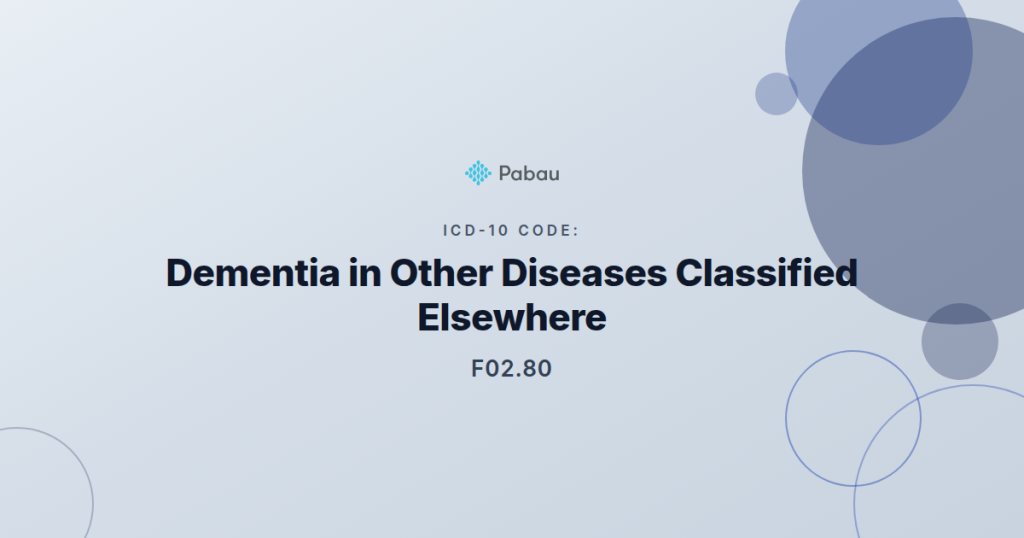
ICD-10 Code F02.80 is the designation for dementia in other diseases classified elsewhere, with the following full descriptor: unspecified severity, without behavioral disturbance, psychotic disturbance, mood disturbance, and anxiety. It is a billable, specific ICD-10-CM code valid for reimbursement across the current fiscal year, confirmed by the CDC/NCHS ICD-10-CM official tool.
The code belongs to category F02 within the F01-F09 block (Mental disorders due to known physiological conditions). Its critical distinguishing feature is that it codes the manifestation of dementia, not the underlying condition causing it. F02.80 applies when:
Confirming all four “without” conditions is essential before assigning F02.80. If any of these features are present and documented, a different specifier code from the F02 family applies instead. Coders working with ICD-10 code for autistic disorder and other neurodevelopmental conditions will recognize this same manifestation pattern across other parts of the F01-F09 block.
The single most important rule for F02.80: the underlying disease code must be sequenced first. This is a non-negotiable requirement under ICD-10-CM Official Guidelines (Section I.C.), maintained by the Centers for Medicare and Medicaid Services (CMS). F02.80 is a manifestation code. It describes what is happening (dementia) but not why. The etiology code identifies why.
Common etiology codes paired with F02.80 include:
| Underlying Disease | Etiology Code | Notes |
|---|---|---|
| Alzheimer’s disease, unspecified | G30.9 | Sequence first; F02.80 follows as manifestation |
| Parkinson’s disease | G20 | Parkinson’s dementia is a common use case for F02.80 |
| Huntington’s disease | G10 | Dementia is a defining feature of late-stage Huntington’s |
| Lewy body disease | G31.83 | Distinct from Parkinson’s-related dementia |
Correct claim sequence: Etiology code (e.g., G30.9) listed as the principal or first-listed diagnosis, followed by F02.80 as an additional code. Reversing this sequence is a common audit flag. The tabular list for F02 explicitly notes “Code first the underlying physiological condition,” which coders can verify in the AAPC Codify ICD-10-CM lookup.
The 2024-2026 ICD-10-CM expansion of category F02 created severity and disturbance specifiers that did not exist in earlier code sets. Understanding this expansion prevents the most common miscoding error: using F02.80 as a default when a more specific code applies.
The “without behavioral disturbance” cluster (severity axis) now includes four codes. The “with behavioral disturbance” cluster mirrors this structure with corresponding codes. Selecting correctly between these two families requires reviewing documented clinical features in the patient record.
F02.81 itself is a non-billable parent code following the FY2024 ICD-10-CM update; coders must assign F02.811 (with agitation) or F02.818 (with other behavioral disturbance) to capture behavioral disturbance specificity. Submitting F02.81 as a standalone diagnosis will produce a front-end claim rejection from most payers.
F02.80 is the correct choice only when the clinical record confirms unspecified severity and explicitly documents no behavioral, psychotic, mood, or anxiety disturbances. Using F02.80 as a catch-all code when severity simply was not assessed, but behavioral features were noted, is an audit risk. For practices managing complex behavioral health encounters, accurate specifier selection is as important as correct etiology sequencing. Practices that handle related behavioral health diagnoses such as situational anxiety ICD-10 code encounters often encounter the same documentation-specificity demands across the F-code range.
Before assigning F02.80, run a three-point documentation check: (1) Is severity clinically unspecified or undocumented? (2) Are behavioral disturbance, psychotic features, mood disturbance, and anxiety all absent from the record? (3) Is the underlying etiology code identified and ready to sequence first? If any check fails, review the F02 family for the correct specifier before submitting.
Payer audits of dementia coding focus heavily on whether the clinical record substantiates the code assigned. For ICD-10 Code F02.80, documentation must support every element of the code descriptor. Incomplete records are the primary driver of denials and recoupment requests in this category.
Clinicians documenting for F02.80 must capture:
A structured psychiatric evaluation template can standardize these documentation elements across providers in a practice. Practices using structured note templates see fewer documentation-related denials because every required field is prompted during the encounter rather than reconstructed from memory afterward. Building F02.80-specific documentation prompts into digital intake forms and clinical note templates is a practical step toward consistent compliance.
For Medicare encounters, CMS expects documentation to be contemporaneous, legible, and specific enough that an independent reviewer could arrive at the same diagnosis. Generic entries such as “patient has dementia” without naming the underlying etiology are insufficient for F02.80 and may trigger automated claim edits. Developing safer clinical notes practices across a neurology or memory clinic reduces this risk systematically.
Category F02 carries an Excludes1 note for F06.7 (mild neurocognitive disorder due to known physiological condition). This is a hard exclusion: F02.80 and F06.7 cannot be coded together on the same encounter for the same condition. F06.7 applies when the neurocognitive presentation does not meet full dementia criteria; F02.80 applies when it does. Distinguishing between the two requires clinical judgment on whether the presentation meets the threshold for a major neurocognitive disorder.
Key code neighbors and boundaries for F02.80:
Neurological ICD-10 codes frequently interact with secondary psychiatric manifestation codes like F02.80. Clinicians managing patients across neurology and behavioral health will recognize this crossover pattern in other areas of the codebook, including neurological ICD-10 codes for cerebrovascular conditions that may affect cognition. The WHO ICD-10 browser provides the international classification context for the F02 block, useful for practices serving internationally mobile patient populations.
Review the Excludes1 note for F06.7 at every F02.80 encounter. When cognitive symptoms are present but the clinician’s assessment does not reach full dementia criteria, F06.7 is the correct code. Assigning F02.80 to a mild neurocognitive presentation overstates the diagnosis and may not align with the documented clinical findings.
F02.80 is confirmed as a billable, specific ICD-10-CM code for the 2025-2026 code year. It can support reimbursement claims across Medicare, Medicaid, and commercial payers when paired with appropriate etiology codes and supporting clinical documentation. The code does not carry blanket non-coverage status, but payer-specific coverage policies and Local Coverage Determinations (LCDs) may impose additional requirements.
Practices billing for dementia-related evaluation and management (E/M) encounters should note:
Practices managing high volumes of neurology or memory care encounters benefit from purpose-built claims management software that can validate diagnosis code pairs (etiology + manifestation) before submission, reducing the rate of preventable claim rejections. For practices operating psychiatry-focused EMR software, integrating F02.80 coding rules directly into encounter templates supports compliance without adding administrative burden.

Pabau's claims management and digital documentation tools help neurology and memory care practices pair etiology codes correctly, document disturbance specifiers, and submit cleaner claims the first time.

F02.80 has a distinct audit risk profile. Three coding errors account for the majority of payer challenges:
A fourth risk worth noting: using F02.80 when F03.90 (unspecified dementia) would be more appropriate. When the clinical record does not clearly identify the underlying cause of dementia, F02.80 is not the correct choice. F02.80 specifically designates dementia in other diseases classified elsewhere, meaning a named underlying condition must be present and coded. Using F02.80 without a corresponding etiology diagnosis in the chart misrepresents the clinical situation and may be flagged during retrospective audits. Practices using mental health EMR platforms with built-in code pairing validation can catch these errors before claims leave the practice.

Need a structured approach to neurocognitive assessment documentation? Psychiatric Evaluation Template provides a step-by-step framework for documenting cognitive function, behavioral features, and severity assessments required for accurate F02-family coding.
Managing multiple ICD-10 diagnosis codes across a mental health practice? Mental Health EMR covers how Pabau supports clinical documentation and coding workflows for behavioral health providers.
Looking for guidance on clinical note compliance across your practice? Safer Clinical Notes outlines documentation best practices that reduce audit risk and support accurate diagnosis coding.
F02.80 denials almost always trace back to documentation gaps rather than coder error: an etiology diagnosis that was not captured at intake, a sequencing rule that was not enforced before claim submission, or a behavioral specifier that was missed because the encounter note never prompted the clinician to assess it. Pabau closes those gaps at the workflow level, so the clinical and coding requirements for F02.80 are built into how each encounter is documented rather than reviewed after the fact.
Neurology and memory care practices can use Pabau digital forms to capture the underlying neurocognitive etiology (Alzheimer’s, vascular, Parkinson’s, frontotemporal) at intake, then surface that diagnosis directly inside the encounter template so the treating clinician confirms it before the F02.80 manifestation code is selected. For behavioral health teams managing comorbid dementia and psychiatric presentations, Pabau’s psychiatry EMR software and mental health EMR features keep the etiology, severity, and behavioral disturbance specifiers visible on the same chart view, reducing the chance of an F02.80 assignment when an F02.A-C severity code or an F02.811/F02.818 disturbance code is the correct choice.
At the billing stage, Pabau’s claims management software validates the etiology + manifestation pair before the claim leaves the practice: a missing or unsequenced etiology code, or an F02.80 submission paired with documentation that supports a more specific F02 code, is flagged for review rather than rejected by the payer. The result is fewer F02.80-related denials, a cleaner audit trail when retrospective reviews do happen, and a sequencing convention that holds across every neurology and memory care encounter the practice records.
F02.80 is one of the more technically demanding codes in the ICD-10-CM F-chapter because it requires accurate identification of an underlying disease, correct application of the etiology/manifestation sequencing rule, and active confirmation that no severity or disturbance specifier applies. Getting any one of these elements wrong produces a coding error that can trigger claim rejections, audits, or inaccurate patient records.
Pabau’s claims management and structured clinical documentation tools help neurology and memory care practices build F02.80 coding accuracy into their workflow, from intake form design through claim submission. To see how Pabau supports complex diagnosis coding for behavioral health and neurology encounters, book a demo.
F02.80 designates dementia of unspecified severity, meaning no severity level has been clinically documented or is not determinable from the record. F02.A0 designates mild severity specifically. If a clinician has assessed the patient and documented mild severity, F02.A0 is the correct code. Use F02.80 only when severity is genuinely unspecified, not as a default when F02.A0 or F02.B0 is more accurate.
No. F02.80 is a manifestation code and must be preceded by the etiology code identifying the underlying disease (e.g., G30.9 for Alzheimer’s, G20 for Parkinson’s disease). Submitting F02.80 without the etiology code will typically fail payer code edits and result in claim rejection.
F02.80 can apply when Alzheimer’s disease (G30.x) is the documented underlying etiology, but Alzheimer’s is also covered by its own category (F00.x in older code sets; now integrated under the F02 manifestation structure). The key step is always to code Alzheimer’s disease first (G30.9 or the appropriate G30.x code) and assign F02.80 as the manifestation code second.
The Mini-Mental State Examination (MMSE) and Montreal Cognitive Assessment (MoCA) are the most widely used. Both provide scored, dated assessments that document the presence of cognitive impairment and help justify the “unspecified severity” designation when severity thresholds from the assessment do not align with a specific mild, moderate, or severe classification in the clinical context.
Yes. F02.80 is confirmed as a valid, billable ICD-10-CM diagnosis code for the FY2026 code year per CMS ICD-10-CM update files and the CDC/NCHS official code tool. The code has been part of the expanded F02 severity specifier structure that was introduced in the 2024 update cycle.