Musculoskeletal & Pain Management Physical Therapy
Cluster of Laslett Template
Download Your Free Cluster of Laslett Assessment Template Cluster of Laslett A s...

May 5, 2026


Buy now, pay later is now available in Pabau

Tibialis posterior is the primary dynamic stabiliser of the medial arch, critical for normal gait and foot control
Progressive exercise design (beginner, intermediate, advanced) allows clinicians to match rehabilitation to tissue tolerance and patient readiness
Standard exercises like heel raises, single-leg calf raises, and resistance band inversion target posterior tibialis strength with evidence-based sets and reps
Pabau digital forms enable clinic-branded, customisable handouts that integrate directly into patient records and treatment workflows
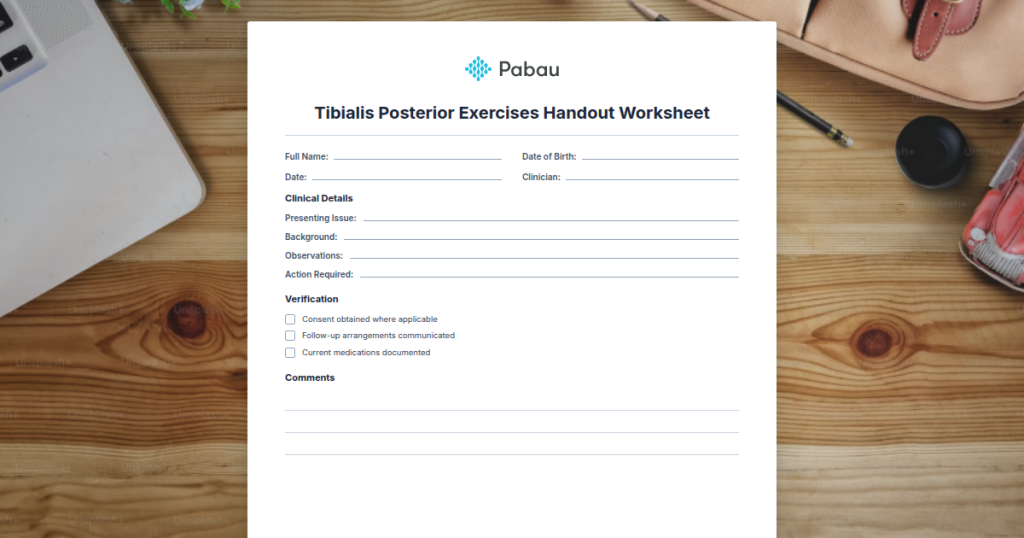
A ready-to-use handout covering tibialis posterior strengthening exercises with staged progression from beginner through advanced levels, complete with sets, reps, frequency guidance, and space for clinic-branded customisation.
Download templateThe tibialis posterior exercises handout is a clinical resource designed for physiotherapists, podiatrists, and musculoskeletal clinicians to distribute to patients recovering from posterior tibial tendon dysfunction (PTTD) or tibialis posterior tendinopathy. The tibialis posterior muscle is the primary dynamic stabiliser of the medial longitudinal arch, a role that becomes critical during the mid-to-late stance phase of walking.
When this muscle weakens or becomes inflamed, patients often develop a progressive flattening of the arch, increased pronation, and pain along the inner ankle or foot. A structured handout provides clear, progressive guidance for restoring muscle function while respecting tissue healing timelines. This prevents patients from performing exercises that exceed their current capacity, which could worsen tendinopathy.
From a regulatory and compliance perspective, a documented worksheet demonstrates informed consent, patient education, and evidence-informed care. It creates a paper trail of patient instruction, which is valuable during clinical audits and supports liability protection. For safer clinical notes and documentation practices, a handout signed by the patient confirms they understood and agreed to the rehabilitation protocol.
A well-designed worksheet follows a staged progression. Begin with the patient’s assessment of pain level, foot arch height, and functional limitations. Use this baseline to determine whether they start at the beginner, intermediate, or advanced level.
Aggressive mobilisation of the posterior tibialis tendon initially may worsen pain; the handout should emphasize starting gently and respecting the patient’s pain response. Some clinics include a note: “If you experience sharp pain (more than a 5/10), stop the exercise and contact the clinic.”
Physiotherapy clinics are the primary users of tibialis posterior exercises handout worksheet. Any practice treating lower limb or foot conditions benefits from this resource. Sports medicine clinics frequently distribute these handouts to runners with posterior tibial tendon pain, a common overuse injury.
Podiatry practices use tibialis posterior exercises handouts when prescribing custom foot orthoses, pairing mechanical support with active muscle strengthening. Osteopathy and chiropractic clinics managing lower limb dysfunction also integrate these handouts into patient care. Musculoskeletal therapy clinics treating patients post-ankle surgery or with flat foot deformity use them routinely to prevent functional decline and support arch recovery.
Any clinic managing patients with stage 1 or 2 posterior tibial tendon dysfunction benefits from this handout. Stage 3 PTTD (severe deformity or failed conservative care) may require surgical intervention, but the handout still serves for pre-operative patient education or post-operative rehabilitation guidance.
Clear, documented exercise guidance reduces patient confusion and improves compliance. A tibialis posterior exercises handout worksheet ensures all patients receive the same level of evidence-informed instruction, standardising quality across your clinic. When distributed consistently, handouts create accountability: patients can reference the handout between appointments, reducing phone calls and email queries about exercise frequency or technique.
From a clinical documentation perspective, a signed or initialled handout becomes part of the patient record and demonstrates informed consent for the prescribed rehabilitation protocol. This protects the clinic during audits or complaints. Mandatory compliance for physiotherapy clinics requires documentation that exercises were explained and agreed to by the patient; a handout satisfies this requirement efficiently.
Workflow efficiency improves when handouts are clinic-branded and integrated into your patient management system. Instead of printing generic PDFs, clinicians can attach a customised handout to each patient’s record within Pabau, ensuring the right patient receives the right version with their name and assigned dates pre-filled.

Attach customised tibialis posterior exercises handouts directly to patient records, send via patient portal, and track compliance-all within one integrated practice management system.

Research confirms that a structured tibialis posterior exercises handout programme is more effective than ad-hoc verbal instruction. Heel raises are the foundational exercise; studies show heel raises train the tibialis posterior in a manner that carries over to its functional role during gait. Single-leg calf raises progress the load further and challenge proprioception.
Resistance band inversion exercises target the posterior tibialis directly; a standard protocol (such as the Sanford Health Posterior Tibial Tendinopathy Rehabilitation Guideline) recommends 200 repetitions of inversion with a TheraBand per session. While high-volume, this gradual repetition builds endurance in the muscle and tendon.
A comprehensive tibialis posterior exercises handout should also reference secondary muscles: the gastrocnemius, soleus, peroneal muscles, and foot intrinsics all contribute to arch stability and lower leg function. Proximal hip stabilisers (gluteus medius) prevent excessive internal rotation during stance, which indirectly protects the posterior tibialis from overload.
A tibialis posterior exercises handout worksheet becomes most valuable when integrated into your digital workflow. Digital forms allow clinicians to create or upload templated handouts, customise them with patient names and dates, and distribute via patient portal or email automatically. This reduces printing costs and ensures patients always have access to the latest version.
Clinic teams should agree on a standard handout and review it annually to incorporate new evidence or respond to common patient questions. A comment section at the bottom of the handout invites patients to note their responses (“This exercise feels sharp”) and creates a feedback loop into the next appointment.
A structured tibialis posterior exercises handout worksheet is a clinical essential for any practice treating foot and ankle dysfunction. It standardises patient education, documents informed consent, and improves exercise compliance. Progressive stages (beginner to advanced) allow clinicians to match rehabilitation intensity to tissue tolerance.
Pabau’s digital forms and patient portal integration make it simple to customise, distribute, and track handout compliance. Rather than printing generic PDFs, you can deliver clinic-branded, personalised tibialis posterior exercises handouts that feel tailored to each patient. Book a demo to see how Pabau streamlines patient education and rehabilitation workflows.
Stage 1 typically lasts 1-2 weeks, Stage 2 lasts 4-6 weeks, and Stage 3 can extend 6-12 weeks depending on symptom resolution and functional gains. Recovery timelines vary; some patients improve within 6-8 weeks, while others with chronic tendinopathy require 12-16 weeks. Reassess every 1-2 weeks and adjust the timeline based on progress.
Yes. Older patients or those with arthritis may start with seated exercises longer before progressing to standing. Runners may progress faster and focus on functional running-specific drills. Patients post-surgery may start with non-weight-bearing exercises and progress gradually. A customisable template allows you to mark which exercises apply to each patient.
Minimal equipment is required: a chair, wall or handrail for balance, and a resistance band (TheraBand). Most patients can perform all exercises at home. A handout that specifies “medium resistance band” or “light blue TheraBand” helps patients purchase the correct resistance level.
Absolutely. A best-practice tibialis posterior exercises handout includes a “Stop and Contact Your Clinician If” section listing red flags: sharp shooting pain, swelling that worsens despite exercises, or signs of deep vein thrombosis. This protects patients and the clinic by setting clear boundaries for safe self-exercise.