

Musculoskeletal & Pain Management Physical Therapy
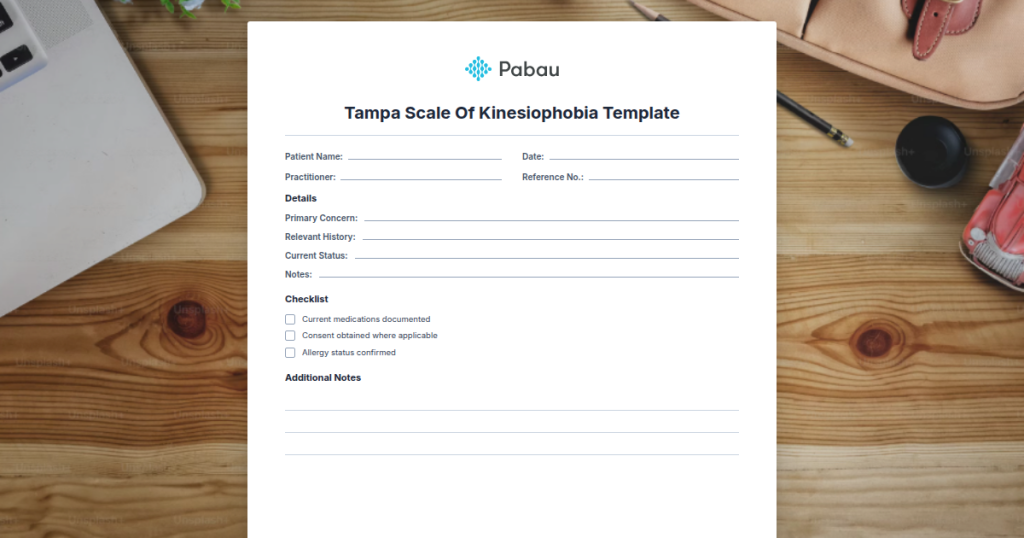
Tampa Scale Of Kinesiophobia Template
Fear of movement-known as kinesiophobia is one of the strongest predictors of po...

April 16, 2026


Buy now, pay later is now available in Pabau

The Tampa scale of kinesiophobia template is a 17-item assessment measuring fear of movement in patients with chronic musculoskeletal conditions.
TSK-17 scores range from 17 to 68, with higher scores indicating greater kinesiophobia; reverse-score items 4, 8, and 12 for accurate results.
Scores ≥37 commonly signal high kinesiophobia requiring targeted psychological interventions alongside physical rehabilitation.
Pabau’s digital forms platform streamlines TSK administration, scoring automation, and patient record integration for faster clinical workflows.
Fear of movement-known as kinesiophobia is one of the strongest predictors of poor rehabilitation outcomes in chronic pain patients. Practitioners often use back pain location charts alongside this scale to correlate fear-avoidance patterns with specific pain sites. The Tampa scale of kinesiophobia template gives physiotherapists, occupational therapists, and pain management clinicians treating conditions such as knee pain a validated tool to identify and quantify this psychological barrier early, enabling targeted interventions that address both physical and emotional dimensions of recovery.
This guide walks you through administering, scoring, and interpreting the Tampa scale of kinesiophobia template in your clinical practice, plus shows how to integrate it into your patient workflows for faster assessment and better outcomes.
A 17-item self-report questionnaire using a 4-point Likert scale to assess fear of movement and re-injury in patients with musculoskeletal conditions. Includes scoring instructions, interpretation thresholds, and clinical guidance notes.
Download templateThe Tampa Scale of Kinesiophobia (TSK) is a validated, psychometric assessment tool originally developed by Miller, Kori, and Todd in 1991. It measures fear-avoidance beliefs-the anxiety a patient experiences when anticipating or performing movements they believe will cause injury or re-injury.
Clinical significance: Kinesiophobia is not simply nervousness about exercise. It is a measurable psychological construct that directly predicts treatment adherence, rehabilitation progress, and functional recovery in patients with low back pain, fibromyalgia, neck pain, and other chronic musculoskeletal conditions.
The template assessment uses 17 statements rated on a 4-point Likert scale (strongly disagree to strongly agree), producing total scores ranging from 17 to 68. Higher scores indicate greater fear of movement and suggest the patient may benefit from cognitive-behavioural therapy, graded exposure (particularly effective for patients with trauma-related chronic PTSD), or psychologically-informed physical therapy alongside standard rehabilitation.
Administering the Tampa scale of kinesiophobia template takes 5-10 minutes and requires no special training. Follow these five steps to ensure accurate scoring and clinical interpretation:
Pabau’s digital forms platform can automate scoring calculations if you use an online version, reducing manual error and saving clinicians 2-3 minutes per assessment.
The Tampa scale of kinesiophobia template applies across multiple healthcare settings where fear-avoidance affects treatment outcomes:
Improves treatment outcomes: Early identification of high kinesiophobia allows clinicians to tailor interventions-adding graded exposure or cognitive restructuring-rather than expecting standard physiotherapy alone to resolve fear-related barriers. Studies show this approach accelerates functional recovery.
Supports informed consent and compliance: Administering the TSK educates patients about the mind-body link in pain and recovery. Understanding their kinesiophobia score helps patients engage with psychologically-informed rehabilitation rather than resisting or abandoning treatment.
Standardises risk stratification: Using a validated, quantified tool (rather than clinician intuition) ensures consistent identification of patients at risk for prolonged disability. This supports audit-readiness and evidence-based care planning.
Facilitates interdisciplinary communication: A standardised TSK score provides a common language between physiotherapists, psychologists, and GPs, making it easier to justify referrals for cognitive-behavioural therapy or pain psychology.
Tracks treatment responsiveness: Re-administering the TSK at 4-6 week intervals quantifies how psychological barriers shift during rehabilitation, providing objective evidence of progress in fear reduction alongside physical gains.
The Tampa scale of kinesiophobia template is free to use in clinical practice. There is no licensing fee or permission barrier-the instrument is published in the peer-reviewed literature and has been translated into 16 languages, making it accessible to international practices. In the UK and EU, administering the TSK as part of standard risk assessment aligns with best practice guidelines from the American Physical Therapy Association (APTA) and supports HCPC (Health and Care Professions Council) compliance expectations for patient-centred care.
The TSK is most valuable when it shapes clinical decision-making, not when it sits in a file unused. Build it into your workflow at the initial assessment appointment, before starting active treatment. Score it immediately and use the result to inform your initial consultation conversation: “Your TSK score is 42. This tells me movement anxiety is a barrier to your recovery. Let’s plan some graded exposure alongside your physiotherapy exercises.” This approach normalises the psychological assessment as part of whole-person care.
For re-assessment, administer the TSK every 4-6 weeks during the treatment episode. A rising score may indicate the treatment is too aggressive; a falling score confirms your graded approach is working. Document both the score and your clinical observation (e.g., “Patient reports less hesitation during active range-of-motion testing; TSK score fell from 45 to 38 over 6 weeks”).
Use Pabau’s AI-powered clinical documentation to record assessment findings alongside TSK scores. Automated notes mean you spend more time with the patient and less time typing after the appointment.

Want to understand the fear-avoidance model in depth? Return-to-Running Protocol: Physical Therapy Guide explains how graded exposure fits into structured rehabilitation timelines for athletes managing movement anxiety.
Need a framework for psychologically-informed practice? Physical Therapy EMR Software helps clinics document both physical and psychological recovery goals, making it easier to track kinesiophobia alongside functional improvement.
Looking for intake form templates that screen for fear-avoidance? Patient Intake Form Templates provide starting points for designing intake questionnaires that integrate pain history, movement anxiety, and treatment expectations.
Fear of movement is a silent killer of rehabilitation success. The Tampa scale of kinesiophobia template gives you a simple, evidence-based way to unmask it. By integrating TSK screening into your initial assessment and using the score to guide treatment planning, you address both the physical and psychological roots of patient suffering. Download the template today and start quantifying what your clinical intuition already knows: psychological barriers matter, and measuring them changes outcomes. Book a demo to see how Pabau helps clinics use patient-reported outcomes to guide faster, smarter rehabilitation.
The Tampa Scale measures fear of movement and re-injury in patients with musculoskeletal pain. High scores predict poor rehabilitation compliance and prolonged functional limitations, prompting clinicians to add cognitive-behavioural or graded exposure interventions.
Sum all 17 item scores (1-4 each) after reverse-scoring items 4, 8, and 12. Total range is 17-68. Scores ≥37 indicate clinically significant kinesiophobia.
TSK-17 is the original 17-item version (scores 17-68); TSK-11 is a shorter 11-item version (scores 11-44). Both are valid. TSK-11 is faster but TSK-17 offers more detail. Choose one and use consistently.
Scores ≥37 on TSK-17 commonly indicate high kinesiophobia requiring psychological support. Scores 17-25 suggest minimal fear; 26-36 suggest moderate concern.
Yes. The TSK is a published, validated assessment tool with no licensing fees or copyright restrictions for clinical use. It is freely available for physiotherapy, occupational therapy, and pain management practices worldwide.