








Uncategorized
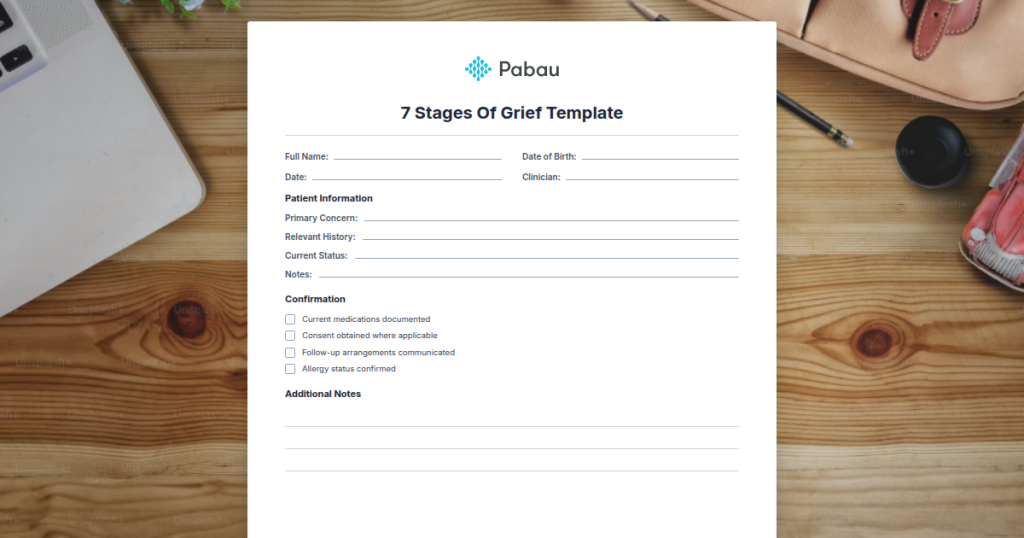
7 Stages Of Grief Template
Grief overwhelms practitioners who lack a structured framework to guide clients ...

April 15, 2026


Buy now, pay later is now available in Pabau

The 7 stages of grief template provides structured guidance for therapists to support clients through shock, denial, anger, bargaining, depression, testing, and acceptance.
Grief is non-linear. Clients may move between stages in any order and revisit stages multiple times throughout their recovery.
ICD-11 Prolonged Grief Disorder (6B42) requires formal assessment. The template helps clinicians differentiate normal grief responses from complicated grief requiring specialist intervention.
Pabau’s digital forms integrate grief assessment workflows directly into your clinical documentation, automating session tracking and progress monitoring for each grief stage.
Grief overwhelms practitioners who lack a structured framework to guide clients through their emotional journey. Without clear stage definitions, clinicians struggle to normalize grief responses and track meaningful progress. The 7 stages of grief template transforms bereavement support from reactive counselling into proactive, evidence-based clinical practice. This guide walks therapists through using the template in session, designing client handouts, and documenting the complex emotional terrain of loss.
Elisabeth Kübler-Ross introduced the original five stages in 1969 in her book On Death and Dying. Over five decades, grief researchers and counsellors expanded the model to seven stages by adding shock and disbelief at the start and testing/reconstruction toward the end. This refined framework better reflects how real clients experience loss-not as a linear progression, but as a spiraling, non-sequential journey through interconnected emotional states.
A ready-to-use clinical template covering all seven grief stages with psychoeducation points, client handout sections, and session-by-session tracking fields for therapists and mental health professionals.
Download templateA 7 stages of grief template is a structured clinical tool that therapists and counsellors use to educate clients about the emotional stages of bereavement, track client progress across grief states, and create psychoeducational handouts. The template maps the non-linear journey clients experience after significant loss-whether death, divorce, diagnosis, job loss, or other major life transitions.
The seven stages are: (1) shock and disbelief, (2) denial, (3) anger, (4) bargaining, (5) depression/pain and guilt, (6) testing and reconstruction, and (7) acceptance and hope. Unlike the outdated myth that clients must progress through stages in order, modern grief frameworks recognize that individuals move between stages fluidly, may experience multiple stages concurrently, and revisit earlier stages as anniversaries and triggers resurface.
Clinically, the template serves several functions. It normalizes grief responses for clients who fear their emotions are pathological. It provides therapists a shared language for session planning and clinical documentation. It differentiates normal grief reactions from complicated grief, which aligns with WHO ICD-11 Prolonged Grief Disorder (6B42) diagnostic criteria. The template sits at the intersection of psychoeducation, assessment, and treatment planning.
The 7 stages of grief template works best as a multi-session tool that evolves with the client’s progress. Below are five clinical steps to integrate the template into your grief counselling workflow.

Pabau's digital forms and automated clinical notes let therapists manage multiple grief clients without manual paperwork. Track each client's progression through the seven stages in real time.

The 7 stages of grief template serves multiple mental health professions and clinical contexts. Grief counsellors and bereavement specialists use it as their core framework. Individual therapists and psychologists incorporate it when clients present with loss-related issues. Psychiatrists reference the template during medication management for grief-related depression to monitor symptom evolution across stages.
Occupational therapists use the template when clients experience functional decline during grief. School counsellors deliver the template to adolescents processing peer or family loss. Palliative care teams and hospice services integrate it into pre-bereavement family education. Support group facilitators use the template to structure group sessions and validate individual member experiences. Workplace employee assistance programs (EAP) deploy grief templates during organizational loss or workplace tragedy.
The template also works across grief types: bereavement grief (death), disenfranchised grief (socially unrecognized losses like miscarriage or non-marital relationship loss), anticipatory grief (waiting for an expected death), and complicated grief meeting ICD-11 criteria.
Clinical clarity. The template standardizes how your team discusses grief, reducing inconsistent messaging to clients and improving continuity if clients see multiple therapists within your practice.
Rapid assessment. Rather than inferring a client’s current grief stage from narrative description, the template provides a quick symptom checklist. This accelerates diagnostic clarity and shortens time to intervention.
Prognostic tracking. Recording which stages a client cycles through session-to-session reveals patterns. Linear progression toward acceptance suggests healthy grief. Cycling backwards without forward movement may signal complicated grief requiring specialist assessment or medication review.
Regulatory alignment. Using a validated seven-stage framework strengthens your compliance documentation, particularly for clients with ICD-11 codes (Prolonged Grief Disorder 6B42, Adjustment Disorder with depressed mood). Auditors and payers recognise the Kübler-Ross model as evidence-based.
Client engagement. Handing clients a clear stage breakdown normalises their experience and reduces catastrophizing (“Am I going crazy?” becomes “I’m in the anger stage, which is normal”). Psychoeducation itself is therapeutic.
Track bereavement milestones (death date, birthday, holidays) in your calendar app six months ahead. Send automatic appointment reminders to grief clients one week before high-risk dates. Many clients cycle back to earlier stages during anniversaries. Proactive outreach prevents crisis presentations and demonstrates continuity of care.
Understanding the distinct emotional and cognitive markers of each stage helps therapists match interventions precisely. The seven stages are distinct emotional states, not destinations.
The 7 stages of grief template helps clinicians distinguish typical bereavement from prolonged grief disorder (ICD-11 6B42) or adjustment disorder with depressed mood (DSM-5-TR). Normal grief involves cycling through stages over 6-24 months with gradual improvement. NIMH research shows that 80% of bereaved individuals experience some symptoms of depression, but these gradually resolve with natural recovery and social support.
Prolonged grief disorder-the ICD-11 diagnosis-emerges when a client remains “stuck” in early-stage grief (shock, denial, anger, bargaining) for 12+ months after a significant loss without meaningful progression toward acceptance. The template’s stage-tracking function flags this pattern. Red flags include: persistent disbelief about the death, intense yearning without any movement toward acceptance, inability to engage in self-care or work, and complete withdrawal from social life beyond typical grief isolation.
When you identify complicated grief patterns on the template, refer to a grief specialist or psychiatrist for formal assessment. Prolonged grief sometimes responds to targeted therapy (Prolonged Grief Therapy) or occasionally medication.

Need evidence-based documentation of grief progression? Digital forms and Pabau’s automated clinical note integration let you embed the 7-stage framework directly into your patient intake and session notes, eliminating manual data entry.
Want to understand ICD-11 Prolonged Grief Disorder coding? Mental health EMR systems like Pabau automatically flag diagnostic criteria and coding recommendations so you can document and bill accurately when prolonged grief requires specialist intervention.
Looking for structured psychoeducation templates for client handouts? Pabau’s capture forms feature converts the 7-stage template into client-friendly digital handouts, reducing paper waste and improving engagement through interactive stage exploration.
Grief counselling without a structured framework leaves both clinicians and clients uncertain about progress and direction. The 7 stages of grief template transforms bereavement support into measurable, stage-based clinical practice. By tracking which stages clients navigate, which coping strategies work, and how they respond to milestones, therapists deliver informed, compassionate care that recognises grief as a normal-though sometimes complicated-response to significant loss. Ready to integrate structured grief documentation into your practice? Book a demo of Pabau to see how digital forms and clinical notes can streamline your grief counselling workflow.
The seven stages are: shock and disbelief, denial, anger, bargaining, depression and guilt, testing and reconstruction, and acceptance and hope. However, they are not linear. Clients may experience them in any sequence and revisit stages multiple times.
Grief timelines vary significantly. Most bereaved individuals show gradual improvement over 6-24 months, though cultural, spiritual, and personal factors influence duration. If a client remains stuck in early stages beyond 12 months without progress, consult a grief specialist for assessment of prolonged grief disorder.
Yes. The stages are emotional states clients may or may not experience, not mandatory steps. Some clients move quickly through early shock and denial, while others linger. The template helps you identify which stages are present, not enforce which ones “should” be.
Elisabeth Kübler-Ross’s original 1969 model included denial, anger, bargaining, depression, and acceptance. The seven-stage version adds shock and disbelief at the start (recognising the acute trauma of sudden loss) and testing/reconstruction toward the end (reflecting the practical life rebuilding that occurs after acceptance emerges).
Normal grief progresses through stages with gradual improvement. Complicated grief (ICD-11 Prolonged Grief Disorder 6B42) involves being stuck in early-stage shock, denial, or yearning for 12+ months without meaningful movement. Use the template to track progression. Prolonged stagnation signals the need for specialist assessment or targeted grief therapy.
Yes, with age-appropriate modifications. Younger children (5-10 years) may need simpler language and concrete examples. Adolescents typically understand the framework. Tailor the template’s vocabulary and examples to developmental level. Some therapists create separate child and teen versions of stage descriptions.