Functional Medicine Primary & Preventive Care
AIP Diet Plan Template
What is the AIP Diet Plan Template? The AIP diet plan template is a clinician-re...

April 16, 2026


Buy now, pay later is now available in Pabau

A bilirubin blood test template standardises lab requisitions and ensures clinical documentation accuracy
The form captures total, direct, and indirect bilirubin measurements for comprehensive liver assessment
Pre-structured templates reduce ordering errors and accelerate test turnaround times
Integration with digital workflows supports CLIA-compliant record-keeping and audit readiness
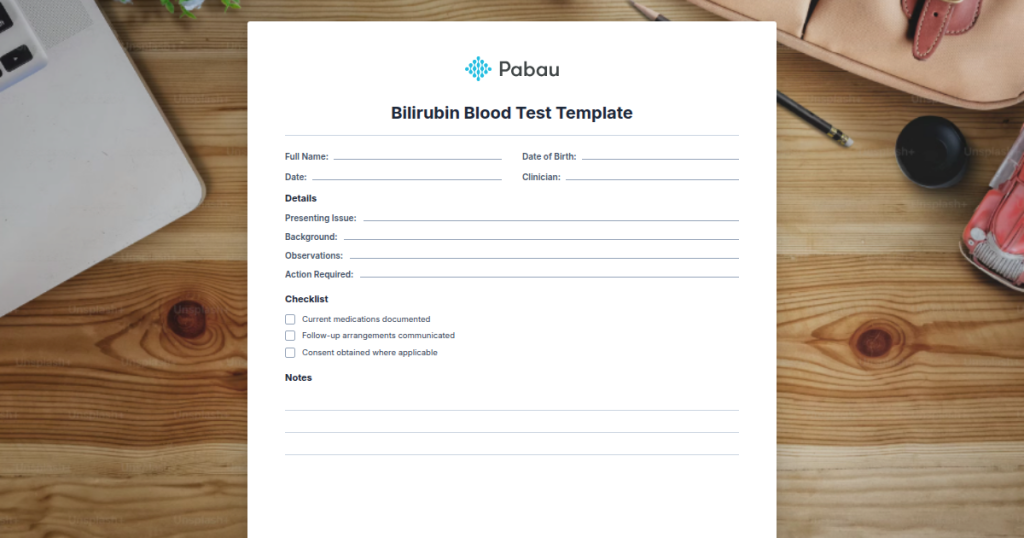
A bilirubin blood test template is a clinical documentation form that streamlines the ordering and interpretation of bilirubin levels in patient care. This template enables healthcare providers to request comprehensive bilirubin testing-measuring total bilirubin, direct (conjugated) bilirubin, and indirect (unconjugated) bilirubin-while capturing essential clinical context that supports accurate laboratory analysis and result interpretation. Clinics using a structured bilirubin blood test template reduce administrative delays and improve the quality of hepatic function assessment.
Bilirubin testing is fundamental to evaluating liver health, diagnosing jaundice, detecting haemolysis, and monitoring conditions like Gilbert Syndrome and neonatal hyperbilirubinemia. A well-designed template ensures that clinicians document the clinical indication, relevant patient history, and preferred measurement units-supporting both laboratory accuracy and digital documentation workflows.
A clinical lab requisition form capturing patient demographic details, clinical indications for testing, relevant medical history, and specific bilirubin measurement requirements (total, direct, indirect) for accurate laboratory assessment and result interpretation.
Download templateBilirubin is a yellow-orange pigment produced when red blood cells break down haemoglobin. The liver processes bilirubin into a form that can be excreted via bile. When this process is impaired-through liver disease, biliary obstruction, or excessive red cell destruction-bilirubin accumulates in the bloodstream, often causing jaundice and clinical symptoms. Testing total bilirubin, direct bilirubin, and indirect bilirubin helps clinicians distinguish between hepatic dysfunction, biliary obstruction, and haemolytic processes.
A bilirubin blood test template formalises this ordering process. It captures the patient’s presenting complaint (e.g. yellowing of skin or sclera), relevant medications, alcohol history, and prior liver disease, ensuring the laboratory has context for result interpretation. The template also clarifies which bilirubin fractions are needed: total bilirubin (normal range 0.1-1.2 mg/dL or 1.7-20.5 μmol/L in adults), direct bilirubin (typically less than 0.3 mg/dL or 5.1 μmol/L), and indirect bilirubin (calculated as total minus direct).
Under CLIA and CAP laboratory standards, documented ordering rationale improves billing accuracy and supports audit compliance. A standardised template meets these regulatory requirements while protecting patient safety through clear documentation of clinical intent.
This bilirubin blood test template follows a five-step clinical workflow designed for rapid, accurate laboratory requisition:
Integrating this template into automated clinical documentation systems reduces manual transcription errors and accelerates turnaround times.
Ready to simplify how your clinic orders and documents bilirubin testing? A structured template ensures every requisition includes the clinical context labs need for accurate analysis. Book a demo to see how Pabau’s digital forms and clinical documentation features integrate lab ordering directly into your patient record workflow-reducing paperwork, speeding result turnaround, and supporting regulatory compliance.
This template serves clinicians across multiple healthcare settings who regularly assess liver function, evaluate jaundice, or monitor bilirubin-sensitive conditions. Private practice GPs use the template to order bilirubin testing during routine wellness screening or when patients present with yellowing of skin or fatigue. Functional medicine and integrative medicine practitioners employ it to evaluate liver detoxification capacity and support metabolic health protocols.
Metabolic health clinics and longevity practices incorporate bilirubin testing into comprehensive wellness assessments. Fertility clinics order bilirubin levels when evaluating pre-conception health or managing polycystic ovary syndrome with associated liver strain. Weight loss clinics monitor bilirubin during intensive dietary interventions that stress hepatic function. Even occupational health services use standardized bilirubin templates during occupational medicine screening to assess workplace chemical exposure effects on liver health.
Mental health and psychiatry practices incorporate bilirubin assessment when medications (antipsychotics, antidepressants) are metabolised hepatically, requiring baseline and periodic monitoring. The standardised format ensures consistent documentation across multi-location practices and supports compliance with occupational health regulations and insurance requirements.
A structured bilirubin blood test template delivers multiple operational benefits. Standardisation: Every clinician in your practice orders bilirubin testing using the same format, eliminating confusion about which bilirubin fractions are needed or preferred units of measurement. Compliance: Pre-structured templates document clinical indication and patient history, meeting CLIA and CAP audit requirements and supporting billing accuracy when laboratory testing codes require documented medical necessity.
Speed: Clinicians complete the template in 90 seconds, accelerating specimen collection and reducing lab turnaround times. Accuracy: Printed checkboxes and field labels reduce transcription errors that cause specimen rejection or result delays. Regulatory readiness: The template captures informed consent elements (e.g. acknowledgment of testing rationale) and supports chain-of-custody documentation required during compliance audits.
Patient safety: Clear documentation of clinical indication supports laboratory technicians in flagging unusual results or recommending reflex testing (e.g. ordering alkaline phosphatase and ALT when bilirubin is elevated). Integration: Digital templates feed directly into electronic health records, eliminating paper handling and enabling functional medicine practices to maintain HIPAA-compliant audit trails.
Audit your bilirubin test ordering patterns monthly. Review which clinical indications trigger testing most frequently and whether your laboratory is reflexing to complementary liver function tests (ALT, AST, alkaline phosphatase, albumin) automatically when bilirubin is abnormal. Standardising reflex patterns reduces unnecessary repeat ordering and improves diagnostic efficiency.
Bilirubin metabolism involves three stages: unconjugated bilirubin production (from haemoglobin breakdown), hepatic uptake and conjugation (in the liver), and excretion into bile. Elevated total bilirubin signals disruption in one or more stages. Elevated direct (conjugated) bilirubin indicates the liver has processed bilirubin successfully but cannot excrete it-pointing to biliary obstruction or hepatocellular injury. Elevated indirect (unconjugated) bilirubin suggests either excessive red cell destruction (haemolysis) or impaired hepatic uptake or conjugation.
Normal total bilirubin in adults typically ranges 0.1-1.2 mg/dL (1.7-20.5 μmol/L), though reference ranges vary by laboratory. Neonatal normal ranges differ dramatically (up to 17-18 mg/dL in some cases) because immature liver conjugation capacity is physiological. Conditions like Gilbert Syndrome cause mild unconjugated hyperbilirubinaemia (1-6 mg/dL) without liver disease and affect 3-10% of the population. Understanding these nuances guides appropriate clinical interpretation and prevents unnecessary alarm or investigation.
When bilirubin is elevated, clinicians order complementary liver function tests: alkaline phosphatase (elevated in biliary obstruction), ALT and AST (elevated in hepatocellular injury), and albumin and prothrombin time (reflecting synthetic liver function). A well-designed template reminds clinicians to consider these reflex tests, supporting comprehensive hepatic evaluation.
Result interpretation depends on the pattern of elevation. Isolated elevated indirect bilirubin suggests haemolysis (hereditary spherocytosis, autoimmune haemolytic anaemia) or Gilbert Syndrome (benign, no treatment needed). Elevated direct bilirubin with elevated alkaline phosphatase points to biliary obstruction (gallstones, pancreatic cancer, strictures). Elevated direct and indirect bilirubin with elevated transaminases indicates hepatocellular injury (viral hepatitis, alcoholic liver disease, drug-induced liver injury, cirrhosis).
When results are abnormal, document your interpretation in the patient record and initiate appropriate follow-up. Mildly elevated unconjugated bilirubin in an asymptomatic patient with normal liver enzymes often reflects Gilbert Syndrome; reassurance and education prevent unnecessary testing. Markedly elevated bilirubin requires imaging (ultrasound, MRCP) and specialist referral. A structured template ensures this clinical reasoning is documented, supporting continuity of care and compliance with standard of care documentation.
For authoritative guidance on bilirubin testing and interpretation, consult the American Association for the Study of Liver Diseases (AASLD), which publishes evidence-based clinical practice guidelines on hepatic disorders. The American Association for Clinical Chemistry (AACC) provides laboratory medicine standards for bilirubin measurement and quality control. For neonatal bilirubin assessment, the American Academy of Pediatrics (AAP) publishes phototherapy guidelines based on age-specific nomograms.
ISO 15189 accreditation (International Standard for Medical Laboratory Quality and Competence) sets global benchmarks for accurate bilirubin measurement. If your laboratory is ISO 15189-accredited, results meet international standards for accuracy and traceability. A bilirubin blood test template that references these standards signals clinical rigour to referring physicians and supports practice credibility.

Need a complete liver function assessment framework? Interpreting Biomarkers Without Overpromising guides clinicians through evidence-based interpretation of liver markers, including bilirubin patterns and when to refer for specialist care.
Want to streamline clinical note-taking for lab orders? Echo AI auto-generates structured clinical documentation from voice dictation, capturing bilirubin test indications and patient history in seconds.
Looking for a template-ready digital forms system? Digital Forms enables you to deploy this bilirubin template across multiple clinic locations with automatic result logging and patient record integration.
A bilirubin blood test template transforms hepatic assessment from informal ordering into a standardised, compliant clinical process. By capturing patient demographics, clinical indication, relevant history, and specific bilirubin measurement requirements, this template accelerates laboratory turnaround, reduces ordering errors, and supports accurate result interpretation. Whether you’re evaluating suspected liver disease, assessing haemolysis, or monitoring medication effects on hepatic function, a structured template ensures every requisition includes the clinical context labs need and every clinician follows the same evidence-based ordering logic.
Download the template today and integrate it into your clinical workflow. For practices ready to digitise bilirubin ordering alongside other lab requisitions, Pabau’s digital forms and clinical documentation features enable paperless, audit-ready lab management across all your clinic locations.
Normal total bilirubin in adults typically ranges from 0.1 to 1.2 mg/dL (1.7 to 20.5 μmol/L), though reference ranges vary by laboratory. Direct bilirubin should be less than 0.3 mg/dL (5.1 μmol/L). Always check your specific laboratory’s reference ranges, as they may differ slightly based on measurement method and population demographics.
Elevated bilirubin can indicate liver disease, biliary obstruction, haemolysis, or Gilbert Syndrome. The pattern of elevation (direct vs. indirect) helps pinpoint the cause. Elevated direct bilirubin with high alkaline phosphatase suggests biliary obstruction. Elevated indirect bilirubin suggests haemolysis or impaired hepatic uptake. Clinicians order complementary tests (ALT, AST, alkaline phosphatase) to narrow the differential diagnosis.
Order bilirubin testing when patients present with jaundice (yellowing of skin or sclera), fatigue, dark urine, pale stools, abdominal pain, or itching. It’s also ordered during routine health screening, pre-conception wellness assessment, baseline monitoring for hepatically-metabolised medications, and occupational health surveillance. Include it in liver function panels when evaluating patients with suspected alcohol use disorder or metabolic syndrome.
Gilbert Syndrome is a benign inherited condition affecting 3-10% of the population, caused by reduced activity of the enzyme UDP-glucuronosyltransferase (UGT1A1). This results in mild unconjugated hyperbilirubinaemia (typically 1-6 mg/dL) without liver disease. Bilirubin levels may rise slightly during illness, fasting, or stress. No treatment is needed; the condition carries no health risk.
Yes. This template is available as a downloadable PDF for immediate use in paper or printed workflows. For digital integration, Pabau’s digital forms feature allows you to deploy this template across multiple clinic locations with automatic result logging and electronic health record synchronisation, supporting HIPAA compliance and audit readiness.