Fertility Reproductive & Sexual Health
Time Lapse Assessment Template
Download Your Free Time-Lapse Assessment Time-Lapse Assessment A comprehensive t...

March 30, 2026


Buy now, pay later is now available in Pabau

Normal fetal heart rate ranges from 110-160 bpm, with variations by gestational age
A Normal Fetal Heart Rate Template streamlines documentation and standardizes prenatal monitoring
Accurate fetal heart rate tracking is essential for identifying potential complications early
The template integrates with EHR systems and supports HIPAA-compliant record-keeping
Monitoring fetal health during pregnancy is one of the most critical responsibilities of obstetric professionals. The Normal Fetal Heart Rate Template provides a standardized, evidence-based tool for documenting and tracking fetal heart rates throughout prenatal care. This comprehensive template helps healthcare providers ensure accurate assessment of fetal wellbeing while maintaining clear, organized clinical records.
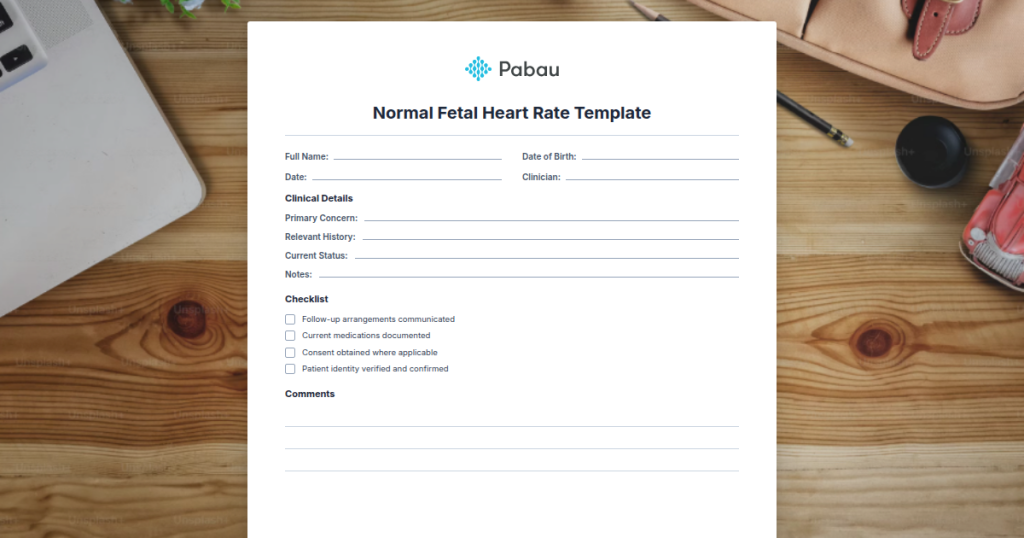
The Normal Fetal Heart Rate Template is a clinical documentation form designed specifically for obstetric and maternal-fetal medicine practitioners. It combines essential patient information fields with standardized heart rate measurement sections and evidence-based reference ranges for different gestational ages. The template eliminates guesswork from fetal assessment by providing healthcare professionals with immediate access to normal parameters at every stage of pregnancy.
This template serves multiple purposes: it creates a permanent clinical record, supports clinical decision-making, facilitates communication between care providers, and demonstrates compliance with documentation standards. Whether used in a hospital setting, private practice, or midwifery clinic, the Normal Fetal Heart Rate Template ensures consistent, high-quality documentation of fetal monitoring.
Fetal heart rate varies significantly throughout pregnancy. Understanding these ranges is essential for proper interpretation of monitoring data. According to the American College of Obstetricians and Gynecologists, normal ranges shift as pregnancy progresses:
The Normal Fetal Heart Rate Template includes built-in reference charts that display these ranges, eliminating the need for providers to memorize or reference external documents. This quick-reference capability reduces assessment time and minimizes the risk of misinterpretation. Factors such as fetal activity, maternal position, medications, and maternal fever can influence readings, making detailed documentation essential.
A well-designed Normal Fetal Heart Rate Template includes several critical sections to ensure comprehensive documentation:
These components work together to create a complete clinical picture. The template’s structured format supports better communication between obstetric providers and ensures nothing is overlooked during routine prenatal care. Many modern templates are designed for easy integration into electronic health record systems, supporting both paper and digital workflows.
Implementing a Normal Fetal Heart Rate Template in your practice requires minimal training. Begin by completing patient demographics at the start of each prenatal visit. Record the current gestational age using established dating criteria. Document maternal vital signs, particularly temperature, since maternal fever can elevate fetal heart rate.
Measure fetal heart rate using your preferred method, recording the value and technique used. Compare the measurement against the gestational age-specific normal range printed on the template. Document any abnormal findings, trending patterns over multiple visits, and clinical impression. Include recommendations for follow-up, whether routine or urgent, based on your assessment.
The Pabau platform allows you to customize templates to match your practice workflow and integrate them seamlessly with your existing electronic health records system, reducing manual documentation burden and improving data accuracy.
Proper interpretation of fetal heart rate is fundamental to effective prenatal care. A normal reading within gestational age-specific ranges typically indicates good fetal condition. However, the Normal Fetal Heart Rate Template helps providers recognize abnormal patterns requiring further investigation.
Bradycardia (heart rate below 110 bpm) may indicate congenital heart block, maternal medication effects, or fetal distress. Tachycardia (above 160 bpm) can reflect maternal fever, fetal anemia, hyperthyroidism, or fetal stress. Neither finding is automatically pathologic, but both warrant closer assessment and possible referral for specialized testing such as fetal echocardiography or non-stress testing.
Heart rate variability, the natural fluctuation around baseline, is an important indicator of fetal wellbeing. The template provides space to document these observations, supporting more detailed clinical assessment. Trending heart rate measurements over multiple visits offers valuable information about fetal development and response to maternal conditions.
Proper documentation protects both patients and providers. When using the Normal Fetal Heart Rate Template, always include exact time stamps, identifying the specific staff member performing the assessment. Use objective language in clinical notes rather than vague descriptions. Record actual heart rate values, not interpretations of those values.
Ensure your practice maintains HIPAA compliance when storing and accessing fetal heart rate records. The template should be stored securely, with access limited to authorized clinical staff. Proper documentation creates a clear decision trail that demonstrates appropriate care even if questions arise later. It also supports better continuity of care when multiple providers manage the same patient.
The Normal Fetal Heart Rate Template helps identify red flags requiring urgent action. Persistent tachycardia above 160 bpm, sustained bradycardia below 110 bpm, absent heart rate acceleration with fetal movement, or recurrent decelerations warrant immediate evaluation and possible referral to maternal-fetal medicine specialists. In labor, marked variability changes or late decelerations may indicate fetal hypoxia requiring expedited delivery.
The template’s structured format ensures nothing is missed during critical assessments. By standardizing this documentation, healthcare teams communicate more effectively during high-risk situations, supporting faster decision-making when fetal wellbeing is in question.
Comprehensive clinical reference tool with standardized heart rate parameters for fetal monitoring throughout pregnancy, including gestational age-specific ranges and assessment documentation fields.
Download templateThe normal fetal heart rate typically ranges from 110 to 160 beats per minute, though early pregnancy rates may reach 170 bpm. The specific normal range varies by gestational age, with rates generally higher in the first trimester and stabilizing in later pregnancy.
Fetal heart rate should be checked at every routine prenatal visit starting around 10-12 weeks. High-risk pregnancies, maternal complications, post-date pregnancies, and labor require more frequent monitoring as determined by clinical assessment.
Common measurement methods include handheld Doppler devices (routine prenatal visits), ultrasound, and electronic fetal monitoring (labor and delivery). The method chosen depends on gestational age and clinical setting.
Brief variations in fetal heart rate can be normal and are expected with fetal movement. However, persistent readings below 110 or above 160 bpm warrant further evaluation to rule out underlying conditions.
Document patient identifiers, visit date, gestational age, actual fetal heart rate measurement, monitoring method used, maternal vital signs (especially temperature), clinical assessment, and any recommendations for follow-up or additional testing.
Medical Disclaimer: This template is designed for use by qualified healthcare professionals and is not a substitute for clinical judgment, professional training, or consultation with maternal-fetal medicine specialists. Always follow your institution’s protocols and current evidence-based guidelines when assessing and managing fetal heart rate abnormalities.