Primary & Preventive Care Wellness
Pneumonia Nursing Care Plan Template
Pneumonia remains a leading cause of hospitalisation and morbidity in acute care...

April 1, 2026


Buy now, pay later is now available in Pabau

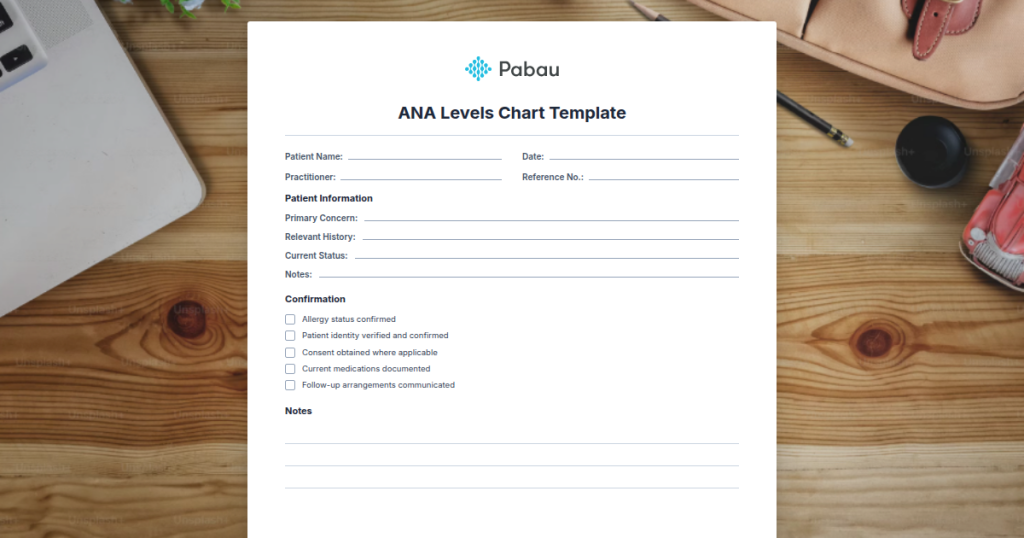
An ANA Levels Chart Template documents antinuclear antibody test results and patterns for autoimmune screening
Proper ANA result interpretation requires understanding titer levels, patterns, and clinical correlation
Digital templates streamline documentation, compliance, and patient record management for clinics
CLIA and CAP standards govern laboratory testing and medical record retention requirements
ANA testing aids diagnosis of lupus, Sjögren’s syndrome, and other autoimmune conditions
An ANA Levels Chart Template is a clinical documentation tool that captures and organizes antinuclear antibody testing data. The ANA Levels Chart Template helps practitioners track test results, interpret titer levels, identify immunofluorescence patterns, and document clinical findings in patient records. For clinics ordering or interpreting ANA tests, this template bridges the gap between laboratory results and actionable clinical decision-making.
ANA testing screens for autoimmune disease markers. When a patient presents with symptoms suggesting lupus, Sjögren’s syndrome, or another systemic autoimmune condition, ANA screening often becomes the first laboratory step. Results require careful interpretation: a titer of 1:160 or higher is generally considered positive, though clinical context always determines next steps. This template standardizes how clinics document and communicate these findings.
A ready-to-use reference chart documenting ANA titer levels, immunofluorescence patterns (homogeneous, speckled, centromere, nucleolar), and clinical associations for streamlined laboratory result tracking and patient record documentation.
Download templateAn ANA test (Antinuclear Antibody test) detects antibodies that attack the body’s own cells, indicating possible autoimmune disease. The ANA Levels Chart Template provides a structured format for recording test results. It documents the patient’s titer level (the dilution factor at which the test remains positive), the pattern of nuclear staining observed under immunofluorescence microscopy, and any associated clinical symptoms.
From a compliance perspective, the template ensures documentation meets CLIA (Clinical Laboratory Improvement Amendments) standards and aligns with CAP (College of American Pathologists) requirements for laboratory testing. Medical record retention laws vary by jurisdiction, but most require ANA documentation to be stored for a minimum of 5-7 years. A structured template supports audit readiness and reduces documentation errors that could delay patient care or trigger insurance claim denials.
Using the ANA Levels Chart Template involves five practical workflow steps that integrate into your clinic’s testing and documentation routine:
The template format standardizes interpretation across your clinic. When multiple practitioners review the same patient’s records, a clear ANA documentation template prevents misinterpretation and ensures consistent clinical decision-making.

Track ANA levels, manage lab results, and keep every patient record complete and audit-ready — all in one clinical platform.

The ANA Levels Chart Template serves multiple healthcare practice types. Functional medicine clinics and integrative medicine practitioners who order routine ANA screening as part of wellness assessment use this template to systematise results. Dermatology clinics evaluating patients with lupus-related rashes benefit from a structured pattern interpretation guide. Primary care and private GP practices managing autoimmune disease monitoring rely on consistent documentation to track titer trends over time. Rheumatology-adjacent practices (chiropractors, physical therapists, wellness coaches) that coordinate with rheumatologists often use the template to explain results to patients and document clinical reasoning.
Any practice ordering or interpreting ANA tests-whether for initial screening, disease monitoring, or research purposes-can adopt this template to improve documentation quality and patient communication.
Standardised documentation: A uniform template ensures every practitioner in your clinic documents ANA results the same way, reducing variability and interpretation errors.
Compliance and audit readiness: Structured templates demonstrate clinical rigor during regulatory inspections. CLIA and CAP audits expect clear, systematic documentation of laboratory test interpretation. The template creates an auditable record that shows clinicians understood the result and acted accordingly.
Patient communication: When you print or share the completed template with patients, it clarifies what the test measures and what the result means. This transparency builds trust and reduces patient anxiety about unexplained lab findings.
Clinical decision support: The template’s reference sections (pattern guide, titer interpretation, associated conditions) prompt clinicians to consider next steps-whether additional antibody testing, specialist referral, or patient education-reducing oversight.
Store multiple ANA Levels Chart Templates in the same patient file and review them chronologically. Falling titer levels may indicate treatment response; rising levels may signal disease flare. This serial tracking — impossible with loose lab reports — becomes routine when you systematise documentation with a template.
Antinuclear antibody testing is foundational to autoimmune disease diagnosis. Different patterns correlate with specific conditions: a homogeneous pattern is common in lupus and drug-induced lupus; a speckled pattern appears in Sjögren’s syndrome and mixed connective tissue disease; a centromere pattern is typical of limited scleroderma. Clinicians must understand these correlations to interpret results responsibly and explain findings to patients.
However, a positive ANA alone does not diagnose autoimmune disease. Approximately 3-5% of the healthy population tests positive. Clinical context is essential. A positive ANA combined with consistent symptoms, positive anti-dsDNA or anti-Ro/La antibodies, and objective findings (rash, joint swelling, serositis) supports an autoimmune diagnosis. This nuanced interpretation is why the ANA Levels Chart Template includes space for clinical correlation-it forces clinicians to document the full reasoning behind their assessment.
According to the American College of Rheumatology (ACR), proper ANA interpretation and follow-up testing prevent both overdiagnosis (treating seronegative patients unnecessarily) and delayed diagnosis (missing true autoimmune disease in seropositive patients). A systematic template supports ACR best practices.
Beyond ANA-specific guidance, medical record documentation for all laboratory testing must meet HIPAA and medical-legal standards. Record the test name, ordering date, result value(s), reference range, lab name, and the ordering practitioner’s signature or digital authentication. Include the date the result was communicated to the patient. If an abnormal result was not acted upon, document the clinical reasoning (e.g., “Positive ANA with negative anti-dsDNA; consistent with non-specific seropositivity; patient asymptomatic; no treatment initiated at this time; advised to follow up in 12 months”).
The ANA Levels Chart Template structure incorporates these best practices, ensuring your clinic’s documentation withstands external scrutiny and serves as a reliable clinical reference.

Want to understand the full scope of autoimmune workup? Interpreting Biomarkers Without Overpromising provides guidance on communicating lab results ethically to patients and avoiding misinterpretation.
Need a template for recording comprehensive patient medical history? Digital Forms can capture patient-reported symptoms and history that contextualise laboratory findings.
Looking to centralise all lab result documentation in one system? Client Record Management keeps ANA charts, follow-up notes, and related clinical data accessible and organised.
The ANA Levels Chart Template transforms autoimmune screening from a reactive process into a systematic, documented workflow. By standardising how your clinic captures titer levels, immunofluorescence patterns, and clinical interpretation, you improve diagnostic accuracy, strengthen compliance, and enhance patient communication. Whether you’re a functional medicine practice, dermatology clinic, or primary care provider, adopting this template supports better clinical outcomes and audit readiness.
A positive ANA (titer 1:160 or higher) indicates the presence of antinuclear antibodies but does not diagnose autoimmune disease on its own. Clinical symptoms, additional antibody testing, and physical findings must support the diagnosis. Approximately 3-5% of healthy people test positive.
Homogeneous pattern: lupus, drug-induced lupus. Speckled pattern: Sjögren’s, mixed connective tissue disease. Centromere pattern: limited scleroderma. Nucleolar pattern: systemic sclerosis. The ANA Levels Chart Template includes a reference guide for quick pattern recognition.
Medical record retention requirements vary by jurisdiction and payer. Most require 5-7 years for active patients and 7-10 years after the patient relationship ends. The template structure supports long-term filing and retrieval.
In most cases, yes. A negative ANA (titer less than 1:80) makes systemic autoimmune disease less likely. However, seronegative lupus and other rare conditions can present without detectable ANA. Clinical judgment and specialist consultation may be needed.
If the ANA is positive and symptoms are consistent with autoimmune disease, consider reflex testing: anti-dsDNA, anti-Ro/La, anti-Smith, or complement levels. The ANA Levels Chart Template prompts you to document your clinical reasoning and next steps.