Primary & Preventive Care
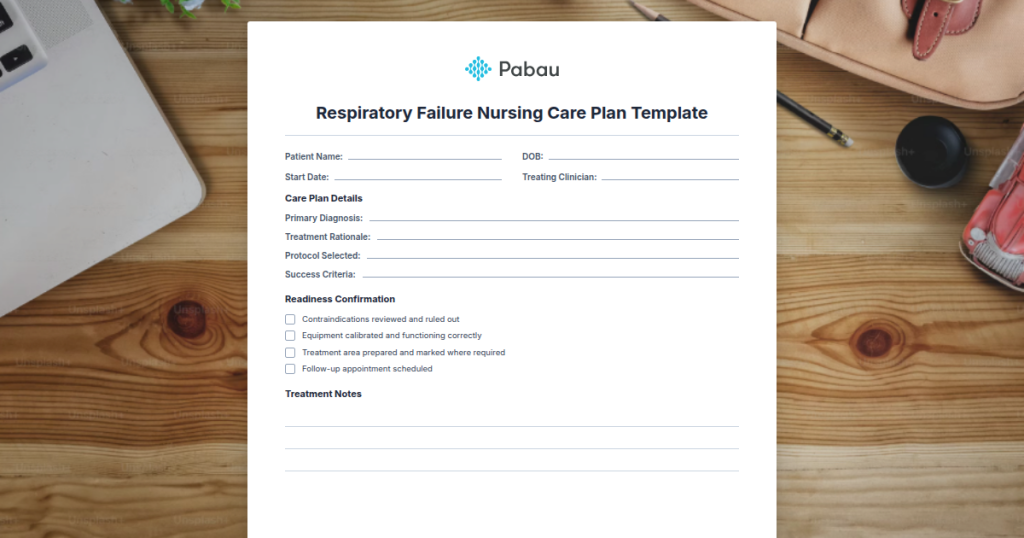
Respiratory Failure Nursing Care Plan Template
A Respiratory Failure Nursing Care Plan Template provides clinicians with a syst...

March 17, 2026


Buy now, pay later is now available in Pabau

SBAR stands for Situation, Background, Assessment, Recommendation – a four-part structured communication framework used across healthcare settings.
A clear SBAR example follows a predictable sequence that reduces ambiguity during handovers, escalations, and referrals.
SBAR is endorsed by NHS England, the WHO, and the Royal College of Nursing as a standard tool for safe clinical communication.
Private clinics and outpatient practices can adapt SBAR for GP referrals, specialist handovers, and post-treatment escalation workflows.
Digital clinical documentation tools can support SBAR-structured notes, reducing communication gaps between care episodes.
Communication failures are a leading contributor to preventable patient harm. An SBAR example – whether spoken during a nursing handover or written into a GP referral – gives every clinician involved in a care episode the same structured map of what is happening, why it matters, what the clinician thinks, and what needs to happen next. NHS England endorses SBAR as a standard patient safety communication tool, and the framework applies equally in a busy ward and a two-clinician private clinic.
This guide explains what SBAR stands for, breaks down each component with worked SBAR examples, and shows how to apply the framework in nursing handovers, patient escalation, outpatient referrals, and private practice settings. It also covers the ISBAR variant, common documentation pitfalls, and how structured clinical communication fits into broader patient record management workflows.
SBAR was originally developed by the US Navy for high-stakes operational communication and was later adapted for healthcare by Dr Michael Leonard at Kaiser Permanente. The framework found rapid adoption because it forces the communicator to think in the same sequence every time – regardless of seniority, specialty, or urgency level. WHO Patient Safety Solution 3 specifically cites structured handover communication – including frameworks like SBAR – as a recommended approach to reducing patient harm from handover failures.
The Situation step answers one question: what is happening right now? A nurse calling a doctor about a deteriorating patient might open with: “I’m calling about Mrs Ahmed in bay 4. She has become acutely confused and her blood pressure has dropped to 88/52.” That single sentence establishes urgency, identifies the patient, and signals the clinical problem without any preamble. The Situation component should take no more than 15-20 seconds to deliver verbally. Written versions – in a referral letter or clinical note – should occupy the opening sentence or a clearly labelled opening field.
Background provides the clinical history relevant to the current situation. This is where the communicator summarises the patient’s diagnosis, relevant past medical history, current medications, and any recent procedures or investigations. The key discipline here is relevance – background should include what the recipient needs to understand the situation, not a full medical history. For the same patient: “Mrs Ahmed is a 72-year-old with type 2 diabetes and hypertension. She was admitted two days ago for a UTI and has been on IV trimethoprim. Her last BP reading four hours ago was 122/78.” The recipient now has enough context to interpret the Situation appropriately.
Assessment is where the communicating clinician states their clinical interpretation. This separates SBAR from a simple information relay. The Assessment step requires the clinician to form a view – even a provisional one – and commit to it. “I think she may be septic. Her NEWS score has risen from 2 to 7 in the last two hours and she is not responding to the fluid challenge we started.” Assessment language should be direct and hypothesis-led, not hedged into meaninglessness. The Nursing and Midwifery Council (NMC) emphasises that nurses must be prepared to advocate for their clinical judgement – the Assessment component of SBAR is the formal mechanism for doing so.
Recommendation closes the communication loop by stating what the clinician believes should happen next. It may be a direct request (“I need you to come and review her within the next 15 minutes”) or a structured suggestion (“I would like to commence the sepsis 6 bundle and request an urgent blood culture”). The Recommendation step ensures the conversation ends with a clear action, not a vague understanding. Without it, SBAR becomes an information dump rather than a communication tool. For written referrals, Recommendation translates into a specific ask – an urgent outpatient appointment, a particular investigation, or a defined management question.
Shift handover is where communication failures cluster. A nurse finishing a 12-hour shift may be handing over 8-15 patients to a colleague who has no prior knowledge of the ward. Without structure, critical information gets compressed, omitted, or buried in narrative. The Royal College of Nursing (RCN) recommends SBAR as a handover tool precisely because it forces prioritisation – each patient gets a concise, structured summary rather than a free-form narrative that varies in completeness from clinician to clinician.
A nursing SBAR example for shift handover might look like this:
Situation: Mr Okafor in bed 6 had a fall at 14:30. No loss of consciousness. GCS 15, no focal neurology. Head CT requested and pending.
Background: 81 years old, known Parkinson’s, on anticoagulation with apixaban. Admitted for elective hip replacement. Pre-op bloods normal.
Assessment: I am concerned about intracranial bleeding given his anticoagulation status. The surgical team has been informed and is reviewing.
Recommendation: Monitor neuro obs hourly until CT result available. If deterioration before result, bleep registrar immediately. Do not administer tonight’s apixaban dose pending review.
This example takes under two minutes to deliver and gives the incoming nurse everything she needs: the event, the relevant risk, the clinical concern, and the specific actions required. It also creates an auditable record if documented in the patient notes – a requirement under NHS England’s patient safety framework. Clinics using digital clinical documentation systems can embed SBAR-structured fields into their handover templates, ensuring completeness without relying on individual clinician habits.

Pabau helps clinics capture, organise, and share clinical information consistently – so nothing critical gets missed between care episodes.

Patient deterioration is the highest-stakes context for SBAR. When a patient’s condition is changing rapidly, the clinician communicating the concern needs to convey urgency, clinical data, and a specific request – all within the first 30-60 seconds of a call or conversation. Hesitation or unclear framing at this point can delay a response by minutes that matter clinically.
Consider a patient who has received IV therapy at a private wellness clinic and develops chest tightness and facial flushing 20 minutes post-infusion. The attending nurse needs to escalate to the supervising clinician. An SBAR example for this scenario:
Situation: I am calling about Ms Patel, 38, who received a vitamin C infusion at 10:15. She is now complaining of chest tightness and facial flushing. Observations: BP 90/60, HR 118, SpO2 97%. I think she may be having an allergic reaction.
Background: No known allergies documented at booking. First time receiving IV vitamin C at this clinic. No significant past medical history on her intake form.
Assessment: Presentation is consistent with a mild-to-moderate anaphylactoid reaction. Symptoms began 15 minutes after infusion completion. She is alert and communicating but distressed.
Recommendation: I have stopped the infusion and positioned her supine. Please come immediately to assess. I am preparing IM adrenaline per protocol. Should I call 999 now or wait for your assessment?
This SBAR example demonstrates three things simultaneously: it communicates the clinical facts, it shows the nurse has already acted, and it ends with a specific binary decision request. The recipient can respond with a clear instruction in under 10 seconds. Private clinics – including aesthetics, wellness, and IV therapy practices – benefit from embedding this framework into their emergency response protocols, because unlike hospital environments, they typically lack the procedural scaffolding that structures escalation automatically.
Build an SBAR escalation card for each treatment room in your clinic. Laminate a physical card with the four headings, the emergency contact number, and the clinic’s on-call clinician rota. Nurses under pressure default to familiar structure – having the card visible removes the cognitive load of remembering the format during a high-stress moment.
Hospital staff encounter SBAR during training and use it daily. Clinicians in private practice – GPs, aesthetic practitioners, physiotherapists, and specialist consultants – often use it inconsistently, if at all. This inconsistency creates the exact information gaps that SBAR was designed to close. A GP referring a patient to a private dermatologist, for example, may write a referral letter that buries the key clinical question in three paragraphs of narrative. The specialist opens it six days later with no clear idea of what decision she is being asked to make.
An SBAR-structured referral does not need to be labelled as such. The structure simply informs how the letter is written. A GP referring to a private dermatologist might use this SBAR example format:
Situation: I am referring Mr Chen, 45, for assessment of a 6mm pigmented lesion on his right forearm that has changed in size and shape over the past three months.
Background: Mr Chen has a family history of melanoma (father, diagnosed age 52). Fitzpatrick skin type III. No previous skin biopsies. Non-smoker, occasional sun exposure. Reviewed in clinic on 14 February 2026.
Assessment: The lesion has irregular borders and variable pigmentation. I am concerned about early melanoma. Dermoscopy not available at this practice.
Recommendation: Please review urgently under the two-week wait pathway. I would be grateful for your assessment and biopsy if clinically indicated.
The specialist receiving this referral can triage it, understand the clinical question, and prepare for the appointment without a follow-up call. That efficiency matters operationally – private practices with high referral volumes can reduce back-and-forth communication by standardising on SBAR-informed referral templates. Compliance and documentation workflows within practice management systems can support this by providing structured referral fields rather than a blank text box.
Aesthetic and elective clinics operate outside the traditional NHS escalation hierarchy, which makes structured communication even more important. A practitioner treating a patient for dermal fillers who develops vascular compromise needs to communicate with clarity and urgency. An SBAR example in this context:
Situation: I am calling about a patient I treated 45 minutes ago with .5ml hyaluronic acid filler to the nasolabial fold. She is now presenting with blanching and increasing pain at the treatment site, consistent with vascular occlusion.
Background: 34-year-old female, no contraindications noted at pre-treatment assessment. Filler product used: [product name], injected via cannula. Treatment completed at 11:30.
Assessment: I believe this is an arterial occlusion. The blanching has spread since I first observed it at 11:45. I have already started hyaluronidase as per protocol.
Recommendation: I need guidance on dosing for a second hyaluronidase injection and advice on whether to transfer to A&E. Can you call me immediately?
This kind of structured communication also creates a contemporaneous record of clinical decision-making – something the Care Quality Commission (CQC) reviews during inspections of registered aesthetic and medical cosmetic practices. Detailed, timestamped documentation of escalation decisions supports clinical governance and demonstrates duty of care. Practices using electronic patient records can document SBAR exchanges directly in the patient’s clinical timeline, creating an auditable handover trail.
Review your last five clinical handover records. Check whether each one contains all four SBAR components. If any section is consistently missing – Assessment is the most common gap – run a 20-minute team session focused specifically on forming and stating a clinical opinion under time pressure. Most handover quality issues are habits, not knowledge gaps.

Need to improve clinical documentation quality across your team? Safer Clinical Notes covers evidence-based frameworks for writing clear, complete, and defensible clinical records.
Looking for a psychiatric evaluation framework that includes structured assessment? Psychiatric Evaluation Template provides a step-by-step guide for comprehensive mental health assessments in private practice.
Managing CQC compliance requirements for your clinic? CQC Inspection Checklist covers the documentation and governance standards inspectors assess during registered practice reviews.
A well-constructed SBAR example does more than transfer information – it structures the thinking behind that information. Every clinician who uses SBAR consistently, whether in a hospital ward handover or a private clinic escalation call, trains themselves to move from observation to assessment to recommendation in a deliberate sequence. That sequence reduces the ambiguity that causes delays, misunderstandings, and harm.
The framework is flexible enough to work in verbal escalation, written referrals, and digital clinical notes. For private practices and outpatient clinics, adopting SBAR as a documentation standard – not just a verbal communication tool – creates the kind of auditable, structured record that supports clinical governance and meets the expectations of regulatory bodies including the CQC and the General Medical Council. The four components are simple. The discipline required to apply them consistently is where the work lies.
Reviewed against current NHS England patient safety guidance, WHO Patient Safety Solutions documentation, and RCN clinical communication resources.
A nursing SBAR example during shift handover might be: Situation – “Mrs Davies in bed 3 has become increasingly breathless over the last hour.” Background – “72-year-old admitted for pneumonia, on IV co-amoxiclav, oxygen sats were 96% at 14:00.” Assessment – “I think she is deteriorating. Sats now 88% on 2L O2, respiratory rate 28.” Recommendation – “Please review immediately and consider increasing oxygen therapy or escalating to the medical registrar.”
SBAR stands for Situation, Background, Assessment, Recommendation. It is a structured communication framework used by healthcare professionals to convey concise, prioritised clinical information during handovers, escalations, and referrals. Each component has a distinct purpose: Situation establishes what is happening, Background provides context, Assessment states the clinician’s interpretation, and Recommendation specifies what needs to happen next.
To write an SBAR note, structure your entry into four labelled sections. Under Situation, state the current clinical problem in one or two sentences. Under Background, summarise the relevant history, medications, and recent findings. Under Assessment, state your clinical interpretation or working diagnosis. Under Recommendation, specify the action you are requesting or the decision that needs to be made. Keep each section concise – the entire note should be readable in under two minutes.
ISBAR adds an Identify step at the start of the framework, making it Identify, Situation, Background, Assessment, Recommendation. The Identify component prompts the clinician to introduce themselves, their role, and the patient’s name and location before delivering the clinical content. ISBAR is particularly common in Australian and Irish healthcare settings and is useful in telephone escalation, where the recipient has no visual cue about who is calling or which patient is being discussed.
SBAR can be used in any situation where one clinician needs to transfer clinical responsibility or concern to another. Common contexts include shift handovers, patient deterioration escalation calls, GP-to-specialist referral letters, post-procedure monitoring communications, and multidisciplinary team updates. It is equally applicable in hospital settings and private clinics, outpatient practices, and aesthetic or wellness environments where formal escalation hierarchies may be less established.
During patient handover, SBAR gives the outgoing clinician a consistent structure for presenting each patient to the incoming team. Rather than a free-form narrative, the outgoing nurse or doctor covers the current situation, the relevant background, their clinical assessment, and any outstanding actions or recommendations. This structure reduces the risk of critical information being omitted during a time-pressured transition and creates a documented record of the handover that can be reviewed if care continuity is questioned.