










Key takeaways
CPT Code 12041 covers intermediate repair of wounds on the neck, hands, feet, and external genitalia measuring 2.5 cm or less.
Intermediate repair means a layered closure into subcutaneous tissue or non-muscle fascia, or a single-layer closure of a heavily contaminated wound.
The most common billing error is upgrading to 12041 when the note only supports simple repair.
A downcode from 12041 to 12001 gives up roughly $149 per wound at 2026 national non-facility rates.
Practice management software like Pabau checks the required billing fields on a claim before you submit it.
CPT Code 12041 is the intermediate wound repair code for the neck, hands, feet, and external genitalia at 2.5 cm or less. Intermediate repair means the closure reached the subcutaneous tissue or non-muscle fascia. A single-layer closure also qualifies when the wound needed extensive cleaning before it could be closed.
This guide covers the official descriptor, the 2026 RVU and fee schedule figures, and the modifiers that apply. You also get the ICD-10 pairings, the documentation a reviewer looks for, and a number on what a downcode costs. Coders in dermatology practices and urgent care will get the most from the comparison table.
CPT Code 12041: definition and official descriptor
The American Medical Association descriptor reads Repair, intermediate, wounds of neck, hands, feet and/or external genitalia; 2.5 cm or less. The code sits in the Surgery section, under the Integumentary subsection, in the Repair (Closure) category.
Three criteria have to be met together before 12041 is the right code:
- The repair is intermediate, rather than simple or complex
- The wound sits on the neck, a hand, a foot, or the external genitalia
- The total repaired length is 2.5 cm or less
What qualifies as intermediate wound repair?
Intermediate repair qualifies in one of two ways, and both turn on the technique used rather than how the wound looks. Knowing where the line falls keeps you off both sides of it, under-coding and over-coding alike.
Intermediate repair applies when the closure involves either of the following:
- Layered closure of one or more of the deeper layers of subcutaneous tissue and/or non-muscle fascia
- Single-layer closure of a heavily contaminated wound that needed extensive cleaning or foreign body removal first
Simple repair covers a single-layer skin closure on a clean, uncontaminated wound, starting at 12001. If the wound needs one suture layer and no deep tissue is involved, simple repair is the correct level.
Complex repair goes further than layered closure. It requires scar revision, extensive undermining, retention sutures, or reconstruction such as a flap or graft, the kind of work plastic surgery practices document daily. That family opens at 13100.
The contamination route is the one coders forget. A single-layer closure on a contaminated wound reaches intermediate on the strength of the wound preparation work, with no deep tissue involved at all. Document the contamination level explicitly. Without that line, the claim reads as simple repair.
Comparing 12041 with related repair codes
CPT Code 12041 opens the intermediate repair family for the neck, hands, feet, and external genitalia. That family runs 12041 through 12047 as the repaired length grows. The table below sets it against the simple and complex families, so you can place a wound by site and length in one pass.
When a wound spans more than one anatomical region, code each region against its own family and measure the sites separately. Complex closures on this same anatomy at 2.6 to 7.5 cm fall to 13132 instead.
RVUs and Medicare reimbursement
Medicare payment comes out of one formula. Total Relative Value Units (RVUs) are multiplied by the Geographic Practice Cost Index (GPCI) and then by the conversion factor. The table below uses the 2026 national values and the $33.4009 conversion factor.
Rates shift every year with the Medicare Physician Fee Schedule (MPFS), and they vary by locality. Confirm yours with the CMS fee schedule lookup or the FastRVU lookup.
Non-facility rates run higher because the practice absorbs the supplies, equipment, and staff time. Facility rates apply in a hospital outpatient department or ambulatory surgical center (ASC), where the facility bills those resources on its own claim. Private payer rates differ from Medicare and have to be checked contract by contract.
That spread is what makes a downcode expensive. Simple repair on this anatomy pays about $114 in the office, against about $263 for 12041. Every claim rewritten down to simple repair therefore gives up roughly $149. Two wounds a week works out at more than $15,000 a year.
Pro Tip
When several wounds of the same repair type sit in one anatomical region, add their lengths together. Then pick the code that matches the total. Record each wound’s own length in the chart, and bill the single aggregated code rather than separate line items.
Modifiers and when to use them
Modifier choice moves both the payment and the audit exposure. The table below covers the ones that come up most often with 12041.
Modifier -25 carries the highest audit risk of any modifier paired with 12041. The Office of Inspector General (OIG) has repeatedly flagged same-day E/M billing with wound repair for closer scrutiny. Same-day E/M and repair is a recurring theme in medical billing compliance guidance.
The E/M note has to document a problem beyond the wound, with independent clinical decision-making. A note that only walks through the laceration and the repair will not carry a separately billable visit.
ICD-10 codes that support medical necessity
Medical necessity for 12041 rests on the paired ICD-10-CM diagnosis code, and most pairings come from the S-series laceration codes. You can check current codes and their crosswalks through the AAPC code lookup.
Always reach for the most specific ICD-10-CM code available. Unspecified codes are acceptable when the chart lacks laterality or finger detail. Specificity still strengthens medical necessity and cuts down on payer requests for records. For a follow-up inside the global period, switch the seventh character to D for a subsequent encounter or S for sequela.
What the procedure note must document
Incomplete documentation is the main reason 12041 claims come back downgraded to simple repair. Every element below belongs in the procedure note. Digital procedure forms that carry these fields as prompts cut the odds of a missing measurement.

- Wound location: specific anatomical site (e.g., dorsal surface of right index finger, anterior neck)
- Wound length: measured in centimeters and recorded precisely (e.g., « 2.3 cm laceration »)
- Wound depth: documentation that subcutaneous tissue or non-muscle fascia was involved, or that contamination required extensive cleaning
- Contamination level: if using the contamination pathway to justify intermediate repair, state the type and extent of contamination
- Repair technique: describe the layered closure approach, suture material type and size for each layer
- Anesthesia type: local, digital block, or field block used
- Number of layers closed: specify each tissue layer closed with sutures
- Clinical time or complexity: if modifier -25 is used, a separate note section must document the distinct E/M assessment
Structured clinical records with built-in procedure templates hand coders every required field before the claim goes out. Practices working from free-text notes most often lose wound depth or contamination level, the two fields that dominate 12041 audit findings.
Records that satisfy a coder still have to satisfy a privacy review, and the retention and access standards sit in HIPAA-compliant documentation. A clean claim depends on both halves being in order.
Common coding errors and how to avoid them
Most denials and audits tied to 12041 trace back to a short list of recurring mistakes. Catching them upfront costs far less than working denial codes through an appeal.
Upgrade errors: coding intermediate when simple is correct
The most common error is billing 12041 when the wound needed only a single-layer skin closure, with no deep tissue involved and no real contamination. If the chart reads simple interrupted sutures, with nothing about subcutaneous tissue or contamination, a reviewer will downcode it. Train providers to document why intermediate repair was chosen, not only what was done.
Wound length aggregation rules
When several wounds of the same complexity and region are repaired in one session, the lengths get added together. AMA guidelines let you code from that total.
A 1.2 cm and a 1.5 cm intermediate hand repair aggregate to 2.7 cm, which bills as 12042 rather than two 12041 line items. Billing them separately creates a duplicate pattern that trips NCCI edits.
Here is the awkward part of that rule. The aggregated code pays about $305, while two separate 12041 lines would bill higher even after the multiple-procedure reduction. The arithmetic rewards the wrong answer, which is why the error keeps surfacing.
E/M co-billing: modifier -25 audit exposure
Modifier -25 is legitimate when the clinician assessed a separate problem at the same visit. A new injury on its own does not justify it. The OIG flags practices whose modifier -25 use with wound repair codes runs above average.
If your practice bills an office visit such as 99213 alongside the repair, both notes have to stand on their own. Pull a sample of those encounters and read them side by side. Compliance management features can run that check before submission.

Anatomical site coding errors
CPT Code 12041 applies to the neck, hands, feet, and external genitalia only. The forearm, upper arm, thigh, and trunk sit outside it, even when the technique is identical. A layered forearm closure is 12031, and 12032 takes over from 2.6 cm. Check the site against the code family before you submit.
How Pabau catches incomplete claims before submission
A 12041 claim usually stalls for one of two reasons. Either the procedure note is too thin to hold the repair level, or a required field on the claim itself was left blank. The first is a charting habit. The second is fixable before the claim ever leaves the building.
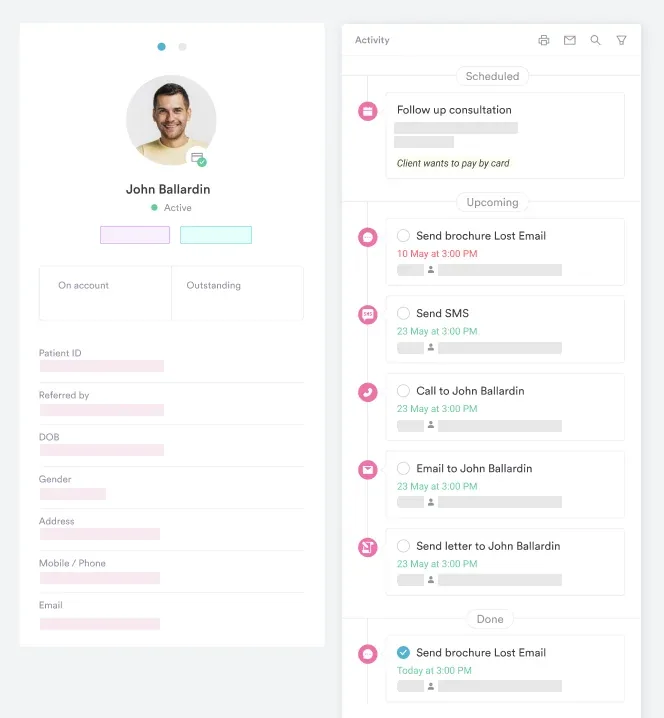
Practice management software like Pabau keeps the repair note, the wound measurement, and the diagnosis code in one client record. Claim forms then pull the patient, treatment, and insurer details straight from that record, so nobody retypes a policy number at five o’clock.
Pabau’s claims management runs a validation check every time you send a claim. It confirms the required billing fields are complete, membership numbers and authorization codes included, and holds submission until they are. Automated workflows handle the reminders around it.
Those checks cover the billing fields on the claim, so the clinical detail in your note is still yours to write. What you gain is one fewer claim posted with a blank required field. Every denial you avoid is one that never has to beat a timely filing deadline.

Send claims with every required field filled
Pabau checks the billing fields on a claim before you submit, and holds anything incomplete until it is resolved. The repair note, the diagnosis code, and the claim all live in one client record.

Conclusion
The whole 12041 decision turns on what the note says about depth and contamination. Record either one and the code holds up. Leave both out and a reviewer reads the encounter as simple repair, whatever technique you actually used.
So the fix sits upstream of billing. Rework the procedure template until it asks for length, depth, and contamination every time, and the coding follows on its own. At roughly $149 a wound, that is an afternoon well spent. Book a demo to see how Pabau keeps repair documentation and claim fields in one record.

Continue your research
Denials already piling up? Denial management in healthcare covers triaging, reworking, and tracking denials so the same code stops bouncing back.
Want the whole billing picture? Revenue cycle management maps every step from the booking to the posted payment.
Losing claims to coverage problems? Insurance eligibility verification shows how to confirm benefits before the patient is in the chair.
Not sure why a payer paid short? Electronic remittance advice explains how to read a remittance and match it back to the claim.
Curious what a claim looks like in transit? The 837 file breaks down the electronic claim format that payers actually receive.
Frequently asked questions
What does CPT Code 12041 cover?
CPT Code 12041 covers intermediate repair of wounds on the neck, hands, feet, or external genitalia measuring 2.5 cm or less. Intermediate repair means a layered closure into subcutaneous tissue or non-muscle fascia. A single-layer closure also qualifies when the wound needed extensive cleaning before it could be closed.
How does 12041 differ from 12001?
12001 is a simple repair code for a single-layer skin closure of a clean wound. 12041 requires a layered closure into deeper tissue, or extensive contamination management. They also cover different anatomy. 12001 includes the scalp, trunk, and extremities, while 12041 is limited to the neck, hands, feet, and external genitalia.
Which modifiers apply to 12041?
Modifier -25 applies when a separate, documented E/M service happened the same day. Modifier -51 covers multiple procedures billed together, and -59 overrides an NCCI bundling edit. Some payers also want -LT or -RT for laterality. Modifier -78 applies to a return to the OR inside the 10-day global period.
What documentation is required to bill 12041?
The note needs the specific anatomical site, the wound length in centimeters, and the tissue depth closed. Add the contamination level if that is the route to intermediate repair. Also record the repair technique, the suture material per layer, the anesthesia type, and the number of layers closed.
What is the Medicare reimbursement rate for CPT Code 12041?
At 2026 national average rates, 12041 pays about $263 in a non-facility setting and about $129 in a facility. Those figures come from 7.87 total non-facility RVUs and 3.87 total facility RVUs. Rates vary by locality, so check the CMS Physician Fee Schedule lookup tool for your area.
Can 12041 be billed with an E/M code?
Yes, with modifier -25, but only when the E/M service is significant and separately identifiable from the repair. The E/M note must show a distinct clinical problem or assessment beyond the wound itself. Routine use of modifier -25 with repair codes is an OIG audit flag.