Med spa clients are savvier than ever. They scroll fast, research hard, and make decisions based on a mix of before-and-afters, Google reviews, and gut feeling.
If you want to stand out, good treatments aren’t enough on their own. You also need clear answers to:
✔️ What sets you apart
✔️ What your audience is actively looking for
✔️ Where your competitors are gaining ground
That’s where competitive analysis comes in. When done right, it helps you stop second-guessing your pricing, marketing strategies, and service approach and start making moves that drive growth.
This guide breaks it all down. You’ll learn how to find your real competitors, spot what’s working for them, and turn those insights into real results.
What is a competitive analysis and why does it matter for med spas
Competitive analysis is about knowing what you’re up against.
Not in a paranoid, binoculars-on-the-rooftop kind of way, but by understanding who else is out there, how they’re positioning themselves, and where you stand in comparison.
For med spas, that kind of awareness changes everything.
Because, as you probably know, the med spa industry is crowded. Everyone’s running ads, posting reels, dropping Botox promos, and fighting to outrank each other on Google. But not everyone is taking the time to do thorough market research.
Competitive analysis helps you:
Uncover in-demand services that other clinics haven’t leaned into
Price confidently, with data that reflects your local market
Evaluate what promotions are working for others (and which ones are flopping)
Make sure your branding is sharp and recognizable
Shape a seamless customer experience from booking to follow-up
It also sharpens your med spa marketing efforts, especially when it comes to keywords and local visibility.
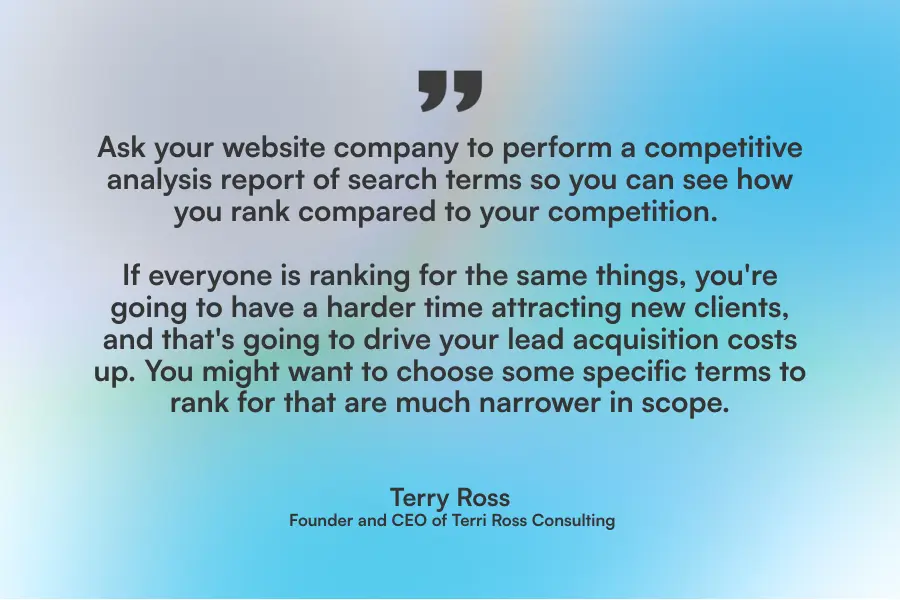
Terry Ross, founder and CEO of Terri Ross Consulting, summed it up perfectly in an AmSpa article:
So, rather than echoing what every other clinic is doing, use what you’ve learned to carve out your edge and make it obvious why clients should pick you.
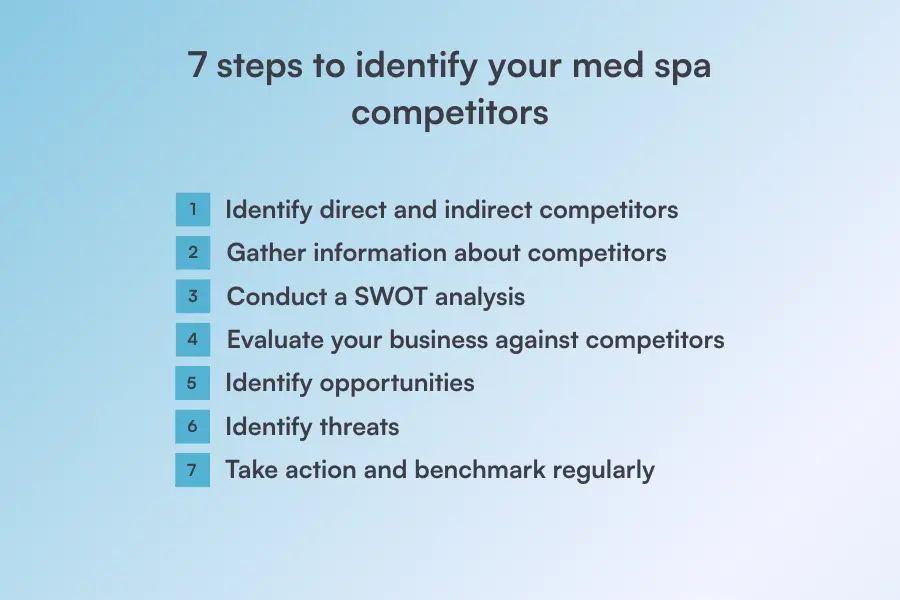
How to do a competitive analysis for med spas
Now that you know why competitive analysis matters, let’s talk about how to do it without getting lost in browser tabs and Instagram rabbit holes.
Start with the obvious: Other medical spas offering similar treatments in your area. If they’re targeting the same demographics with the same services, they’re your direct competition. Easy enough.
But don’t stop there.
Plenty of aesthetic practices outside the traditional med spa space are pulling from the same pool of clients. Think dermatologists, plastic surgeons, or wellness providers offering overlapping services like skincare consults or dermal fillers. These are your indirect competitors, and they’re just as important to track.
Ignore them, and you’re only seeing half the picture.
To get a real sense of your market, dig through:
Google search: Try “med spa near me,” “Botox in [your city],” or “lip filler [area]” and check who shows up in the map pack.
Yelp and review platforms: Great for spotting top-rated med spa software solutions and the kinds of experiences clients are talking about.
Booking platforms: These often show which local clinics are active, what services they offer, and how they price them.
Social media: Instagram, TikTok, and even LinkedIn give you a peek into how other clinics position themselves and how audiences respond.
Your own clients and staff: They’ve seen what else is out there. Their input can tell you who else is on people’s shortlist, and why.
💡 Pro tip: Don’t treat these sources like separate boxes to tick. The real value comes when you layer the insights. One competitor might have slick branding but weak reviews. Another might have killer Search Engine Optimization (SEO) but clunky booking. Stack it all together, and the trends (and gaps) become obvious.
2. Gather information about competitors
A few names on a list don’t tell you much. You need to dig in and see what your competitors are really up to. Here’s a list of questions that will help you in the process:
Where are they based, and how many locations are they running?
Are they single-location, franchised, or expanding into a chain?
Which treatments are front and center on their website and socials?
How are they pricing their services?
Are they pushing memberships, bundles, or high-ticket one-offs?
What social media channels are they active on, and what does their website say about their brand?
Are they showing up in local search for the services you also offer?
What kind of feedback are they getting in online reviews?
Once you’ve got the lay of the land, you’ll know exactly where you stand. (Hey, it even rhymes!). Now, onto your SWOT.
3. Conduct a SWOT analysis
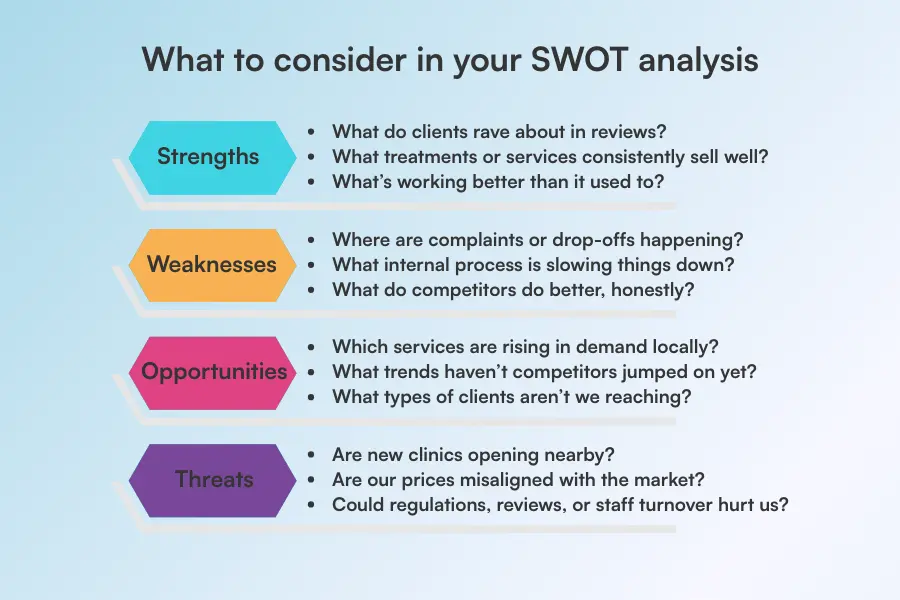
ASWOT analysis is your chance to take a clear-eyed look at your business. Strengths, weaknesses, opportunities, and threats. All of it on the table.
Use what you found in your competitor research to guide your thinking. For example:
Think of it as a pressure test. It forces you to stop running on autopilot and start thinking like someone evaluating your business from the outside. Which, spoiler alert, is exactly what your clients are doing.
4. Evaluate your business against competitors
It’s time to turn the lens inward. Start with the obvious marker, using the SWOT analysis from the previous step as your guide:
Is your pricing aligned with your positioning, or are you charging premium rates for a mid-tier experience?
How does your brand come across online — polished, personal, forgettable?
Are your treatments and packages resonating with your target audience, or are you still pushing what worked five years ago?
Then look beyond what your surface-level reports show.
You might have a solid client base, but few referrals. Plenty of high-quality reviews, but barely a ripple on Instagram. Patterns like that usually mean there’s a pain point lurking beneath the surface. One that’s easier to catch when you track the right KPIs.
When you’ve laid everything out, you’ll get a clearer sense of what’s working, what’s underperforming, and where the next smart move could come from.
5. Identify opportunities
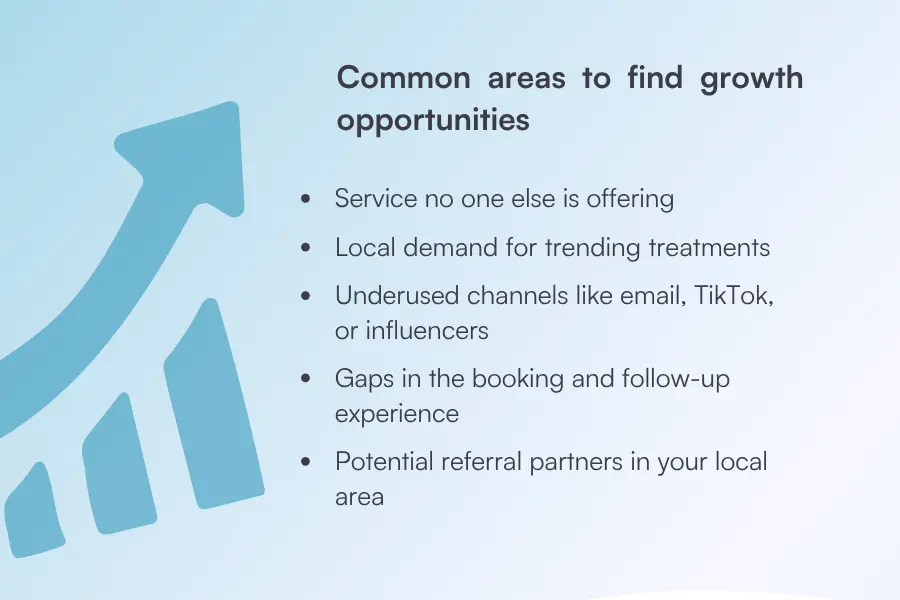
Once you’ve mapped the landscape, the blind spots start to show… and those are pure gold.
Maybe none of your competitors offer body treatments for postpartum clients. Maybe you’re the only one not doing microneedling, and the search traffic says you should be.
Here are some of the most common places worth digging into:
And then there’s the tech angle. If your competitors are still chasing emails, printing consent forms, or manually confirming appointments, that’s a gap you can step right into.
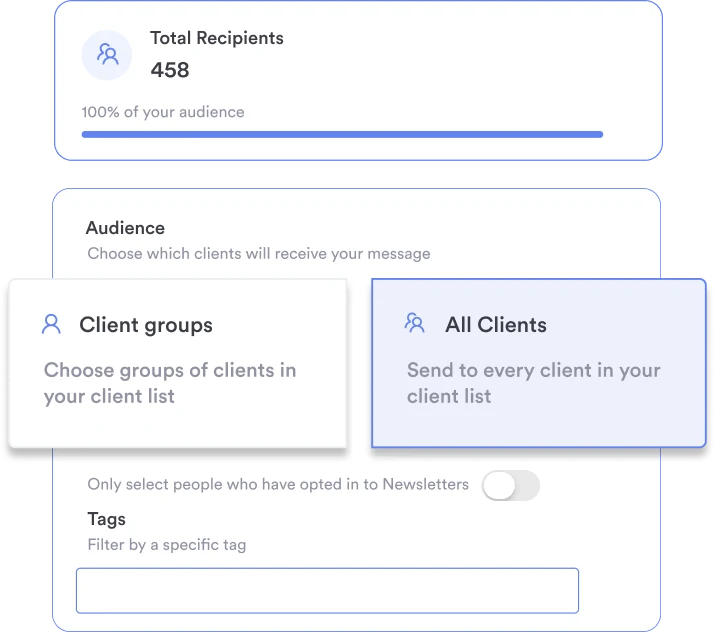
Using an all-in-one practice management software like Pabau cuts the admin and keeps your marketing on track. You can automate reminders, deliver post-care instructions on time, and run campaigns that link back to your client records.
A great way to stay organized and keep the client experience on point, don’t you think?
6. Identify threats
On the flip side, some discoveries come with a raised eyebrow and a gulp.
That new location you’ve been eyeing might already be oversaturated, with three other clinics setting up shop down the street. One poorly handled review might be all it takes to push a competitor’s search ranking to page three and keep it there.
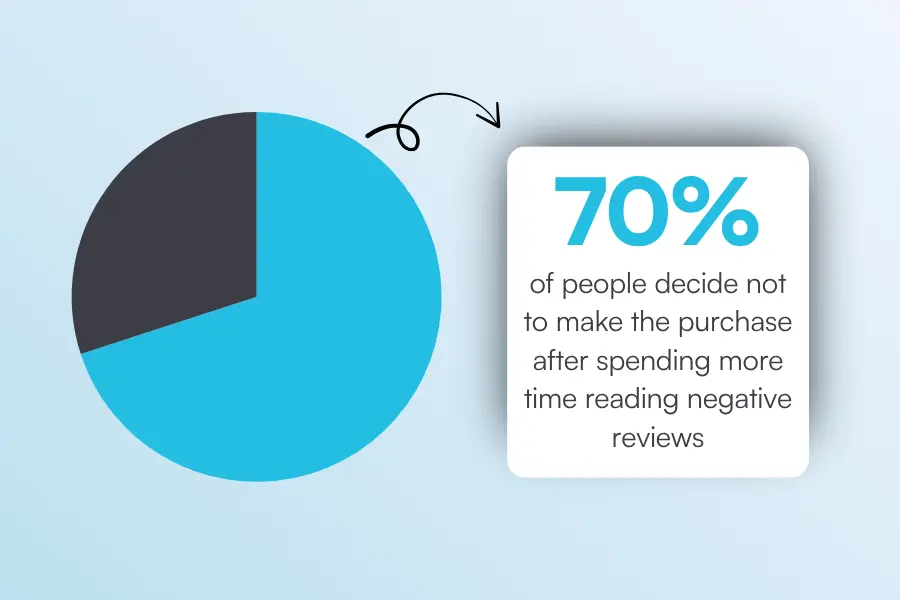
And the risk is more than reputational. In a 2022 study by Frontiers in Psychology, researchers found that when participants spent more time reading negative reviews, 70% chose not to make the purchase. The takeaway is that people don’t just notice bad feedback… they act on it.
New regulations on prescriptions, consent, or advertising that catch teams off guard
Discount-heavy offers that shift how clients value treatments
New systems or tech they’ve already adopted while you’re still stuck chasing paperwork
Threats don’t always show up as emergencies. Sometimes they build slowly, like falling response rates or creeping compliance issues. When you see them early, you’ve got time to adjust. When you don’t, they start showing up in your calendar, your revenue, and your reviews.
7. Take action and consistently benchmark against competitors
You did the work. You found the gaps. You spotted the patterns. Now what?
A competitive analysis means nothing if it just lives in a Google Doc you never open again. The medical spas that grow are the ones that do something with the information.
You might decide to:
Adjust prices that hurt profitability or no longer reflect market value
Equip your team to close service gaps your competitors ignore
The real advantage comes when you treat this as an ongoing practice, not a one‑time project.
Set a reminder to repeat this process every quarter or at least before any big shift in your marketing plan, pricing, or service model. Competitors evolve. So should you.
Use Pabau to help you stay ahead of the competition
The whole point of a competitive analysis is to make better calls every time you update a service, adjust your pricing, or revisit your marketing.
But that only works if the systems behind your med spa are built to keep up.











![Medical Aesthetics Marketing: 8 Strategies to Grow Your Practice [Updated 2026]](https://pabau.com/wp-content/uploads/2022/07/Medical-Aesthetics-Marketing-8-Strategies-to-Grow-Your-Practice-Updated-2026-1-1024x614.webp)