Functional Medicine Primary & Preventive Care
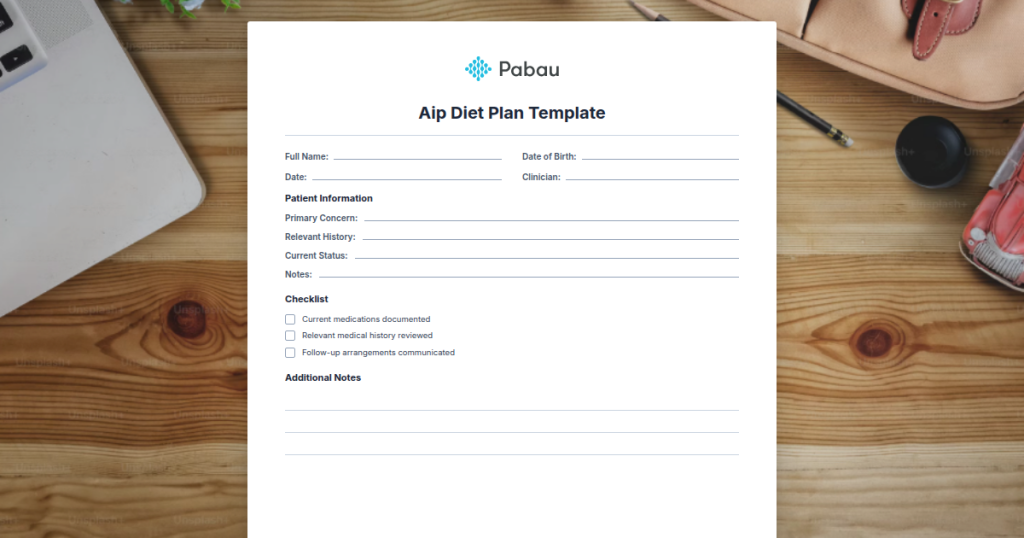
AIP Diet Plan Template
What is the AIP Diet Plan Template? The AIP diet plan template is a clinician-re...

April 16, 2026


Buy now, pay later is now available in Pabau

The AIP Diet Plan Template is a structured clinical tool for managing autoimmune conditions through elimination and reintroduction of specific foods.
Two-phase protocol: elimination phase removes common trigger foods (grains, legumes, dairy, nightshades, eggs); reintroduction phase systematically tests food tolerance.
Practitioners use the template to document patient dietary progress, symptom tracking, and clinical outcomes without manual meal planning.
Pabau’s template integrates seamlessly into client records, allowing practitioners to store, assign, and monitor AIP plans as part of structured care workflows.
Free downloadable PDF template saves practitioners hours on form creation and ensures consistent clinical documentation across patient cohorts.
The AIP diet plan template is a clinician-ready tool designed specifically for healthcare practitioners managing patients with autoimmune conditions. Rather than generic meal-planning sheets, this template structures the entire Autoimmune Protocol (AIP) approach-elimination phase, reintroduction tracking, and food lists-into a single, customizable document. Practitioners can assign the template to patients, track dietary compliance (capture baseline data with a patient weight loss intake form adapted for AIP protocols) within their client records, and monitor symptom correlations without building forms from scratch.
Developed to support practitioners in functional medicine, integrative practice, and wellness clinics, the aip diet plan template eliminates the gap between clinical guidance and patient documentation. Instead of directing patients to external meal-planning apps or loose PDFs, practitioners now embed the template directly into Pabau’s client management system, ensuring dietary plans become a formal part of the patient’s clinical record and treatment journey.
A comprehensive nutritional guidance template supporting patients following the Autoimmune Protocol diet through structured elimination and reintroduction phases with clinical documentation fields for symptom tracking and food tolerance assessment.
Download templateThe aip diet plan template serves three core clinical functions. First, it structures patient education-many patients entering an AIP protocol feel overwhelmed by the elimination list. A template breaks this into digestible phases. Second, it creates accountability through symptom tracking: patients log foods eaten and any autoimmune flares, revealing personal triggers. Third, it becomes a clinical record. Instead of relying on patient recall during follow-up appointments, practitioners have documented evidence of dietary adherence and symptom patterns.
Common use cases include:
Using the aip diet plan template in clinical practice follows a structured five-step workflow:
The template integrates with Pabau’s digital forms feature, allowing practitioners to update field labels to match their clinical terminology. A functional medicine practitioner might rename “nightshades” to “solanine-containing vegetables” for patient education clarity.
The template is most valuable for practitioners working with:
If your practice sees patients with Hashimoto’s, IBD, rheumatoid arthritis, lupus, or other autoimmune diagnoses, the aip diet plan template becomes a clinical asset. Practitioners report that structured documentation reduces follow-up appointment time because symptom patterns and dietary triggers are already documented.
Consistent patient guidance. Without a template, practitioners rely on verbal instruction or generic printed handouts, creating variability in what patients actually do. A standardised template ensures every patient receives the same elimination phase structure and reintroduction framework, improving protocol adherence and comparability of outcomes across your patient cohort.
Clinical documentation and compliance. Regulatory bodies (CQC in the UK, state medical boards in the US) expect documented evidence that patients received education and understood treatment rationale. The template provides that paper trail-practitioners can demonstrate they provided structured AIP guidance, not just casual advice.
Reduced administrative burden. Creating bespoke meal plans or AIP guides for every patient consumes practitioner time. A template template eliminates this. Practitioners assign the form, patients complete it, and practitioners focus on clinical interpretation rather than form creation.
Improved patient outcomes through tracking. When patients systematically document reintroduction attempts and symptom responses, trigger identification becomes scientific rather than intuitive. Patients discover their personal AIP blueprint-which nightshades they tolerate, which legumes cause flares-rather than following a generic protocol indefinitely.
Workflow integration. Unlike standalone meal-planning apps, an integrated template becomes part of the client record. Practitioners see dietary compliance alongside lab trends and appointment notes, enabling holistic clinical decision-making.
Define a consistent symptom scoring system before patients start the elimination phase-e.g., 0=no symptoms, 5=severe flare. Have patients rate fatigue, joint pain, and digestive symptoms on day 1 and weekly throughout elimination. When reintroducing foods, any symptom spike above baseline signals intolerance. This quantified approach removes guesswork from trigger identification and gives practitioners objective data to adjust the protocol.
Consumer-focused AIP meal plans (7-day or 30-day templates) assume all autoimmune patients follow identical elimination rules. They provide recipes but rarely address reintroduction systematically. A clinical aip diet plan template differs fundamentally.
Clinical templates emphasize personalisation. After the elimination phase, the template guides systematic reintroduction-not “here are 30 days of recipes”-allowing practitioners to identify each patient’s unique trigger foods. This level of customisation requires practitioner involvement and clinical oversight, which is exactly what differentiates functional medicine from consumer nutrition apps.
When practitioners use a template within Pabau’s practice management system, they can also link reintroduction attempts to symptom notes in the client record, creating a clinical narrative that generic meal plans cannot provide. Practitioners see patterns: “This patient tolerates ghee and reintroduced eggs week 4 with no reaction, but nightshades triggered a flare on day 3 of reintroduction.”
The aip diet plan template acknowledges that autoimmune patients need both structure and hope. The elimination phase can feel restrictive-removing foods is emotionally challenging. A well-designed template frames elimination as temporary and scientific: “For 30-90 days, we remove these foods to identify triggers. Then we systematically bring foods back to discover what works for your body.”
Reintroduction is where patient engagement spikes. Patients are eager to test whether they can tolerate their favourite foods again. The template channels this motivation into systematic testing rather than chaotic “I’m trying everything” approaches. When practitioners schedule follow-up appointments to review reintroduction progress, patients feel supported-their dietary journey becomes part of their clinical care, not an isolated experiment.
Research on autoimmune protocol compliance indicates that structured dietary interventions with documented tracking improve both adherence and clinical outcomes. Templates facilitate that structure by making the invisible (dietary choices) visible through documentation.

Need guidance on functional medicine assessments? Functional Medicine Software covers how practitioners structure comprehensive evaluations that connect dietary, lifestyle, and lab findings.
Want to streamline patient intake workflows? Digital Forms explains how Pabau’s form builder allows you to customise templates like the AIP plan to match your clinic’s specific terminology and assessment priorities.
Looking for templates on related topics? Lifestyle vs Pharmacologic Interventions provides a clinical framework for positioning dietary protocols alongside medical management.
The AIP Diet Plan Template transforms autoimmune nutritional management from informal patient guidance into structured clinical documentation. By systematising both elimination and reintroduction phases, practitioners enable patients to discover their personal trigger foods rather than following generic protocols. When integrated into practice management, the template becomes part of the clinical record-evidence that dietary intervention was delivered, monitored, and refined based on patient response.
Schedule a Pabau demo to see how this template fits within a complete practice management system.
Typically 30-90 days, depending on symptom severity and response. Most practitioners recommend 30 days minimum to allow gut healing and symptom stabilisation before reintroduction begins. Patients with severe active disease may extend to 90 days.
Yes. While the core elimination phase is consistent across autoimmune diagnoses, practitioners can customise field labels, add condition-specific symptom tracking, and adjust reintroduction sequences. A Hashimoto’s patient might prioritise iodine-containing foods differently than an IBD patient.
The template includes motivation anchors-practitioners can add notes explaining why each food category is eliminated. Many practitioners schedule weekly check-ins during elimination to troubleshoot challenges, celebrate wins, and reinforce that the phase is temporary and purposeful.
Within Pabau, practitioners can link the AIP template to appointment notes and lab orders. When inflammatory markers (CRP, ESR) improve alongside documented dietary compliance, that evidence strengthens the case for continuing the protocol or modifying it.
While AIP is typically used to manage active autoimmune conditions, some wellness practitioners use it preventively for patients with autoimmune family history or early symptom clusters. The template adapts to both approaches-eliminate to identify triggers or eliminate to prevent escalation.