IVF & Gynecology Reproductive & Sexual Health
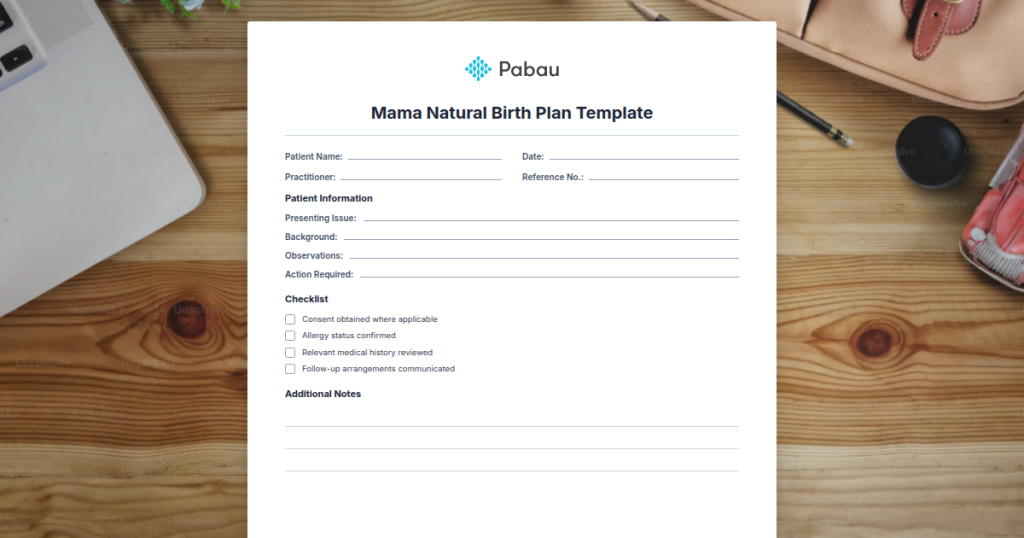
Mama Natural Birth Plan Template
Download Your Free Mama Natural Birth Plan Template Mama Natural Birth Plan A co...

April 15, 2026


Buy now, pay later is now available in Pabau

A structured birth plan template that helps expectant mothers communicate preferences for labour, delivery, and postpartum care to clinical staff
Reduces miscommunication between patients and providers by documenting pain management, intervention preferences, and newborn care wishes upfront
Supports informed consent workflows by clarifying patient understanding of medical procedures and enabling practitioners to address concerns before labour
Streamlines prenatal documentation and clinic workflows with a single, ready-to-use form compatible with Pabau’s digital forms system
A comprehensive birth plan template covering labour preferences, delivery wishes, postpartum care, and newborn procedures. Helps expectant mothers and clinical teams align on birthing goals through clear, documented communication.
Download templateA Mama Natural Birth Plan Template is a structured document that allows expectant mothers to articulate their labour and delivery preferences in writing. Rather than relying on verbal communication during active labour, a documented birth plan provides your clinical team with advance notice of patient wishes regarding pain management, medical interventions, newborn procedures, and postpartum care.
This template serves multiple clinical functions. It initiates prenatal dialogue about patient values and medical understanding. It documents informed consent by confirming which procedures the patient accepts or declines. It reduces last-minute decision-making during labour when communication becomes difficult. From a legal and compliance perspective, a documented birth plan demonstrates that your clinic respects patient autonomy and maintains clear record-keeping aligned with professional standards set by the American College of Obstetricians and Gynecologists (ACOG) and NHS maternity guidance.
Many clinics using digital intake forms convert birth plans into fillable templates within their practice management system, reducing paper and improving data capture during the prenatal period.
Implementing a mama natural birth plan template follows a structured workflow that integrates prenatal assessment with delivery planning.
Multiple clinical settings rely on birth plans to structure prenatal care.
Clarifies patient understanding: Writing preferences forces expectant mothers to research labour options and understand what each choice entails. Many patients discover they lack clarity on delayed cord clamping, for example, until drafting the plan.
Supports informed consent: A documented plan demonstrates that your clinic obtained informed consent before labour. The patient’s signature confirms they understand offered procedures and made deliberate choices about acceptance or refusal.
Reduces clinical conflict: When labour becomes intense, patients often request pain relief they stated they wanted to avoid. A prior, written plan provides reference point for staff and patient to revisit original goals together, rather than reacting in crisis mode.
Improves team alignment: Doctors, midwives, nurses, and partners all have the same document to reference. This alignment reduces redundant conversations and ensures consistent information delivery.
Supports audit and compliance: Documented birth plans serve as evidence that your clinic respects patient autonomy and maintains HIPAA-compliant clinical records. They demonstrate your practice meets NHS standards for maternity care and regulatory expectations.

Digital forms and integrated client records let your clinic capture birth plans, manage consent workflows, and store patient preferences in one system.

A comprehensive mama natural birth plan template divides preferences into distinct sections, each addressing a stage of labour and delivery.
A mama natural birth plan template should clearly reference clinical evidence supporting patient options. Delayed cord clamping, for example, is recommended by ACOG and WHO to improve iron stores in newborns and is now considered standard care in many settings rather than a preference.
Similarly, immediate skin-to-skin contact supports breastfeeding initiation and bonding, aligning patient preference with clinical best practice. Your template should frame these not as unusual requests but as standard options supported by evidence-based maternity care.
This grounding reassures both patients and clinicians that documented preferences reflect informed choice rather than uneducated wishes. It also reduces defensiveness when labour complications require preference modification.
Many patients using a mama natural birth plan template express strong preference for natural labour without medical intervention. Your prenatal counselling must acknowledge this goal whilst preparing for medical reality.
Approximately 30% of labouring patients in hospital settings receive epidural analgesia, and emergency complications arise in roughly 15-20% of deliveries. A well-structured birth plan therefore includes contingency language. Instead of stating “I refuse pain medication”, frame it as “I prefer to attempt natural pain management first, and will request pain relief if labour becomes unbearable.”
This language preserves patient autonomy whilst acknowledging that labour intensity is unpredictable. It prevents the patient from feeling they have “failed” if complications force intervention, and it documents that your clinic discussed realistic expectations.
A Mama Natural Birth Plan transforms birth preparation from informal preference-sharing into structured, documented informed consent. By capturing patient values, clarifying medical understanding, and aligning your clinical team around documented goals, the template reduces miscommunication during labour and supports both patient autonomy and clinical safety.
Ready to streamline prenatal workflows and ensure birth plans reach all patients consistently? Book a demo with Pabau to explore how digital forms and integrated practice management can automate birth plan distribution, capture consent signatures, and store preferences alongside patient records-all in one secure system.
A natural birth plan should cover pain management preferences (such as continuous labour support, movement, or position changes rather than pharmacological pain relief), delivery preferences (position, perineal support, delayed cord clamping), newborn procedures accepted or declined (vitamin K, eye ointment, vaccinations), and postpartum wishes (breastfeeding initiation timing, skin-to-skin contact duration). It should remain flexible to accommodate medical complications.
Start with a structured template divided into labour, delivery, and postpartum sections. For each section, list your preference and why it matters to you. Use collaborative language (e.g., “I prefer to avoid” rather than “I will not”). Discuss your plan with your healthcare provider during prenatal visits to identify any medical factors that affect feasibility. Prioritise which preferences are most important to you, in case complications require changes.
Yes. Bring multiple copies of your completed, signed birth plan to hospital admission. Provide one to the labour and delivery nurse, one to the midwife, and one to your obstetric team. This ensures all staff know your preferences and can reference them if questions arise. Confirm during early labour that nothing has changed since your last prenatal visit.
If labour complications develop (such as fetal distress, arrest of labour, or maternal high blood pressure), your clinical team will discuss necessary modifications and explain why your stated preference must change. A well-drafted birth plan includes flexibility language acknowledging this possibility. Your original document demonstrates you made informed choices and supports rather than contradicts clinical decision-making during emergencies.
Yes. Most downloadable templates allow customisation to reflect your clinic’s specific offerings, available pain management methods, newborn screening protocols, and hospital policies. Customisation ensures the plan aligns with your local care pathways and reduces patient confusion about what your facility can provide. Review customised versions with your clinical team and legal advisor before deploying to patients.