

Tooth Charts
Tooth Chart: Free Downloadable Template for Dental Clinics A tooth chart is a vi...

March 6, 2026


Buy now, pay later is now available in Pabau

The BAP technique uses just 10 injection points (5 per side) compared to 40+ with traditional skin boosters
Each BAP point receives 0.2ml of Profhilo in the superficial subcutaneous layer using a 29G needle
Standard protocol requires 2 sessions 4 weeks apart, with maintenance every 6 months
The five key injection points are: zygomatic protrusion, nasal base, tragus, chin, and mandibular angle
Aspiration before injection and proper depth control are critical for patient safety
Profhilo has revolutionised skin bioremodelling, but its effectiveness depends entirely on correct administration. Unlike traditional dermal fillers, Profhilo's high concentration of hyaluronic acid (HA) requires precise placement using the Bio Aesthetic Points (BAP) technique developed by IBSA Derma.
This guide provides aesthetic practitioners with a comprehensive clinical protocol for Profhilo injection, covering anatomical landmarks, treatment schedules, injection technique, and post-treatment management.
The Bio Aesthetic Points (BAP) technique is a standardised injection protocol developed specifically for Profhilo administration. IBSA designed this method to maximise the product's unique diffusion properties whilst minimising patient discomfort and treatment time.
Traditional HA skin boosters require 40 or more injection points across the face. The BAP technique achieves superior results with just 10 strategic points (5 per side). This reduction is possible because of Profhilo's hybrid cooperative complex structure, which allows the product to spread naturally through the tissue planes.
The technique was developed with three core objectives:
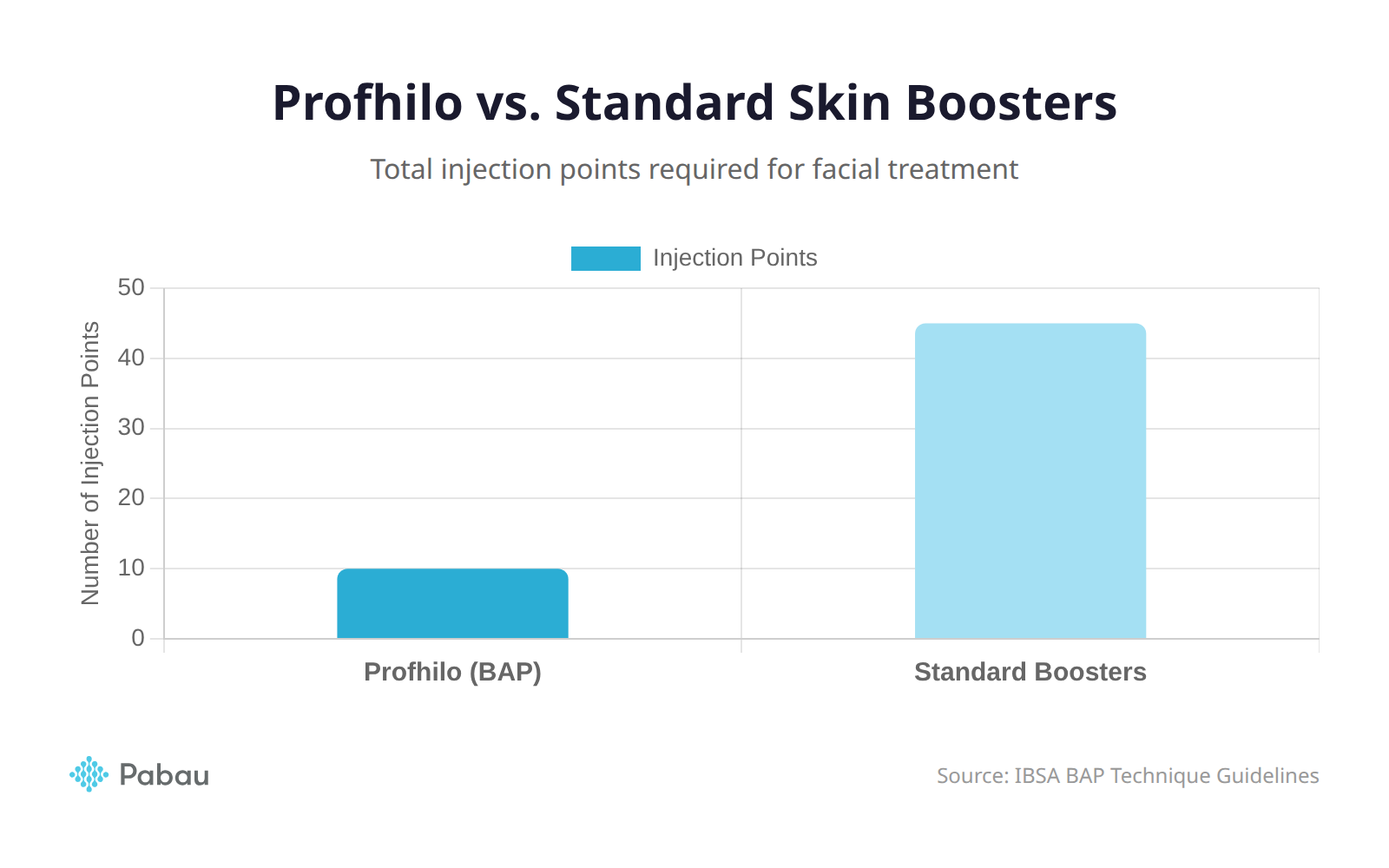
The chart above illustrates the efficiency advantage of the BAP technique. By reducing injection points by 75%, practitioners can deliver treatments faster whilst patients experience significantly less discomfort.
Mastering the BAP technique requires precise identification of anatomical landmarks. Each of the five points per side has been selected for optimal safety and diffusion.
Location: The most prominent point of the zygomatic arch, typically 1-2cm lateral to the lateral canthus.
Landmark identification: Ask the patient to clench their teeth. Palpate along the zygomatic arch to locate the highest point of the bone. This point sits above the masseter muscle insertion.
Clinical note: This is the most superior BAP point and initiates upward diffusion across the mid-face.
Location: At the junction where the nasal ala meets the cheek, approximately 1cm lateral to the nasolabial fold.
Landmark identification: The point sits in the triangle formed by the nose, nasolabial fold, and orbital rim. Avoid injecting directly into the nasolabial fold itself.
Clinical note: This point treats the mid-face area and supports diffusion towards the perioral region.
Location: Approximately 1cm anterior and superior to the tragus of the ear.
Landmark identification: Place your finger on the tragus and move 1cm forward towards the face. The injection point should be in the soft tissue just anterior to the cartilage.
Clinical note: This point ensures lateral face coverage and jawline enhancement.
Location: Central chin, approximately 1cm above the inferior border of the mandible.
Landmark identification: Midline of the chin, in the soft tissue between the mentalis muscle and bone. Avoid the mental foramen, which sits more laterally.
Clinical note: This is the only midline BAP point and supports lower face diffusion.
Location: At the angle of the mandible, approximately 1-2cm superior to the bone's inferior edge.
Landmark identification: Ask the patient to clench their teeth. Palpate the angle where the mandible turns from the ramus to the body. The injection point sits just above this landmark.
Clinical note: This point provides jawline definition and ensures even distribution to the lower third of the face.
Mark all 10 BAP points with a surgical marker before beginning injections. This ensures symmetry and allows you to verify placement with the patient upright before they recline for treatment.
“The BAP technique transformed our Profhilo treatments completely. We’ve reduced appointment times by 40% whilst improving results. Our clients experience minimal discomfort, and we’ve had zero complications since implementing the standardised protocol. Documenting the injection points in Pabau’s client records gives us complete treatment traceability.”

Profhilo's treatment protocol follows a specific timeline designed to optimise tissue remodelling and collagen stimulation.
The initial treatment course consists of two sessions, four weeks apart.
Session 1 (Week 0):
Session 2 (Week 4):
The four-week interval allows the first treatment to stimulate fibroblast activity before the second dose amplifies this response. Patients typically begin seeing improvements after the first session, with optimal results appearing 4-8 weeks after the second treatment.
After completing the initial two-session protocol, patients have two maintenance options:
Option 1: Six-month cycle
Option 2: Quarterly maintenance
Use your practice management software to schedule maintenance appointments automatically. Setting up automated reminders at the 5-month mark increases rebooking rates by 60% compared to manual follow-up.
Each BAP point receives exactly 0.2ml of Profhilo. With 10 points total (5 per side), one 2ml syringe provides the complete treatment dose.
Practitioners should not increase the dose per point or add additional injection sites. The BAP technique's effectiveness relies on consistent dosing at anatomically correct locations.
Correct injection technique is critical for both safety and optimal results. Profhilo must be deposited in the precise tissue plane to achieve proper diffusion.
Use a 29G (13mm) needle for all BAP injections. This gauge provides several advantages:
Profhilo must be injected into the superficial subcutaneous tissue, not the dermis or deep fat compartments.
Depth landmarks:
Technique: Insert the needle at a 45-degree angle, advancing to approximately 10mm depth. The product should flow easily without resistance. If you encounter resistance, you're likely too shallow (dermis) or against fascia.
Profhilo is administered as a bolus (single depot) rather than a threading technique.
Procedure:
The bolus will be visible as a small raised bump immediately after injection. This is normal and expected. The product will begin diffusing within 24-48 hours.
Always aspirate before injecting Profhilo. Whilst the BAP points are in relatively safe zones, individual anatomy varies.
Aspiration technique:
Vascular complications, whilst rare with the BAP technique, can be serious. Aspiration is your primary safety mechanism for avoiding intravascular injection.
For comprehensive guidance on obtaining proper consent before aesthetic procedures, review the requirements for digital consent forms to ensure full documentation of risks and benefits.
Proper post-treatment guidance is essential for optimal results and patient satisfaction.
Patients will have visible raised areas (papules) at each injection point immediately after treatment. This is normal and indicates correct superficial placement.
Patient instructions:
Some practitioners photograph the injection sites immediately after treatment to reassure patients that the appearance is expected.
Advise patients to avoid the following for 24-48 hours post-treatment:
Heat exposure:
Physical activity:
Heat and increased blood flow can exacerbate swelling and may affect product distribution.
Comprehensive record-keeping protects both practitioner and patient. Modern aesthetic clinic software makes this documentation seamless.
Essential documentation:
Using dedicated before and after photo tools integrated with patient records ensures consistent documentation and helps track treatment outcomes over time.
Instruct patients to contact the clinic immediately if they experience:
Whilst serious complications with the BAP technique are rare, early recognition and intervention are critical if they occur.
For clinics managing multiple practitioners and treatment protocols, robust patient records systems ensure every team member can access complete treatment history and respond appropriately to patient concerns.
Whilst some practitioners prefer cannulas for other injectable treatments, the BAP technique was developed for needle administration. IBSA's clinical studies and training materials specify a 29G needle.
Cannulas offer theoretical advantages for safety, but the BAP points are designed to be low-risk zones when proper needle technique is used. Additionally, the precise superficial placement required for optimal Profhilo diffusion is easier to achieve with a needle.
If you choose to use a cannula, ensure you:
Yes, Profhilo can be combined with other aesthetic treatments, but timing is important.
Safe combination protocols:
The two-week interval prevents products from affecting each other's placement or diffusion patterns. Many practitioners offer "combination packages" with appropriate spacing built into the treatment schedule.
Clinics using MedSpa software can automate scheduling to ensure appropriate intervals between combination treatments.
The BAP technique has an excellent safety profile when performed correctly. Common, expected side effects include:
Immediate (resolves within 24-48 hours):
Less common (occurs in <5% of patients):
Rare complications:
Profhilo is fundamentally different from traditional hyaluronic acid dermal fillers in structure, mechanism, and application.
Key differences:
| Aspect | Profhilo | Traditional HA Fillers |
|---|---|---|
| HA concentration | 64mg/2ml (highly concentrated) | 20-24mg/ml (cross-linked) |
| Cross-linking | Hybrid cooperative complex (no chemical cross-linking) | Chemically cross-linked |
| Mechanism | Bioremodelling (stimulates collagen and elastin) | Volumising (fills and supports tissue) |
| Injection technique | 10 BAP points, bolus injection | Multiple points, variable technique |
| Primary indication | Skin quality, laxity, hydration | Volume loss, structural support |
| Diffusion | Spreads through tissue planes | Stays where placed |
Profhilo treats skin quality from within by stimulating fibroblasts to produce new collagen and elastin. Fillers provide structural support and volume replacement. These are complementary treatments rather than alternatives.
The Profhilo BAP technique represents a paradigm shift in injectable skin treatments. By standardising the protocol around 10 precisely defined anatomical points, IBSA has created a treatment that is simultaneously more effective, safer, and faster than traditional skin booster approaches.
For aesthetic practitioners, mastering the BAP technique requires:
As bioremodelling treatments become increasingly popular, clinics that implement standardised protocols and comprehensive documentation systems will differentiate themselves through superior outcomes and patient safety.
Modern practice management systems help aesthetic clinics maintain protocol consistency across multiple practitioners, automate treatment scheduling, and provide the documentation infrastructure required for medical defence and regulatory compliance.
Ready to streamline your injectable treatment protocols? Book a demo to see how Pabau helps leading aesthetic clinics standardise care, reduce administrative burden, and scale with confidence.

Implementing digital treatment records? Learn how injection plotting tools power effective record-keeping in aesthetic practices.
Building your Profhilo protocol documentation? Discover Botox face mapping techniques you can adapt for bioremodelling treatments.
Managing multiple aesthetic treatment protocols? Compare the best aesthetic clinic software for standardising care across your practice.