ICD11
ICD-11 6A02: Autism Spectrum Disorder – Diagnosis & Coding Guide
What is ICD-11 6A02: Autism Spectrum Disorder? ICD-11 code 6A02 represents Autis...

March 11, 2026

Discover free eBooks, guides and med spa templates on our new resources page


Buy now, pay later is now available in Pabau

Read case studies from our satisfied clients

Compare Pabau with alternative systems
 Integrations
 Measure Pabau savings
  Our security commitment
  About us
Learn why this holistic care and aesthetic medicine clinic chose Pabau to power patient care and performance.
Read more
Our free printable reference sheet covers the 25 most commonly used ICD-10 codes for autism spectrum and neurodevelopmental conditions. Download it for faster, more accurate clinical documentation.

F84.0 is the primary ICD-10 code for autistic disorder, covering autism spectrum disorder, infantile autism, and Kanner’s syndrome
The F84 category includes six codes for pervasive developmental disorders, each with distinct clinical criteria
Accurate ICD-10 coding reduces claim denials and supports continuity of care across providers
Documentation must link the chosen code to clinical findings, severity, and functional impact
ICD-11 introduced code 6A02 for autism, but ICD-10-CM remains the US billing standard through 2026
If you work with patients on the autism spectrum, selecting the correct ICD-10 code for autistic disorder is essential for both reimbursement and clinical documentation. The primary code, F84.0, applies to the majority of autism spectrum presentations. However, several related codes exist for specific conditions within the pervasive developmental disorder category. In this guide, you will find the full breakdown of F84.0, related codes, documentation tips, and billing best practices.
According to the CDC’s ADDM Network (2025), approximately 1 in 31 children aged 8 years has been identified with autism spectrum disorder. As a result, clinicians across specialties encounter this diagnosis regularly and need to code it correctly.
The ICD-10 code for autistic disorder is F84.0. This code falls under the broader F84 category, which covers pervasive developmental disorders. In addition, F84.0 serves as the standard billing code for autism spectrum disorder in the ICD-10-CM classification system used across the United States.
F84.0 includes several inclusion terms recognised by the World Health Organisation:
For example, a clinician diagnosing a child with classic autism presentation would assign F84.0 regardless of whether the referral mentions “autism spectrum disorder” or “autistic disorder.” Similarly, adult patients receiving a first-time diagnosis also use F84.0 when the presentation meets diagnostic criteria.
Always document the specific behavioural observations, developmental history, and standardised assessment scores that support the F84.0 diagnosis. Payers frequently request this documentation for prior authorisation of ABA therapy and other interventions.
The F84 subcategory contains all ICD-10 codes for pervasive developmental disorders. Consequently, understanding each code helps clinicians select the most accurate classification for their patient’s presentation.
This is the most commonly billed code. It applies to patients meeting DSM-5 criteria for autism spectrum disorder, including those previously diagnosed with classic autism, infantile autism, or Kanner’s syndrome. Furthermore, this code covers the full range of severity levels within ASD.
Rett’s syndrome is a distinct genetic condition primarily affecting girls. It involves regression of motor and language skills after a period of normal development. Therefore, clinicians should assign F84.2 only when genetic testing confirms MECP2 mutations or the clinical presentation matches established diagnostic criteria.
Previously known as Heller’s syndrome, this code applies when a child shows normal development for at least two years before significant regression in multiple domains. In contrast to F84.0, the regression pattern is the defining characteristic.
Although the DSM-5 merged Asperger’s syndrome into the broader autism spectrum disorder category, F84.5 remains a valid ICD-10-CM code. As a result, some clinicians still use this code for patients who present with average or above-average intellectual ability alongside social communication difficulties.
F84.8 covers other pervasive developmental disorders not classified elsewhere, including overactive disorder associated with stereotypies. Meanwhile, F84.9 is used for pervasive developmental disorder, unspecified, which includes atypical autism. Use F84.9 only when the clinical picture does not fully meet criteria for a more specific code.
The following table lists all F84 codes relevant to autism spectrum and pervasive developmental conditions. For a complete printable reference, download our free worksheet.
| ICD-10 Code | Description | Key Indicators |
|---|---|---|
| F84.0 | Autistic disorder | Social communication deficits, restricted interests, repetitive behaviours |
| F84.2 | Rett’s syndrome | Regression after normal development, primarily girls, MECP2 mutation |
| F84.3 | Childhood disintegrative disorder | Normal development for 2+ years then significant regression |
| F84.5 | Asperger’s syndrome | Social difficulties with preserved language and cognitive function |
| F84.8 | Other pervasive developmental disorders | Overactive disorder with stereotypies and movement patterns |
| F84.9 | Pervasive developmental disorder, unspecified | Atypical autism, incomplete criteria for specific PDD |
The prevalence of autism spectrum disorder has risen steadily over the past two decades. Consequently, the volume of claims using the ICD-10 code for autistic disorder has increased significantly.
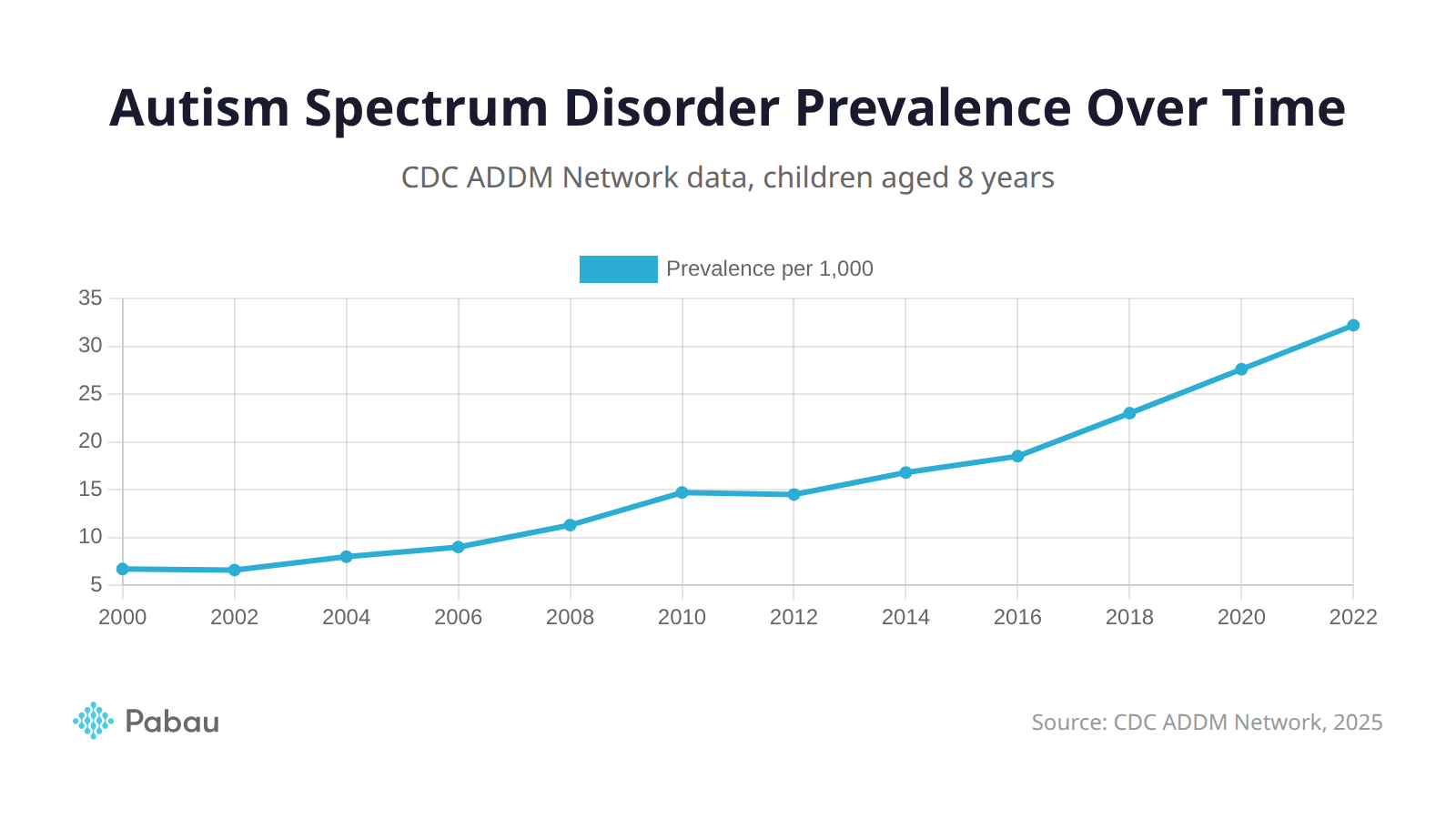
As the chart above illustrates, ASD prevalence has risen from 1 in 150 children in 2000 to 1 in 31 in 2022. This increase reflects improved screening, broadened diagnostic criteria, and greater awareness among clinicians. For instance, many adults are now receiving first-time diagnoses, further expanding the patient population that requires accurate ICD-10 coding.
In addition, this trend means practices specialising in neurodevelopmental conditions process higher volumes of claims tied to F84 codes. Therefore, coding accuracy directly impacts revenue cycle performance.
Proper documentation supports the ICD-10 code for autistic disorder and reduces the risk of claim denials. Here are the essential elements to include in every encounter note.
Every encounter note should reference the specific observations and assessments that support the F84.0 code. For example, document:
The DSM-5 uses three severity levels for autism spectrum disorder. Similarly, your documentation should clearly indicate the level of support the patient requires:
Including severity in your notes helps payers understand the medical necessity for recommended treatments. Furthermore, it supports continuity when the patient transitions between providers.
Many patients with autism present with co-occurring conditions. Consequently, each comorbidity should receive its own ICD-10 code alongside F84.0:
“Pabau has transformed how we manage patient documentation at our clinic. Having structured clinical records that link directly to diagnosis codes means we spend less time on admin and more time with our patients. The ability to track treatment progress over time has been invaluable for our neurodevelopmental assessments.”

Even experienced billers make errors when coding for autism spectrum conditions. Here are the most frequent mistakes and how to avoid them.
The unspecified code F84.9 should be a last resort. However, many practices default to it when documentation is incomplete. To fix this, ensure assessments clearly support a specific diagnosis. In most cases, F84.0 is the appropriate choice for patients meeting ASD criteria.
Submitting F84.0 alone often understates the clinical picture. As a result, payers may deny services that address co-occurring conditions. Therefore, always list each comorbid diagnosis separately on the claim.
Changing between F84.0 and F84.5 across visits without clinical justification raises red flags during audits. Consistency matters. If a patient’s diagnosis has been updated, document the clinical reasoning for the change.
Set up diagnosis code templates in your practice management software to pre-populate F84.0 and common comorbidity codes for autism patients. This reduces manual entry errors and speeds up the billing workflow.
The World Health Organisation released ICD-11 in January 2022, introducing significant changes to autism classification. However, the United States continues to use ICD-10-CM for billing purposes, and no official transition date has been announced.
In ICD-11, autism spectrum disorder is classified under code 6A02, with sub-codes based on intellectual and language functioning:
This structure better reflects the spectrum nature of autism. Nevertheless, until the US formally adopts ICD-11, clinicians must continue using F84.0 and related F84 codes for all billing purposes. Meanwhile, familiarising yourself with the ICD-11 framework can help prepare your practice for the eventual transition.
Modern practice management software streamlines the entire coding and documentation process. For practices that regularly bill autism-related services, the right software eliminates many common sources of error.
Using digital forms tailored to neurodevelopmental assessments ensures that clinicians capture all required documentation elements. For instance, pre-built templates can prompt for severity levels, assessment scores, and comorbidity screening results.
A comprehensive client record system links diagnosis codes to treatment notes, assessment results, and billing history in one place. As a result, staff can quickly verify that the submitted ICD-10 code matches the clinical documentation.
Practices handling sensitive neurodevelopmental data must maintain strict compliance standards. Automated workflows help ensure that documentation meets both clinical and regulatory requirements. In addition, built-in audit trails support practices during payer reviews.
For a detailed compliance overview, see our HIPAA compliance checklist for primary care.
Integrated claims management reduces the gap between clinical documentation and billing submission. Furthermore, automated code validation catches common errors before claims reach the payer. Practices using AI-powered documentation tools can also speed up note-taking while maintaining coding accuracy.
You can learn more about how AI is enhancing practice management and reducing administrative burden.
The ICD-10 code for autism spectrum disorder is F84.0, classified as autistic disorder. This single code covers the full range of autism spectrum presentations, including infantile autism and Kanner’s syndrome.
Yes, F84.5 is the ICD-10-CM code for Asperger’s syndrome. Although the DSM-5 merged Asperger’s into the broader autism spectrum disorder diagnosis, the ICD-10-CM system still maintains F84.5 as a valid, billable code.
Use F84.9 (pervasive developmental disorder, unspecified) only when clinical documentation does not support a more specific diagnosis. In most cases, a thorough assessment will point to F84.0 or another specific F84 code.
No official transition date has been set. The US currently uses ICD-10-CM for all medical billing, and F84.0 remains the correct code for autistic disorder. Clinicians should continue using ICD-10-CM codes until an official announcement is made.
Yes, and you should. List F84.0 as the primary diagnosis code, then add separate codes for each co-occurring condition such as ADHD (F90.x), anxiety (F41.1), or language disorders (F80.x). This ensures accurate clinical representation and supports medical necessity for all services rendered.
Most payers require standardised assessment results (such as ADOS-2 or ADI-R scores), a developmental history, behavioural observations, and a clear statement of diagnosis with severity level. Having structured intake forms helps capture this information consistently.

Looking for the right EHR for your practice? Explore the best EHR systems for private practice in 2026.
Want to reduce admin time with smarter tools? Learn how AI is enhancing practice management across clinical workflows.
Going paperless in your clinic? Discover the benefits of going paperless and how it saves time and space.