ITB Syndrome Exercises Handout Template
What Is an ITB Syndrome Exercises Handout Template? The iliotibial band is a thi...

March 17, 2026


Buy now, pay later is now available in Pabau

The Ottawa ankle rules calculator reduces unnecessary ankle and foot X-rays by up to 40% in emergency and urgent care settings
Five palpation zones and two functional tests determine whether radiography is needed after an ankle injury
Sensitivity exceeds 98% for detecting clinically significant fractures, making it one of the most validated clinical decision tools
The rules apply to patients aged 2 and older but require caution with intoxicated, polytrauma, or neuropathy patients
Integrating the Ottawa ankle rules into digital clinical workflows improves documentation consistency and audit readiness
Every year, ankle injuries account for roughly 10% of all emergency department visits. However, fewer than 15% of these patients actually have a fracture. The Ottawa ankle rules calculator helps clinicians decide which patients genuinely need an X-ray and which can be safely managed without radiography. Originally developed by Stiell et al. (1992) at the Ottawa Civic Hospital, this clinical decision tool has since become one of the most validated prediction rules in emergency medicine.
For physiotherapists, urgent care practitioners, and sports medicine clinicians, the Ottawa ankle rules calculator is an essential part of the initial assessment toolkit. In this guide, you will learn how the rules work, when to apply them, their limitations, and how to integrate them into your clinical documentation workflow.
The Ottawa ankle rules calculator uses a straightforward two-part assessment: palpation of specific bony landmarks and a functional weight-bearing test. Understanding these components ensures accurate application and reduces the risk of missed fractures.
An ankle X-ray series is indicated if the patient has pain in the malleolar zone AND any one of the following findings:
The emphasis on posterior bony tenderness is deliberate. Ligamentous injuries typically produce tenderness over the anterior or inferior aspects of the malleoli. In contrast, fractures tend to cause posterior bony tenderness. This anatomical distinction is what gives the Ottawa ankle rules calculator its high sensitivity.
A separate set of criteria applies to the midfoot. An X-ray of the foot is indicated if the patient has pain in the midfoot zone AND any one of the following:
These midfoot criteria help detect navicular fractures and fifth metatarsal (Jones) fractures, both of which are commonly missed on initial presentation. For this reason, the Ottawa ankle rules calculator should always include the midfoot assessment when patients report midfoot pain.
Palpate the posterior 6 cm of each malleolus using the tip of your thumb, not the flat of your hand. Focal bony tenderness at a specific point is far more clinically significant than diffuse soft-tissue soreness across the region.
The Ottawa ankle rules calculator stands on one of the strongest evidence bases in clinical medicine. Understanding this evidence helps you explain the tool's reliability to patients and colleagues who may question a decision not to X-ray.
Stiell et al. (1992) developed the rules by prospectively studying 750 patients presenting with ankle injuries to the Ottawa Civic Hospital emergency department. The derivation study identified the combination of palpation zones and weight-bearing tests that best predicted fractures. A subsequent validation study of over 1,000 patients confirmed the rules' performance.
The landmark result was a sensitivity of 100% for malleolar fractures and 98% for midfoot fractures. This means the Ottawa ankle rules calculator correctly identifies virtually every clinically significant fracture. The specificity is lower, around 40-50%, which means some patients without fractures still receive X-rays. However, the primary goal is ruling out fractures safely, and sensitivity is the metric that matters most for a screening tool.
A Cochrane systematic review and subsequent meta-analyses have confirmed these findings across diverse settings and populations. Bachmann et al. (2003) published a comprehensive review in the BMJ examining 27 studies with over 15,000 patients. The pooled sensitivity remained above 98% for both ankle and midfoot fractures.
Furthermore, studies from North America, Europe, Asia, and Australia have consistently replicated these results. The Ottawa ankle rules calculator performs reliably regardless of the clinical setting, provided the examiner applies the palpation technique correctly.
Implementation studies show that the Ottawa ankle rules calculator reduces ankle X-ray rates by 30-40% without missing clinically significant fractures. In addition, average emergency department waiting times decrease because fewer patients require radiography. Several cost-effectiveness analyses have demonstrated substantial savings for health systems that adopt the rules routinely.
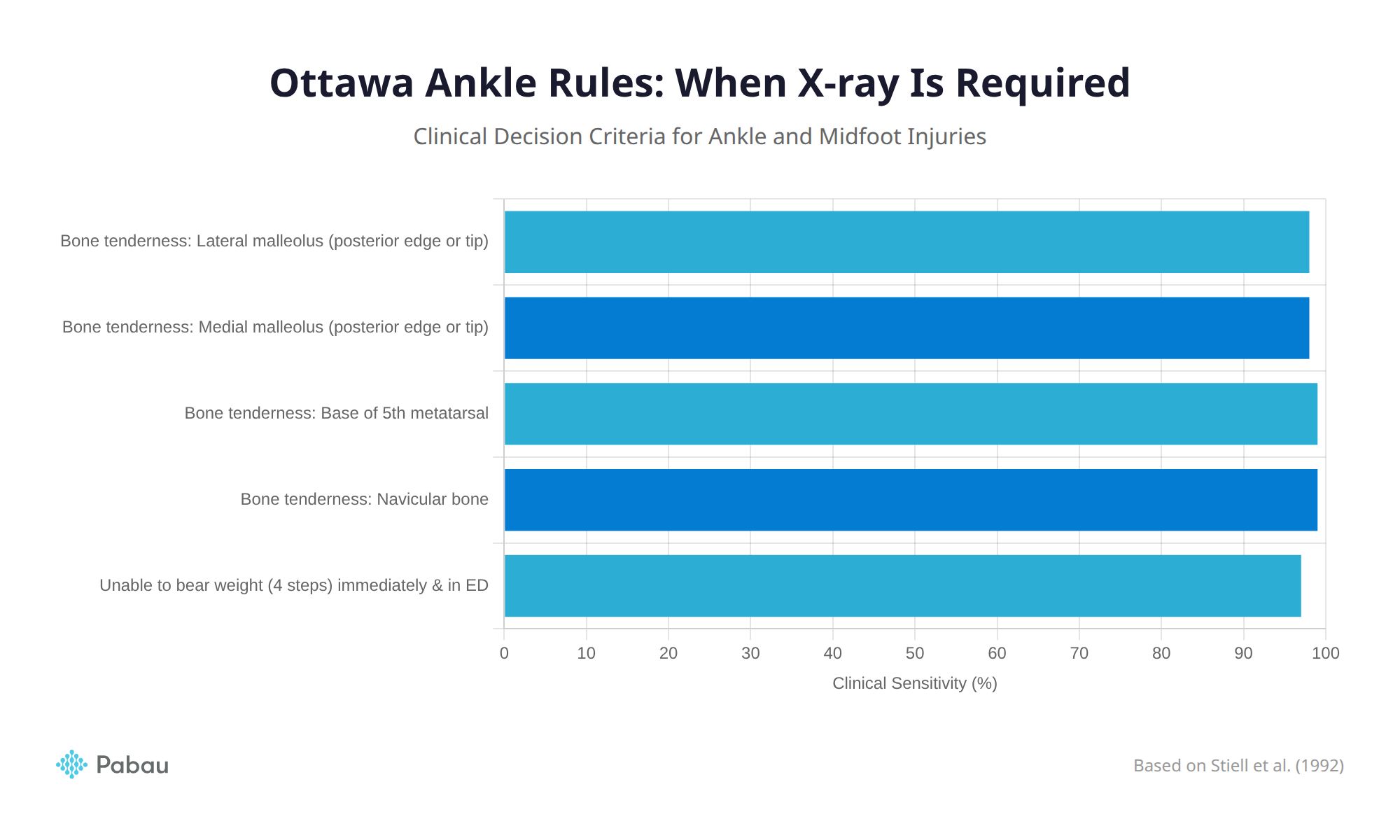
Applying the Ottawa ankle rules calculator correctly requires a systematic approach. Follow these steps during your clinical assessment to ensure consistent, defensible results.
Verify that the injury involves the ankle or midfoot. The rules were designed for blunt trauma mechanisms such as twisting, rolling, or direct impact injuries. Penetrating injuries, crush injuries, and suspected stress fractures fall outside the scope of the Ottawa ankle rules calculator.
Before applying the rules, confirm the patient does not meet any exclusion criteria:
Palpate the posterior 6 cm of both the medial and lateral malleolus. Apply firm pressure with your thumb tip along the posterior bony edge. Ask the patient to indicate whether they feel bony tenderness specifically at the palpation site. Record your findings for each side.
Palpate the navicular bone on the medial side and the base of the fifth metatarsal on the lateral side. Again, use focal pressure and distinguish between bony tenderness and surrounding soft-tissue discomfort.
Ask the patient to take four steps. They do not need to walk normally; limping counts as successful weight-bearing. The patient must attempt this both at the time of injury (by history) and during the examination. Inability to complete four steps in either scenario triggers a positive finding on the Ottawa ankle rules calculator.
If any criterion is positive, radiography is indicated. If all criteria are negative, the Ottawa ankle rules calculator suggests that X-ray is not required. Document each palpation zone result, the weight-bearing test outcome, and your clinical decision clearly in the patient record.
Always document the specific Ottawa ankle rules findings, not just the outcome. Writing ‘Ottawa rules negative’ is insufficient. Record each palpation zone and the weight-bearing result individually to create a defensible clinical note.
The Ottawa ankle rules calculator is highly sensitive but not infallible. Clinicians must recognise situations where the rules may not perform as expected.
The Ottawa ankle rules calculator has a small false-negative rate, typically under 2%. Most missed fractures are avulsion fractures or stress fractures that may not produce posterior bony tenderness in the classic zones. Additionally, patients assessed very early after injury (within the first hour) may not yet exhibit tenderness patterns reliably.
Several patient groups require clinical judgement beyond the Ottawa ankle rules calculator alone:
In these scenarios, consider obtaining radiography regardless of the Ottawa ankle rules calculator result. Clinical judgement always supersedes any decision rule.
The original Ottawa ankle rules were validated in adults aged 18 and over. However, subsequent studies have extended their use to children aged 2 and above. Sensitivity remains high in paediatric populations, though growth plate injuries (Salter-Harris fractures) can occasionally be missed. For children under 5, exercise additional caution and consider a lower threshold for imaging.
Consistent application of the Ottawa ankle rules calculator requires more than clinical knowledge. You need a workflow that prompts the assessment, captures findings, and supports clinical audits.
Creating a structured form for the Ottawa ankle rules calculator ensures every practitioner follows the same steps. Fields should include each palpation zone (medial malleolus, lateral malleolus, navicular, fifth metatarsal base), the weight-bearing test result, and the clinical decision. Dropdown menus or checkboxes reduce documentation variability.
Pabau's digital forms builder lets you create custom Ottawa ankle rules templates with auto-scoring logic. When a clinician selects a positive finding, the form can automatically flag that radiography is indicated. This removes ambiguity and speeds up the assessment process.
Monitoring your use of the Ottawa ankle rules calculator across your patient population helps identify patterns and quality improvement opportunities. For example, tracking the ratio of negative X-rays to total ankle injuries reveals whether your team is applying the rules consistently.
With measurements tracking tools, you can log assessment scores alongside outcome data. Furthermore, automated workflows can trigger follow-up assessments at 7-10 days for patients who were initially managed without imaging, ensuring no delayed fracture presentations slip through.
Thorough documentation protects both the patient and the clinician. Every Ottawa ankle rules calculator assessment should be recorded in the patient's clinical record with timestamps and practitioner details. If you decide against imaging despite borderline findings, document your clinical reasoning explicitly.
For physiotherapy practices managing mandatory compliance requirements, having a standardised Ottawa ankle rules template demonstrates that your team follows evidence-based protocols. This is valuable for clinical governance reviews and insurance audits alike.
“Pabau’s custom forms have transformed how we document clinical assessments. We built our musculoskeletal screening templates in minutes, and now every practitioner follows the same structured approach. The time savings are significant.”

Even experienced clinicians sometimes misapply the rules. Avoiding these common errors improves accuracy and patient outcomes.
The most frequent mistake is palpating the tip or anterior surface of the malleolus rather than the posterior 6 cm. The Ottawa ankle rules calculator specifically targets the posterior bony edge because this is where fracture tenderness localises. Anterior tenderness more commonly indicates ligamentous injury rather than fracture.
Many clinicians default to the ankle criteria alone and overlook the midfoot component. Navicular and fifth metatarsal fractures cause significant morbidity if missed. Always assess both the ankle and midfoot zones when a patient presents with pain following a twisting injury.
The four-step weight-bearing test is a critical component that some clinicians skip when patients report severe pain. However, the test is designed to be attempted, not necessarily completed painlessly. Limping through four steps counts as successful weight-bearing. Only true inability to take any steps constitutes a positive finding on the Ottawa ankle rules calculator.
A negative Ottawa ankle rules calculator result is clinically meaningful and must be documented with the same rigour as a positive result. Recording "no bony tenderness over posterior medial malleolus, posterior lateral malleolus, navicular, or fifth metatarsal base; able to bear weight for four steps" creates a clear audit trail that supports your clinical decision.
The Ottawa ankle rules calculator is an excellent training resource for clinical students and junior staff. Its structured approach teaches the fundamentals of evidence-based clinical decision-making.
New practitioners often over-order imaging because they lack confidence in their clinical assessment skills. Teaching the Ottawa ankle rules builds a framework for systematic musculoskeletal examination. As staff gain experience with the rules, their overall clinical reasoning improves beyond just ankle injuries.
Regular clinical audits comparing Ottawa ankle rules calculator outcomes against imaging results provide valuable learning opportunities. If your practice tracks that 95% of rule-negative patients remain fracture-free at follow-up, this data reinforces confidence in the tool. You can run these audits using practice analytics to identify patterns across your clinical team.
Practices that use patient management software can automate outcome tracking by linking initial assessment forms with follow-up visit data. This creates a feedback loop that continuously validates your team's application of the Ottawa ankle rules calculator.
A negative Ottawa ankle rules calculator result does not mean the injury is trivial. Several scenarios warrant referral or escalation even when the rules suggest no fracture.
Persistent symptoms beyond 5-7 days warrant reassessment and possible imaging. Similarly, patients with significant joint instability on clinical testing may have ligamentous injuries requiring specialist review. In addition, suspected syndesmotic injuries (high ankle sprains) present with proximal fibular tenderness that falls outside the standard Ottawa ankle rules palpation zones.
For these cases, clinical judgement takes precedence. The Ottawa ankle rules calculator is a fracture screening tool, not a comprehensive injury assessment. Always consider the complete clinical picture.
See how Pabau helps physiotherapy and urgent care clinics deliver consistent, evidence-based patient care with digital forms and automated workflows.

Running a physiotherapy clinic? Learn about mandatory compliance requirements for physiotherapy clinics and how to stay audit-ready.
Want to improve patient follow-up rates? Discover how reducing patient no-shows keeps your rehabilitation schedules on track.
Looking for better clinical documentation? See how digital medical forms replace paper-based assessments and improve data quality.
The Ottawa ankle rules calculator is a clinical decision tool that helps practitioners determine whether a patient with an ankle or midfoot injury needs an X-ray. It uses specific palpation zones and a weight-bearing test to identify patients at low risk of fracture, reducing unnecessary radiography by up to 40%.
The Ottawa ankle rules calculator has a sensitivity exceeding 98% for detecting clinically significant ankle and midfoot fractures. This means it correctly identifies virtually all fractures. The specificity is around 40-50%, meaning some patients without fractures will still be sent for imaging as a precaution.
Yes, the Ottawa ankle rules calculator has been validated for children aged 2 and above. Sensitivity remains high in paediatric populations. However, growth plate injuries (Salter-Harris fractures) can occasionally be missed, so clinicians should use a lower imaging threshold for children under 5.
The Ottawa ankle rules calculator assesses five palpation zones: the posterior 6 cm of the medial malleolus, the posterior 6 cm of the lateral malleolus, the navicular bone, and the base of the fifth metatarsal. Tenderness at any of these zones, combined with inability to bear weight, indicates a need for radiography.
Yes. If symptoms persist beyond 5-7 days despite a negative Ottawa ankle rules calculator result, reassessment and imaging are warranted. The rules are designed for initial assessment of acute injuries. Persistent pain may indicate occult fractures, stress fractures, or significant ligamentous injuries that require further investigation.
The Ottawa ankle rules calculator does not specifically assess for syndesmotic (high ankle) injuries. These injuries produce tenderness along the proximal fibula and interosseous membrane, which falls outside the standard palpation zones. If you suspect a high ankle sprain, clinical assessment with a squeeze test and external rotation test is more appropriate.