Primary & Preventive Care
Respiratory Failure Nursing Care Plan Template
A Respiratory Failure Nursing Care Plan Template provides clinicians with a syst...

March 17, 2026


Buy now, pay later is now available in Pabau

Evidence-based activity templates reduce preparation time for therapists
Free worksheets support CBT, DBT, and emotion regulation work
Age-appropriate designs engage children across developmental stages
Digital integration enables progress tracking and outcome measurement
Customisable templates adapt to diverse clinical presentations
Therapy worksheets for kids are structured activities designed to help mental health professionals engage children in therapeutic work. These tools transform abstract concepts-anxiety, anger, emotions, coping skills-into concrete, interactive exercises that young clients can understand and apply. Rather than lengthy talk-based sessions, worksheets create space for children to express themselves through drawing, writing, problem-solving, and reflection.
The challenge most clinicians face is balancing evidence-based practice with time constraints. Creating custom activities for each session consumes hours, yet generic printable materials often miss the mark with specific clients or presentations. Quality therapy worksheets for kids bridge this gap by providing research-backed templates grounded in cognitive-behavioral and dialectical-behavioral approaches that align with professional standards.
This guide covers what these worksheets are, how to implement them effectively across age groups, and how integrating them into your clinical documentation system transforms both client outcomes and practice efficiency. You’ll discover which therapeutic modalities benefit most, how to adapt materials for different developmental levels, and how modern practice management tools can track worksheet completion and therapeutic progress.
Therapy worksheets for kids are most effective when they’re readily available and closely integrated into your session workflow. This free template combines emotion identification, coping skill practice, and progress reflection into one age-appropriate resource designed for practitioners.
An interactive worksheet template designed to engage children in therapeutic sessions. Features age-appropriate activities, emotion regulation exercises, and coping skill development prompts to support clinical outcomes.
Download template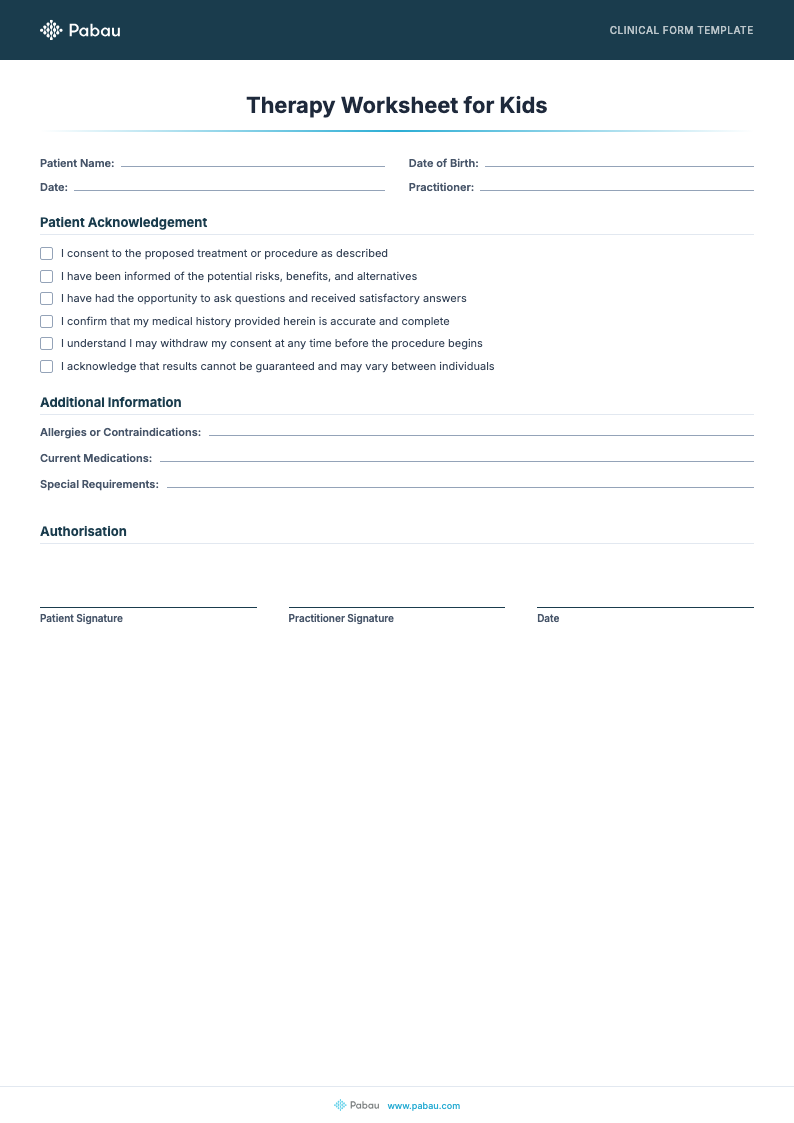
A therapy worksheet for kids is a structured, interactive document that facilitates therapeutic engagement during clinical sessions with children and adolescents. Unlike generic activity sheets, evidence-based therapy worksheets are grounded in established psychological frameworks-particularly cognitive-behavioral therapy (CBT) and dialectical-behavior therapy (DBT)-and designed to translate clinical concepts into age-appropriate language and visual formats.
These worksheets serve multiple clinical purposes. They help children externalize emotional experiences through drawing, writing, or rating scales. They provide structure when verbal processing alone feels overwhelming. They create concrete artifacts of therapeutic work that clinicians can reference across sessions, documenting emotional shifts and skill acquisition.
From a regulatory and ethical standpoint, therapy worksheets for kids support informed practice and documentation standards. Under HIPAA and child privacy protection frameworks, clinician-completed worksheets become part of the medical record, creating an auditable trail of therapeutic activities and outcomes. This is particularly important in settings where clinical supervision, care coordination, or legal accountability requires demonstrating adherence to evidence-based protocols.
According to the American Psychological Association’s guidelines for child mental health, evidence-based worksheets grounded in cognitive-behavioral and dialectical frameworks show measurable improvements in emotional regulation, anxiety reduction, and skill acquisition across diverse child populations. Well-designed therapy worksheets for kids also honor developmental appropriateness. A worksheet for a 6-year-old uses simple illustrations, single-word responses, and sensory elements (stickers, checkboxes). A 14-year-old’s worksheet incorporates more complex thought-feeling-behaviour connections, reflection prompts, and skill-building language aligned with adolescent cognitive capacity.
The distinction matters: free worksheets vary enormously in clinical rigor. Printable resources from informal websites may lack theoretical grounding. Evidence-based therapy worksheets for kids, by contrast, reference peer-reviewed research in child psychology and have been validated through clinical use. Professional practice management frameworks increasingly distinguish between activity sheets (generic content) and clinical worksheets (outcome-tracked, protocol-aligned tools).
Integrating therapy worksheets for kids into your clinical workflow requires intentionality at five key decision points:

Discover how Pabau's integrated clinical documentation system keeps worksheets, progress notes, and treatment plans in one organised space-so your focus stays on your clients.

Therapy worksheets for kids benefit a wide range of mental health practitioners and clinic types:
Psychology and counselling practices serving children aged 6-18 are the primary users. Child psychologists, clinical social workers, counsellors, and licensed therapists routinely integrate evidence-based worksheets into session protocols. Whether working from private practice, community mental health centres, or school-based clinics, these practitioners use interactive evidence-based tools to structure sessions, track progress, and engage young clients in their own therapeutic work.
Psychiatry and pediatric mental health clinics use therapy worksheets for kids as part of comprehensive treatment planning. Psychiatrists often pair medication management with psychotherapeutic activities; worksheets provide concrete behavioural and emotional data that informs dosing and modality adjustments.
ADHD and autism assessment teams employ worksheets designed for neurodevelopmental presentations. These worksheets support clients with attention or executive function challenges by breaking tasks into smaller, visually scaffolded steps.
School psychologists and educational counsellors working in primary and secondary schools integrate worksheets into universal prevention programmes and targeted interventions. These settings often have limited session time, making efficient, evidence-based worksheets essential.
Occupational therapists working with children on emotional regulation, sensory processing, and social skills integrate therapy worksheets designed to complement physical and sensory interventions.
Speech-language pathologists managing selective mutism, pragmatic language disorder, and communication anxiety use modified worksheets that reduce verbal demand while building confidence.
Family therapy and couples counselling practices use child-focused worksheets during family sessions to help younger members articulate concerns and participate meaningfully in session work.
The common thread: all these practitioners work with children who benefit from concrete, interactive, age-appropriate tools that externalise emotional or behavioural work and create documented evidence of therapeutic progress.
Compliance and legal protection. Completed therapy worksheets for kids become part of the clinical record, demonstrating adherence to evidence-based treatment protocols. Supervisors and auditors can see exactly what therapeutic activities were employed and how the child responded. This documentation supports licensure compliance and protects against liability claims challenging the appropriateness of treatment.
Workflow efficiency. Creating custom activities for each session is time-consuming. Therapy worksheets for kids eliminate this burden. A curated template library reduces session preparation from 30 minutes to seconds, allowing clinicians to focus on clinical formulation and therapeutic relationship rather than worksheet design.
Measurable progress tracking. Static verbal notes don’t clearly show progress. Worksheets create a visual record. Comparing worksheet responses across weeks-emotion intensity ratings, coping strategy effectiveness, thought pattern shifts-demonstrates tangible change that both clinician and child recognise. This motivates continued engagement.
Child engagement and self-efficacy. Young clients often disengage from purely verbal processing. Interactive worksheets-with drawing, rating scales, choices-hold attention and create agency. Children feel ownership of their therapeutic work when they’re directing the pencil and making decisions.
Age-appropriate communication. Worksheets translate clinical language into developmentally appropriate formats. A 7-year-old can rate “sadness” on a 1-5 face scale; an adolescent can complete a thought-feeling-behaviour chain. Matching worksheet complexity to developmental stage ensures accessibility.
Consistency across practitioners. In multi-clinician settings, standardised therapy worksheets delivered through integrated practice management systems ensure every child receives aligned treatment regardless of which therapist is present. This reduces variance and strengthens outcomes.
Parent and caregiver communication. Worksheets create a tangible artefact to show caregivers: “Your child worked on identifying feelings today using this sheet.” This builds transparent, collaborative relationships with families.
Integration with outcome measurement systems. Modern practice management platforms track worksheet completion and responses, converting therapy worksheets for kids into quantified progress data that informs supervision, quality assurance, and funder reporting.
Document worksheet theme selection in your clinical notes. Instead of writing ‘client completed emotion identification worksheet,’ record: ‘Client completed emotion identification worksheet identifying anxiety as butterflies in stomach and anger as hot face. Practiced grounding technique; client reported 50% anxiety reduction by end of exercise.’ This specificity creates measurable, recoverable clinical data that strengthens treatment planning and outcome tracking across sessions.
Therapy worksheets for kids require deliberate age calibration to remain effective:
Use worksheets with dominant visual elements: coloured rating scales with emoji faces, simple illustrations, space for drawing and stickers. Minimize text to 20-30 words per prompt. Offer concrete coping strategies: “breathing like a balloon,” “5 senses grounding,” “movement breaks.” These children benefit from worksheets framed as collaborative puzzles: “Let’s figure out what helps you calm down.” Emotion vocabulary is still developing; provide emotion word lists and allow non-verbal responses (pointing, drawing). Sessions typically benefit from one focused worksheet per session, not multiple activities.
Transition toward thought-feeling-behaviour frameworks. Introduce CBT-structured worksheets with short text explanations. These clients appreciate some autonomy: offer worksheet options and allow them to suggest modifications. Acknowledge peer and social contexts explicitly. Worksheets addressing friendship conflict, social anxiety, or identity questions resonate more than abstract emotion concepts. Include elements of choice and agency: “Which coping skill feels most realistic for you?” Validate that some worksheets feel “babyish”-offer teen-appropriate alternatives without shame.
Use worksheets resembling journal prompts or reflection guides rather than “activity sheets.” Incorporate psychoeducation: explain the neuroscience of emotion regulation, the CBT model, or DBT skills philosophically. These clients often respond well to worksheets addressing identity, values, relationships, and future planning. Frame therapy worksheets for kids as tools for self-understanding, not clinical exercises. Allow digital completion options if your practice permits. Explicit narrative about how worksheet completion supports their stated therapy goals increases buy-in.
Across all ages, one principle holds: introduce the worksheet collaboratively, complete it together, and reflect the content back. The worksheet is the tool; your clinical relationship is the mechanism of change.
Therapy worksheets for kids become exponentially more powerful when integrated into comprehensive client record systems that track completion and outcomes.
Digital storage and retrieval. Scanned or directly completed digital worksheets live alongside clinical notes, treatment plans, and progress summaries. At session start, retrieve the prior week’s worksheet in seconds-no file hunting. This continuity deepens clinical work and demonstrates progress visually across time.
Structured outcome tracking. Modern practice management systems allow you to tag worksheets by modality (CBT, DBT), presenting problem (anxiety, anger, trauma), and age group. Over time, you can analyse: Which worksheets generate highest engagement? Which correlate with fastest progress? Which do specific clients resist? This data informs your template library curation and funder reporting requirements. The National Institute of Mental Health recommends routine outcome measurement as essential to evidence-based practice; digitised worksheets make this feasible for all clinic sizes.
Client portal access. Secure patient portals allow guardians and older adolescents to view completed worksheets, reinforcing therapeutic work between sessions. Caregivers see concrete evidence of their child’s progress and can reinforce coping strategies at home. For adolescents, reviewing their own worksheets across weeks builds metacognitive awareness of change.
Multi-practitioner coordination. In settings with multiple clinicians (supervision, covering clinicians, psychiatric consultants), shared digital worksheets ensure every practitioner understands the child’s recent therapeutic focus, emotional presentation, and responses. This alignment strengthens treatment coherence.
Outcome measurement for funders and supervisors. Therapists can aggregate worksheet data to show: “100% of clients completed emotion identification worksheets; 78% demonstrated measurable anxiety reduction within 4 weeks.” This evidence supports licensing renewal, clinical supervision documentation, and funding applications-particularly important for practices seeking evidence-based credentials.
Compliance and auditing. Timestamped, digitally stored therapy worksheets for kids create an auditable clinical record. Regulators and supervisors can verify that therapeutic activities align with documented treatment goals and professional standards. This protects both clinician and client.

Want to structure your session workflow around evidence-based activities? Digital Forms lets you create, customise, and auto-populate therapy worksheets for kids directly into client records during sessions.
Need to track which worksheets drive the best outcomes? Psychology Practice Software aggregates worksheet completion data so you can measure progress and refine your therapeutic approach.
Looking to reduce session prep time and paperwork? Client Portal enables guardians and older adolescents to review completed worksheets, extending therapeutic work into the home and building accountability.
Want AI-powered clinical documentation that captures worksheet-based conversations? Echo AI automatically generates progress notes from your verbal reflections about worksheet activities, saving documentation time without sacrificing clinical detail.
Therapy worksheets for kids are far more than time-fillers or busywork. They are evidence-based clinical tools that translate abstract therapeutic concepts into concrete, interactive exercises children can engage with and learn from. When grounded in CBT or DBT frameworks, age-appropriately calibrated, and integrated into comprehensive clinical documentation systems, they become powerful drivers of measurable therapeutic progress.
The return on investment is clear: clinicians save preparation time, children demonstrate faster engagement and skill acquisition, and guardians gain transparent visibility into their child’s therapeutic work. Regulatory compliance strengthens. Outcome measurement becomes feasible. Multi-practitioner care coordination improves.
The research supporting therapy worksheets for kids in mental health, psychology, speech-language pathology, and occupational therapy is robust. What matters now is integration-embedding worksheets into workflows that prioritise both clinical rigour and operational efficiency. Starting with one curated template, testing it across your client population, measuring outcomes, and expanding your library is a sustainable path forward.
Your child clients are waiting for tools that meet them where they are-interactive, visual, age-appropriate, and genuinely therapeutic. Therapy worksheets for kids, properly implemented, deliver exactly that.
Quality varies significantly. Free worksheets grounded in CBT or DBT research, completed with therapeutic guidance, are evidence-supported. Generic printable worksheets may lack clinical rigour. The key is matching worksheet type to presenting problem and completing it collaboratively during sessions, not assigning it as homework alone.
Most children benefit from worksheets by age 5-6. Elementary-age children (6-11) respond best to visual, drawing-based activities. Younger children (3-5) may need worksheets adapted to simpler formats: colour-matching, sticker activities, or drawing prompts with minimal text.
No. Worksheets are therapeutic tools that complement, not replace, clinical relationship and verbal processing. They externalise emotions and scaffold skill development. The therapeutic relationship-your presence, validation, and clinical expertise-remains central to outcomes.
One focused worksheet per session is standard. Using multiple worksheets in a single session can feel overwhelming for children. Let the child’s presenting concern and engagement level guide frequency. Some clinicians use worksheets bi-weekly; others weekly.
Store completed worksheets in secure, encrypted clinical documentation systems (like practice management software) that comply with HIPAA, GDPR, or local privacy regulations. Avoid leaving worksheets visible or storing them in unsecured locations. Include worksheet completion in your clinical notes for continuity of care.
Refusal is clinically relevant data. Never force completion. Explore the refusal: “It feels hard?” “Does this feel babyish?” “What would help?” Offer alternatives: drawing instead of writing, verbal responses you document, or choosing a different worksheet. Respect builds therapeutic alliance more than completed worksheets.