Mark Brave

Pregnancy resting heart rate chart
A pregnancy resting heart rate chart sets out the expected resting pulse for eac...

5
Last Updated: Oct 30, 2026
Free PDF 1 page, print-ready Clinician-reviewed
A menopause hormone levels template is a sheet for recording FSH, estradiol and LH results across the menopause transition. Reference ranges shift between perimenopause, menopause and postmenopause, so each entry sits next to the range for that stage.
It also captures symptoms, health history and quality-of-life impact alongside the numbers. Keeping all of it in one place makes treatment conversations easier to hold and easier to revisit.
A one-page reference and tracking sheet for menopause hormone results. A table sets out typical FSH, estradiol and progesterone patterns by stage, followed by a seven-row results tracker and notes on when testing is worth ordering.
Start from scratch, or upload this PDF or any form you already use, and Pabau's AI Form rebuilds it with tick boxes, text fields and a signature. Attach it to the treatment once, and every patient gets it on time.
AI Form rebuilds the consent, history and aftercare forms you already use. You review each one, then publish.
Patients complete forms on their phone before they arrive, so the front desk stops retyping paper.
Every signed form is versioned and attached to the treatment record, ready when you need it.
Set how long a consent stays valid. Returning patients skip forms they have already signed.
Supports HIPAA and GDPR compliance AES-256 encryption 4.8 on G2 4.7 on Capterra Trusted by 4,000+ practices worldwide

A menopause hormone levels template records FSH, estradiol and LH results next to the reference range for each menopause stage.
FSH fluctuates in perimenopause, so diagnosis in women over 45 rests on age, symptoms and cycle history.
Menopause is confirmed after 12 consecutive months without a period, never by a single blood test.
Reference ranges are lab-specific, so the template should carry your own laboratory’s values.
Once HRT starts, reassess symptoms instead of FSH, and check estradiol only where the treatment route calls for it.
A menopause hormone levels template is a structured clinical record for tracking hormonal changes across the menopause transition. It captures follicle-stimulating hormone (FSH), estradiol (E2), luteinizing hormone (LH), anti-Müllerian hormone (AMH), progesterone, testosterone, thyroid-stimulating hormone (TSH) and prolactin. Each lab result sits beside symptom severity and treatment response, so the record shows how results, symptoms and treatment move together.
Hormone tracking also supports informed consent and duty of care. In England, the Care Quality Commission (CQC) expects practices to keep clear records of diagnostic tests, clinical reasoning and patient communication. A complete template shows that your practice assessed the patient’s hormonal status, explained the findings and based treatment on the evidence.
The template also ties each lab result to a clinical decision. With a template, every result carries its context, the date it was interpreted and the decision it led to. That supports continuity of care, cuts duplicate testing and keeps records ready for review by regulators or insurers.
Putting the template to work takes five steps that fit into your existing appointment and documentation routine.
Used this way, the template doubles as a clinical tool and a compliance record. Symptoms, hormone data and decisions sit together, which shows that your menopause care is evidence-based and patient-centered.
The template suits any practice that treats women through midlife hormonal change. HRT practices rely on it to justify treatment decisions and monitor safety. Functional and integrative medicine practitioners use it to connect lab results to symptoms and tailor their plans. Private practices and GPs gain standardized hormone records that slot into general health files.
Gynecologists, obstetricians and pelvic health specialists use it when menopause overlaps with other reproductive or pelvic conditions. Women’s health and wellness centers add hormone assessment as the basis for their recommendations.
Many HRT and functional medicine practices also treat male hormone decline. For those patients, a male hormone cycle template tracks the equivalent testosterone patterns, and men’s health practice software keeps both patient groups in one system.
In each setting, the template replaces intuition with recorded evidence. A functional medicine practitioner can record baseline results and symptom scores, recommend diet and lifestyle changes, and compare symptom scores at a 12-week review.
An HRT practice can track how patients respond to micronized progesterone, estradiol patches or other formulations, judged mainly on symptom relief. A practice using an AI scribe can draft the template from the consultation itself, which cuts admin without losing detail.
Standardized clinical documentation: Templates remove the variation of free-text notes. Every patient’s hormone assessment holds the same data points, so you can audit how consistently your practice delivers menopause care and fix what falls short. Regulators such as the CQC look for structured documentation because it shows clinical rigor.
Improved patient safety: Hormone levels, symptom severity, contraindications and treatment rationale sit in one place. That lowers the risk of an overlooked finding or a conflicting treatment. If a patient reports a family history of thromboembolism, the template prompts a careful HRT risk assessment and keeps that note visible at every appointment.
Audit and compliance readiness: When insurers, regulators or a patient’s attorney request records, the template shows that your decisions were informed and evidence-based. FSH results, interpretation, consent discussions and follow-up plans all sit in one structured format. That lowers medicolegal risk and supports your position in any professional liability claim.
Clearer patient communication: Patients often ask, “Are my hormone levels normal?” A template with the reference ranges beside each result lets clinicians give a clear, quantified answer. A simplified printout of the reference table for the patient to take home improves health literacy and engagement in treatment decisions.
A template inside your practice management system cuts admin time. Instead of lab results in email, side spreadsheets and retyped notes, one record holds results, interpretation and decisions. When that record links to scheduling, you can see which patients are due for follow-up and book them before the monitoring window passes.
Many clinicians order FSH and estradiol together, hoping one test will confirm perimenopause. Neither can. Estradiol swings widely, even within a single cycle, and FSH is variable through the transition too. NICE menopause guidance advises diagnosing women over 45 from symptoms and cycle changes, without an FSH test.
Base the diagnosis on age, symptoms and menstrual history. Where you do test, document serial FSH results over time as supporting data, never as the deciding result. That stops one-off numbers from driving repeat tests and keeps your clinical reasoning easy to follow.
Hormone production becomes erratic through the transition before it settles at a new baseline. In perimenopause, the years before the final period, FSH rises as the ovaries respond less to pituitary signals.
FSH above 30 IU/L points to declining ovarian function, but levels swing widely in this phase and can read normal on the next test. Estradiol can stay normal or even rise early in perimenopause, despite falling egg reserves.
Menopause itself is defined as 12 consecutive months without a period, so it is confirmed in hindsight. After that point FSH stays high. Because of FSH testing limitations, testing is most useful when periods cannot guide you, such as after a hysterectomy or with very irregular cycles.
Postmenopausal FSH typically sits above 30–40 IU/L and is often higher. Estradiol falls sharply, usually below 20 pg/mL, as the ovaries stop producing eggs and estrogen. Progesterone becomes almost undetectable because the corpus luteum, which makes progesterone after ovulation, no longer forms.
Reading results by stage prevents clinical errors. A perimenopausal woman with symptoms and a moderately raised FSH may benefit from lifestyle changes or carefully started HRT. A postmenopausal woman with high FSH and low estradiol needs different counseling, focused on long-term risk. The template records these stage-specific readings so every clinician applies the same logic.
Reference ranges vary between laboratories and assay methods, so always use your own lab’s values. The Endocrine Society and The Menopause Society (formerly NAMS) publish interpretation guidance. The patterns below are general benchmarks, and the chart sets the three stages side by side.
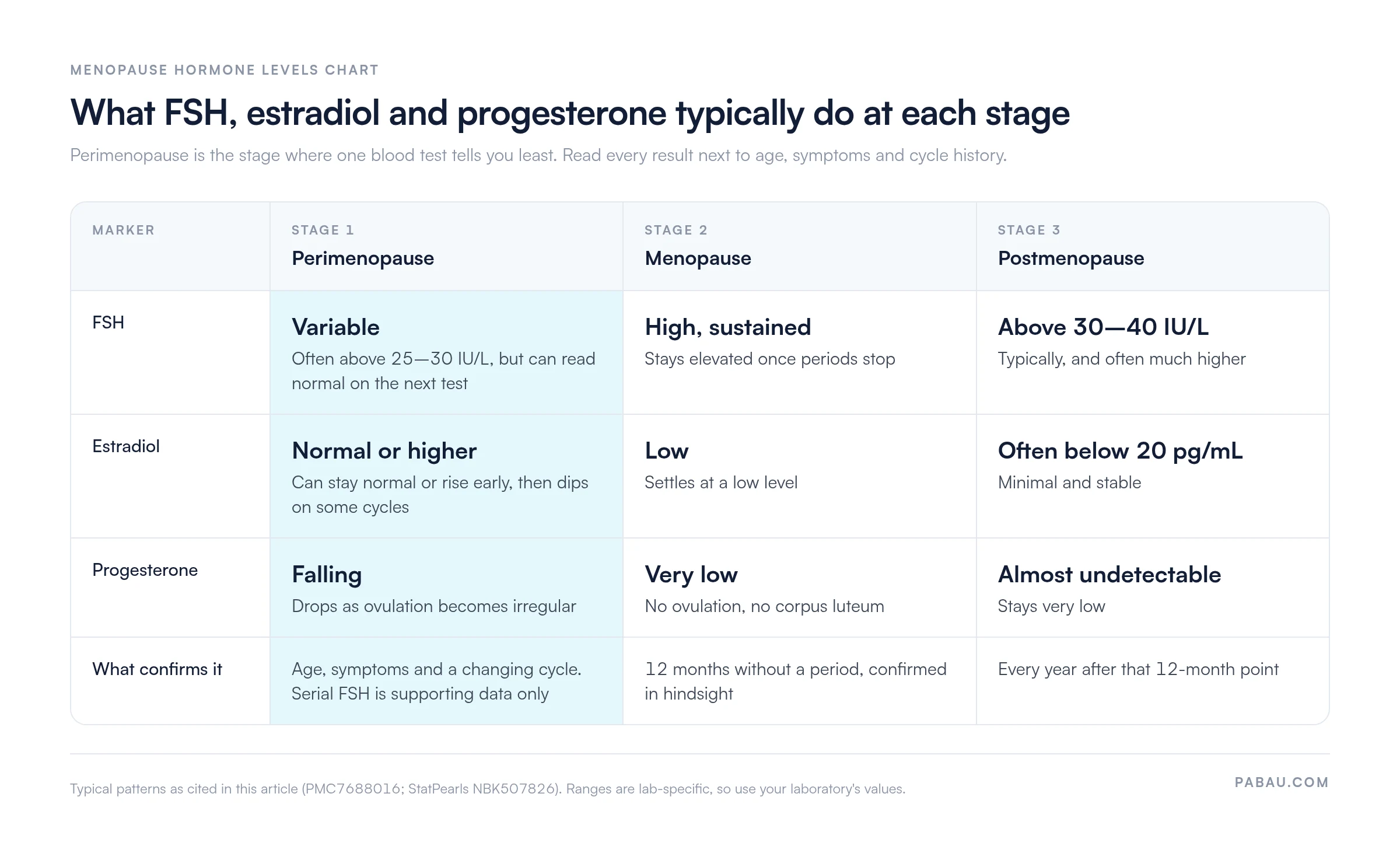
Perimenopause (FSH variable, often above 25–30 IU/L): FSH rises and swings between tests. Estradiol stays in the premenopausal range or dips below it in some cycles. This stage often brings the most bothersome symptoms because hormone shifts are sudden and unpredictable. Logging symptom timing next to each result shows which shifts line up with the worst symptoms.
Menopause (confirmed after 12 months without a period): Once 12 months of amenorrhea have passed, FSH stays high and estradiol stays low. Symptoms can last for years but tend to follow a steadier pattern as hormone levels plateau.
Postmenopause (FSH typically above 30–40 IU/L, often higher): FSH remains high and estradiol is minimal, often below 20 pg/mL. Most classic symptoms ease over time, though some women have hot flashes or mood changes for eight years or more.
Hormone therapy decisions after menopause center on symptom burden and fracture and cardiovascular risk, not on confirming menopause status. Practices offering these reviews often run them through HRT clinic software that keeps each year’s risk assessment on file.
Build your own laboratory’s ranges into the template. FSH testing for monitoring HRT is not recommended, because FSH does not reliably reflect how well the estrogen dose is working. With ranges printed beside each result, clinicians can interpret findings on the spot instead of waiting for external lab notes.
Many practices keep menopause results in lab PDFs, symptom notes on paper and treatment decisions in free text. Pabau, the practice management platform we build, brings those into each patient’s record.
Patients complete your symptom questionnaire through Pabau’s digital forms before the appointment, so the intake is ready when they arrive. Pabau Scribe, our AI scribe, drafts the consultation note from the conversation for the clinician to review. With digital medical records, hormone results, forms and treatment decisions stay attached to the patient’s full history.
The result is a menopause record any clinician can pick up at follow-up, with each decision traceable to the result behind it.

Pabau’s digital forms and AI-assisted notes cut the time spent on menopause assessment documentation, and keep every hormone result in the patient record.

A menopause hormone levels template is worth adopting because it changes how your clinicians decide. Reading each result by stage, next to age, symptoms and cycle history, stops a single FSH number from driving a diagnosis.
Start with the first consultation and the 6–8 week review, since those two visits carry the decisions you will revisit most. The cost is a few extra minutes at intake, repaid at every review that follows. Book a demo to see how Pabau keeps menopause hormone results, symptoms and treatment decisions in one patient record.

Starting a patient on HRT? Bio-identical HRT template gives you a structured form for documenting bioidentical hormone therapy.
Tracking estradiol in male patients too? Male estrogen levels template applies the same structured tracking to estrogen results in men.
Offering hormone pellet therapy? Hormone pellet insertion guide walks through the clinical procedure step by step.
Training your team on hormone results? Endocrinology quiz tests clinical knowledge, with an answer key included.
Test on days 3–5 of the cycle if the patient still has periods, or on any day if she has none. FSH and estradiol fluctuate through the cycle in perimenopause, so record the cycle day on the template. Serial FSH results over months tell you more than a single test.
No. In women over 45 with typical symptoms, the diagnosis rests on age, symptoms and cycle history, without routine hormone tests. FSH helps in women aged 40–45, in younger women when early menopause is suspected, or after a hysterectomy. Estradiol fluctuates too much to diagnose with, and LH adds little beyond FSH. TSH is worth checking to rule out thyroid disease that mimics menopausal symptoms.
Baseline testing before treatment is standard where tests are indicated. After starting HRT, review symptoms at 6–8 weeks, and check estradiol only where the treatment route calls for it. FSH is not used to monitor HRT. Once symptoms are stable, an annual review is reasonable unless symptoms change. Record each review interval in the template.
Symptoms matter more. Symptoms and menstrual history come first, and hormone levels are supporting data. A woman with classic symptoms and a raised FSH is likely perimenopausal or menopausal. Menopause is confirmed only after 12 consecutive months of amenorrhea. A woman with severe hot flashes and 11 months without a period is still perimenopausal, whatever her FSH reads.
TSH matters most, because thyroid disease mimics menopausal symptoms. Progesterone, testosterone, prolactin and AMH can add context, depending on symptoms and treatment goals. Record every tested value in the template so the patient’s results build into a complete picture over time.