



Mental Health & Therapy Speech Therapy
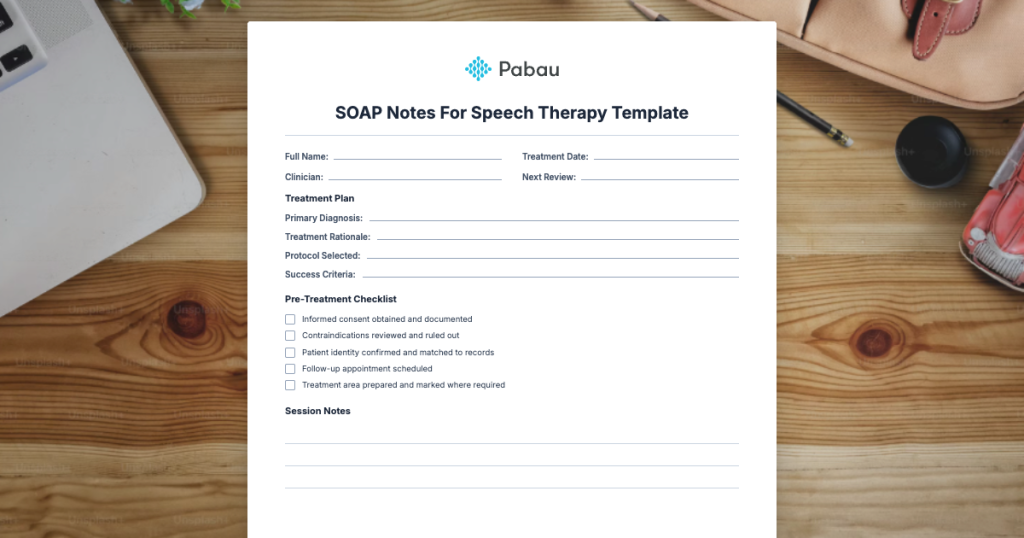
SOAP Notes For Speech Therapy Template
SOAP Notes for Speech Therapy: A Complete Documentation Framework Speech-languag...

February 26, 2026

Discover free eBooks, guides and med spa templates on our new resources page


Buy now, pay later is now available in Pabau

Read case studies from our satisfied clients

Compare Pabau with alternative systems
 Integrations
 Measure Pabau savings
  Our security commitment
  About us
Learn why this holistic care and aesthetic medicine clinic chose Pabau to power patient care and performance.
Read more

Essential documentation for clinics performing penile rejuvenation procedures
Covers informed consent, medical screening, contraindications, and post-care
Ensures regulatory compliance and reduces liability exposure
Addresses sensitive male health privacy considerations
A P-Shot consent form is the cornerstone of safe, compliant penile rejuvenation practice. This template provides clinics with complete informed consent language, medical screening questions specific to erectile dysfunction treatments, contraindication assessment, and post-procedure care instructions. By documenting patient understanding and agreement upfront, clinics protect themselves legally while ensuring patients receive clear guidance on risks, benefits, and recovery protocols.
Whether your clinic offers P-Shot therapy as a standalone treatment or as part of a broader men’s sexual wellness program, a comprehensive P-Shot consent form is non-negotiable for informed consent compliance and patient safety documentation.
A comprehensive template combining P-Shot consent documentation, medical screening questions, contraindication assessment, informed consent language, post-procedure care instructions, and patient agreement signature blocks.
Download template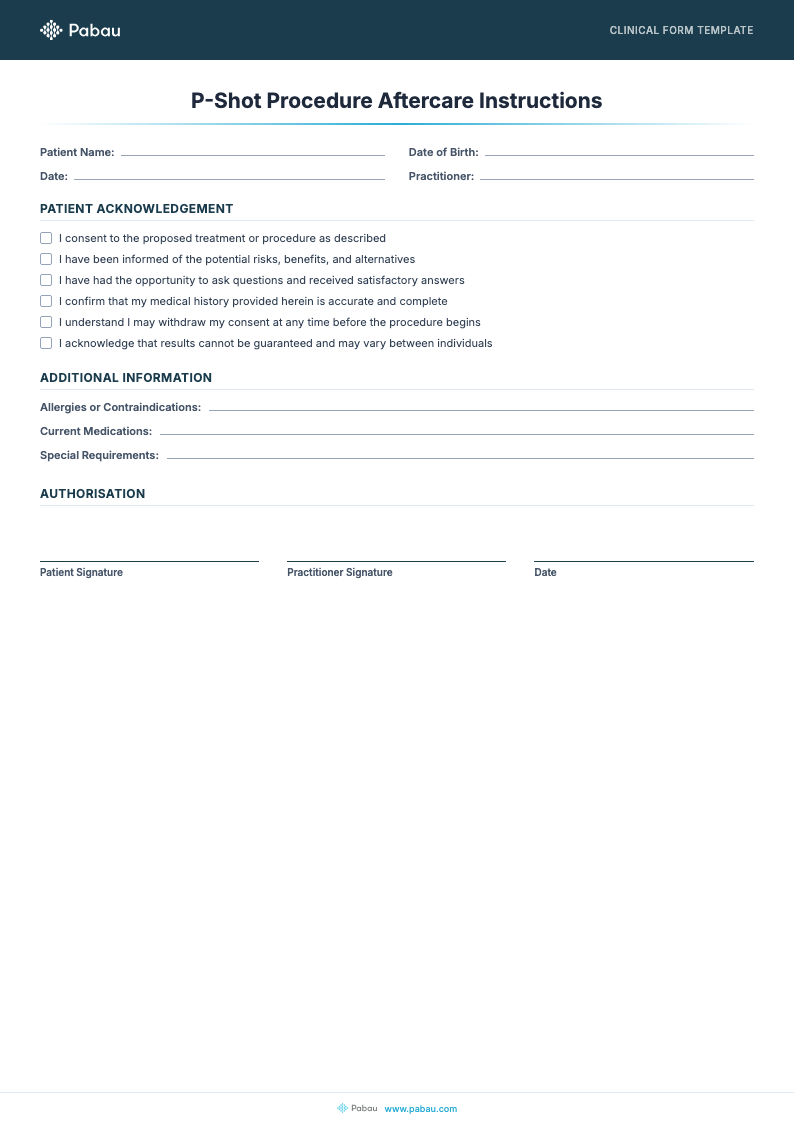
A P-Shot consent form is a legally binding patient agreement document that outlines the risks, benefits, alternatives, and post-procedure expectations of Priapus Shot (platelet-rich plasma) therapy for penile rejuvenation. The form establishes informed consent-a fundamental requirement under medical board regulations and informed consent laws across all US states and internationally regulated healthcare settings.
The form serves three clinical and legal functions: documenting that the patient understands the procedure, medical risks, and contraindications; establishing the clinic’s commitment to transparent communication; and creating a medical-legal record demonstrating compliance with informed consent standards. For clinics offering P-Shot therapy, a comprehensive consent form is essential for reducing liability exposure, demonstrating due diligence, and protecting both practitioner and patient.
P-Shot consent forms are distinct from general aesthetic procedure consents because they address procedure-specific risks related to erectile dysfunction treatment, penile tissue sensitivity, blood draw protocols, and sexual dysfunction outcomes. A customised form reflects the clinical realities of men’s sexual health procedures and accounts for the sensitive nature of this treatment category.
Implementing a P-Shot consent form requires systematic workflow integration. The form should be sent to the patient prior to their consultation appointment, allowing time for review and questions before the procedure discussion. This pre-appointment delivery ensures informed consent discussions are grounded in the patient’s existing knowledge.
If the patient has questions during the consent discussion, document the responses and any clinical modifications to the standard consent language. Never pressure a patient to sign; informed consent requires genuine understanding and voluntary agreement. If a patient declines the P-Shot procedure after consultation, retain the completed form in the medical record to document the decision-making process.

Automate P-Shot and aesthetic procedure consent forms with <a href="https://pabau.com/features/digital-forms/" target="_blank" rel="noopener">customisable digital forms</a>, automatic reminders, and secure signature capture. Connect consent collection to patient records and billing in one platform.

A P-Shot consent form is essential for any clinic offering men’s sexual health treatments, particularly:
Medical spas and aesthetic clinics performing PRP-based penile rejuvenation procedures need a form tailored to the procedure’s unique risks and outcomes. General aesthetic consent templates do not adequately address erectile dysfunction treatment considerations or penile tissue sensitivity.
Regenerative medicine clinics using platelet-rich plasma for soft tissue repair must document PRP-specific protocols, including blood draw procedures, centrifugation methods, and patient suitability for autologous blood product treatments.
Men’s health and sexual wellness clinics combining P-Shot therapy with other treatments (HRT, ED medications, testosterone optimisation) require comprehensive screening for drug interactions, contraindications, and combined treatment safety.
Private cosmetic surgery and dermatology practices expanding into men’s wellness services need a form that addresses aesthetic procedure consent standards while respecting the clinical sensitivity and privacy concerns specific to male genital procedures.
Legal compliance and liability reduction. A comprehensive consent form documents informed consent, satisfying medical board requirements for informed consent documentation. If a patient disputes treatment outcomes or claims insufficient disclosure, the signed consent form provides evidence that risks, alternatives, and expected outcomes were clearly communicated. This significantly reduces litigation exposure and supports clinic defence in regulatory disputes.
Medical safety through systematic screening. The form’s medical history section identifies absolute contraindications (active genital infection, blood clotting disorders, recent anticoagulation therapy) and relative contraindications (diabetes, poor wound healing history, sexually transmitted infections) before treatment. Systematic screening prevents unsafe treatment of unsuitable candidates and guides clinicians toward alternative approaches for high-risk patients.
Privacy and data protection compliance. For clinics handling sensitive male health information, a consent form that addresses photo documentation and patient privacy demonstrates commitment to confidentiality. According to HIPAA privacy guidance, patient consent for sensitive health information handling is a legal requirement. Patients appreciate explicit acknowledgement that their intimate health information will be protected and segregated from general clinic records.
Treatment expectation alignment. By documenting realistic outcomes, recovery timelines, and activity restrictions, the form reduces post-treatment dissatisfaction and improves patient compliance with aftercare instructions. Clear expectations lead to better clinical outcomes and higher patient satisfaction.
Audit readiness and regulatory defence. CQC inspections, medical board audits, and insurance reviews examine patient consent documentation. A complete, well-completed consent form demonstrates your clinic’s commitment to informed consent protocols and patient safety, strengthening your position during compliance reviews.
Implement a two-signature protocol: patient signature on the consent form, and clinician counter-signature acknowledging completion of the informed consent discussion. This dual-signature standard creates a stronger legal record than patient signature alone and demonstrates the clinic’s professional standard of care.
Effective P-Shot consent forms include detailed medical screening because platelet-rich plasma therapy safety depends on patient-specific medical factors. Your consent form should screen for absolute contraindications that preclude treatment: active genital infection or herpes simplex lesions (risk of infection spread via needle injection); uncontrolled blood clotting disorders (haemophilia, thrombocytopenia below 50,000); acute thrombosis or recent stroke (elevated bleeding risk); and active malignancy of the genital tract (tissue safety concerns).
Relative contraindications-conditions requiring clinical judgment-include diabetes (impaired wound healing), anticoagulation therapy (bleeding risk, though some patients may be candidates with dosage adjustment), recent antibiotics for STI treatment (timing of clearance before treatment), and severely impaired penile tissue viability (previous priapism, Peyronie’s disease with significant fibrosis). Patients with relative contraindications may still be candidates if the practitioner documents clinical reasoning and risk mitigation strategies in the consent discussion.
Always screen for medications that increase bleeding risk: NSAIDs, aspirin, warfarin, dabigatran, rivaroxaban, apixaban. Request patients discontinue NSAIDs 5-7 days before treatment and pause warfarin or DOAC therapy per cardiologist guidance. Document all medication interactions and clinical decisions in both the consent form and the patient’s medical record.
A robust P-Shot consent form must address post-procedure recovery and activity restrictions. Standard P-Shot aftercare includes: avoiding sexual activity for 48-72 hours post-procedure (allows tissue settling and reduces bleeding risk); refraining from strenuous exercise, hot baths, and swimming for 5-7 days (heat increases inflammation); avoiding NSAIDs for 5-7 days post-procedure (PRP efficacy may be reduced by anti-inflammatory drugs); and maintaining penile area hygiene with gentle cleansing. The consent form should communicate these restrictions clearly and confirm patient understanding and agreement.
Privacy considerations are critical for P-Shot consent forms because the procedure involves sensitive male anatomy. Include explicit language addressing: confidentiality of treatment records; limitations on staff observation (only clinical personnel necessary for treatment); and secure handling of photo documentation for before-and-after tracking. Clearly state that genital photos will not be shared externally, displayed in marketing, or retained beyond the treatment timeline without separate written consent. Male patients often worry about confidentiality breaches-addressing this proactively in the consent form builds trust and demonstrates your clinic’s professionalism.

Need guidance on digital patient forms? Digital Forms & Capture enables clinics to send customisable consent forms pre-appointment, track completion, and auto-populate patient records-reducing administrative burden and improving informed consent workflows.
Looking to automate clinical documentation? Echo AI can assist clinicians in documenting consent discussions and clinical assessments, ensuring thorough records of informed consent conversations and baseline patient status.
Want to streamline aesthetic clinic workflows? Men’s Health Clinic Software is purpose-built for clinics offering P-Shot, HRT, ED treatment, and sexual wellness services-with integrated consent workflows, privacy-first patient records, and compliance-ready documentation.
A comprehensive P-Shot consent form is far more than a legal checkbox-it is a clinical tool that protects both your clinic and your patients. By clearly documenting informed consent, screening for medical contraindications, and setting realistic expectations, you create a foundation for safe, compliant, and successful P-Shot therapy delivery.
Download the P-Shot consent form template above to streamline your consent workflows, reduce administrative burden, and ensure every patient receives consistent, evidence-based informed consent documentation.
A complete P-Shot consent form includes: procedure description and step-by-step process; risks and benefits of P-Shot therapy; contraindications screening; medical history questions; acknowledgement of alternative treatments; post-procedure activity restrictions; photo documentation consent; privacy and confidentiality statements; and signature blocks for patient and clinician. The form should be specific to P-Shot therapy, not a generic aesthetic procedure template.
Informed consent documentation is required by medical board regulations across all US states and in internationally regulated healthcare settings. While specific consent form requirements vary by jurisdiction, courts and regulatory bodies expect evidence that patients understood procedure risks and alternatives before treatment. A comprehensive consent form satisfies these obligations and provides legal protection for your clinic.
No. A P-Shot procedure requires a specialised consent form addressing erectile dysfunction treatment, penile tissue sensitivity, PRP-specific risks, blood draw protocols, and sexual dysfunction outcomes. Generic consent forms do not adequately cover the unique clinical and legal considerations of penile rejuvenation therapy. Customised P-Shot consent forms provide better legal protection and clearer patient communication.
Absolute contraindications include: active genital infection, uncontrolled blood clotting disorders, anticoagulation therapy (unless cardiologist-cleared), recent thrombosis, and active genital malignancy. Relative contraindications include: diabetes, poorly controlled hypertension, severe penile fibrosis, and recent antibiotics for STI treatment. Your consent form should screen for all contraindications and document clinical decision-making if proceeding with relative contraindications.
Standard P-Shot aftercare recommends abstaining from sexual activity for 48-72 hours post-procedure to allow tissue settling and reduce bleeding risk. Your consent form should clearly communicate this restriction and explain the clinical rationale. Patients who resume sexual activity too quickly risk bleeding, swelling, and reduced treatment efficacy.
Include explicit privacy language in your P-Shot consent form addressing: confidentiality of genital photos; limitation of staff observation to clinical personnel only; secure handling of sensitive health data; and explicit consent requirements for any before-and-after photo use. State clearly that genital photos will not be shared, displayed in marketing, or retained beyond clinical follow-up without separate written consent.