Aesthetics & Beauty Medspa
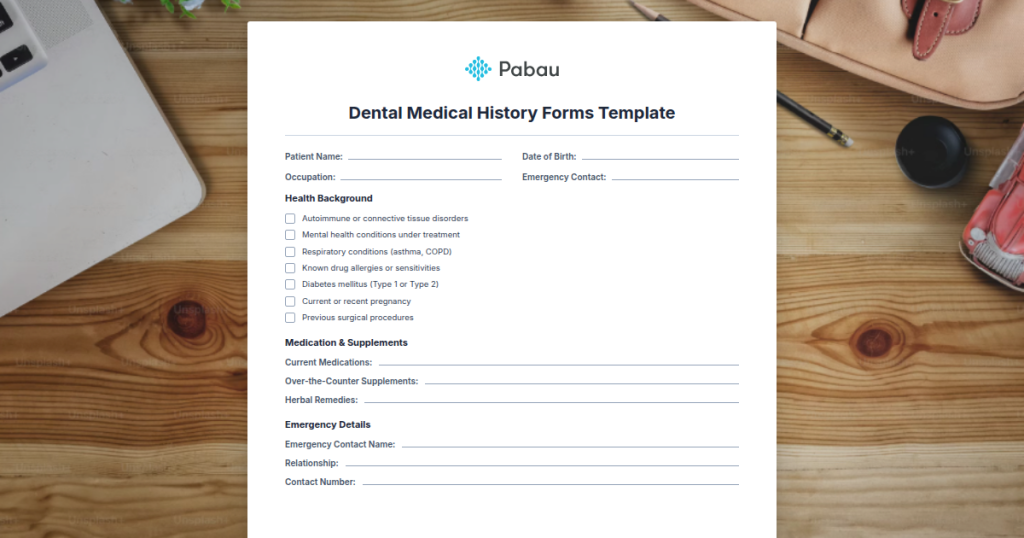
Dental Medical History Forms Template
A dental medical history form template is a standardised patient intake document...

March 16, 2026


Buy now, pay later is now available in Pabau

Comprehensive treatment documentation ensures regulatory compliance and patient safety
Digital HydraFacial treatment records streamline clinic workflows and reduce paperwork
Pre-treatment screening prevents complications and protects against liability claims
Organised records support continuity of care and enable data-driven treatment planning
Aesthetic practitioners performing HydraFacial treatments face a critical documentation challenge. Every treatment requires systematic recording of patient medical history, treatment parameters, skin reactions, and outcomes. A well-designed hydrafacial treatment record becomes the clinical foundation for safe practice, regulatory compliance, and measurable client results. Without structured documentation, clinics risk missing contraindications, failing to track treatment efficacy, and exposing themselves to liability disputes.
The hydrafacial treatment record template bridges this gap by providing a comprehensive, clinic-ready form that captures every essential data point before, during, and after treatment. From medical history screening to sensory testing and skin reaction assessment, the template ensures estheticians and aesthetic practitioners document HydraFacial treatments consistently and thoroughly. This guide walks through what the template covers, how to implement it in your workflow, and how structured treatment documentation transforms your clinic’s compliance posture and client safety protocols.
A ready-to-use documentation template covering patient details, medical history screening, treatment parameters including anaesthetic type and duration, sensory testing results, skin reactions assessment (erythema and blood spots), and post-treatment verification. Designed for estheticians, aesthetic nurses, and medical spa teams performing HydraFacial treatments.
Download template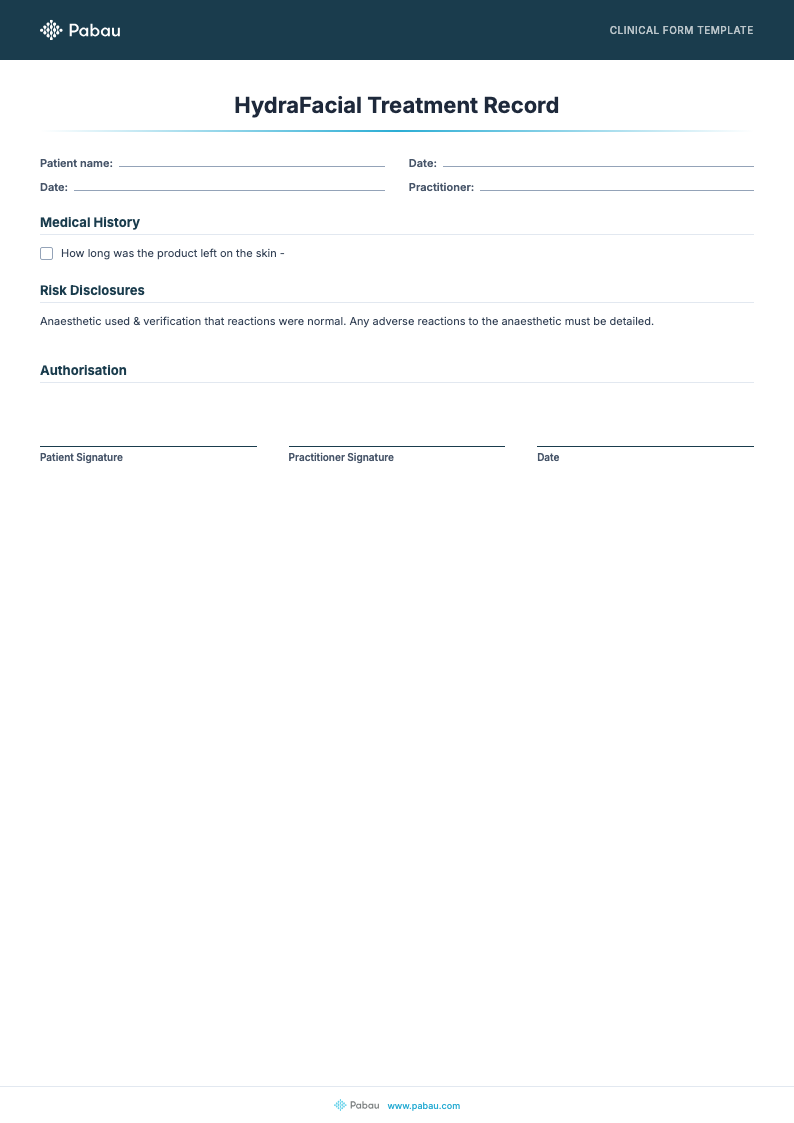
A hydrafacial treatment record is a clinical documentation form that captures comprehensive treatment details for HydraFacial procedures performed in aesthetic clinics, medical spas, and dermatology practices. The form documents patient medical history, treatment parameters, observed skin reactions, and treatment outcomes in a structured format, creating a permanent clinical record that supports evidence-based practice and patient safety.
The record serves three critical functions. First, it screens for contraindications before treatment by capturing relevant medical history and allergies. Second, it documents the treatment itself-anaesthetic used, application duration, needle lengths selected, and sensory testing results. Third, it records observable skin reactions (erythema severity, blood spots, distribution patterns) and client verification that they’re satisfied with outcomes and understand aftercare requirements. This three-part structure transforms HydraFacial treatment into a measurable, repeatable clinical process rather than an undocumented service.
From a regulatory standpoint, a properly completed hydrafacial treatment record demonstrates professional standard of care, which is fundamental to defending against patient complaints or liability claims. State cosmetology boards, medical board oversight bodies, and professional liability insurers expect aesthetic practitioners to maintain detailed treatment records. The form also supports continuity of care-if a client returns three months later, the original record allows the practitioner to compare skin improvements, adjust treatment parameters, and provide personalised recommendations based on actual treatment history rather than memory.
Additionally, aggregating treatment records enables clinics to identify patterns in treatment efficacy, client satisfaction, and adverse reactions. This data supports informed decision-making about which treatment protocols work best for specific skin types, justifies service pricing based on documented value, and enables evidence-based client consultation. For skin clinic teams, maintaining structured aesthetic treatment records is as foundational as maintaining medical records in any clinical setting.
Implementing the hydrafacial treatment record into your clinic workflow follows a five-step process that fits naturally into your appointment timeline. Each step ensures you capture required documentation while keeping the process efficient for both practitioners and clients.
Clinics using digital forms and unified client records can streamline this entire process by auto-populating patient name, appointment date, and medical history from previous visits, then archiving the completed form directly in the patient’s record with a single click.

Discover how Pabau's digital forms and client records transform aesthetic treatment workflows, reducing paperwork while improving compliance and treatment consistency.

The hydrafacial treatment record is designed for any aesthetic or medical practice offering HydraFacial treatments. This includes medical spas, aesthetic clinics, dermatology practices, and skin clinics where estheticians, aesthetic nurses, licensed aestheticians, and dermatologists perform hydrafacial procedures.
Medical spas and multi-practitioner aesthetic clinics benefit most immediately. These settings often have multiple estheticians rotating through HydraFacial appointments, making standardised documentation critical for consistency. When one practitioner’s treatment notes differ vastly from another’s, clients notice inconsistency and may assume varying quality. A unified treatment record template ensures every HydraFacial client receives the same documentation standard, making follow-up appointments seamless and demonstrating professional consistency to clients. Medical spa software solutions now integrate these templates directly, eliminating manual filing.
Solo esthetician practitioners gain accountability and measurability. A solo practice might think detailed treatment documentation is unnecessary-“I remember my clients’ reactions and treatment outcomes.” However, maintaining systematic records allows estheticians to track which needle lengths work best for specific skin types, whether clients typically report satisfaction with different anaesthetic brands, and which aftercare instructions prevent side effects. This data transforms intuition into evidence-based practice.
Dermatology-led aesthetic clinics rely on treatment records for clinical governance and staff supervision. Dermatologists oversee esthetician-led HydraFacial treatments and require documented evidence that screening and treatment protocols are followed correctly. A structured treatment record simplifies auditing and demonstrates compliance during CQC inspections or professional liability reviews.
Franchised and chain medical spas require standardised documentation across multiple locations. Franchise partners expect consistency, and corporate oversight demands proof that treatment protocols are identical in every clinic. A single HydraFacial treatment record template rolled out across all locations ensures compliance and supports quality assurance across the network.
Legal and regulatory protection. A completed hydrafacial treatment record demonstrates that you followed standard-of-care protocols and obtained informed consent before treatment. If a client later claims they didn’t know about a potential side effect or alleges improper technique, the signed treatment record proves you documented their understanding and medical clearance. Professional liability insurers specifically expect aesthetic practitioners to maintain detailed treatment records; clinics without them face premium increases or coverage denials.
Continuity of care. When a client returns three months later for a second HydraFacial, the original treatment record provides essential context. You can review which anaesthetic worked best, whether they experienced any sensitivity, what skin reactions they had, and how they responded to aftercare. This allows you to personalise the second treatment based on actual history, not assumptions. Clients appreciate practitioners who remember treatment details and adjust the protocol accordingly.
Consistent quality and reduced errors. Standardised documentation ensures every HydraFacial client is treated with the same protocol checklist. You can’t forget to ask about contraindications or skip sensory testing if the form prompts you for every step. This eliminates the risk of undocumented deviations and ensures clients receive equivalent service quality regardless of which esthetician they see. Consultation form templates aligned with treatment records further reduce deviation.
Data-driven treatment planning. Aggregating treatment records reveals patterns in client outcomes. You can analyse which needle settings produce the best results for different skin types, identify which clients experience excessive erythema (suggesting they may need modified protocols in future), and demonstrate measurable value to clients comparing before-and-after skin reactions across visits. This transforms HydraFacial from an intuitive service into an evidence-based treatment.
Audit readiness and compliance confidence. Care Quality Commission (CQC) inspections and professional licensing reviews both examine whether practices maintain adequate treatment records. A well-organised system of hydrafacial treatment records puts you in a position of strength during these reviews, demonstrating professional governance and client safety commitment. Compliance frameworks and GDPR guidance ensure your records meet data protection standards.
Separate your HydraFacial treatment records by treatment date and practitioner. Run a monthly audit: check 10% of completed forms for missing signatures, incomplete sensory test results, or illegible handwriting. Flag incomplete records immediately and ask the esthetician to complete them before the client’s next appointment. This 15-minute monthly task catches documentation gaps early, preventing compliance issues during reviews and ensuring your record system remains audit-ready.
Effective pre-treatment screening is the first line of defence against adverse outcomes and contraindication-related complications. Your hydrafacial treatment record should capture specific medical history items that influence treatment safety and efficacy.
Absolute contraindications to clarify. Ask about active skin infections (herpes simplex, impetigo, severe acne with pustules), isotretinoin use within the past 12 months, and recent invasive skin procedures (laser ablation, chemical peels, microdermabrasion within the past two weeks). Clients with these conditions should not receive HydraFacial treatment until they meet safety criteria. Document your clinical reasoning if a client has a relative contraindication but you proceed anyway.
Allergy history. The treatment record should capture anaesthetic allergies with specificity. Don’t just ask “Do you have any allergies?” Instead, ask: “Have you had a reaction to local anaesthetics like lidocaine? Have you experienced unexpected redness, swelling, or itching after previous aesthetic treatments?” This targeted questioning reveals true anaesthetic sensitivities versus general medication allergies that may not affect topical anaesthetics. Facial consultation forms provide templates for asking these screening questions consistently.
Recent sun exposure and photosensitising medications. Clients who’ve been in intense sun within the past week, or who take photosensitising medications (certain antibiotics, NSAIDs, retinoids), may experience excessive erythema or post-inflammatory hyperpigmentation after HydraFacial. Ask about these factors and consider postponing treatment or using modified parameters if risk factors are high.
Skin expectations and prior experiences. Ask if the client has had facials or skin treatments before, and what results they expect from HydraFacial. Clients with unrealistic expectations (expecting permanent smoothing from one treatment, or expecting results visible immediately after treatment) benefit from reset conversations documented in the record. This prevents post-treatment disappointment and positions follow-up treatments appropriately.
Accurate documentation of observable skin reactions creates measurable, comparable data across repeat treatments and supports safety monitoring. Your hydrafacial treatment record should capture reaction severity, distribution, and client perception in standardised language.
Erythema grading. The standard approach uses a three-tier severity scale: mild (light pink flush that resolves in 1-2 hours), moderate (visible redness lasting 2-4 hours), and severe (deep red, persisting beyond 4 hours or spreading beyond the treatment area). On your record, note both severity and distribution: “Mild, even across cheeks and forehead” or “Moderate, scattered on chin and jawline.” This specificity helps you compare patterns across clients and identify whether certain needle lengths or anaesthetic combinations predictably cause stronger reactions.
Blood spots and petechiae. Record whether blood spots appeared during or after treatment, their severity (scattered vs. dense, single areas vs. multiple), and whether they resolved immediately or persisted. Blood spots indicate the treatment reached appropriate depth to stimulate collagen, but excessive spots may suggest the client has clotting sensitivities or that your technique needs adjustment. Document this for comparison at future visits. Proper before and after photo documentation paired with treatment records creates visual evidence of aesthetic treatment records outcomes.
Client satisfaction and aftercare understanding. Before the client leaves, ask directly: “Are you happy with how your skin feels and looks immediately after treatment?” Document their response verbatim or tick a satisfaction scale. Also confirm they understand aftercare-no makeup for 4 hours, avoid direct sun for 24 hours, use gentle cleanser-and note whether you provided written aftercare instructions. This closes the documentation loop and creates evidence that you set correct expectations.
Adverse reactions. If a client experiences unexpected reactions (excessive swelling, allergic-like response, delayed rash), document the timeline, symptoms, actions taken, and outcome in your record. This creates a safety incident log that protects you if the client later claims you were negligent or didn’t respond appropriately. Detailed adverse reaction documentation also identifies patterns-for example, if three clients react badly to a new anaesthetic brand, you can discontinue that product before causing more harm.

Need to ensure proper client consent and understanding? HydraFacial Consent Form Guide provides detailed consent principles and templates for aesthetic practitioners looking to strengthen informed consent workflows.
Want to capture before-and-after treatment photos systematically? Before and After Photo Documentation explains how integrating visual records with treatment documentation creates a complete clinical audit trail.
Looking to digitalise all intake and consent forms? Digital Forms for Aesthetic Practices explores how digital intake and consent forms reduce paperwork while improving compliance and data accessibility.
A well-designed hydrafacial treatment record transforms how aesthetic clinics approach client safety, regulatory compliance, and treatment effectiveness. By systematically capturing medical history, treatment parameters, skin reactions, and client satisfaction, you move from intuitive aesthetic practice to evidence-based treatment protocols that deliver measurable value to clients and credibility to regulators.
Implementation is straightforward. Start by distributing the template to clients 24-48 hours before their appointment, use it to guide your treatment workflow, and file the completed record immediately after the procedure. Within a few weeks, you’ll notice improved consistency across practitioner teams, better continuity between client visits, and the confidence that comes from knowing every HydraFacial treatment is documented to professional standards.
Clinics that prioritise treatment documentation stand apart during regulatory reviews, instil greater confidence in clients, and create a data-driven foundation for service expansion and pricing strategy. In the competitive aesthetic market, systematic hydrafacial treatment records aren’t just compliance-they’re a competitive advantage that demonstrates your commitment to clinical excellence.
HydraFacial is generally painless. Most clients report a gentle suction sensation and slight tingling from the serum application. Your hydrafacial treatment record documents the anaesthetic used and whether sensory testing felt comfortable to the client. If a client reports unexpected pain during treatment, note this in the record-it may indicate they need a different protocol in future appointments.
A standard HydraFacial treatment typically takes 30-45 minutes depending on the selected protocol (Basic, Deluxe, or Platinum). Your treatment record should document the actual treatment duration and time the anaesthetic was applied, creating a data point for future appointment scheduling and outcome correlation.
HydraFacial is designed to be safe for all skin types when performed by trained practitioners using appropriate protocols. However, clients with darker skin tones may experience post-inflammatory hyperpigmentation if they have recent sun exposure or are prone to dyschromia. Your hydrafacial treatment record captures skin type, sun exposure history, and post-treatment reactions, allowing you to flag clients who may need modified protocols or extended healing time.
A comprehensive hydrafacial treatment record should capture: client name and date, medical history (allergies, contraindications, recent procedures), anaesthetic type and application duration, sensory test results, needle lengths used, observable skin reactions (erythema and blood spot severity), client satisfaction verification, and practitioner name or initials. Your record becomes the clinical evidence that safe, documented treatment occurred.
Most practitioners recommend avoiding makeup for 4 hours post-treatment to allow skin to fully settle and anaesthetic to wear off completely. Your hydrafacial treatment record should document the specific aftercare instructions you provided to the client, creating a reference point if they contact you later with questions about post-treatment timeline.
Treatment records must be stored securely in compliance with data protection regulations (GDPR in the UK, HIPAA in the US). Paper records should be filed in locked cabinets with restricted staff access. Digital records must be encrypted and backed up regularly. Your storage system should allow you to retrieve a specific client’s treatment history within seconds, and to run aggregated reports across all records for quality assurance and outcome analysis.