Uncategorized
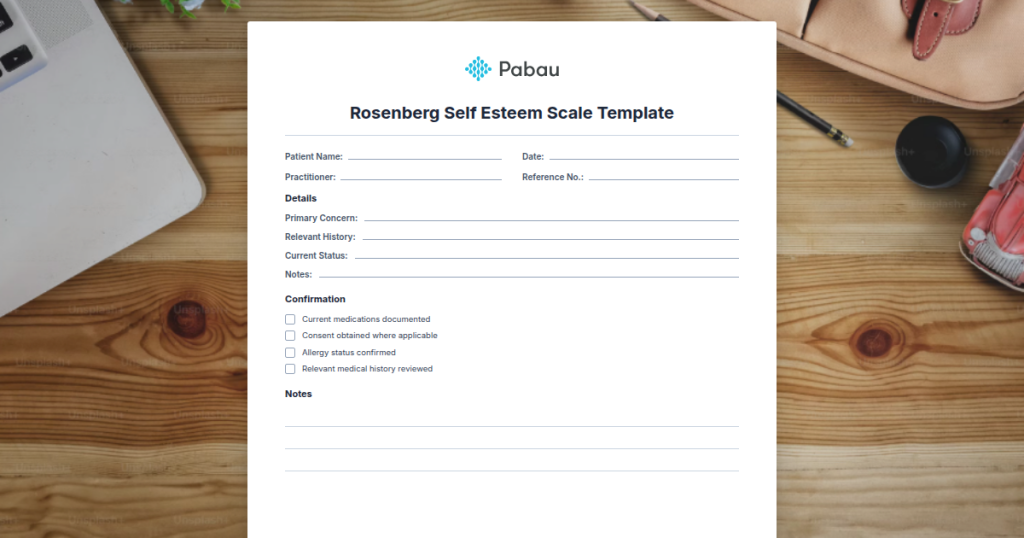
Rosenberg Self Esteem Scale Template
The Rosenberg Self Esteem Scale Template is an essential assessment tool for men...

March 4, 2026

Discover free eBooks, guides and med spa templates on our new resources page


Buy now, pay later is now available in Pabau

Read case studies from our satisfied clients

Compare Pabau with alternative systems
 Integrations
 Measure Pabau savings
  Our security commitment
  About us
Learn why this holistic care and aesthetic medicine clinic chose Pabau to power patient care and performance.
Read more

The Rosenberg Self-Esteem Scale is a validated 10-item assessment measuring global self-worth, widely used in mental health clinical practice
Free downloadable template available in PDF format, ready for immediate use with patients in clinical settings
Scoring uses a 4-point Likert scale with reverse-scored items; total scores range from 0-30 indicating self-esteem levels
Strong psychometric properties with test-retest correlations of 0.82-0.88 and Cronbach’s alpha of 0.77-0.88 across diverse populations
The Rosenberg Self Esteem Scale Template is an essential assessment tool for mental health professionals. Originally developed by sociologist Morris Rosenberg in 1965, this 10-item scale measures global self-worth and self-acceptance. It remains one of the most widely used psychological instruments in clinical practice, research settings, and therapeutic interventions across diverse populations.
The Rosenberg Self Esteem Scale Template is a standardized, brief assessment designed to evaluate how individuals perceive their overall self-worth. The scale asks respondents to rate agreement with 10 statements using a 4-point Likert scale ranging from “Strongly Disagree” to “Strongly Agree.” Five items are positively worded, while five are negatively worded (reverse-scored). This balanced approach reduces response bias and provides reliable measurement of self-esteem across clinical populations.
Therapists, counselors, psychologists, and other mental health practitioners use this template during intake assessments, ongoing treatment monitoring, and outcome measurement. The scale is particularly valuable for clients presenting with depression, anxiety, relationship difficulties, or self-confidence concerns. Mental health EMR systems often integrate assessment tools like this to streamline documentation and track progress systematically.
Access the complete Rosenberg Self Esteem Scale Template immediately. This ready-to-use PDF template includes all 10 assessment items, scoring instructions, and interpretation guidelines formatted for clinical use.
Standardized template for measuring global self-worth in clinical settings. Includes all scale items, scoring guidance, and interpretation framework.
The Rosenberg Self Esteem Scale Template consists of these 10 statements:
Items 3, 5, 8, 9, and 10 require reverse-scoring before calculating the total. This balanced structure ensures accurate measurement and reduces acquiescence bias common in single-direction scales.
Scoring the Rosenberg Self Esteem Scale Template is straightforward. Respondents indicate their level of agreement on a 4-point scale: 1 (Strongly Disagree), 2 (Disagree), 3 (Agree), and 4 (Strongly Agree). For the five reverse-scored items (3, 5, 8, 9, 10), flip the scoring so that “Strongly Agree” becomes 1 point and “Strongly Disagree” becomes 4 points. Sum all 10 items to obtain a total score ranging from 0-30.
Document raw scores and interpretation in patient charts. Many measurement tracking software solutions automate this calculation, reducing transcription errors and improving clinical documentation efficiency.
Midway through your assessment implementation, consider how your practice management system will support ongoing measurement tracking. Book a demo to see how integrated assessment tools streamline patient outcomes monitoring and improve clinical decision-making.
Score interpretation guides treatment planning and therapeutic focus. A score below 15 indicates low self-esteem warranting targeted interventions such as cognitive-behavioral therapy, schema therapy, or other evidence-based approaches. Scores between 15-25 represent normal self-esteem range common in general populations. Elevated scores above 25 may indicate healthy self-regard or, in some cases, defensive self-enhancement.
Serial administration of the Rosenberg Self Esteem Scale Template at treatment intervals provides objective progress measurement. This practice aligns with evidence-based therapy practice management standards emphasizing measurement-based care and client outcome tracking.
The Rosenberg Self Esteem Scale demonstrates strong psychometric properties. Test-retest correlations range from 0.82 to 0.88 across various populations, indicating excellent temporal stability. Cronbach’s alpha values span 0.77 to 0.88, confirming internal consistency and reliable measurement of a single construct (global self-worth). These metrics support the Rosenberg Self Esteem Scale Template as a validated instrument meeting professional standards for clinical assessment.
Research from the University of Maryland Sociology Department provides comprehensive validation evidence. The scale has been translated into numerous languages and validated across diverse cultural groups, making it appropriate for multicultural clinical settings.
Use the Rosenberg Self Esteem Scale Template during initial intake assessment to establish baseline self-esteem levels. Readminister at regular intervals (monthly, quarterly, or as clinically indicated) to monitor treatment progress and inform intervention adjustments. The brief 10-item format requires minimal administration time, typically 2-3 minutes, making it practical for busy clinical settings.
The scale is appropriate for adolescents and adults. It works particularly well for clients presenting with depression, anxiety disorders, relationship concerns, and self-concept difficulties. Comprehensive client management systems enable practitioners to track assessments alongside clinical notes, creating integrated outcome monitoring.
Administer the Rosenberg Self Esteem Scale Template in a confidential, comfortable setting where clients feel safe responding honestly. Provide clear instructions explaining that there are no “right” or “wrong” answers and that responses are confidential. Allow sufficient time for thoughtful completion without pressure. Consider administering the scale before other assessments to minimize fatigue effects.
Discuss results therapeutically, using scores to guide conversation about self-perception, specific domains of self-worth concern, and treatment goals. Normalize that self-esteem fluctuates and that therapy can address underlying beliefs and patterns contributing to low self-regard.
The Rosenberg Self Esteem Scale Template consists of these 10 statements:
Items 3, 5, 8, 9, and 10 require reverse-scoring before calculating the total. This balanced structure ensures accurate measurement and reduces acquiescence bias common in single-direction scales.
Scoring the Rosenberg Self Esteem Scale Template is straightforward. Respondents indicate their level of agreement on a 4-point scale: 1 (Strongly Disagree), 2 (Disagree), 3 (Agree), and 4 (Strongly Agree). For the five reverse-scored items (3, 5, 8, 9, 10), flip the scoring so that “Strongly Agree” becomes 1 point and “Strongly Disagree” becomes 4 points. Sum all 10 items to obtain a total score ranging from 0-30.
Document raw scores and interpretation in patient charts. Many measurement tracking software solutions automate this calculation, reducing transcription errors and improving clinical documentation efficiency.
Midway through your assessment implementation, consider how your practice management system will support ongoing measurement tracking. Book a demo to see how integrated assessment tools streamline patient outcomes monitoring and improve clinical decision-making.
Score interpretation guides treatment planning and therapeutic focus. A score below 15 indicates low self-esteem warranting targeted interventions such as cognitive-behavioral therapy, schema therapy, or other evidence-based approaches. Scores between 15-25 represent normal self-esteem range common in general populations. Elevated scores above 25 may indicate healthy self-regard or, in some cases, defensive self-enhancement.
Serial administration of the Rosenberg Self Esteem Scale Template at treatment intervals provides objective progress measurement. This practice aligns with evidence-based therapy practice management standards emphasizing measurement-based care and client outcome tracking.
The Rosenberg Self Esteem Scale demonstrates strong psychometric properties. Test-retest correlations range from 0.82 to 0.88 across various populations, indicating excellent temporal stability. Cronbach’s alpha values span 0.77 to 0.88, confirming internal consistency and reliable measurement of a single construct (global self-worth). These metrics support the Rosenberg Self Esteem Scale Template as a validated instrument meeting professional standards for clinical assessment.
Research from the University of Maryland Sociology Department provides comprehensive validation evidence. The scale has been translated into numerous languages and validated across diverse cultural groups, making it appropriate for multicultural clinical settings.
Use the Rosenberg Self Esteem Scale Template during initial intake assessment to establish baseline self-esteem levels. Readminister at regular intervals (monthly, quarterly, or as clinically indicated) to monitor treatment progress and inform intervention adjustments. The brief 10-item format requires minimal administration time, typically 2-3 minutes, making it practical for busy clinical settings.
The scale is appropriate for adolescents and adults. It works particularly well for clients presenting with depression, anxiety disorders, relationship concerns, and self-concept difficulties. Comprehensive client management systems enable practitioners to track assessments alongside clinical notes, creating integrated outcome monitoring.
Administer the Rosenberg Self Esteem Scale Template in a confidential, comfortable setting where clients feel safe responding honestly. Provide clear instructions explaining that there are no “right” or “wrong” answers and that responses are confidential. Allow sufficient time for thoughtful completion without pressure. Consider administering the scale before other assessments to minimize fatigue effects.
Discuss results therapeutically, using scores to guide conversation about self-perception, specific domains of self-worth concern, and treatment goals. Normalize that self-esteem fluctuates and that therapy can address underlying beliefs and patterns contributing to low self-regard.
The original scale is in the public domain and may be used without explicit permission. Minor formatting adjustments for your practice are acceptable, though altering item wording or content is not recommended as it compromises validity.
Administration frequency depends on clinical context. During initial treatment phases for depression or anxiety, monthly administration is common. For ongoing monitoring, quarterly administration is typical. Adjust based on treatment intensity and client needs.
Yes. The scale has been validated for use with adolescents age 12 and above. It remains one of the most widely used self-esteem measures in youth mental health research and clinical practice.
A score below 15 indicates low self-esteem warranting clinical attention. Conduct further assessment exploring specific domains of self-worth concern, depressive symptoms, and suicidal ideation as clinically appropriate. Implement targeted interventions addressing underlying cognitions and self-concept patterns.
Implementing the Rosenberg Self Esteem Scale Template within a comprehensive digital forms system streamlines administration, scoring, and documentation while maintaining HIPAA compliance and clinical security standards essential in modern mental health practice.