Uncategorized
Chest Pain Location Charts Template
Chest pain assessment is one of the most critical diagnostic challenges in healt...

March 4, 2026

Discover free eBooks, guides and med spa templates on our new resources page


Buy now, pay later is now available in Pabau

Read case studies from our satisfied clients

Compare Pabau with alternative systems
 Integrations
 Measure Pabau savings
  Our security commitment
  About us
Learn why this holistic care and aesthetic medicine clinic chose Pabau to power patient care and performance.
Read more
Chest pain assessment is one of the most critical diagnostic challenges in healthcare. A Chest Pain Location Charts Template provides clinicians with a standardized, visual tool to document and evaluate patient symptoms systematically. This downloadable resource helps practitioners map pain patterns, differentiate cardiac from non-cardiac causes, and improve clinical decision-making across primary care, emergency medicine, and specialty practices.

Chest Pain Location Charts Templates provide standardized visual mapping tools for accurate symptom documentation
These templates help distinguish between cardiac, musculoskeletal, pulmonary, and gastrointestinal pain patterns
Ready-to-use templates improve assessment speed and enable better patient communication during consultations
Integration with digital forms and EHR systems streamlines clinical workflows and reduces manual charting time
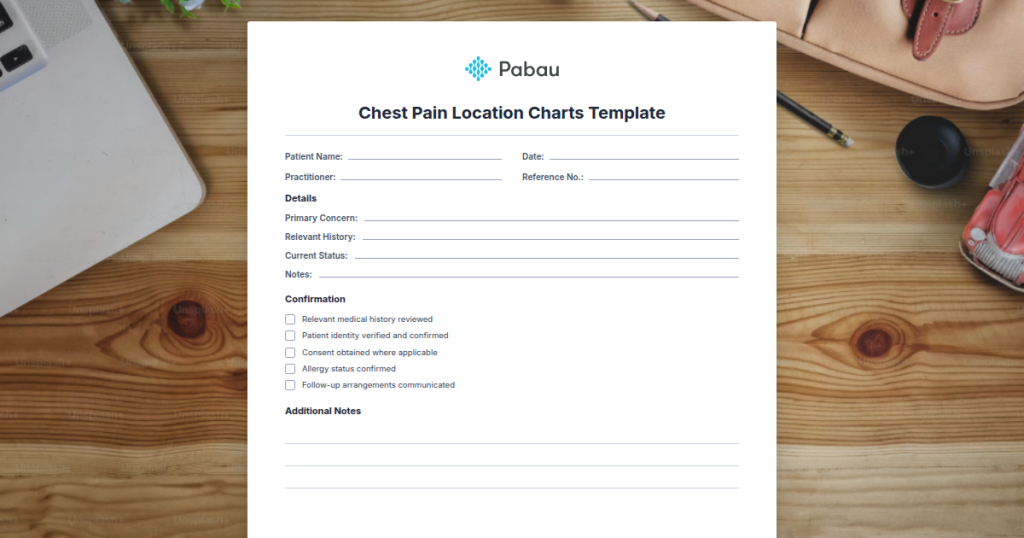
A Chest Pain Location Charts Template is a diagnostic assessment form featuring anatomical diagrams of the chest from anterior and posterior views. The template enables clinicians to mark the exact location where a patient experiences discomfort, record pain intensity using standardized scales, and document associated characteristics such as radiation patterns, quality descriptors, and timing.
The template typically includes sections for pain intensity scales, quality descriptors (sharp, dull, pressure, burning), radiation indicators, duration fields, and a comprehensive checklist of associated symptoms. This structured approach transforms subjective patient reports into objective clinical data that supports diagnostic accuracy. Organizations like the American Heart Association emphasize the importance of systematic pain assessment in cardiac evaluation protocols.
Implementing a Chest Pain Location Charts Template into your clinical workflow delivers multiple benefits. First, it standardizes documentation across your practice, ensuring consistency regardless of which clinician completes the assessment. Second, it accelerates the evaluation process by providing a visual checklist, reducing time spent on manual note-taking during patient consultations.
The template also enhances diagnostic accuracy by prompting clinicians to systematically evaluate pain location, radiation patterns, and associated symptoms. Patients benefit from clearer communication, as they can visually indicate their symptoms rather than relying solely on verbal description. This is particularly valuable in high-pressure settings like emergency departments where rapid, accurate assessment is critical.
Ready-to-use templates eliminate the need for custom form development, saving administrative time and enabling immediate implementation. Many practices find that a Chest Pain Location Charts Template reduces documentation errors and improves chart completeness, both essential for compliance and quality measurement.
A comprehensive Chest Pain Location Charts Template should include the following essential elements:
Optional advanced features include sections for risk factor assessment, medication history, and space for clinical interpretation notes. Digital form versions can integrate with electronic health records, automatically populating patient data and enabling seamless clinical workflow integration.
Implementing a Chest Pain Location Charts Template requires minimal training. During patient intake, present the template and ask the patient to indicate their pain location on the anatomical diagram. Have them mark the primary area of discomfort using a specific marking method (circle, X, shading).
Next, guide the patient through the associated sections: pain intensity rating, quality descriptors, and radiation patterns. Document the timing of symptom onset and any triggering or relieving factors. Complete the associated symptoms checklist by asking targeted questions about breathing difficulty, sweating, nausea, or chest wall tenderness.
Once completed, the template provides a visual summary of the patient’s presentation that supports your clinical assessment. Use this information alongside vital signs, physical examination findings, and any diagnostic testing to develop your differential diagnosis. Patient record systems allow you to store completed templates digitally alongside other clinical documentation.
A key advantage of using a Chest Pain Location Charts Template is the ability to recognize clinically meaningful pain patterns. Cardiac pain typically presents as central chest discomfort that may radiate to the left arm, shoulder, or jaw. It is often described as pressure, heaviness, or tightness rather than sharp pain.
Musculoskeletal pain, by contrast, tends to be localized to specific chest wall areas and often reproduces with palpation or specific movements. Pleuritic pain is typically sharp and worsens with deep breathing. Gastrointestinal referred pain often presents in the epigastric or left upper quadrant region. The visual mapping provided by the Chest Pain Location Charts Template helps clinicians quickly identify these patterns and narrow their differential diagnosis.
Ready to streamline your chest pain assessment process? Download our professionally designed Chest Pain Location Charts Template in PDF and editable formats. The template is ready to print or customize with your clinic branding, making it ideal for solo practitioners, group practices, and healthcare systems alike.
The template supports multiple languages and integrates seamlessly with most practice management platforms. Whether you use paper charts or digital documentation, this Chest Pain Location Charts Template adapts to your workflow.
Effective chest pain documentation requires more than simply completing the form. Always use the template as a starting point for comprehensive assessment. Document the patient’s description in their own words alongside the visual representation. Include relevant risk factors (smoking, family history, prior cardiac events) and current medications.
Add clinical pearl observations such as whether pain reproduces with chest wall palpation or positional changes. Note vital signs and any physical examination findings relevant to your differential diagnosis. A completed Chest Pain Location Charts Template combined with thorough narrative documentation creates a clear clinical record that supports continuity of care and protects against liability.
Consider scheduling a demo of practice management software that integrates chest pain documentation tools with your existing clinical workflows. Many platforms offer customizable form builders that allow you to modify templates to match your specific protocols and patient population needs.
Successful integration of a Chest Pain Location Charts Template depends on consistent use across your team. Distribute copies to front desk staff, nurses, and clinicians. Train all staff on proper completion, emphasizing the importance of having patients complete the visual component themselves rather than clinician interpretation.
For practices using electronic health records, establish protocols for template scanning or digital form completion. Create a standardized location in each patient record where the completed chart is stored, enabling quick retrieval during follow-up visits or referrals. Client management systems facilitate this organization and improve clinical decision-making.
Review completed templates regularly to identify trends in your patient population’s presentation patterns. This data can inform quality improvement initiatives and staff training programs. Practices that systematically use a Chest Pain Location Charts Template consistently report improved documentation quality and faster diagnostic workup times.
A Chest Pain Location Charts Template assists in evaluating myocardial infarction, angina, musculoskeletal chest pain, pulmonary conditions, gastrointestinal referred pain, and pericarditis. While not diagnostic on its own, the template provides crucial information that supports your clinical assessment alongside laboratory and imaging findings.
Yes. Most downloadable templates are available in editable formats that allow you to add your clinic logo, modify field names, adjust language, or add specialized questions relevant to your patient population. Some practice management platforms enable template customization directly within the software.
A properly designed template supports regulatory compliance by standardizing documentation and ensuring complete capture of relevant clinical information. When used with HIPAA-compliant systems, it protects patient privacy and enables secure record management.
Visual assessment tools like a Chest Pain Location Charts Template enable patients to graphically indicate their symptoms, reducing ambiguity in communication. This visual representation helps clinicians and patients reach shared understanding of the problem and improves the quality of the clinical encounter.
Conclusion: A Chest Pain Location Charts Template is an evidence-based tool that transforms subjective patient descriptions into objective clinical data. By implementing this standardized assessment approach, healthcare practitioners improve diagnostic accuracy, enhance patient communication, and streamline documentation workflows. Download your free template today and experience faster, more confident chest pain evaluations across your practice.