Primary & Preventive Care Wellness
Small Bowel Obstruction Nursing Care Plan Template
A comprehensive small bowel obstruction nursing care plan template provides stru...

March 13, 2026

Discover free eBooks, guides and med spa templates on our new resources page


Buy now, pay later is now available in Pabau

Read case studies from our satisfied clients

Compare Pabau with alternative systems
 Integrations
 Measure Pabau savings
  Our security commitment
  About us
Learn why this holistic care and aesthetic medicine clinic chose Pabau to power patient care and performance.
Read more

RCM spans patient registration through final payment collection
Clean claim rates directly impact practice cash flow
Automation reduces manual errors in billing workflows
Denial management requires systematic root-cause analysis
Integration between clinical and financial systems matters
Healthcare revenue cycle management coordinates every financial touchpoint in patient care delivery. From the moment a patient schedules an appointment to the day their account balance reaches zero, each interaction either accelerates or delays revenue realisation for your practice.
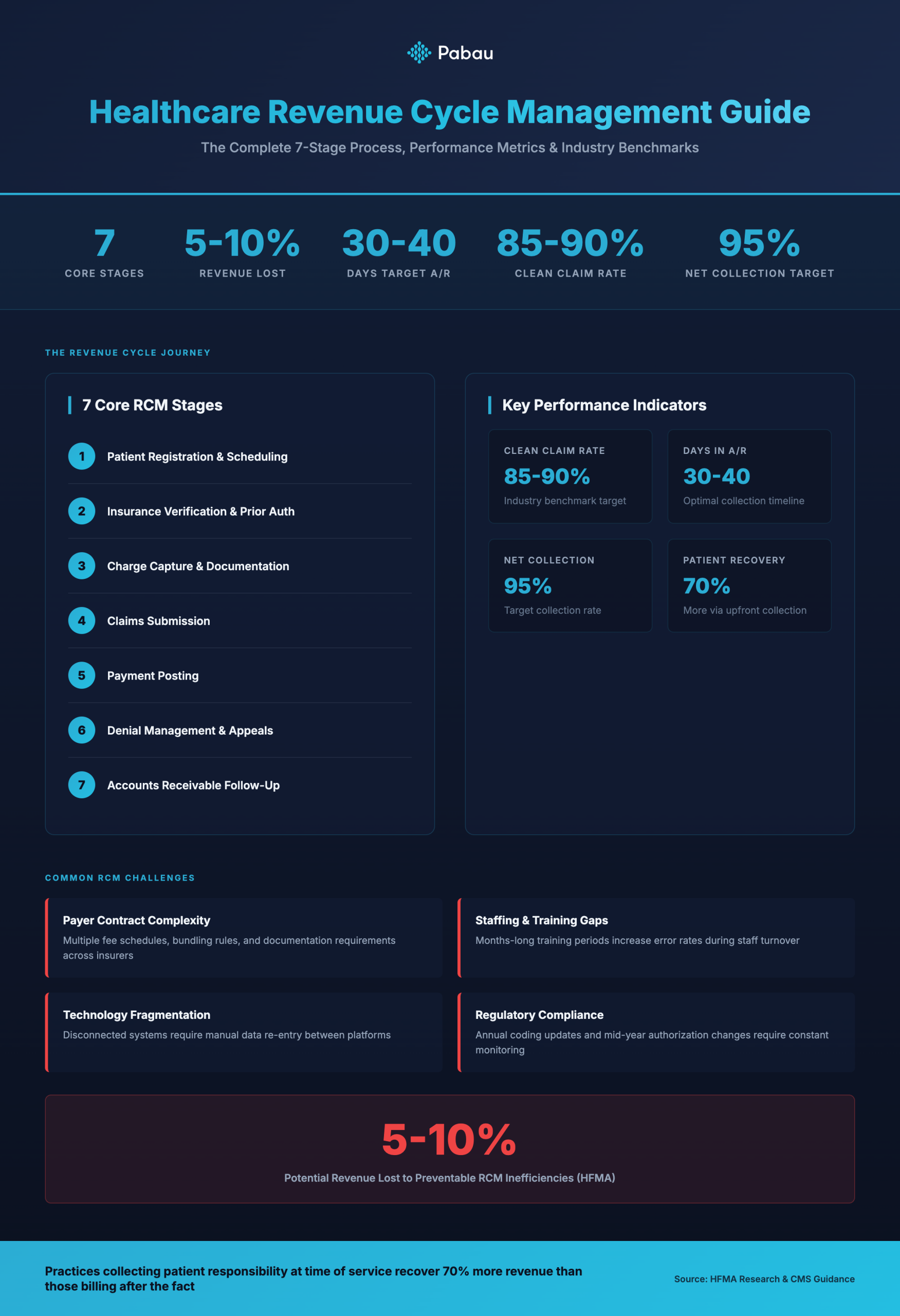
Most clinics treat billing as an afterthought. Claims get submitted weeks after service delivery. Denials pile up without investigation. Patient balances age into write-offs. According to the Healthcare Financial Management Association (HFMA), practices lose 5-10% of potential revenue to preventable cycle inefficiencies. That percentage compounds when manual processes dominate workflows and clinical staff double as billing coordinators.
Revenue cycle management in healthcare refers to the administrative and clinical functions that capture, manage, and collect patient service revenue. It begins when a patient first contacts your practice and ends when all services are paid-either by insurance carriers or the patient directly.
The cycle encompasses patient registration, insurance verification, charge capture, claims submission, payment posting, and accounts receivable follow-up. Each stage depends on accurate data from the previous one. An error in eligibility verification cascades into claim denials. Incomplete documentation delays charge capture. Missed coding updates trigger payer rejections.
Unlike traditional retail transactions, healthcare revenue cycles operate with payment uncertainty. You deliver services before confirming coverage. Payers adjudicate claims weeks after submission. Patients receive bills months post-treatment. This lag creates operational complexity that doesn’t exist in industries with point-of-sale payment.
Private practices and multi-location clinics face distinct RCM pressures. Solo practitioners often handle billing alongside clinical work. Enterprise groups negotiate contracts with dozens of payers simultaneously. Claims management software helps standardise workflows across both models, but the underlying process stages remain constant.
Revenue cycle management unfolds across interconnected stages. Each one generates data that feeds downstream processes. Breaking the cycle into discrete steps reveals where inefficiencies hide.
Registration captures demographic and insurance information before service delivery. Front desk staff verify patient identity, update contact details, and record insurance policy numbers. Incomplete or inaccurate data at this stage propagates through every subsequent step.
Clinics using online booking systems collect patient information digitally before appointments. This reduces transcription errors and gives billing teams clean data from the start. Manual intake forms introduce spelling mistakes, transposed digits, and illegible handwriting that delay claim processing.
Verification confirms active coverage and identifies patient financial responsibility. Staff contact payers directly or query electronic eligibility systems. This step reveals co-pays, deductibles, and coverage limits before services are rendered.
Prior authorisation applies when payers require approval for specific procedures. Failing to secure authorisation before treatment guarantees claim denial. Some specialties-particularly those involving imaging, surgery, or high-cost medications-face authorisation requirements for the majority of services. According to CMS guidance, authorisation timelines vary by payer and procedure urgency, creating administrative overhead that clinical staff must navigate.
Charge capture translates clinical services into billable codes. Providers document diagnoses and procedures in the patient record. Billing staff assign corresponding CPT and ICD codes. Undercoding leaves revenue on the table. Overcoding triggers audits and compliance penalties.
The gap between service delivery and charge entry matters. A physiotherapist treating eight patients per day might batch-code at the end of each session or wait until the following morning. Delayed coding increases the risk of forgotten modifiers or incomplete procedure documentation. AI-powered clinical documentation tools automate note-taking during encounters, reducing the lag between service and charge entry.

Discover how Pabau connects clinical documentation, claims submission, and payment tracking in one integrated platform. See automated workflows that reduce claim errors and accelerate reimbursement.

Claims submission transmits billing data to payers electronically or via paper forms. Electronic claims reach payers faster and return rejection notices within 24-48 hours. Paper claims take weeks to process and offer no immediate feedback on errors.
Clean claim rates measure the percentage of claims accepted on first submission without additional information requests. Industry benchmarks sit around 85-90%. Practices consistently below 80% signal systemic data quality issues. Common rejection reasons include invalid policy numbers, missing modifiers, and diagnosis codes that don’t support the billed procedure.
Payment posting records payer remittances and patient payments against open accounts. Staff reconcile explanation of benefits (EOB) statements with submitted claims. Discrepancies trigger appeals or patient balance transfers.
Manual posting introduces errors. A transposed digit applies $350 to the wrong account. A missed contractual adjustment overstates patient responsibility. Automated posting through electronic remittance advice (ERA) feeds reduces these mistakes, but practices still need staff to investigate payment variances and underpayments.
Denial management analyses rejected claims to identify root causes. Some denials stem from technical errors-incorrect patient identifiers or missing referral numbers. Others reflect coverage disputes requiring clinical documentation or peer-to-peer review with medical directors.
Practices that ignore denials forfeit revenue. A $200 claim denied for lack of medical necessity might be overturned with additional chart notes. But if no one appeals within the payer’s filing deadline, the practice absorbs the loss. Tracking denial reasons by payer and procedure code reveals patterns that inform front-end process improvements.
Accounts receivable (A/R) follow-up pursues unpaid balances from payers and patients. Staff monitor aging reports to prioritise collection efforts. Claims outstanding beyond 90 days become progressively harder to collect.
Patient collections require different tactics than payer follow-up. Insurance denials need appeal letters and supporting documentation. Patient balances respond to payment plans, automated reminders, and clear billing statements. Integrated payment processing allows patients to settle balances directly through a portal, reducing the collection timeline.
Run aging reports weekly, not monthly. Intervene on claims aging past 30 days before they become write-off candidates. Flag denials immediately and assign owners to appeal deadlines. Waiting until claims hit 60 or 90 days dramatically reduces collection probability and extends your cash conversion cycle.
Revenue cycle efficiency directly determines practice liquidity. Clinics with optimised RCM collect payments faster, reduce outstanding balances, and maintain predictable cash flow. Those with weak processes struggle to cover payroll during slow months and accumulate uncollectable accounts receivable.
Days in accounts receivable measures how long it takes to convert services into cash. Benchmark targets sit between 30-40 days for most specialties. Practices exceeding 50 days face working capital constraints. They delay equipment purchases, defer staff hiring, and rely on lines of credit to bridge payment gaps.
Net collection rates compare actual payments to expected reimbursement after contractual adjustments. A 95% net collection rate means you’re collecting $95 for every $100 of collectable revenue. Rates below 90% indicate you’re writing off preventable losses. The gap often traces to inadequate follow-up on denials or incomplete charge capture.
Patient satisfaction correlates with billing transparency. Surprise bills erode trust. Unclear statements generate confusion. When patients understand their financial responsibility upfront and receive accurate invoices promptly, they’re more likely to pay balances in full and return for future care. Patient portals provide self-service access to statements and payment history, reducing the administrative burden on front desk staff.
Healthcare organisations face persistent revenue cycle obstacles that resist quick fixes. These challenges stem from regulatory complexity, payer behaviour, and internal workflow limitations.
Practices negotiate rates with multiple commercial insurers, government programs, and managed care organisations. Each contract contains unique fee schedules, bundling rules, and documentation requirements. A procedure reimbursed at $300 by one payer might pay $175 from another.
Contract complexity multiplies when clinics operate across state lines or accept international insurance. UK private healthcare clinics, for instance, navigate CCSD coding for insurers like Bupa and AXA while simultaneously handling NHS referrals that follow entirely different reimbursement structures. Staff must track which codes apply to which payer type without introducing billing errors.
Small practices often lack dedicated billing specialists. Administrative staff juggle scheduling, registration, and coding alongside patient service duties. Turnover in billing departments erases institutional knowledge about payer quirks and denial patterns.
Training new staff on RCM workflows takes months. They must learn clinical documentation standards, payer-specific rules, and software systems simultaneously. During the ramp-up period, claim error rates rise and collections slow. Medical spa software and similar practice management platforms reduce training time by standardising workflows and automating repetitive tasks.
Many clinics operate with disconnected systems. The scheduling tool doesn’t talk to the EHR. The billing software runs separately from payment processing. Staff manually re-enter data between platforms, introducing errors at each handoff.
Fragmented technology prevents real-time visibility into the revenue cycle. Billers can’t see clinical documentation until providers finalise charts. Front desk staff lack access to outstanding patient balances during check-in. Financial reports require manual data pulls from multiple systems. According to HFMA research, integrated platforms reduce these inefficiencies by connecting clinical and financial workflows in a single database.
HIPAA mandates strict controls on patient financial information. Billing staff must secure transmitted claims, restrict access to payment data, and maintain audit trails. Compliance failures trigger penalties and erode patient trust.
Coding updates occur annually. CPT codes change every January. ICD codes expand periodically to capture new diagnoses. Payers introduce new prior authorisation requirements mid-year. Practices must monitor regulatory updates continuously or risk submitting outdated codes that payers automatically reject.
Assign one staff member to monitor payer bulletins and coding updates quarterly. Create a shared tracker for new authorisation requirements by payer and procedure. Schedule monthly billing team meetings to review denial trends and regulatory changes. Reactive approaches to compliance create preventable revenue leakage.
High-performing practices apply systematic approaches to RCM. They measure outcomes, fix root causes, and invest in technology that eliminates manual bottlenecks.
Real-time eligibility checks prevent surprise denials. Query payer systems at scheduling and again 24 hours before the appointment. Coverage can lapse between booking and service delivery. A verification performed three weeks in advance offers no protection if the policy terminated yesterday.
Document verification results in the patient record. Note the effective date, co-pay amount, deductible status, and any prior authorisation requirements. When claims later deny for coverage issues, this documentation proves due diligence and supports appeals.
Estimate patient out-of-pocket costs at registration. Collect co-pays before service delivery. Offer payment plans for high-deductible patients facing large balances. According to HFMA data, practices collecting at time of service recover 70% more patient revenue than those billing after the fact.
Transparent cost discussions improve patient experience. Patients appreciate knowing what they’ll owe before treatment. Surprise bills generate complaints and payment delays. Clinics that present cost estimates during scheduling see higher collection rates and fewer billing disputes.
Clinical documentation templates ensure providers capture billing-relevant information consistently. Templates prompt for required elements like medical necessity justification, procedure details, and time-based service durations.
Inconsistent documentation creates coding ambiguity. One provider writes detailed procedure notes. Another uses shorthand that doesn’t support the billed CPT code. Standardisation reduces this variation and speeds charge capture. Digital forms guide providers through structured data entry, capturing billable elements without disrupting clinical workflow.
Fast claim submission shortens the payment cycle. Electronic claims filed the same day as service delivery reach payers while the encounter is still fresh. Delayed submission increases the risk of missing filing deadlines and extends days in A/R.
Batch billing at month-end concentrates work into a few hectic days and creates backlog risks. Daily submission spreads the workload and surfaces rejection issues immediately. When a claim rejects on day two, staff can correct and resubmit before the week ends. Month-end batching means rejections don’t surface until the following month.
Track denial reasons by payer, procedure code, and provider. Sort denials into categories: technical errors, coverage issues, medical necessity disputes, and authorisation failures. Quantify the dollar value lost to each category.
Denial analysis reveals systemic problems. If 30% of denials cite missing referral numbers, the front desk needs better verification protocols. If one payer consistently denies claims for lack of medical necessity, clinical documentation templates need strengthening. Without analysis, practices treat denials as random events rather than preventable losses.
Technology transforms manual RCM tasks into automated workflows. Software validates data at point of entry, flags errors before claim submission, and tracks follow-up tasks systematically.
Automated eligibility verification queries payers in real time during patient registration. Staff receive immediate confirmation of coverage status, eliminating phone calls and fax requests. Electronic claim scrubbing software reviews billing data for common errors before transmission, catching missing modifiers and invalid code combinations that would otherwise trigger rejections.
Revenue cycle analytics dashboards display key performance indicators in real time. Managers monitor clean claim rates, days in A/R, and collection percentages without manually compiling reports. Trend charts reveal whether metrics are improving or deteriorating month-over-month. Private practice management systems integrate these analytics directly into the clinical platform, giving administrators financial visibility alongside operational metrics.
Artificial intelligence tools identify patterns in denial data and suggest process improvements. Machine learning algorithms predict which claims carry high denial risk based on historical patterns. Some platforms automatically route flagged claims for manual review before submission, preventing rejections proactively.
Patient engagement tools reduce administrative workload by enabling self-service. Patients book appointments, verify insurance, complete intake forms, and pay balances through online portals. This offloads routine tasks from front desk staff and captures patient information digitally, improving data accuracy from the cycle’s start.
Revenue cycle performance requires quantitative measurement. Practices that track KPIs identify problems early and benchmark improvement over time.
Clean claim rate measures the percentage of claims accepted on first submission. Calculate by dividing accepted claims by total claims submitted. Target rates exceed 90%. Rates below 85% signal data quality issues in registration or coding workflows.
Days in A/R tracks the average time between service delivery and payment receipt. Calculate by dividing total A/R balance by average daily charges. Industry benchmarks range from 30-40 days. Values above 50 days indicate collection problems or slow payer remittance.
Net collection rate compares payments received to expected reimbursement after contractual adjustments. Calculate by dividing total payments by (total charges minus contractual adjustments). Rates above 95% represent strong performance. Rates below 90% suggest write-offs from inadequate follow-up or undercoding.
Claims denial rate measures the percentage of submitted claims rejected by payers. Target rates stay below 10%. Higher rates indicate systemic issues in eligibility verification, coding accuracy, or documentation completeness.
Cost to collect calculates the expense of operating the revenue cycle as a percentage of collections. Include billing staff salaries, software costs, and overhead. Efficient practices maintain costs below 3-4% of net collections. Higher percentages suggest overstaffing or inefficient processes.

Need structured intake workflows? Chiropractic Intake Form Template demonstrates systematic patient data collection that supports accurate billing.
Looking for compliance guidance? HIPAA Compliance for Clinic Software explains security requirements for protecting patient financial information.
Expanding your practice? How to Grow a Medical Practice covers operational strategies that support revenue cycle scaling.
Healthcare revenue cycle management connects clinical service delivery with financial outcomes. Practices that treat RCM as a core operational function rather than an administrative afterthought see faster payments, lower denial rates, and more predictable cash flow.
Success requires systematic attention to each cycle stage. Verify insurance before encounters. Submit claims promptly. Analyse denial patterns monthly. Invest in technology that automates manual tasks and surfaces actionable data. The alternative-reactive billing workflows and fragmented systems-leaves revenue uncollected and extends payment timelines indefinitely.
Healthcare revenue cycle management refers to the administrative and clinical processes that capture, manage, and collect patient service revenue from initial appointment scheduling through final payment collection. It includes patient registration, insurance verification, charge capture, claims submission, payment posting, denial management, and accounts receivable follow-up.
Small clinics often handle RCM with limited staff who manage multiple roles, focusing on a narrower set of payer contracts and manual processes. Large healthcare systems operate with dedicated billing departments, negotiate rates with dozens of payers, and leverage enterprise software for automation. Both face the same core process stages but differ in resources and workflow complexity.
Common denial reasons include invalid or expired insurance policy numbers, missing prior authorisations, incomplete clinical documentation, incorrect diagnosis or procedure codes, and services deemed not medically necessary. Technical errors like missing modifiers or duplicate claim submissions also trigger rejections. According to HFMA research, 50-65% of denials are preventable through improved front-end processes.
Automation reduces manual data entry errors, speeds eligibility verification through real-time payer queries, flags claim errors before submission, and tracks follow-up tasks systematically. Automated payment posting through electronic remittance advice eliminates manual reconciliation. AI-powered tools identify denial patterns and predict high-risk claims, enabling proactive intervention before rejection.
Industry benchmarks place clean claim rates between 85-90%, with high-performing practices exceeding 90%. Clean claim rate measures the percentage of claims accepted on first submission without additional information requests. Rates below 80% indicate systemic data quality issues in registration, coding, or documentation workflows that require immediate correction.
Patient engagement tools improve collections by enabling upfront cost estimates, self-service payment through portals, and automated balance reminders. Transparent financial communication reduces billing disputes and increases the likelihood of full payment. HFMA data shows practices collecting at time of service recover 70% more patient revenue than those billing retrospectively.