Primary & Preventive Care
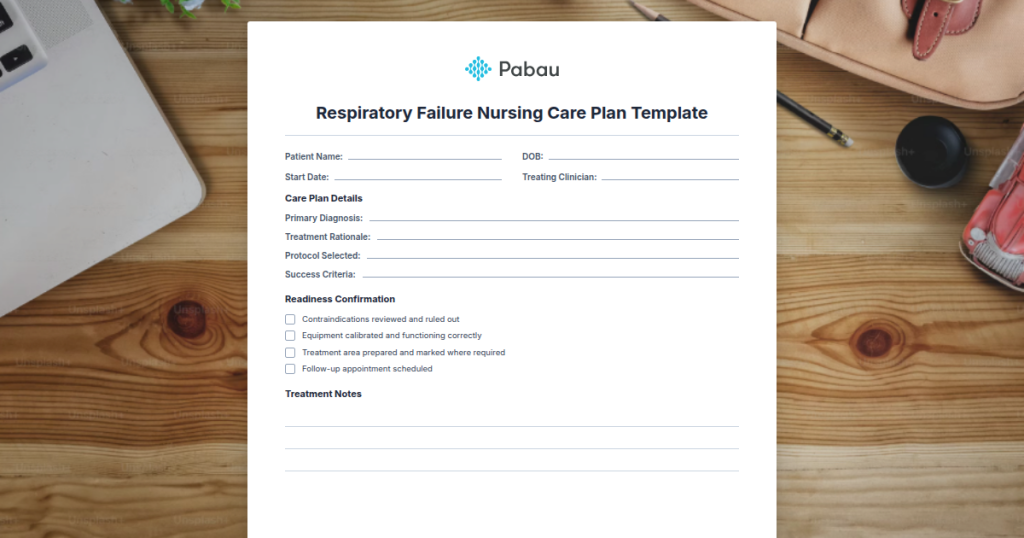
Respiratory Failure Nursing Care Plan Template
A Respiratory Failure Nursing Care Plan Template provides clinicians with a syst...

March 17, 2026


Buy now, pay later is now available in Pabau

Nursing concept maps visually connect patient assessment data, diagnoses, and interventions for holistic care planning
Templates reduce documentation time and improve clinical reasoning among nursing students and practising nurses
Spider mapping and hierarchical formats help organise complex clinical information into actionable care plans
Free downloadable templates streamline the concept mapping process across diverse patient presentations
A nursing concept map template transforms how nurses visualise patient care. Rather than reading through linear care plans, these templates display relationships between patient symptoms, nursing diagnoses, clinical interventions, and expected outcomes in one integrated diagram. For nursing students learning the nursing process and for practising nurses managing complex patients, concept mapping clarifies clinical reasoning and ensures no critical detail is missed.
This guide walks you through what a nursing concept map template is, how to use it in clinical and educational settings, and how it strengthens patient care planning. We’ll also provide a free downloadable template ready to adapt to your patients or classroom.
A structured visual template for nursing students and clinicians to map clinical concepts, patient assessment data, nursing diagnoses, and interventions. Supports care planning and clinical decision-making.
Download template
A nursing concept map is a visual diagram that displays the relationships between a patient’s presenting complaints, underlying clinical conditions, nursing diagnoses, planned interventions, and predicted patient outcomes. Unlike traditional linear care plans, concept maps use shapes, lines, and linking phrases (such as “leads to,” “caused by,” or “evidenced by”) to show how each element connects.
These visual tools emerged from educational research on how learners process complex information. Concept mapping forces nurses to think beyond isolated tasks and instead understand the interconnected nature of patient care. Concept mapping was first published in nursing studies in 1992 and has since become a standard teaching methodology. A patient presenting with shortness of breath, for example, isn’t isolated-it connects to underlying lung disease, which connects to medication side effects, which connects to specific nursing interventions aimed at oxygen saturation and patient safety.
Clinically, concept maps serve as a patient care management tool that bridges clinical assessment and actionable nursing diagnoses. Educationally, they’re essential for nursing students learning to integrate pathophysiology, pharmacology, and nursing interventions into coherent care strategies. The map becomes both a learning artefact and a clinical documentation method-showing regulators (such as nursing boards) and care teams that the nurse has reasoned through the clinical picture holistically.
Concept maps also support informed consent and patient safety workflows. By visually representing the relationship between a patient’s risk factors and planned interventions, the map clarifies what the nurse understands about the patient’s condition and how care will be personalised.
Using a nursing concept map template effectively requires five key steps that guide you from patient data collection through intervention planning. Follow this structured process to ensure complete, clinically sound concept mapping every time.
The five-step process transforms your nursing concept map template into a living clinical document that protects patient safety. For detailed visual guidance on structuring each element, see how to create a basic nursing concept map that organizes patient data effectively.
, demonstrates nursing reasoning, and streamlines care planning across the team.

Capture concept maps and patient assessment data directly in Pabau's integrated digital forms. Reduce paperwork and centralise your nursing documentation.

Nursing students are the primary users of nursing concept map templates during their education. Templates reinforce the nursing process by forcing learners to visually show their reasoning. Instructors use concept maps as authentic assessment tools-they reveal whether a student truly understands the connections between pathophysiology and nursing care or merely regurgitates memorised facts. A well-designed nursing concept map template scaffolds this learning—training nursing process using concept maps has been shown to increase professional self-efficacy in clinical settings and standardises grading expectations across mental health education programs and other nursing specialties.
Mental health and psychiatric nurses use concept mapping to organise complex patient presentations involving multiple diagnoses, medications, and psychosocial factors. A patient with anxiety, depression, and trauma history requires a nursing concept map template to show how these conditions interact and how nursing interventions target each domain holistically.
Primary care and family medicine nurses apply mapping for patients with chronic diseases (diabetes, hypertension, COPD) where multiple body systems and lifestyle factors interconnect. The nursing concept map template clarifies patient education priorities and long-term monitoring plans, making it easier to coordinate care across the multidisciplinary patient care team.
Acute care and critical care nurses use rapid concept mapping during shift handovers to communicate complex patient status. A concept map on rounds shows the ICU team visually how a patient’s ventilator settings connect to blood gas results, which connect to fluid balance and cardiac output-enabling faster clinical consensus. Critical care settings benefit enormously from structured templates that ensure no detail is missed under time pressure.
Occupational health and school nurses map preventive health interventions and wellness concepts for populations, using a nursing concept map template to show how health education connects to behaviour change and long-term outcomes.
Improves clinical reasoning. A nursing concept map template forces you to identify not just what’s wrong, but why-and how interventions address root causes rather than symptoms alone. This deeper thinking prevents missed diagnoses and unsound care decisions.
Reduces documentation errors. By visually organising all relevant data upfront, you’re less likely to omit critical information during charting. The template structure acts as a safety checklist-are contraindications documented? Are nursing diagnoses linked to assessment findings? Is the intervention rationale clear? This systematic approach to safer clinical note-taking reduces liability and improves patient safety audits.
Strengthens interprofessional communication. A visual concept map is understood faster by doctors, physiotherapists, pharmacists, and social workers than a paragraph narrative. Handovers and care conferences move more efficiently when everyone sees the same clinical picture created using a standardised nursing concept map template.
Supports nursing education accreditation. Regulators and accreditation bodies increasingly expect evidence of structured clinical reasoning in student portfolios. A nursing concept map template provides that evidence-it demonstrates graduates can integrate knowledge, not just recall it.
Enables audit and compliance. A completed concept map in the patient record shows that you applied recognised nursing frameworks (NANDA nursing diagnoses, evidence-based interventions, documented consent). This protects you if clinical decisions are later questioned and demonstrates professional standards compliance.
Facilitates student self-assessment. Learners can compare their nursing concept map template completions to exemplar maps and identify gaps in their reasoning. This metacognitive reflection deepens learning far more than traditional essay-based assignments.
Build concept maps collaboratively during team huddles. Have the patient, nurse, physiotherapist, and social worker each contribute their perspective to the map. Collaborative mapping surfaces missing information, prevents silos, and builds consensus on priorities-turning documentation into a real care planning conversation.
A nursing concept map template integrates seamlessly with established clinical decision-making frameworks used in nursing. The SBAR (Situation-Background-Assessment-Recommendation) model, for example, can be embedded into your concept mapping: the situation (presenting complaint) sits at the centre, background (medical history and contraindications) branches outward, assessment (nursing diagnoses) flows logically from evidence, and recommendations (interventions) point toward predicted outcomes.
By using a nursing concept map template that maps these relationships visually—allowing for perceiving interactions and relationships between biopsychosocial aspects of the patient, you move beyond checklist-driven charting toward clinical forms that capture your reasoning process. This is especially important in high-stakes scenarios-a complex surgical case, a patient with multiple comorbidities, or a critical incident investigation. The completed concept map becomes evidence of your clinical thinking, not just a list of tasks. Different hierarchical and flow map formats can be selected based on whether you’re prioritizing interventions or mapping sequential care pathways.
Triage nurses also benefit from rapid concept mapping. Rather than spending time on detailed narrative charting during a busy ED shift, concept maps (even hand-sketched versions of your template) communicate urgency, risk factors, and immediate priorities to the receiving team in seconds.
Nursing educators increasingly require students to submit concept maps alongside or instead of traditional care plans for clinical placements. The template approach standardises expectations-all students map the same patient using the same structure, making grading consistent and feedback specific.
Students completing practicum hours often feel overwhelmed by the volume of patient information they encounter. Concept maps are graphical visual diagrams designed to show relationships within a specific knowledge domain, making them ideal for organizing complex clinical data. A nursing concept map template channels this chaos into order. By the end of a clinical shift, a student has a visual artefact showing their patient understanding-something concrete to discuss with their preceptor or instructor. This becomes portfolio evidence of clinical competency for registration exams or job interviews.
Pre-licensure programs use concept maps to prepare students for the NCLEX (National Council Licensure Examination) and similar registration exams. Practice questions often ask “what is the priority nursing diagnosis?” or “which intervention addresses the underlying cause?” Resources on mastering nursing concept maps with examples demonstrate how to build maps starting from chief complaints through prioritized interventions, directly mirroring NCLEX-style clinical reasoning.
Concept mapping trains exactly this type of hierarchical, cause-and-effect thinking. Students who map frequently score higher on high-stakes exams because they’ve practised clinical reasoning repeatedly.
Many schools now integrate digital AI-powered clinical documentation tools that auto-populate some concept map fields based on patient data entered into the EHR. This hybrid approach reduces documentation burden while maintaining the pedagogical benefit of structured clinical reasoning.

Want to understand NANDA nursing diagnoses better? Psychiatric Evaluation Template shows how to structure clinical assessment data that feeds into accurate diagnosis formulation.
Looking for a clinic management system that captures digital forms? Digital Forms in Pabau lets you upload concept map templates and collect patient responses automatically, eliminating paper handoff.
Need to streamline patient intake across your nursing team? Clinic Management Software Buyers Guide walks through features that support fast, compliant patient assessment workflows.
A nursing concept map template transforms the way nurses visualise, communicate, and reason through patient care. Whether you’re a student building clinical thinking skills or a practising nurse managing complex presentations, mapping clarifies relationships between assessment data, diagnoses, interventions, and outcomes in ways linear narratives cannot.
Download the free template provided above, adapt it to your patient population or classroom context, and integrate concept mapping into your practice. Over time, you’ll notice faster handovers, fewer omitted details, and stronger clinical reasoning-hallmarks of safer, more cohesive nursing care.
Start by placing the patient’s primary health problem at the centre of your nursing concept map template. Branch outward with associated symptoms, risk factors, and medical history. Identify relevant nursing diagnoses linked to the assessment data. Finally, branch into planned interventions and expected patient outcomes. Use linking phrases (such as “causes,” “leads to,” or “evidenced by”) to show relationships between concepts.
Use the template structure: 1) Patient demographics and primary diagnosis in the centre. 2) Assessment findings (vital signs, symptoms, lab results) around the primary problem. 3) Nursing diagnoses derived from assessment data. 4) Planned nursing interventions addressing each diagnosis. 5) Expected outcomes and evaluation criteria. Link each element with arrows and descriptive phrases to show cause-and-effect relationships within your nursing concept map template. Many clinics now digitise this process using integrated patient records to keep concept maps accessible during care.
Concept maps organise scattered patient data into a unified visual picture. This helps nurses see patterns (e.g. how anxiety is fuelling elevated blood pressure), prioritise interventions (treating root causes rather than symptoms), and communicate care plans to the wider team. Using a nursing concept map template also reduces charting time by pre-structuring what information is essential to document.
Yes. Interprofessional teams can build a nursing concept map together during care rounds or huddles. Each discipline (nursing, medicine, therapy, social work) contributes their perspective, and the shared concept map becomes a consensus care plan everyone understands. Digital tools and standardised templates make collaborative mapping easier, allowing real-time updates as patient status changes.
Templates save time, ensure consistency, reduce documentation errors, improve clinical reasoning transparency, support interdisciplinary communication, and provide evidence of structured nursing assessment. For students, templates scaffold learning and provide portfolio artefacts. For practising nurses, they clarify complex cases and support regulatory compliance.
The main purpose is to visually represent relationships between clinical concepts-showing how patient data (symptoms, history, test results) connects to nursing diagnoses and how nursing interventions address those diagnoses. Using a nursing concept map template forces holistic thinking rather than task-focused charting, leading to better patient outcomes and safer care.