








Key takeaways
CPT code 99421 covers 5 to 10 cumulative minutes of online digital E/M for an established patient over 7 days.
The patient or an authorized representative has to send the first message, so provider-prompted exchanges do not qualify.
Medicare pays roughly $15 to $16 in 2026, based on a work RVU of 0.25 plus locality adjustments.
Nothing is separately billable if an E/M visit for the same problem happened in the previous 7 days.
Practice management software like Pabau logs cumulative time inside the client record, which supports accurate code selection across 99421 to 99423.
CPT code 99421 covers 5 to 10 cumulative minutes of online digital evaluation and management (E/M) for an established patient, spread across a 7-day window.
Most of that work already happens in your practice. Someone messages the portal about a rash or a blood pressure reading. A provider reads it, thinks about it, and replies. Those minutes are billable, and they usually go unbilled because nobody wrote them down.
One distinction matters before anything else. Unlike telehealth software codes, 99421 needs no live audio or video connection. Billers who file it as telehealth collect avoidable denials.
CPT code 99421 covers asynchronous digital visits
The American Medical Association (AMA) defines 99421 as an online digital E/M service for an established patient. It applies when a physician or qualified health professional (QHP) spends 5 to 10 cumulative minutes answering a patient-initiated question over 7 days.
Asynchronous is the operative word. The provider and the patient never have to be online at the same moment. Portal messages, secure email, and equivalent digital channels all count, as long as the patient sent the opening message.
One point trips up new billers. 99421 is not a telehealth code, so the telehealth waivers from the Public Health Emergency (PHE) never applied to it. The code predates the PHE and does not depend on audio-video technology.
How 99421, 99422, and 99423 divide by time
All three codes describe the same service and differ only by cumulative minutes. You are not billing per message. You are billing the total time spent reading, thinking, and replying across one 7-day window.
*Approximate 2026 Medicare national averages from the CMS Physician Fee Schedule. Rates vary by locality and change every year. Check the current MPFS for your area before billing.
Cross 10 minutes and the claim becomes 99422. Cross 20 and it becomes 99423. A single 7-day inquiry cannot be split into two claims, so only one code from the family applies per episode.
Who can bill the code, and who can’t
Only physicians and QHPs enrolled in Medicare under their own National Provider Identifier (NPI) may report CPT code 99421 independently.
That limit bites hardest in mixed teams, which is a daily reality for primary care practices handling heavy portal traffic.
- Physicians (MD/DO): May bill 99421 independently.
- Nurse practitioners (NPs) and physician assistants (PAs): May bill under their own NPI as QHPs, subject to their state scope of practice.
- Clinical nurse specialists (CNS) and certified nurse midwives (CNM): Eligible as QHPs where state law permits.
- Registered nurses, medical assistants, and other clinical staff: Cannot bill 99421 independently. Their time may count toward the cumulative total under incident-to supervision, but the claim goes out under the supervising physician or QHP’s NPI.
Incident-to arrangements complicate all of this. When the supervision picture is unclear, bill under the supervising physician’s NPI rather than risk a compliance finding. Sorting out provider credentialing before the first claim goes out saves a lot of rework later.
The American Academy of Family Physicians (AAFP) publishes specialty guidance on provider eligibility for online digital E/M services. Read it next to your own payer contracts.
The patient has to start the conversation
Patient initiation is a hard requirement, not a preference. The 7-day clock starts only when the patient, or an authorized representative such as a parent or guardian, sends the first message. A provider-prompted exchange does not qualify at all.
Here is where the line falls:
- Qualifies: A patient messages the portal about a medication side effect, a refill, or a new symptom.
- Qualifies: A parent messages the portal on behalf of their minor child.
- Does not qualify: The provider sends a follow-up asking how the patient responded to a treatment change.
- Does not qualify: Staff send an automated notification asking the patient to check in about a chronic condition.
- Does not qualify: The message concerns a problem already addressed at an office visit inside the same 7-day period.
Check that your patient portal software timestamps the patient’s opening message separately from automated notifications.
That log becomes your initiation record at audit, and solid patient care management tooling keeps it intact without extra admin work.
Documentation that survives an audit
Documentation is where most 99421 denials start. The record has to support both the time threshold and the clinical substance of the exchange. A note reading „responded to patient portal message“ will not hold up under review.
Your record needs all of this:
- Date and time of the patient’s first message, which sets the start of the 7-day window.
- Cumulative time spent by the billing provider reviewing, researching, and replying. Staff time only counts where incident-to rules genuinely apply.
- Content of the clinical exchange: the patient’s question, the provider’s reasoning, and any advice, orders, or referrals issued.
- Confirmation that the patient is established, because new patients are not eligible for this code family.
- Date the 7-day period closed, plus the cumulative total that decided the code tier.
Undercoding is the quieter problem. Log time message by message and you lose the running total. Three messages over five days about one issue can add up to 12 minutes, which is 99422, not 99421.
Pro Tip
Track cumulative time in your practice management system as you answer each message, not at the point of billing. A running log built while the window is open is far stronger audit evidence than a time entry reconstructed weeks later.
ICD-10 codes that support medical necessity
Every 99421 claim needs a diagnosis that justifies a clinician’s response. A purely administrative request, such as a form or a records copy, does not. The pairings below are the ones that turn up most often in portal traffic.
Always pick the most specific code your notes support. Unspecified codes raise denial risk and draw audit attention. Mental health practices lean on this table heavily, because medication check-in messages arrive constantly.
If a pairing looks borderline, the AAPC Codify tool includes CPT-to-ICD-10 crosswalks that settle it before the claim goes out.
What Medicare pays for 99421 in 2026
Medicare pays roughly $15 to $16 for CPT code 99421 in 2026 under the Medicare Physician Fee Schedule (MPFS). That figure rests on a work Relative Value Unit (RVU) of 0.25 and a non-facility total of 0.47 RVUs.
Your locality shifts it, because the MPFS applies a Geographic Practice Cost Index (GPCI) adjustment to each component.
Check the current rate for your MAC locality before you bill. The conversion factor changes every year. GPCI also means a San Francisco practice and a rural Mississippi practice are paid different amounts for the same code.
Private payers are far less predictable
Commercial coverage for online digital E/M runs from full payment to nothing at all. Some plans pay the whole 99421-99423 family. Others restrict it by provider type or diagnosis, and a few exclude it outright.
- Verify coverage first: Call the payer or check their provider portal for coverage, prior authorization, and provider-type limits. Building eligibility verification into intake catches most of it.
- State mandates vary: Some states require commercial insurers to cover digital services. Those mandates reach fully insured plans only, so self-funded employer plans are generally exempt.
- Medicaid is state by state: Some programs cover 99421-99423, and others use their own equivalent codes. Check your state’s Medicaid billing manual.
- Write the policy down: Keep each payer’s coverage determination in your billing protocols. Policies change annually, usually alongside fee schedule updates.
Strong EHR integration between the clinical record and the billing queue helps here too. The system can flag a coverage mismatch before the claim ever leaves the practice.
Compliance rules that trigger 99421 denials
Several rules here differ from standard E/M billing, and breaking them means non-payment rather than a fixable denial. A few are hard edits applied before the claim reaches adjudication at all.
- Same-day restriction: 99421 cannot be billed on the same date of service as a face-to-face or synchronous telehealth E/M visit for the same problem. The online work bundles into the office visit instead.
- Global surgical period: Work inside the global period of a surgical procedure is not separately billable. A post-operative portal message therefore does not support 99421.
- Established patients only: The patient needs at least one prior face-to-face visit with the provider. A same-specialty colleague in the same group also counts.
- One code per 7-day episode: Only one code from 99421-99423 applies per inquiry period. You cannot bill 99421 on day two and 99422 on day five for the same issue.
- Place of service: POS 02 covers telehealth delivered somewhere other than the patient’s home, and POS 10 covers telehealth in the patient’s home. Online digital E/M is asynchronous and not telehealth, so CMS guidance points to POS 11 or the POS matching the provider’s location. Confirm with your MAC.
- No modifier in most cases: Unlike telehealth codes, 99421-99423 usually need no GT or 95 modifier. Check each payer’s rules before adding one.
The messaging channel is part of compliance too. HIPAA-compliant software is a prerequisite, because the platform has to meet minimum necessary standards for protected health information (PHI). Consumer email does not qualify as a patient portal here.
How a 99421 claim moves through the system
Once it leaves the practice, a 99421 claim looks entirely ordinary. What makes it different is everything that happens before submission, inside the 7-day window. Here is the path, step by step.
- Day 1. The patient messages the portal. Your system timestamps it, and the 7-day clock starts.
- Days 1 to 7. The provider logs each block of time against that one encounter, not against separate notes.
- Day 7. The window closes. Add the minutes, choose 99421, 99422, or 99423, and set the date of service to the closing date.
- Coding. Attach the ICD-10-CM code the message supports, then set the place of service your MAC expects.
- Submission. The claim goes out on a CMS-1500 or its electronic equivalent, the 837 file, through your clearinghouse.
- Adjudication. The payer checks patient status, the 7-day overlap edits, and medical necessity before releasing payment.
Run this check before you submit
Five things are worth confirming on every online digital E/M claim:
- The patient sent the first message, and the timestamp proves it.
- No E/M visit for the same problem happened in the previous 7 days.
- The cumulative minutes are logged and match the code tier you chose.
- The patient is established with the provider or the same-specialty group.
- The date of service is the day the window closed, and you are inside the payer’s timely filing limits.
Four mistakes that cost the most
Billing per message. Each reply gets its own claim, so a 12-minute episode goes out as two 99421s instead of one 99422. The payer denies the second one.
Counting staff minutes as provider minutes. Only the billing provider’s time counts, unless incident-to rules genuinely apply to that exchange.
Skipping the 7-day lookback. A message about a problem seen in the office last Tuesday belongs to that visit, not to a fresh claim.
Filing under the wrong NPI. A nurse’s reply billed under the nurse is a compliance finding waiting to be written up.
Denials from this family cluster around a small set of reason codes. Reading your remittance against the standard denial codes tells you which of those four you keep repeating.
How Pabau connects portal messages to paid claims
Both failure points here are workflow problems rather than knowledge problems. Cumulative time has to accumulate somewhere, and the clinical record has to sit next to the claim. A manual log plus a standalone messaging app manages neither.
Practice management software like Pabau keeps the two together. Pabau’s client portal gives established patients one secure channel, and every message is timestamped inside the client record. When the window closes, your initiation proof, notes, and time entries are already in the same place.
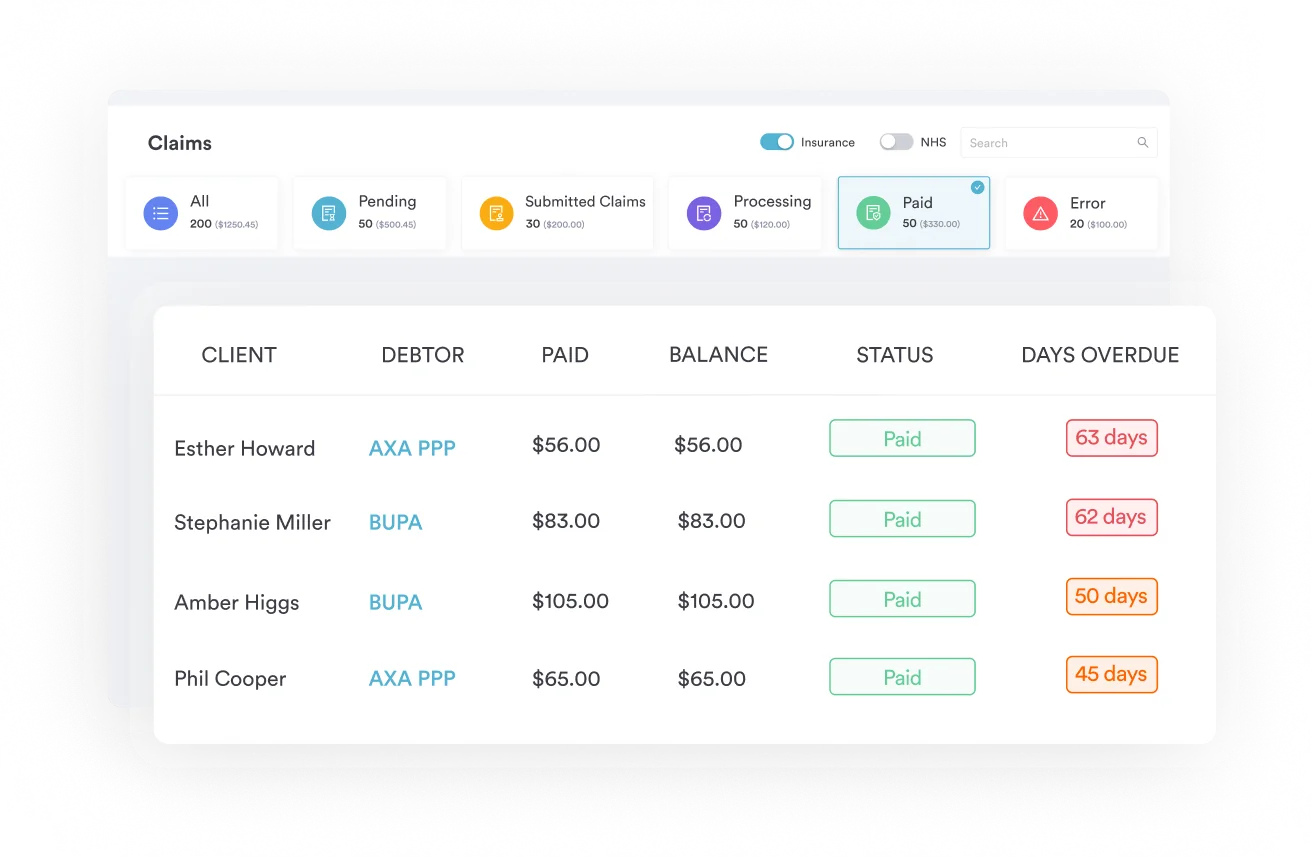
From there, Pabau’s claims management software turns that encounter into a submitted claim. Claims are grouped by status, so a stalled 99421 surfaces while you can still do something about it.
Esteem Life Medical Group runs the same setup. Their records stay straight, and audits stop being a scramble for evidence that should already exist.

Turn portal messages into billable, documented claims
Pabau logs cumulative message time inside the client record and carries it straight into a claim. Your team picks the right tier across 99421 to 99423 without rebuilding the timeline from memory.

Conclusion
The money in 99421 is already sitting in your portal. The clinical work happens, the minutes get spent, and the claim never gets filed. Fixing that is a documentation habit, not a coding change.
Start the running time log on day one of every patient-initiated inquiry, and check the 7-day lookback before you code. Those two habits recover most of what practices currently leave on the table. They are also the first things an auditor asks to see.
Want cumulative time tracking and claim status in one place? Book a demo and we will walk you through how Pabau handles online digital E/M, from the first portal message to the paid claim.

Continue your research
Building out asynchronous and video consultations together? Telehealth in GP clinics shows how primary care teams run both alongside normal appointments.
Want to see where portal revenue fits in the bigger picture? Revenue cycle management maps every step from patient registration through to final payment.
Not sure why a paid claim came back short? Electronic remittance advice explains how to read an ERA and reconcile it against what you billed.
Need to give a patient something they can claim back? Superbill template includes a free download and a worked example you can copy.
Worried about where billing rules meet federal law? Medical billing compliance covers the statutes, the common violations, and a downloadable checklist.
Frequently asked questions
Does the patient owe a copay for 99421?
Yes. The Part B deductible and 20% coinsurance apply, so the patient owes roughly $3 on a $15 to $16 allowed amount. Medicare also expects documented patient consent for e-visits. Verbal consent is acceptable, and you can collect it once a year.
Can you bill 99421 within 7 days of an office visit?
Not for the same or a related problem. CPT treats the online work as part of that visit. The rule runs both ways, so if the message leads to an E/M visit inside 7 days, the online service folds into the visit.
What is the difference between 99421 and 98970?
Provider type. Codes 98970 to 98972 cover the same online digital work by clinicians who cannot report E/M, such as physical therapists and dietitians. Medicare marks those three invalid and assigns no RVUs, so check payer policy before using them.
How many times can you bill 99421 for one patient?
Once per 7-day episode. A new episode needs a fresh patient-initiated inquiry that is unrelated to any E/M service in the previous 7 days. A chronic patient can generate several episodes a year, but never two overlapping claims.
Is 99421 on the Medicare telehealth list?
No. Medicare treats it as a communication technology-based service rather than a telehealth service. Originating-site rules, geographic restrictions, and telehealth modifiers do not apply. The code was payable before the pandemic waivers and stays payable after them.