Musculoskeletal & Pain Management Physical Therapy
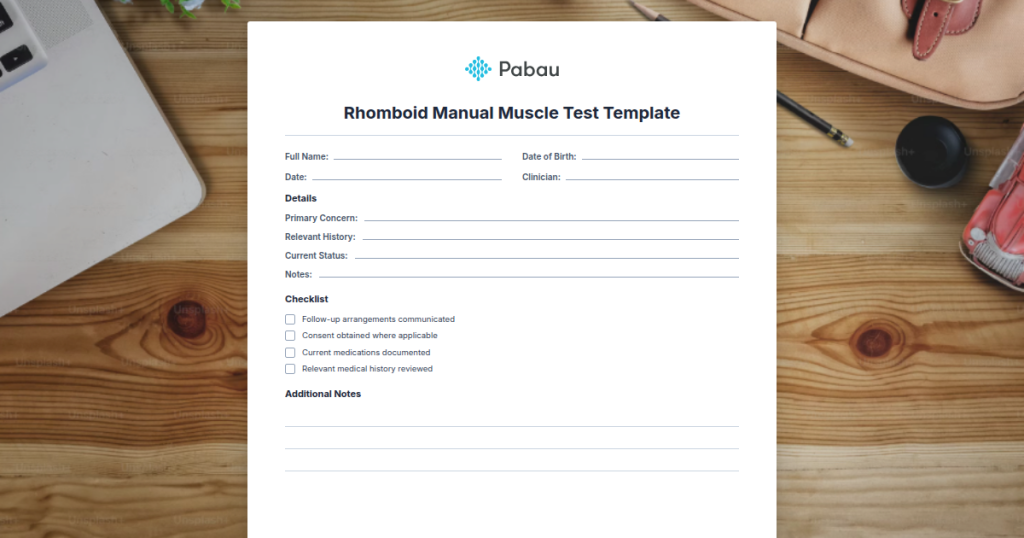
Rhomboid Manual Muscle Test Template
What is the Rhomboid Manual Muscle Test? Physical therapists and physiotherapist...

April 6, 2026


Buy now, pay later is now available in Pabau

Maps pain across cervical, thoracic, lumbar, and sacral regions for accurate assessment
Supports precise clinical documentation and treatment planning workflows
Integrates patient communication with systematic pain location tracking
Essential for multi-session pain progression monitoring and outcome measurement
Enhances informed consent by clarifying anatomical pain references
A back pain location chart is a visual diagnostic and documentation tool that enables healthcare practitioners to systematically identify, map, and record the precise anatomical areas where patients experience pain. Rather than relying on verbal descriptions alone, this chart provides a standardised framework for clinicians to mark pain locations across the cervical spine (neck), thoracic spine (mid-back), lumbar spine (lower back), and sacral region. This visual approach transforms vague patient reports-“my back hurts”-into actionable clinical data that informs diagnosis, treatment planning, and progress tracking. Validated pain assessment tools demonstrate improved diagnostic accuracy when visual body maps are incorporated into clinical workflows.
that informs diagnosis, treatment planning, and progress tracking. Back pain location charts serve as visual tools that help both patients and providers pinpoint areas of discomfort for more targeted care.
that informs diagnosis, treatment planning, and progress tracking.
In clinical practice, a back pain location chart serves three critical functions: diagnostic clarity (distinguishing between localised muscle pain and referred pain patterns), documentation compliance (creating a permanent record for medico-legal protection), and treatment alignment (helping clinicians explain findings to patients using their own marked diagram). For physiotherapists, chiropractors, sports medicine practitioners, and medical doctors managing musculoskeletal conditions, this chart becomes part of the patient’s clinical narrative.
The template is grounded in clinical anatomy. Each region of the back corresponds to specific nerve roots and muscle groups, and spinal structures. By mapping pain location precisely, practitioners can begin differentiating between conditions-sciatica (lower back radiating down the leg) presents differently from thoracic outlet syndrome (upper back and shoulder). This anatomical clarity also supports informed consent conversations, where patients see their own pain marked on an anatomical diagram, reducing misunderstanding and improving compliance with treatment plans.
A visual diagnostic tool that helps healthcare professionals systematically identify and document specific areas of pain across the back and knee regions, supporting precise clinical assessment and targeted treatment planning for various musculoskeletal conditions.
Download templateUsing a back pain location chart follows a structured five-step workflow that ensures consistency and clinical accuracy across your practice. The process is straightforward but requires systematic attention to patient communication and anatomical reference.
The entire process typically takes 5-10 minutes during intake. When integrated into your digital forms workflow, the chart can be completed on a patient portal or iPad before the appointment, saving chair time and allowing you to review findings before the session begins.
The back pain location chart is essential for any healthcare practice treating musculoskeletal conditions. Physiotherapists managing post-injury rehabilitation use the chart to track pain progression across a course of treatment. Sports medicine doctors rely on it to differentiate acute injury pain from chronic referred pain in athletes. Chiropractors document subluxation-related pain across spinal regions. Osteopaths use the chart to assess structural restrictions linked to pain location.
The template also serves general medical practices and private GPs managing chronic pain patients, occupational health services assessing work-related back injury, and wellness clinics documenting baseline pain before intervention. For multi-location practices, standardising pain assessment across all clinics ensures consistency and facilitates clinical handover when patients transition between practitioners. The chart is equally valuable in acute care settings (emergency assessment, post-operative monitoring) and chronic pain management (measuring long-term outcomes for insurance reporting).
Precise clinical diagnosis: A marked back pain location chart eliminates guesswork. Michigan Body Map research demonstrates that visual body maps are preferred by patients and more accurately depict pain location compared to traditional pain assessment checklists.
By documenting exactly where pain occurs and how it refers, you narrow the differential diagnosis. A patient marking only the lower left lumbar region with radiation to the lateral foot suggests L5 nerve involvement, whereas widespread mid-back pain might indicate muscular rather than neural origin. This precision accelerates your clinical reasoning and justifies specific interventions.
Objective outcome measurement: Pain location charts provide visual proof of clinical progress. Comparing baseline markings to follow-up charts shows patients and insurers that treatment is working-the pain region has shrunk, or referred symptoms have resolved. This objective evidence supports continued treatment authorisation and strengthens your practice’s outcome reporting.
Enhanced informed consent: When patients see their pain marked on an anatomical diagram, clinical conversations become clearer. Instead of discussing “nerve involvement” abstractly, you can point to the marked region and explain the likely anatomical structure, treatment approach, and expected timeline. This clarity reduces misunderstanding and improves patient compliance with treatment plans.
Medico-legal documentation: A patient-marked and clinician-verified pain location chart creates a permanent, detailed record of the patient’s presenting complaint. In the event of a claim or complaint, this chart demonstrates that you conducted a thorough, systematic assessment-essential for regulatory bodies like the Care Quality Commission (CQC) or professional councils reviewing your clinical notes.
Workflow efficiency: When the back pain location chart is part of your patient portal or intake forms, data capture becomes automatic. Patients complete the chart before arriving, and the information flows directly into your clinical notes and appointment summary-no manual transcription needed.
Combine the back pain location chart with digital note-taking. Use echo-based clinical documentation to automatically transcribe your palpation findings and pain assessment directly into the patient record, linking the marked chart to structured clinical notes. This integration transforms a paper form into a dynamic clinical decision-making tool.
The anatomical location where a patient marks pain reveals diagnostic clues. Cervical spine pain (neck and upper back region) often indicates muscle strain, cervical spondylosis, or nerve compression affecting the shoulder and arm. Patients typically report stiffness worse with certain neck movements and may experience headaches if upper cervical structures are involved.
Thoracic spine pain (mid-back between the shoulder blades) is frequently musculoskeletal-postural fatigue, muscle tightness, or facet joint irritation. However, referred pain from thoracic structures can radiate around the ribs, mimicking intercostal neuralgia. Thoracic outlet syndrome, where nerve and vascular structures compress as they exit the chest, produces pain and numbness across the shoulder and arm.
Lumbar spine pain (lower back) represents the most common presentation. Local lumbar pain suggests discogenic pain, facet joint irritation, or muscular strain. Radiating pain down one leg (unilateral sciatica) indicates nerve root compression-typically L5 or S1 involvement. Bilateral leg pain or pain in the central lower back with lower extremity weakness may signal cauda equina compression, a surgical emergency.
Sacral pain (base of spine, above the buttocks) often reflects sacroiliac joint dysfunction, particularly in women post-pregnancy or patients with asymmetrical muscle strength. Understanding these location-to-diagnosis relationships allows you to ask targeted follow-up questions: “When you marked the lower left side, did the pain travel anywhere?” Their answer confirms whether you’re addressing local muscle pain or referred neural pain, directing your treatment strategy.
A single back pain location chart provides a snapshot; serial charts create a narrative of clinical progress. Document the date on each chart, then file them chronologically in the patient record. At each follow-up visit, place the current chart beside the baseline version and invite the patient to observe changes: “Three weeks ago, your pain covered this entire lower back region. Today, it’s only in the left side. That’s measurable improvement.”
This visual feedback is psychologically powerful. Patients often feel that progress is slow because day-to-day pain fluctuates. Comparing marked charts shows objective improvement even when patients don’t consciously notice it. For multi-session episodes of care, this serial data supports your clinical decision-making: if pain location hasn’t changed after four treatments, your current approach may need adjustment.
Practices using automated clinical documentation systems can link scanned or photographed charts to appointment notes, creating a visual timeline. Some practices photograph the marked chart, file the image in the EMR, and use that digital record for insurance reporting and outcome tracking. The chart becomes part of your objective evidence base for treatment efficacy.

Integrate pain location charts and intake forms directly into your patient workflow. Automate data capture, reduce admin burden, and improve clinical documentation consistency across your practice.

A back pain location chart works most effectively when paired with functional outcome measures. While the location chart documents where pain exists, measures like the Oswestry Disability Index (ODI) quantify how much pain affects daily function. The Back Pain Functional Scale is another validated tool with good correlation to other clinical outcome measures used for assessing low back pain.
Together, they tell a complete story: “Pain location has reduced, AND the patient can now walk 20 minutes without stopping-both indicate genuine improvement.”
Practices often combine the location chart with pain scale rating (-10 numerical rating scale), symptom history (duration, aggravating factors), and movement-based assessment (range of motion, strength testing). This layered approach captures both subjective (where it hurts, how much) and objective (what structures are involved, what movements restore pain) data. Documentation becomes richer and more defensible for regulatory review.
For practitioners using appointment scheduling and patient management software, standardising pain assessment across all patients enables practice-wide outcome tracking. You can report to referrers: “Across our 150 back pain episodes this year, average pain location reduction was 60% by discharge”-compelling data that demonstrates clinical effectiveness.
Use consistent marking conventions. Establish a practice standard: red shading for acute local pain, blue for chronic pain, arrows for radiating patterns. Consistency allows any clinician reviewing the chart to quickly interpret findings without asking clarifying questions. Document your conventions in the patient’s initial assessment note.
Combine patient perception with palpation findings. The patient’s marking shows their perception of pain; your palpation adds clinical objectivity. If the patient marks widespread lumbar pain but palpation reveals localised tenderness only at L4-L5, note this discrepancy. It may indicate central sensitisation, where the nervous system amplifies pain perception beyond structural damage-an important finding that changes treatment approach. Central sensitization in chronic pain requires specific therapeutic approaches distinct from structural tissue injury management.
Document neurological screening results on or near the chart. Following clinical practice guidelines for low back pain ensures your assessment includes appropriate classification of mobility impairments, referred pain patterns, and neurological screening linked to diagnosis.
If the patient marks pain radiating to the leg, note whether strength, sensation, and reflexes are intact or compromised. A positive neurological finding (weakness, dermatomal numbness) alongside pain location marking indicates possible nerve root compression, raising the urgency of your recommendation.
Photograph or scan the chart for the digital record. Filing the original form is important for medico-legal protection, but a scanned or photographed version in your EMR system allows quick visual review during future appointments and supports telehealth consultations where you can reference the image with the patient.

Looking to streamline clinical intake? Digital Forms automates pain location chart delivery and captures patient responses directly into your EMR.
Need to improve clinical note quality? Safer Clinical Notes guide provides frameworks for documenting assessment findings clearly and defendably.
Running a multi-location practice? Sports Medicine Software ensures consistent pain assessment protocols across all clinic locations.
A back pain location chart transforms vague patient descriptions into precise clinical data. By mapping pain across anatomical regions-cervical, thoracic, lumbar, and sacral-practitioners can differentiate local pain from referred patterns, support diagnostic reasoning, and create objective evidence of clinical progress. The chart serves multiple roles: it’s a diagnostic aid during assessment, an educational tool during informed consent conversations, a documentation artefact for medico-legal protection, and an outcome measure across episodes of care.
Integrating the back pain location chart into your practice workflow-especially through digital forms and patient portal systems-reduces administrative burden and ensures consistency across your team. Whether you manage acute sports injuries, chronic musculoskeletal pain, or post-operative recovery, the chart remains a foundational clinical tool that enhances both patient safety and practice efficiency.
Yes. Many practices include the chart in pre-appointment digital forms or email it to patients before arrival. Patient pre-marking saves chair time, allows you to review findings before the session, and provides a baseline impression without clinician influence. Always verify the marked areas during palpation and assessment.
Use the chart at initial assessment, mid-treatment (around visit 3-4 if treating for 6+ sessions), and discharge. Comparing charts over time provides objective outcome evidence and reinforces patient perception of progress. For chronic pain management, consider charts every 4-6 weeks to track long-term patterns.
Start with broad anatomical regions and narrow through palpation. Ask “Is it closer to your neck or closer to your tailbone?” or “Is the pain more toward the middle of your back or off to one side?” Palpate each region gently and ask the patient to indicate when you touch a tender area. Document your clinical findings alongside the patient’s general marking.
Yes, provided you store the physical chart securely and any scanned versions in encrypted systems. Treat the chart as you would any clinical assessment form-confidential patient information requiring secure filing. If you use digital forms, ensure your platform is GDPR-compliant and patient data is protected with appropriate access controls.
The Pabau Back Knee Pain Location Chart covers both posterior knee and back regions, making it versatile for musculoskeletal practices treating multiple areas. For specialised assessments (e.g., full-body pain mapping), you may combine this chart with region-specific templates depending on your clinical focus.