Primary & Preventive Care
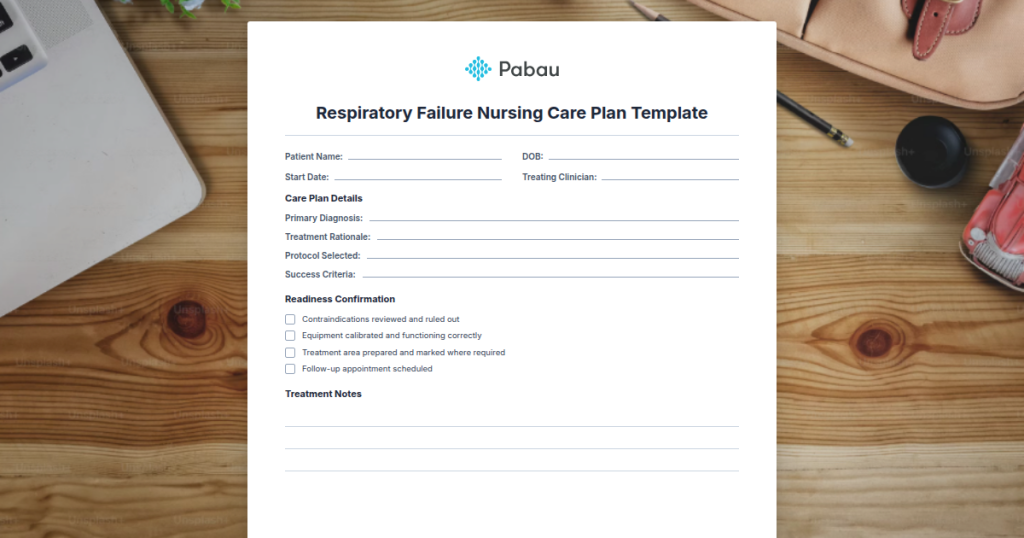
Respiratory Failure Nursing Care Plan Template
A Respiratory Failure Nursing Care Plan Template provides clinicians with a syst...

March 17, 2026


Buy now, pay later is now available in Pabau

SOAP notes structure mental health documentation into four clear sections
Subjective and Objective sections require different levels of clinical detail
Assessment and Plan sections guide ongoing treatment decisions
Standardised SOAP formatting supports compliance and clinical continuity
Mental health professionals face a unique documentation challenge: capturing the nuance of therapeutic work within a structured framework that supports clinical continuity and regulatory compliance. A SOAP note for mental health template addresses this directly. It provides therapists, counselors, and psychiatrists with a consistent format for recording patient encounters-translating clinical observations, therapeutic goals, and treatment decisions into clear, defensible documentation.
This guide walks you through using a SOAP note template specifically designed for mental health settings. Whether you’re documenting individual therapy, psychiatric assessments, or counseling sessions, understanding each section ensures your notes serve both clinical and legal purposes.
A ready-to-use documentation template covering patient details, mental status examination, clinical observations, diagnostic impressions, treatment planning, and session notes for therapy and counseling practice.
Download templateSOAP stands for Subjective, Objective, Assessment, Plan-a framework used across healthcare to organise clinical information. In mental health, the SOAP format serves a specific purpose: it captures the complexity of therapeutic work while maintaining clarity for other clinicians, insurance companies, and regulatory bodies who may review the record.
A mental health SOAP note is not a therapy transcript or a session summary. It is a clinical document that records the patient’s presenting concerns, your observations and assessments, your clinical impression, and your plan for ongoing treatment. When written with structure and precision, SOAP notes become powerful tools for continuity of care-enabling another clinician to understand your clinical reasoning and pick up treatment seamlessly if needed.
From a legal and compliance perspective, thorough SOAP notes protect both you and your clients. They demonstrate informed consent, support insurance billing documentation, satisfy regulatory requirements (particularly important for practitioners working within HIPAA compliance frameworks), and create defensible records if clinical decisions are questioned. Mental health practices operating under professional liability standards-whether in the UK (GMC, BACP) or internationally-rely on comprehensive documentation to evidence safe, ethical practice.
Using a SOAP note template effectively requires understanding what belongs in each section and how to balance completeness with efficiency. Here are five core steps mental health practitioners follow when completing a SOAP note:
This structured approach transforms what might otherwise be scattered observations into a coherent clinical narrative. Mental health SOAP notes require careful attention to both clinical detail and organizational clarity.
Practices using digital intake forms can pre-populate demographic and historical information, saving time during documentation and reducing transcription errors.

Pabau's digital forms and templates integrate with your scheduling and client records, helping you document sessions efficiently while maintaining compliance and clinical quality.

SOAP notes are essential across multiple mental health specialities. Therapists and counsellors documenting individual therapy sessions benefit from the structure-it helps distinguish between what the client shared (Subjective) and what you observed clinically (Objective). Psychiatrists and psychiatric nurse practitioners rely on SOAP notes to track symptom changes across medication management appointments. Clinical psychologists use SOAP formatting when conducting assessments or monitoring treatment progress. Substance abuse counsellors and addiction specialists document recovery work and relapse prevention planning in SOAP format.
Beyond traditional one-to-one practice, group therapy settings increasingly require SOAP-formatted documentation. Multi-disciplinary teams-where therapists, psychiatrists, social workers, and nurse specialists collaborate-depend on standardised SOAP notes to ensure everyone understands clinical decisions and can contribute meaningfully to care. If you’re working in a private practice, community mental health centre, hospital psychiatry department, or secure facility, SOAP notes are foundational to safe, professional practice.
Clarity and consistency: A template ensures every clinician in your practice documents the same way. Consistency reduces the risk of important clinical information being missed and makes handovers faster when clients see multiple therapists or transition to another provider.
Compliance and legal protection: Thorough, structured documentation protects you during audits, complaints, or regulatory reviews. If a client questions a clinical decision or an insurer denies a claim, your SOAP note becomes evidence of your professional reasoning. Regulatory bodies-whether the BACP in the UK or state licensing boards elsewhere-expect to see clear documentation practices.
Clinical safety: Structured assessment sections force you to document risk systematically. Safety planning becomes part of your regular note, not an afterthought. If a client’s risk level changes, it is immediately visible in the Assessment and Plan sections.
Time efficiency: Once you internalise the SOAP structure, documentation becomes faster. You know exactly what to record in each section, eliminating the mental effort of deciding what information goes where. Practices using AI-powered clinical documentation can draft initial SOAP structures from session recordings, then refine them with clinical context.
Insurance and billing alignment: Mental health insurance companies expect SOAP-formatted clinical documentation. Using a template ensures your notes meet insurer requirements, reducing claim denials and simplifying the billing process.
Document within 24 hours of a session whenever possible. Recent session details are clearer in your memory, and you are more likely to capture nuance accurately. Late documentation increases the risk of omissions or misremembered details.
Effective mental health SOAP notes balance clinical detail with readability. Each section serves a distinct purpose, and understanding those purposes helps you write notes that work both clinically and practically.
The Subjective section captures what the client tells you. It includes their chief complaint, current symptoms, mood, sleep, appetite, and any life events or stressors they mention. Write this in a narrative format that reflects the client’s reported experience. You might include direct quotes if they illustrate the client’s emotional state or clinical concern. For example: “Client reports feeling ‘trapped and hopeless’ about work situation, describes low mood since supervisor criticism two weeks ago, sleep reduced to 4-5 hours nightly.” This section should typically be 100-150 words-enough detail to understand the client’s perspective without becoming a transcript.
Shift from the client’s reported experience to what you observe. Document appearance (appropriately groomed, tearful, agitated), behaviour (cooperative, withdrawn, anxious), speech (pressured, slow, coherent), mood and affect (stated affect matches observed affect or describes incongruence), thought process (goal-directed, tangential, racing thoughts), and orientation to person, place, time. Include Mental Status Examination findings if formally assessed. Keep language clinical but avoid jargon that obscures meaning. Write: “Alert and oriented x3. Speech normal rate and volume. Affect congruent with mood-reports sadness, appears visibly sad with intermittent eye contact.”
Here you synthesise Subjective and Objective information into your clinical impression. Reference any formal diagnoses (DSM-5 codes if used), progress toward treatment goals, and changes since the last session. Explain your clinical reasoning-why the symptoms presented matter, how they fit the client’s history, and what they tell you about current functioning. For example: “Assessment: Ongoing major depressive episode (F32.1), moderate severity. Sleep disturbance and concentration difficulties increasing. Responding to therapy-demonstrates better emotional regulation in session, reporting some behavioural activation. No current suicidal ideation; safety maintained.”
Be specific about what happens next. Rather than “Continue therapy,” write: “Continue weekly CBT with focus on cognitive restructuring of work-related thoughts. Teach behavioural activation strategies for anxiety. Monitor sleep and appetite. Client to track mood daily using PHQ-9 in session next week.” Include safety planning if applicable, any referrals needed, medication considerations, and the timeline. The Plan section transforms your assessment into actionable clinical direction.
Beyond following the SOAP structure, effective mental health documentation requires attention to tone, accuracy, and ethical practice. Write objectively-avoid language that judges or labels the client (“patient is manipulative” becomes “client uses indirect communication style to avoid conflict”). Use precise language; “client is anxious” is vague compared to “client reports racing thoughts, rapid speech, and describes chest tightness when discussing deadline.”
Time management matters. Notes written weeks after a session lack precision and may not capture the client’s actual presentation. Digital practice management systems with built-in documentation templates encourage timely recording. Similarly, consistency in language and format across your notes-whether you work alone or in a team-ensures clinical continuity and reduces misunderstandings. Continuity of care documentation becomes especially critical when clients transition between providers or treatment settings.
and reduces misunderstandings.
Consider your audience. SOAP notes may be read by the client themselves (if they request access), other clinicians on a multi-disciplinary team, insurance companies, or regulators. Write as if your note might be reviewed in a professional complaint or court proceeding. Avoid abbreviations that are not universally understood, don’t speculate about diagnosis without evidence, and never include personal opinions about the client’s choices.
A psychiatry SOAP note uses the same Subjective, Objective, Assessment, Plan structure as general mental health SOAP notes but emphasises medication management, diagnostic clarity, and psychiatric assessment. Psychiatrists often include more detailed mental status examination and medication-related side effect tracking.
The Objective section should include mental status examination elements: appearance, behaviour, speech, mood and affect, thought process, and orientation. Aim for 150-250 words-enough to give another clinician a clear picture of your observations without becoming a transcript.
Yes. For group therapy, adapt the Subjective section to cover individual contributions and group dynamics. The Objective section documents group behaviour and interactions. The Assessment addresses both individual progress and group cohesion. The Plan specifies individual and group-level interventions.
Yes. Even uneventful sessions require documentation. Absence of progress can be clinically significant-it may indicate treatment resistance, environmental barriers, or the need to adjust your approach. Document what was discussed, your observations, and any adjustments to the treatment plan.
Record information necessary for clinical decision-making without unnecessary detail. If a client discloses abuse or trauma, document what is clinically relevant and your response. Avoid graphic details unless they directly affect treatment. Follow your jurisdiction’s data protection standards (GDPR in the UK, HIPAA if you treat US patients).
Most clinical settings prefer a mix: bullet points for key information (medications, diagnoses, appointments) and brief narrative paragraphs for Assessment and Plan. Consistent format across your practice ensures readability and professional presentation.
Write in past tense for the session (“Client reported…” “Affect was…”) and present tense for clinical judgement and plan (“Client requires… I recommend…”). This distinguishes between what happened during the session and ongoing clinical thinking.
Reference previous sessions in the Assessment section. Note improvements or deterioration in specific symptoms, functional ability, or goal achievement. Use standardised measures (PHQ-9, GAD-7) where possible to provide objective progress tracking alongside narrative description.
A SOAP note for mental health template transforms documentation from an administrative burden into a clinical tool. When structured thoughtfully, SOAP notes communicate your clinical reasoning, support continuity of care, and protect both you and your clients. Whether you work in private practice, community mental health, psychiatry, or counselling, mastering SOAP documentation is fundamental to professional mental health practice.
Start with the template, adapt it to your practice setting, and refine it over time. Your notes will become clearer, faster to write, and increasingly valuable as clinical records. That structure-Subjective, Objective, Assessment, Plan-might seem rigid initially, but it becomes a natural framework once internalised. Your future self, your colleagues, and regulators reviewing your practice will all benefit from documentation that demonstrates clear clinical thinking and safe, ethical care.