Primary & Preventive Care
Respiratory Failure Nursing Care Plan Template
A Respiratory Failure Nursing Care Plan Template provides clinicians with a syst...

March 17, 2026


Buy now, pay later is now available in Pabau

Psychology intake forms standardise assessment and ensure practitioners collect mental health history before treatment.
Comprehensive forms capture consent, contraindications, family psychiatric history, and substance abuse screening.
Digital intake forms improve clinic efficiency, reduce paperwork, and allow remote completion.
HIPAA-compliant digital delivery through secure client portals protects sensitive mental health information.
Structured assessment data integrates with treatment planning and outcomes tracking.
A psychology intake form is a foundational clinical assessment document that mental health practitioners use to gather comprehensive information about new clients before their first therapy session. This structured intake collects personal demographics, detailed psychiatric and medical history, family mental health history, substance use patterns, suicidality screening, and informed consent declarations. The form establishes a complete clinical baseline, informs treatment planning, and creates a documented record of the client’s presenting concerns and risk factors.
Mental health practices rely on a psychology intake form to standardise assessment, ensure nothing critical is overlooked, and demonstrate compliance with clinical governance and documentation standards. Whether you’re a solo therapist, a psychology clinic, or a larger mental health service, intake forms become your clinical foundation – the document that bridges first contact to personalised treatment design.
This guide walks you through what a psychology intake form contains, why each section matters, how to customise one for your practice, and how modern practice management systems automate digital delivery while keeping sensitive data secure. We’ve included a free downloadable template you can start using immediately.
A foundational clinical assessment form covering patient demographics, mental health history, substance use screening, family psychiatric history, and informed consent declarations.
Download template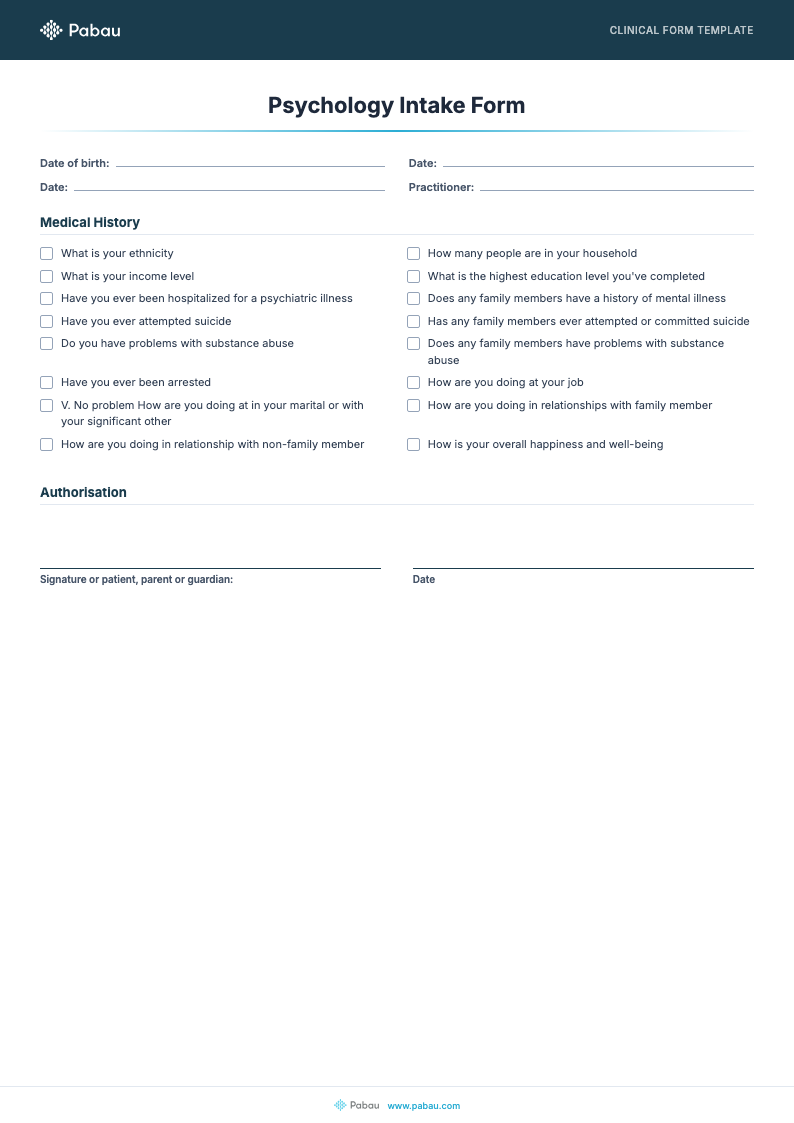
This comprehensive psychology intake form template is ready for immediate use in your practice. It captures all essential information mental health professionals need before beginning therapy: client contact details, emergency contacts, primary care and psychiatric provider information, complete medical and psychiatric history, family mental health history, substance use and abuse screening, employment and relationship functioning, suicidality assessment, and formal informed consent sections.
The template is HIPAA-compliant and designed for both paper completion and digital delivery through secure client portals. Customise the form to match your practice brand and add or remove sections based on your clinical focus (e.g. trauma screening, eating disorder history, autism assessment items). Use it as a foundation for your own intake workflows or integrate it directly into your practice management system.
A psychology intake form is a structured clinical document that serves as the gateway to therapy. It collects personal, medical, and psychological information systematically so clinicians can understand a client’s full context before designing treatment. The form typically spans 10-15 pages and covers five main domains: demographics (name, contact, emergency contacts, insurance), medical and psychiatric history (hospitalizations, diagnoses, current medications, past treatments), family history (mental illness, substance abuse, suicide in relatives), substance use and risk screening (alcohol, drugs, self-harm, suicidality), and informed consent (client acknowledgment of confidentiality limits, therapist credentials, treatment process).
In clinical practice, the intake form serves multiple critical functions. First, it documents informed consent – the client’s signed acknowledgment that they understand therapy’s limits, confidentiality exceptions (duty to warn, child abuse reporting), and their rights. Second, it screens for risk – identifying active suicidality, substance dependence, or psychiatric hospitalisation history that shapes treatment intensity and safety planning. Third, it establishes the clinical record – creating a baseline against which progress can be measured through standardised outcome tracking over time.
Fourth, the form protects both practitioner and client – legally documenting that the client consented to treatment and that the therapist collected appropriate risk information. From a regulatory standpoint, psychology licensing boards in most jurisdictions require documented intake assessment. The American Psychological Association (APA) recommends comprehensive intake assessment aligned with ethical practice standards. Forms without formal intake documentation may face liability in negligence claims or licensing investigations.
Digital intake forms have transformed this workflow. Rather than clients completing forms in the waiting room, modern practices send intake links via email 24-48 hours before the appointment. Clients complete forms remotely on any device, data syncs automatically to the practice management system, and clinicians review flagged items (suicidality, substance use) before the first session. This approach reduces appointment time spent on paperwork, improves data quality, and creates a professional first impression.
Implementing a psychology intake form in your practice follows a structured five-step workflow designed around clinical safety and administrative efficiency.

Pabau's digital forms system automates intake delivery, captures responses in real time, and links data directly to client records and treatment planning.

The psychology intake form is essential for any mental health practice, regardless of size, setting, or client population focus.
Private practice therapists and counsellors – solo practitioners and small group practices use psychology intake forms to establish professional standards from day one. A structured form demonstrates you take assessment seriously, creates a documented baseline for progress tracking, and protects you legally. Whether you specialise in anxiety, depression, trauma, family therapy, or life coaching, intake forms are non-negotiable. Therapy practice management software simplifies delivery and storage of these forms.
Psychology clinics and mental health centres – multi-disciplinary teams (psychologists, psychiatrists, counsellors, case managers) rely on standardised intake forms so all practitioners access consistent information. A shared form reduces duplication, ensures no risk item is overlooked, and supports collaborative treatment planning across disciplines.
Telehealth and online therapy platforms – digital-first therapy services depend on intake forms because there’s no waiting room to screen clients in person. Remote delivery allows therapists to review psychiatric history and risk factors before the first video call, making the session more efficient and safer. Telehealth software integrates intake data with video consultation workflows.
Psychiatric practices and psychiatry clinics – psychiatrists use intake forms to screen medication history, family psychiatric genetics, and substance use before prescribing. The form creates the clinical record psychiatry boards require during licensing audits.
ADHD assessment and coaching practices – practitioners screening for ADHD, conducting psychological assessments, or offering executive function coaching use psychology intake forms to capture developmental history, family psychiatric and neurodevelopmental history, and educational background.
Structured intake assessment delivers clinical, operational, and legal benefits that compound over time.
Clinical benefits. A comprehensive intake creates a rich, documented baseline. You understand family psychiatric history, past treatment response, substance use patterns, and current risk factors before designing treatment. This knowledge allows you to tailor interventions, anticipate complications, and build treatment plans on concrete information rather than assumptions. Clients feel heard – the form signals you care about their full story.
Risk management and safety. Intake forms systematically screen for suicidality, substance dependence, and psychiatric crisis. Documented screening protects you legally. If a client later experiences a negative outcome, your records show you assessed for risk, identified concerning patterns, and took appropriate action. The form becomes evidence of standard-of-care assessment.
Regulatory compliance. Psychology licensing boards in most jurisdictions require documented intake assessment. Your intake form demonstrates compliance with state regulations, APA ethical guidelines, and HIPAA documentation standards. During licensing audits or complaints investigations, your intake procedures are your defence. Compliance management tools help practices track and document their assessment procedures.
Operational efficiency. Digital intake forms mean clients complete assessment before arriving for their appointment. Clinicians review data before the session, not during it. The first appointment becomes therapy, not paperwork. Automated reminders reduce no-shows. Integrated data flows into treatment planning and outcomes tracking, eliminating manual re-entry.
Outcomes measurement. Intake baseline scores become the starting point for ongoing measurement. Standardised forms allow you to track progress quantitatively, demonstrating treatment effectiveness to clients, insurers, and licensing boards. Measurement tracking software automates outcome monitoring linked directly to intake data.
Audit your current psychology intake form against the sections in this template. Count how many items each section contains (demographics, medical history, psychiatric history, substance use, risk screening, consent). If your form skips entire domains – for example, no family psychiatric history or no substance abuse screening – you’re missing critical clinical information. Redesign sections based on the template, then field-test with 5-10 new clients and gather feedback on clarity and completion time before rolling out system-wide.
Every psychology intake form should include core sections aligned with clinical best practice and regulatory standards.
Capture full legal name, preferred name and pronouns, date of birth, address, email, and primary contact phone. Include emergency contact names and phone numbers (typically a family member or trusted friend). This basic information ensures you can reach the client, document their identity, and contact someone if they’re in crisis.
List the client’s primary care physician, psychiatrist (if any), and other relevant specialists with contact information. This allows you to coordinate care, request prior records, and communicate with other providers with appropriate consent.
Ask whether the client has ever been hospitalised for psychiatric illness (dates, diagnoses, treatments). Document past therapy, medications tried, diagnoses they’ve received, and whether they’ve ever been on psychiatric medications. This history shapes treatment planning and helps you avoid repeating ineffective approaches.
Assess whether family members have mental illness (depression, anxiety, bipolar disorder, psychosis, personality disorders), substance abuse, or suicide. Family history is one of the strongest predictors of psychiatric risk. A client with multiple relatives with depression or bipolar disorder is at higher genetic risk.
Ask about alcohol, cannabis, and other drug use patterns. Determine whether the client feels their substance use is a problem. Screen for past substance abuse treatment. Active substance abuse complicates therapy and may require specialised treatment.
Ask directly: “Have you ever attempted suicide?” and “Has any family member ever attempted or committed suicide?” Assess current suicidal thinking, plans, access to means, and protective factors. Document this screening meticulously. AI-powered clinical documentation can help flag suicide risk items for immediate review.
Include statements about confidentiality limits (duty to warn, child abuse reporting), your clinical credentials, the therapy process, and client rights. Obtain a signature from the client, parent (if minor), or guardian. Digital form software captures e-signatures securely within the client record.
The shift from paper to digital intake forms has transformed how psychology practices operate. Understanding the advantages of each approach helps you choose the right method for your setting.
Modern practice management systems allow therapists to send intake form links via email or SMS before the appointment. Clients complete forms on any device – phone, tablet, or computer – from home. Responses sync automatically to the practice database. Clinicians review completed forms before the session, flagging risk items or missing data. Digital delivery is HIPAA-compliant when transmitted through encrypted client portals.
Advantages of digital intake: Clients complete forms at their own pace and have time to think carefully about answers. Data is captured in structured fields (no illegible handwriting). Response rates improve – clients reminded 24 hours before appointments are more likely to complete intake before arrival. You reduce first-appointment time spent on paperwork. Automated reminders reduce no-shows. Data integrates directly into treatment planning, measurement tracking, and progress notes.
Clients arrive early and complete forms in the waiting room or bring pre-completed forms to the first appointment. The therapist can observe the client’s approach to the form and clarify confusing responses in real time.
Advantages of paper intake: Works for all age groups and technical abilities. No platform required. Tangible record. Observation of client’s writing and engagement can provide clinical insight. Disadvantages: Reduces appointment time available for therapy. Response rates are lower (clients rush). Handwriting can be illegible. Manual data entry into electronic records is time-consuming. Paper creates compliance and storage challenges.
Best practice: Use digital intake as your default. Send forms 24-48 hours before appointments. Offer paper as a backup option for clients who request it or lack email access. Review submitted forms before the session and follow up on missing data during the first appointment.

Looking for guidance on consent documentation in therapy? Group Therapy Informed Consent provides a framework for documenting client understanding of therapy boundaries, confidentiality, and rights.
Need a structured approach to clinical assessment? Psychiatric Evaluation Template outlines comprehensive evaluation procedures for mental health clinicians.
Want to streamline client onboarding with digital forms? Capture Forms Software enables secure digital intake delivery through client portals with automated workflows.
Seeking to integrate intake data with treatment planning? Client Portal links intake responses directly to client records, supporting seamless treatment documentation.
A psychology intake form is more than paperwork – it’s the clinical and legal foundation of your practice. It signals professionalism to clients, demonstrates compliance to regulators, captures risk systematically, and creates a baseline for measuring outcomes.
The template provided in this guide covers every essential domain: demographics, emergency contacts, medical history, psychiatric history, family history, substance use, risk screening, and informed consent. Customise it for your specific client population (add ADHD assessment items, trauma screening, eating disorder history, or autism screening as relevant), then implement it digitally through a secure client portal.
Digital delivery transforms the intake experience. Clients complete forms before arriving, data integrates automatically into your records, and you review flagged items before the first session. This approach improves efficiency, reduces no-shows, and creates a professional impression from the start. Start with the downloadable template, implement it in your practice next month, and refine based on feedback. Within weeks, you’ll notice better-informed first sessions, clearer treatment planning, and stronger compliance documentation.
Mental health practitioners (therapists, psychologists, psychiatrists, counsellors, life coaches, ADHD assessors) use intake forms to standardise client assessment. Any mental health practice, from solo practitioners to large clinics, benefits from structured intake.
Intake forms capture essential clinical information before treatment begins, screen for safety risks (suicidality, substance abuse), document informed consent, establish a baseline for outcome measurement, and create a medical record that satisfies regulatory requirements.
Client demographics, emergency contacts, health care provider information, complete medical and psychiatric history, family psychiatric history, substance use screening, suicidality and self-harm assessment, employment and relationship functioning, and informed consent declarations with signatures.
Benefits include comprehensive risk assessment, regulatory compliance, improved clinical decision-making, operational efficiency (digital delivery saves appointment time), professional credibility, and documented baselines for outcomes tracking.
Before every new therapy relationship. Send the form 24-48 hours before the first appointment via email or client portal. Review completed forms before the session to identify any risk items or missing information requiring discussion.
Use encrypted client portals for digital delivery, transmit forms via secure email (not standard email), store completed forms in HIPAA-compliant practice management systems with access controls, and include confidentiality notices on the form itself.