Primary & Preventive Care
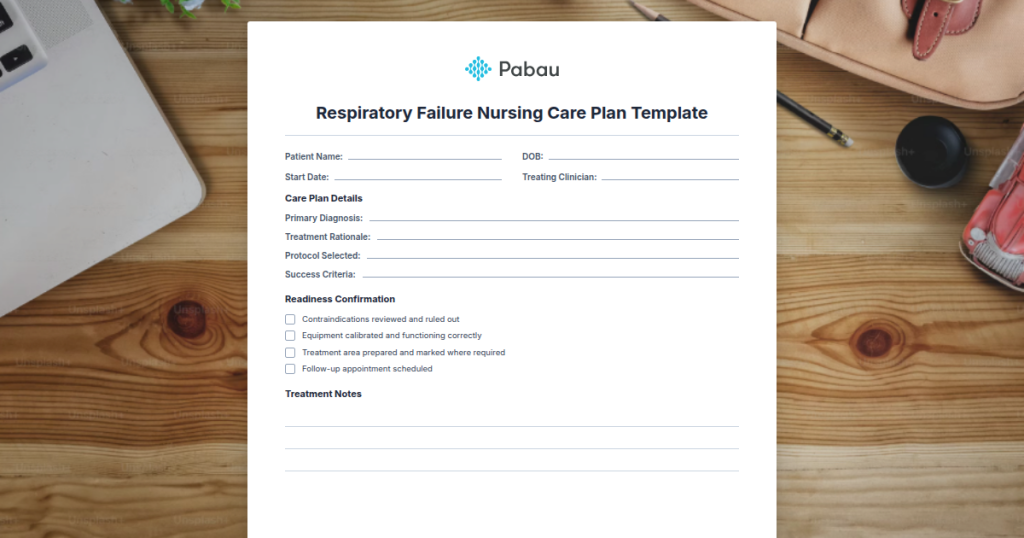
Respiratory Failure Nursing Care Plan Template
A Respiratory Failure Nursing Care Plan Template provides clinicians with a syst...

March 17, 2026


Buy now, pay later is now available in Pabau

Read case studies from our satisfied clients

Compare Pabau with alternative systems
 Integrations
 Measure Pabau savings
  Our security commitment
  About us
Learn why this holistic care and aesthetic medicine clinic chose Pabau to power patient care and performance.
Read more

ITB Syndrome Exercises Handout Template provides structured rehabilitation protocols clinicians can print and distribute to patients
Stretching and foam rolling reduce tensor fasciae latae tension and restore hip mobility within 4-6 weeks
Progressive strengthening of gluteus medius and hip abductors addresses underlying biomechanical deficits
Return-to-activity criteria based on pain scale and functional milestones reduce re-injury risk
The iliotibial band is a thick fascial band running along the outer thigh, anchoring from the tensor fasciae latae and gluteus maximus to the tibia. ITB syndrome occurs when this band becomes tight and inflamed, typically from overuse, weakness in hip stabilisers, or biomechanical imbalances. An ITB Syndrome Exercises Handout Template serves as a clinical tool for physical therapists, sports medicine practitioners, chiropractors, and other clinicians to deliver consistent, evidence-based rehabilitation guidance to patients.
The template documents patient-specific exercise progressions, contraindications (absolute and relative), and structured return-to-activity timelines. Clinicians use it to ensure every patient receives the same quality of instruction, reducing liability risk and improving compliance. The handout also functions as a take-home reference, allowing patients to continue guided rehabilitation between sessions and reinforcing the clinical framework established in practice.
Regulatory frameworks like the Chartered Society of Physiotherapy (CSP) and the American Physical Therapy Association (APTA) emphasise the importance of written patient education materials that document the clinical rationale and expected timeline for recovery. A standardised template demonstrates professional competence and supports clinical audit requirements in regulated healthcare environments.
A comprehensive rehabilitation resource covering therapeutic exercises, stretching progressions, strengthening protocols, and return-to-activity milestones for iliotibial band syndrome management.
Download templatePhysical therapy clinics treating running injuries and musculoskeletal pain benefit most from this template. Sports medicine practices working with athletes at all levels-from weekend runners to semi-professional competitors-use standardised handouts to accelerate recovery and maintain training capacity. Chiropractors managing lower-limb complaints find the handout bridges biomechanical adjustment with active rehabilitation, improving patient satisfaction and outcomes.
Osteopaths and integrative medicine practitioners incorporate the handout into multimodal treatment plans. Occupational therapists working with patients whose ITB syndrome affects work function use the template to document functional recovery goals and return-to-work timelines. Physiotherapy clinics in the UK, Australia, and other Commonwealth nations find the template aligns with professional standards set by the CSP and Sports Medicine Australia.
Multi-location clinics benefit particularly-a standardised template ensures every patient at every location receives the same evidence-based guidance, reducing variation and improving audit compliance. Solo practitioners can print and distribute the handout immediately, saving time on handwritten notes and improving documentation consistency.
Consistency and risk mitigation. A templated approach ensures every clinician in the team follows the same progression protocol, reducing the risk of under-treating or over-prescribing exercise intensity. Written exercise guidance creates a documented trail of clinical decision-making, supporting professional indemnity and audit compliance.
Patient compliance and outcomes. Patients who receive a printed handout they can reference at home are significantly more likely to complete home exercise programmes correctly. The handout also clarifies exercise-induced pain (expected during the subacute phase) versus new injury pain (reason to pause progression), improving patient safety.
Time savings during consultations. Handing the patient a pre-written template eliminates time spent explaining exercise progressions verbally. Clinicians spend consultation time assessing and modifying the protocol, not repeating instructions. This allows practitioners to see more patients while maintaining quality.
Continuity across practitioners. When a patient switches from one clinician to another (due to scheduling or cross-coverage), the template ensures seamless continuity. The new practitioner knows exactly where the patient is in the protocol and can adjust accordingly. This is particularly valuable in multi-location practices.
Myofascial release using foam rolling or massage tools is the foundation of early-stage ITB treatment. The technique reduces tension in the tensor fasciae latae and ITB itself, restoring length and tissue extensibility. Patients typically report pain reduction within 2-3 sessions when foam rolling is performed daily (90 seconds per leg).
Stretching sequences progress from static holds (30-second tension while lying down) to dynamic stretching (active movement through range while standing). The figure-four stretch and piriformis stretch address underlying hip external rotator tightness, a key driver of ITB overload. Most patients experience measurable hip flexion and abduction range improvement within 4 weeks of consistent stretching.
Sports medicine practitioners often combine stretching with manual therapy-soft tissue release by the clinician followed by active-assisted stretching creates faster tissue adaptation than either method alone. The template documents this dual approach, ensuring team members apply consistent technique.
Hip abductor weakness, particularly in the gluteus medius, is the primary biomechanical driver of ITB syndrome in runners. Strengthening exercises target this deficiency systematically. Early-stage exercises (weeks 1-2) include supine hip abduction and side-lying clamshells at low resistance. Intermediate exercises (weeks 3-4) introduce standing abduction with resistance bands and single-leg stance work. Advanced exercises (weeks 5-6) include lateral band walks, step-ups, and single-leg squats.
Return-to-running criteria should be pain-based and functional, not calendar-based. Once the patient tolerates 30 minutes of pain-free walking, introduce run/walk intervals: 1 minute running alternating with 2 minutes walking, repeated for 20 minutes total. Progression follows: once achieved pain-free, increase running intervals to 2-minute runs with 1-minute walks. Build to continuous 20-minute runs, then gradual pace increase. Full running activity is appropriate only when pain remains below 2/10 throughout and for 24 hours post-session.

See how Pabau's digital forms and patient portal help you distribute standardised handouts, track patient compliance, and simplify documentation workflows.

When distributing an ITB Syndrome Exercises Handout Template, document patient acknowledgment-a signed copy in the record confirms the patient received the handout and understood the protocol. Include absolute contraindications (active inflammation, undiagnosed pain, recent surgery) and relative contraindications (pain greater than 5/10, neurological symptoms, structural damage) clearly on the template.
The handout must clarify the distinction between therapeutic pain (muscle fatigue during exercise) and concerning pain (sharp, stabbing, or neurological symptoms). Patients should know when to pause and contact the clinic. Document pain thresholds: exercise is appropriate if pain is ≤3/10 during activity and returns to baseline within 2 hours. Pain ≥4/10 or increasing pain over consecutive days signals the need for protocol modification.
Reviewed against current APTA guidelines and sports medicine best practices for lower-limb rehabilitation.

Need to streamline patient handout distribution? Digital forms and patient portals allow you to deliver templated handouts electronically, track patient acknowledgment, and improve compliance documentation.
Want to automate patient education workflows? AI-assisted clinical documentation helps you generate personalised exercise recommendations while maintaining consistency with your ITB protocol.
Looking to measure patient outcomes across teams? Physical therapy practice management software enables centralised tracking of exercise compliance and pain progression metrics.
The ITB Syndrome Exercises Handout Template transforms patient rehabilitation from ad-hoc instruction to structured, documented protocol. By combining myofascial release, progressive stretching, and systematic strengthening with clear return-to-activity milestones, clinicians guide patients to durable recovery and reduced recurrence risk. The template also serves as a professional documentation tool, supporting audit compliance, team consistency, and medicolegal protection. Practices using standardised handouts report higher patient compliance, faster functional recovery, and improved team efficiency-making the template a valuable investment for any clinic treating lower-limb musculoskeletal conditions.
Most patients see symptom improvement within 2-3 weeks and return to running within 6-8 weeks if they follow the protocol consistently. Recovery timeline depends on severity, compliance, and underlying biomechanical deficits. Some patients improve faster; others require 10-12 weeks.
Progression should always be pain-guided, not time-based. If a patient is pain-free and strong at week 2, advance to week 3 exercises. If pain increases, hold at the current level or regress. The template is a guide; individual variability is normal.
Foam rolling is contraindicated if acute inflammation is present or if the patient has unstable knee/hip structures. For most subacute and chronic ITB cases, foam rolling is safe and effective. Always assess the patient before recommending any home modality.
Multi-site pain often indicates biomechanical compensation patterns. Modify the ITB Syndrome Exercises Handout to address all affected areas. Consult the patient’s imaging and examination findings to prioritise which structure requires the most attention first.
Yes. Athletes training for endurance events can use a preventive version of the template during off-season conditioning. Focus on hip strengthening and flexibility maintenance to reduce ITB syndrome risk during competitive phases.