

Musculoskeletal & Pain Management Physical Therapy
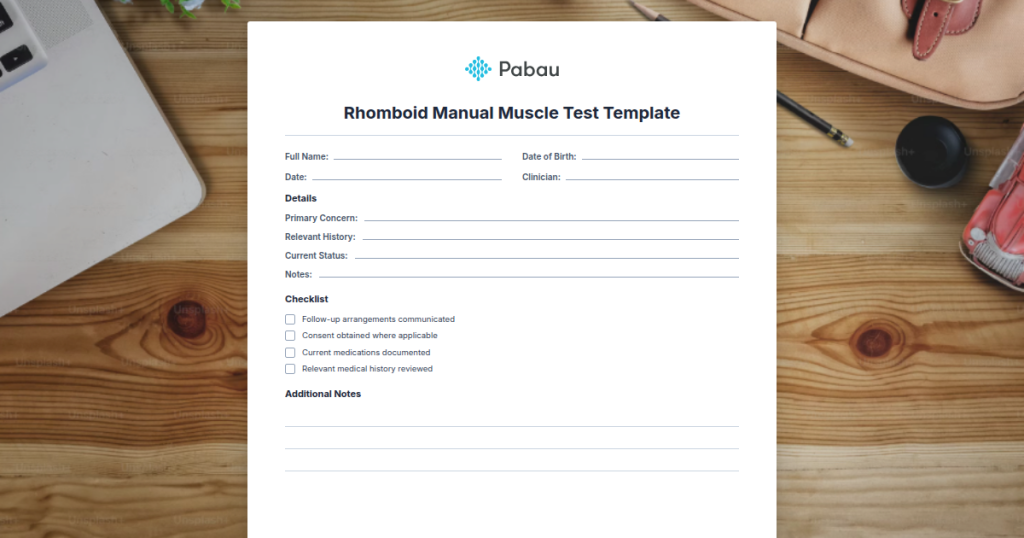
Rhomboid Manual Muscle Test Template
What is the Rhomboid Manual Muscle Test? Physical therapists and physiotherapist...

April 6, 2026


Buy now, pay later is now available in Pabau

Hand pain diagrams standardise patient assessment across clinicians and visits.
Visual mapping improves diagnostic accuracy for conditions like carpal tunnel and trigger finger.
Structured documentation supports ICD-10-CM coding and insurance billing workflows.
Digital diagrams integrate with patient portals for pre-visit completion.
Evidence-based templates reduce documentation time and clinical liability.
Hand pain affects millions of patients annually across physiotherapy, chiropractic, orthopaedic, and general practice settings. Yet clinicians often struggle to document exactly where and how pain manifests-relying on verbal descriptions that vary between visits and practitioners. A hand pain diagram solves this problem. It provides a standardised visual tool for patients to map pain location, intensity, and patterns in real time, capturing diagnostic detail that written notes cannot. This article explores what a hand pain diagram is, how clinics use it effectively, and why downloadable templates have become essential in modern clinical workflows.
For physiotherapists treating repetitive strain injury, for chiropractors evaluating nerve compression syndromes, and for orthopaedic nurses preparing patients for surgery, the hand pain diagram template standardises intake data. Research on structured hand assessment tools-particularly the Katz hand diagram used in carpal tunnel diagnosis-demonstrates that visual symptom mapping improves diagnostic accuracy and supports evidence-based treatment planning. Beyond clinical utility, diagrams create a permanent, timestamped record that satisfies regulatory requirements under HIPAA and CMS documentation standards.
A ready-to-use assessment diagram for mapping hand pain location, intensity, and distribution patterns to support clinical diagnosis and documentation.
Download templateA hand pain diagram is a clinical assessment tool that enables patients to visually mark pain location, intensity, and characteristics on anatomical hand outlines. The diagram typically shows dorsal (back) and palmar (front) hand surfaces, divided into zones corresponding to nerve territories, anatomical structures, and common injury sites. Clinicians use the completed diagram to identify pain distribution patterns-whether symptoms follow a dermatome, a nerve pathway, or a specific joint-which guides differential diagnosis.
The tool serves a dual purpose: clinical and legal. Clinically, it captures patient-reported symptom distribution at a specific moment in time, reducing the subjective interpretation gap between what patients describe and what clinicians document. Legally, it creates an objective record that demonstrates informed consent, thorough assessment, and attention to regulatory compliance under HIPAA privacy rules and CMS documentation standards. For conditions like carpal tunnel syndrome, where diagnosis depends partly on symptom distribution, structured hand diagrams have been validated in research as supporting clinical decision-making. Research shows the hand diagram is valuable in diagnosing carpal tunnel syndrome with 80% sensitivity and 90% specificity among patients with upper extremity paresthesias.
Modern versions integrate with digital intake forms, allowing patients to complete diagrams via clinic portals before arrival. This pre-visit workflow shifts administrative burden away from clinic staff and ensures clinicians receive consistent, timestamped data at each appointment.
Implementing a hand pain diagram workflow requires five key steps grounded in real clinic operations. Each step moves from initial patient instruction through documentation and clinical decision support.
Clinics that embed diagram completion into pre-visit workflows report 30-40% faster appointment starts and more complete initial assessments. When patients have already marked pain distribution before sitting down, clinicians can focus appointment time on differential diagnosis rather than gathering basic symptom data.

Hand pain diagrams work best when patients complete them before arrival. See how Pabau's digital forms automate pre-visit assessment and link directly to clinical records.

Hand pain diagrams benefit a broad range of healthcare practitioners and specialities. Physiotherapists treating repetitive strain injury, post-surgical hand rehabilitation, and nerve compression syndromes use diagrams to track symptom evolution across multiple visits. A patient recovering from carpal tunnel decompression will show progressively smaller pain zones as median nerve compression resolves-the diagram visually demonstrates functional improvement that measurements alone might miss.
Chiropractors and osteopaths use hand pain diagrams to assess whether symptoms correlate with cervical or thoracic spine dysfunction. Pain distributed across multiple fingers may suggest a nerve root compression at C6 or C7, while isolated thumb pain might indicate a more distal, local cause. The carpal tunnel syndrome clinical practice guidelines from the American Physical Therapy Association recommend structured assessment tools for differential diagnosis, while isolated thumb pain might indicate a more distal, local cause. Orthopaedic nurses preparing patients for hand surgery rely on diagrams to document baseline symptom severity, which becomes a critical comparison point post-operatively.
General practitioners and urgent care clinics use hand pain diagrams for triage and referral decisions. A patient presenting with sudden, severe pain in the index and middle fingers with associated swelling may warrant urgent nerve compression assessment and specialist referral, while gradual onset across multiple zones might suggest inflammatory arthropathy requiring different investigation. Mental health practitioners and occupational health nurses working with patients experiencing stress-related pain or work injury also employ diagrams to document the relationship between activity patterns and symptom distribution.
Improved diagnostic accuracy. Structured symptom mapping eliminates the ambiguity of verbal descriptions. When a patient says “my hand hurts,” a clinician might interpret that as global hand pain or localised finger pain. A diagram shows exactly which anatomical regions the patient perceives as painful, which directly informs differential diagnosis. Studies on the Katz hand diagram demonstrate that clinicians using structured diagrams achieve higher diagnostic accuracy for carpal tunnel syndrome compared to clinical assessment alone.
Standardised documentation and compliance. Regulators and insurers expect thorough, objective assessment documentation. A completed hand pain diagram-particularly one timestamped and attached to the patient record-demonstrates that you performed a systematic, methodical assessment. This evidence protects the clinic during audits and supports billing decisions. Research has also shown that catastrophic thinking was independently associated with larger pain areas on hand diagrams, suggesting that diagram markings may indicate patient coping strategies.
The American Academy of Orthopaedic Surgeonsand the American Society for Surgery of the Hand recommend documented pain assessment as part of standard musculoskeletal injury evaluation.
Treatment planning clarity. Once you understand the precise pain distribution, you can tailor treatment to the underlying cause. If pain follows a median nerve territory, median nerve mobilisation exercises become more justified than global hand stretching. The diagram guides you toward evidence-based intervention selection, improving patient outcomes and reducing unnecessary treatment.
Appointment efficiency. Patients who arrive with pre-completed diagrams save clinicians 5-10 minutes per appointment. Multiply this across a busy physiotherapy clinic seeing 20 patients per week, and the time saving is substantial. Pre-visit completion also means clinicians can focus consultation time on treatment and education rather than information gathering.
Longitudinal outcome tracking. Collecting diagrams at each visit creates a visual record of symptom evolution. After four weeks of physiotherapy, showing a patient that their pain zone has shrunk from covering the entire palm to just the thumb provides powerful evidence of progress-and motivation for continued treatment adherence.
Document the date, time, and patient position (sitting, standing, after activity) when the diagram was completed. Pain perception changes throughout the day and varies with posture. A hand pain diagram completed at 9am after a night of poor sleep differs diagnostically from one completed at 3pm after a morning of activity. Recording context ensures you and future clinicians interpret the diagram accurately.
Understanding common hand pain patterns helps clinicians interpret diagrams and guide diagnosis. Recent research has demonstrated that color-coded heatmaps for wrist pathologies can help clinicians visualize pain levels and locations to narrow differential diagnosis.
Median nerve compression (carpal tunnel syndrome)typically produces pain and paraesthesia in the thumb, index, middle finger, and radial (lateral) half of the ring finger. Patients often mark these zones with tingling or numbness rather than sharp pain, and symptoms frequently worse at night or after repetitive gripping. The diagram shows a clear demarcation at the midline of the ring finger, distinguishing median from ulnar nerve involvement.
Ulnar nerve compression presents inversely: pain and tingling in the little finger and ulnar (medial) half of the ring finger. Patients may report weak grip strength and difficulty with fine motor tasks. The diagram boundary runs along the opposite side of the ring finger compared to median compression, making differential diagnosis straightforward.
Trigger finger (stenosing tenosynovitis) produces localised pain at the base of one or two fingers, often with a catching or locking sensation. The diagram will show pain concentrated in a small zone at the palmar base rather than radiating along a nerve territory. This localised pattern helps distinguish trigger finger from nerve compression, which typically produces more dispersed symptoms.
De Quervain’s tenosynovitis causes pain at the thumb base and radial wrist, often radiating into the thumb and forearm. The diagram shows pain concentrated on the radial (thumb) side of the wrist and proximal thumb, which is pathognomonic for this condition. Patients often report pain when gripping or twisting objects.
Osteoarthritis of the hand produces pain across multiple joints rather than following a single nerve distribution. The diagram shows scattered pain zones at the DIP and PIP joints of multiple fingers, sometimes with redness or swelling marked by the patient. Unlike nerve compression, arthritis pain is usually worse with morning stiffness and improves with activity (until fatigue sets in).
Accurate hand pain documentation supports precise ICD-10-CM coding, which improves billing accuracy and supports clinical research. The diagram itself does not code pain; rather, it informs which code you select. Common hand pain ICD-10-CM codes include:
M79.3 – Panniculitis, unspecified (affecting hand). Used for diffuse soft tissue pain across the hand without a specific anatomical diagnosis.
G56.0 – Carpal tunnel syndrome. If the diagram shows classic median nerve distribution (thumb, index, middle, radial ring finger), code G56.0 (right or left side).
M25.5 – Pain in joint. For localised joint pain documented on the diagram, followed by the specific joint code (e.g. M25.51 for hand/wrist pain).
M71.0 – Abscess of bursa. For trigger finger or other tendon sheath inflammation, when the diagram shows localised finger base pain consistent with stenosing tenosynovitis.
Document the diagram attachment in your assessment note: “Patient-completed hand pain diagram attached showing pain localised to thumb, index, and middle finger with reported numbness in median distribution-consistent with carpal tunnel syndrome. Code G56.00.” This documentation link ensures that billing and clinical records align, reducing claims denials and supporting audit defence.
To reduce administrative burden, many clinics now use AI-powered clinical documentation tools that automatically suggest ICD-10-CM codes based on diagram findings and assessment notes. This integration accelerates coding accuracy and reduces the manual review time needed before claim submission.
A hand pain diagram transforms patient assessment from subjective verbal description into objective, visual, timestamped documentation. For physiotherapists, chiropractors, orthopaedic practitioners, and general clinicians, the diagram accelerates diagnostic clarity, supports evidence-based treatment planning, and protects the clinic through comprehensive compliance documentation. When integrated into digital intake workflows, diagrams also improve appointment efficiency-patients arrive with data already captured, clinicians focus on treatment and education, and administrative staff spend less time on manual data entry.
The free hand pain diagram template provided above is ready to print and use immediately. Consider implementing diagram completion as a standard part of your intake process for all hand pain presentations. Over time, you’ll build a visual record of common pain patterns in your patient population, which informs your clinic protocols and treatment protocols. Start with one template, measure how it affects your assessment quality and appointment flow, then expand the practice systematically.
Yes. Sending the diagram link via email or SMS 24 hours before arrival allows patients to complete it at home, in a calm environment where pain perception may be more accurate. Pre-completed diagrams save appointment time and reduce clinic administrative burden. Digital forms automatically timestamp completion, creating a dated record.
A hand pain diagram focuses specifically on the hand’s anatomy and nerve territories, allowing detailed assessment of finger pain distribution and localisation. A general body map covers the entire body and lacks the anatomical detail needed for differential diagnosis of hand conditions like carpal tunnel syndrome or trigger finger.
Complete a fresh diagram at the first appointment and then at each 4-week interval, or when symptoms change significantly. Comparing diagrams longitudinally shows whether pain zones are shrinking or spreading, which provides objective evidence of treatment progress and guides adjustments to your intervention plan.
Hand pain diagrams work best for conditions with defined pain distributions: nerve compression, arthritis, tendinitis, and post-surgical pain. Diagrams are less useful for diffuse inflammatory conditions where pain covers the entire hand uniformly. Use clinical judgement to determine when a diagram will add diagnostic value.
Generic hand outlines are universally readable across all specialities. Whether you’re a physiotherapist, chiropractor, orthopaedic nurse, or general practitioner, the same anatomy applies-thumb, fingers, palm, dorsum, and nerve territories remain constant. A diagram completed at one clinic transfers clinically to another, though each clinic should retain a copy for their own records.