Primary & Preventive Care Wellness
75 Hard Challenge PDF Template
Key Takeaways Structured 75-day fitness and mental toughness challenge combining...

March 5, 2026

Discover free eBooks, guides and med spa templates on our new resources page


Buy now, pay later is now available in Pabau

Read case studies from our satisfied clients

Compare Pabau with alternative systems
 Integrations
 Measure Pabau savings
  Our security commitment
  About us
Learn why this holistic care and aesthetic medicine clinic chose Pabau to power patient care and performance.
Read more

Standardised behavioral assessment tool for identifying emotional and developmental concerns
Designed for children and adolescents aged 6-18 years across clinical and educational settings
Supports systematic evaluation of internalising and externalising problem behaviours
Enables consistent documentation for treatment planning and progress monitoring
An aberrant behavior checklist template is a standardised assessment instrument used by mental health professionals to measure and document problem behaviours in children and adolescents. The acronym ABC reflects its purpose: identifying abnormal or atypical behaviours that deviate from developmental norms. This checklist serves as a foundational clinical tool across psychology, psychiatry, occupational therapy, and applied behaviour analysis (ABA) settings.
The aberrant behavior checklist template captures a comprehensive range of behavioural domains. It systematically evaluates internalising problems (anxiety, withdrawal, emotional dysregulation) alongside externalising concerns (aggression, rule-breaking, impulse control difficulties). Clinicians use the template to establish baseline behavioural profiles, track therapeutic progress, and communicate assessment findings to parents, teachers, and other stakeholders.
Designed for structured assessment, the aberrant behavior checklist template translates complex behavioural observation into quantifiable data. This standardisation supports evidence-based treatment planning and regulatory compliance-critical for clinics operating under behavioural health documentation standards.
Using an aberrant behavior checklist template requires a structured five-step clinical workflow that ensures comprehensive coverage and consistent documentation.
This systematic approach transforms raw behavioural observation into clinically actionable data. By following each step, practitioners ensure they capture the full complexity of a child’s behavioural profile.
A comprehensive standardised assessment tool that evaluates behavioral and emotional problems in children and adolescents across multiple dimensions including internalising and externalising behaviours.
Download template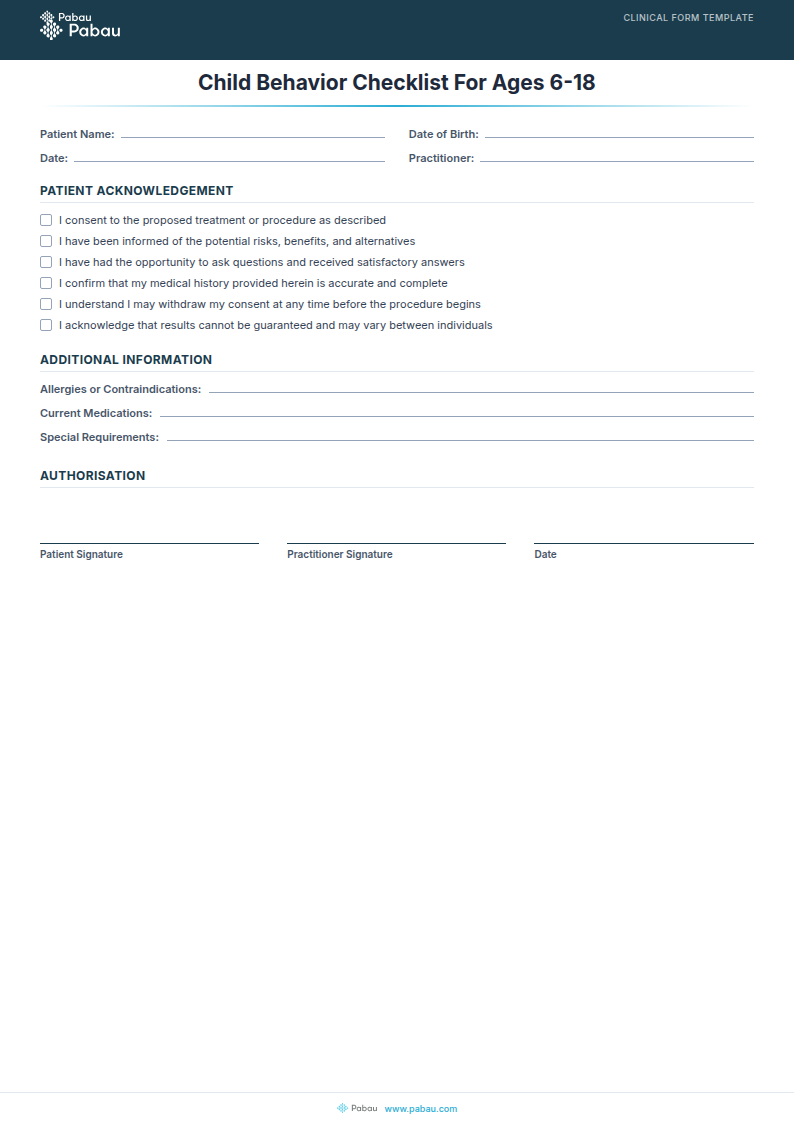
The template is immediately ready for clinical use. No configuration needed-print, distribute, score, and integrate into patient records within minutes. Automated clinical documentation tools can streamline note-writing after assessment completion, saving time while maintaining clinical rigour.
The aberrant behavior checklist template applies across multiple clinical and educational sectors where child behavioural assessment informs care decisions.
Structured behavioural assessment offers operational and clinical advantages that extend beyond documentation compliance.
Objective measurement and standardisation: The aberrant behavior checklist template replaces subjective clinical impressions with quantifiable data. Standardised scoring enables clinics to compare a child’s current functioning against established normative samples, reducing diagnostic bias and improving treatment precision.
Multi-informant consistency: Behaviour varies across settings-home, school, clinical office. The template’s structured format allows clinicians to systematically collect observations from multiple caregivers and educators, revealing environmental and contextual factors that shape behavioural presentation.
Treatment response tracking: Objective baseline scores provide a measurable endpoint for progress monitoring. Periodic reassessment demonstrates whether therapeutic interventions are effective or require modification, supporting clinical decision-making and justifying continued care to insurers and families.
Regulatory and insurance compliance: Mental health documentation standards increasingly require standardised outcome measures. Using a validated aberrant behavior checklist template ensures compliance with HIPAA requirements and supports insurance authorisation for ongoing treatment.
Communication clarity: Quantified behavioural data communicates assessment findings more effectively to parents, school systems, and medical teams than narrative descriptions alone. Numerical scores and domain breakdowns simplify case conferences and inter-agency collaboration.
Several operational factors influence successful template implementation in your practice setting.
Scoring accuracy and clinician training: Correct interpretation of the aberrant behavior checklist template depends on clinician familiarity with scoring conventions and normative thresholds. Ensure staff understand domain-specific cut-scores and what elevated scores indicate clinically. Brief standardisation training reduces scoring errors and improves diagnostic accuracy.
Multi-setting data collection logistics: Gathering completed checklists from school staff, teachers, and parents requires coordination. Digital form distribution through ADHD-focused practice management systems accelerates data collection and reduces missing information.
Longitudinal tracking and documentation: The aberrant behavior checklist template’s true value emerges through repeated administration. Establish protocols for reassessment intervals (typically 4-8 weeks during treatment) and ensure scores are documented and trended within the patient’s clinical record for easy progress review.
HIPAA-compliant storage: Behavioural assessment data constitutes protected health information (PHI). Store completed checklists securely with access restricted to clinical team members. Digital storage systems must encrypt data in transit and at rest, satisfying HIPAA Security Rule requirements.

Pabau's digital forms and clinical note automation reduce time spent on administrative tasks so clinicians focus on patient care. Centralise all assessment data, track outcomes, and ensure compliance with regulatory standards.

Integrating the aberrant behavior checklist template into clinical workflow requires attention to broader assessment best practices that maximise validity and clinical utility.
Contextual screening and developmental history: Before administering the aberrant behavior checklist template, gather comprehensive developmental and environmental history. Traumatic experiences, developmental milestones, school transitions, family stressors, and medical history all contextualise behavioural presentation. Mental health EMR systems allow clinicians to maintain integrated records linking behavioural assessment to historical context.
Collaborative care coordination: Behavioural assessment is most effective when school staff, parents, and medical providers communicate findings and coordinate interventions. Multi-disciplinary team meetings using shared assessment data ensure consistency across care settings and prevent fragmented treatment approaches.
Informed consent and cultural sensitivity: Explain the purpose and scope of behavioural assessment to caregivers before administration. Be mindful that behavioural norms vary across cultural contexts-scores may reflect cultural differences in emotional expression or parenting practices rather than clinical pathology. Interpret results within the family’s cultural framework.

Looking for evidence-based ADHD assessment protocols? How to Score the Vanderbilt ADHD Rating Scale provides a step-by-step guide to administering and interpreting another key paediatric behavioural screening tool used alongside the aberrant behavior checklist template.
Need structured guidance for clinical note-writing after assessment? Psychiatric Evaluation Template offers a framework for documenting comprehensive mental health assessments, ensuring consistent and thorough clinical records.
Want to integrate behaviour tracking into practice operations? Mental Health EMR Software centralises assessment data, automates progress tracking, and supports regulatory compliance for behavioural health practices.
The aberrant behavior checklist template is a foundational tool for child and adolescent behavioural assessment across psychology, psychiatry, occupational therapy, and educational settings. By systematising observation and translating behaviour into quantifiable data, the template supports accurate diagnosis, effective treatment planning, and objective progress monitoring. Integrating the checklist into your clinical workflow-whether through digital forms or traditional paper administration-ensures rigorous, compliant, and family-centred care. Download the template today and establish structured behavioural assessment as a cornerstone of your clinical practice.
The template is designed for children and adolescents typically aged 6-18 years. Different versions may exist for younger children, so clinicians should verify age-appropriate scoring norms before administration.
Readminister the template every 4-8 weeks during active treatment to objectively track therapeutic progress. More frequent administration may be warranted in intensive intervention settings; less frequent use is typical for maintenance or monitoring phases.
The template serves both functions. It contributes to diagnostic assessment by identifying problem behaviours that meet diagnostic criteria, and it objectively measures change during treatment, supporting progress monitoring and intervention adjustment.
Request completed checklists from parents, teachers, and other caregivers who observe the child across different settings. Digital form systems simplify distribution and collection, improving response rates and consistency.
Completed checklists contain protected health information (PHI) and must be stored securely with access limited to authorised clinical staff. Use encrypted digital storage systems and ensure physical forms are locked in confidential filing systems.