Coaching Mental Health & Therapy
7 Habits Printable Worksheets
The 7 Habits Printable Worksheets translate Stephen Covey’s foundational p...

February 22, 2026


Buy now, pay later is now available in Pabau

Stephen Covey’s 7 Habits framework builds personal and team effectiveness through structured habit development.
Worksheets provide clinicians with evidence-based tools to guide clients through goal setting and habit formation.
Template structure aligns with clinic workflows for mental health, therapy, coaching, and wellness practice.
Printable formats enable seamless integration into patient onboarding and session workflows.
The 7 Habits Printable Worksheets translate Stephen Covey’s foundational personal development framework into structured clinical tools for modern healthcare practices. These worksheets help therapy clinicians, mental health professionals, and coaching practitioners guide clients through systematic habit formation, goal setting, and long-term behaviour change aligned with Covey’s principles of proactive thinking, prioritisation, and continuous self-renewal.
Whether you’re running a psychology practice, therapy clinic, or wellness coaching business, these 7 habits printable worksheets reduce preparation time and standardise your approach to client development work. Teams can distribute them during intake, use them as session frameworks, or integrate them into post-session homework. Unlike generic worksheets, these are designed specifically for clinical environments where documented habit progress supports treatment planning and compliance.
This guide explains what the worksheets cover, how to implement them in clinic workflows, which practice types benefit most, and where to access them-plus actionable steps for embedding habit-based frameworks into your standard clinical process.
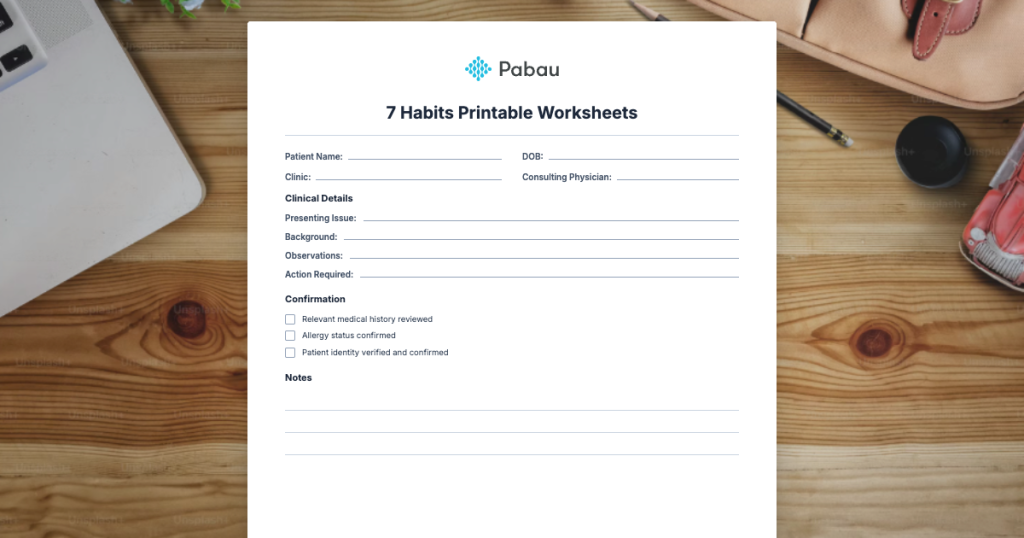
Structured worksheets covering all 7 habits with practical exercises for habit formation, goal setting, vision statements, priority planning, collaboration frameworks, and self-renewal practices. Ready to print and distribute to clients.
Download template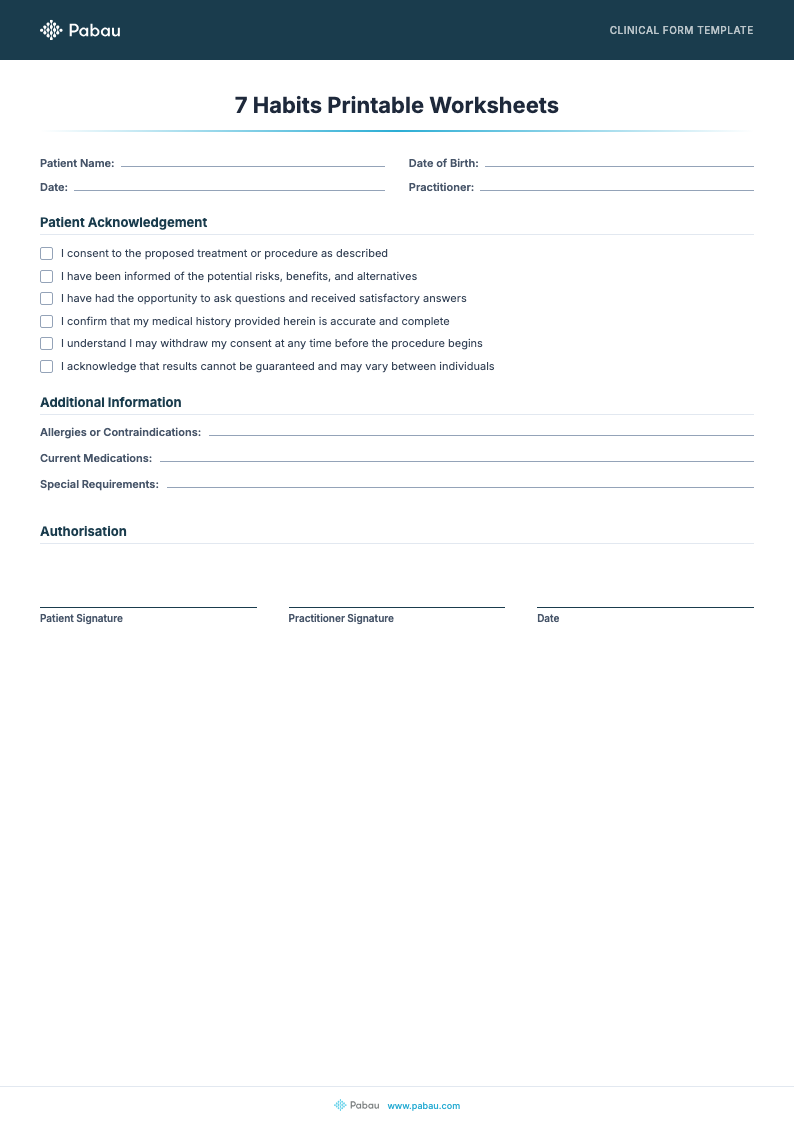
The 7 Habits framework, developed by Stephen Covey and first published in 1989, remains one of the most influential personal development systems in clinical and organisational settings. The framework divides into two foundational categories: private victories (habits 1-3, focused on personal effectiveness and self-mastery) and public victories (habits 4-7, focused on collaborative success and interdependence).
The 7 Habits Printable Worksheets translate these principles into structured templates that mental health professionals, therapists, coaches, and wellness practitioners can use directly with clients. Each worksheet guides users through one habit, offering reflection prompts, practical exercises, and action-planning spaces. The worksheets are grounded in the habit formation science that underpins behaviour change therapy-providing clinicians with evidence-aligned tools without requiring extensive training beyond standard clinical practice.
Unlike generic self-help materials, these worksheets are designed for clinical workflows. They function as session aids, homework assignments, treatment planning documents, and progress tracking tools. Clinics use them for intake processes, ongoing therapy sessions, coaching engagements, and post-session reinforcement. The printable format means no software integration required-they slot seamlessly into existing paper or digital record systems.
The framework’s emphasis on vision, priorities, and self-renewal makes it particularly suited to mental health and therapy contexts where long-term thinking, values alignment, and sustainable behaviour change are central treatment goals.
Implementing the 7 Habits Printable Worksheets in your clinic follows a practical five-step operational model that aligns with standard therapy and coaching workflows. Each step builds progressively on the previous, allowing clients to move through the habit framework at a sustainable pace while maintaining session structure and clinical documentation.
For clinics using digital intake forms, worksheets can be emailed or pre-printed for sessions, then scanned into the client record after completion. This ensures continuity whether your practice is fully digital or hybrid.

Automate client onboarding, session scheduling, and treatment planning with a practice management system designed for mental health and therapy clinics. See how Pabau integrates habit worksheets and clinical notes.

The 7 Habits framework applies across diverse mental health and wellness settings. Clinicians in these specialties report the strongest uptake and client engagement with the worksheets.
Therapy and Counselling Clinics use the worksheets as core session tools for talk therapy, cognitive behavioural therapy (CBT), and solution-focused work. Therapists appreciate the structured format because it aligns with goal-setting protocols and provides tangible homework assignments between sessions. Clients benefit from the actionable framework, which gives them language and tools to apply therapeutic concepts at home.
Psychology Practices (including individual and group psychology) integrate the worksheets into treatment plans for anxiety, depression, relationship issues, and life transitions. The habit-based approach resonates with clients seeking sustainable behaviour change rather than symptom management alone. Psychologists document worksheet progress as evidence of therapeutic intervention and client engagement.
Coaching Clinics and Wellness Centres use the worksheets as the primary framework for one-on-one executive coaching, life coaching, and team development. The worksheets provide structure for multi-session coaching engagements and serve as deliverables clients can reference long after the coaching relationship ends.
ADHD and Neurodevelopmental Clinics use the worksheets (simplified versions or with visual supports) to help clients develop executive function skills, time management, and relational awareness-three areas where the 7 Habits framework adds concrete value. The progressive structure from personal to interpersonal habits mirrors typical neurodevelopmental coaching progressions.
Occupational Therapy and Rehabilitation Services incorporate the worksheets into functional recovery programs where clients need structured goal-setting and habit-building support. The worksheets help clients envision their recovery trajectory and identify daily habits that support independence and well-being.
Accelerates session productivity. A structured worksheet reduces time spent explaining concepts and allows more time for therapeutic dialogue. Clients see the habit framework on paper immediately, enabling faster engagement with the work. Clinicians report sessions feel more focused and purposeful because the worksheet anchors both participant to the same objective.
Standardises your clinical approach. Using the same worksheets across your team ensures consistency in how clients are introduced to habit-building work. New therapists or coaches have a clear template to follow, reducing variation and training overhead. All clients experience the same quality and depth of framework exposure, supporting equal care standards and easier team supervision.
Provides audit-ready documentation. Completed worksheets become part of the clinical record, demonstrating that specific therapeutic interventions were delivered and that the client engaged with evidence-aligned tools. This is valuable during audits, clinical reviews, and compliance checks. The worksheets also support continuity of care if a client switches therapists-the new clinician can see exactly which habits were explored and at what depth.
Supports homework and real-world application. The worksheets function as take-home assignments, extending therapeutic work beyond the session. Clients apply habits in daily situations, then report back with concrete examples. This reinforces behaviour change and allows clinicians to support progress through secure messaging and track completion in their records. Research on habit formation shows that practice and feedback accelerate habit embedding-worksheets operationalise both.
Increases client ownership and accountability. Writing on worksheets (rather than just talking) creates a record the client owns. They can review their own responses, see their progress across habits, and refer back to the worksheets weeks or months later. This tangible artefact increases perceived ownership of the change process and supports long-term habit maintenance after the therapeutic relationship ends.
Reduces materials preparation time. A pre-made, ready-to-print worksheet template eliminates the need for clinicians to design their own materials. Your team can order, print, and stock the worksheets-or deploy digital versions in under a minute. This operational efficiency translates to lower session prep overhead and faster client onboarding.
Batch-assign 7 habits printable worksheets at the start of a therapy block or coaching engagement. Tell the client: ‘Over the next 7 weeks, we’ll explore one habit per session. Each week, you’ll complete the worksheet here, try it out at home, and we’ll review progress next time.’ This signals commitment, manages expectations about pacing, and creates natural session rhythm without weekly negotiation about topic.
Stephen Covey’s framework divides into two psychological movements: achieving private victory (independence) before pursuing public victory (interdependence). This sequencing matters clinically because clients cannot effectively collaborate, lead, or support others if they lack personal agency and clarity about their values.
The First Three Habits Build Self-Mastery: Habit 1 (Be Proactive) teaches stimulus-response awareness-the client observes their reactions and learns to choose responses aligned with values rather than impulse. Habit 2 (Begin with the End in Mind) asks clients to articulate their vision: who do they want to be, and what legacy do they want to leave in their relationships and work? Habit 3 (Put First Things First) operationalises that vision through prioritisation, distinguishing urgent tasks from important ones. Therapists working with anxiety, ADHD, or decision-making struggles find these three habits create the scaffolding for sustainable change.
The Next Three Habits Build Interdependence: Habit 4 (Think Win-Win) shifts from scarcity mindset to abundance thinking in relationships. Habit 5 (Seek First to Understand, Then to be Understood) emphasises empathic listening and perspective-taking-core skills in family therapy, couples work, and conflict resolution. Habit 6 (Synergize) teaches teams to leverage diverse viewpoints to solve problems no individual could solve alone. Clinics report that clients completing these three habits show measurable improvements in relational functioning and reduced interpersonal conflict.
Habit 7 (Sharpen the Saw) addresses continuous renewal across four dimensions: physical (health and exercise), mental (learning and growth), social/emotional (relationships and empathy), and spiritual (values and purpose). This habit anchors the entire framework-without renewal, burnout replaces progress. For therapy clients, Habit 7 often becomes the first habit they take seriously because it directly addresses self-care and preventing relapse.
The framework’s strength in clinical contexts is its integration of thinking (vision), feeling (empathy), and doing (action). Worksheets operationalise all three dimensions, making the abstract concrete and trackable.
Effective implementation of habit worksheets depends less on the worksheet design and more on how your clinic integrates them into existing workflows. Three operational models have proven most successful in mental health and therapy settings.
The Sequential Intake Model: Introduce the 7 Habits framework during the initial consultation or intake appointment. Explain it as the overarching structure for your work together. Provide a one-page overview describing all seven habits and position it as the roadmap clients will follow throughout treatment. This sets clear expectations: “We’ll work through these habits systematically, one every 1-2 weeks.” Clients appreciate transparency about the treatment arc, and clinicians benefit from having a predetermined structure that reduces session-to-session planning.
The Thematic Model: Integrate worksheets thematically into treatment modules. A client working on anxiety might start with Habit 1 (proactive response) and Habit 2 (vision of calm), skipping the others until later. A client in couples therapy might prioritise Habits 4-6 (win-win thinking, listening, synergy). This flexibility allows clinicians to tailor the framework to the client’s current need while maintaining the structure worksheets provide.
The Group and Workshop Model: Run workshops or group sessions where all clients work through a single habit together. This is particularly effective for coaching clinics using classes and group programs for habit-building. A “Habit 1: Be Proactive” workshop might run for one evening or a half-day, with all participants completing the worksheet and discussing real-world applications in a group setting. Workshops increase revenue per clinician-hour, create community, and demonstrate thought leadership.
Regardless of model, success depends on consistency: using the same worksheets every time, assigning homework, and reviewing progress. Clinics that implement worksheets inconsistently-some therapists using them, others not-report fragmented client experiences and reduced perceived value. Lock in one model, train your team, and execute systematically.

Want to automate client intake and reduce worksheet distribution time? Digital Forms let you email worksheets directly to clients pre-appointment or embed them into your intake process, eliminating printing and manual distribution.
Need to track which clients have completed each habit worksheet? Client Records store completed worksheets and link them to therapy notes, giving your team a complete habit progress history for each client.
Running group habit-building workshops or coaching cohorts? Classes and Groups Management allows you to schedule, track attendance, and manage participant progress across cohort-based habit-building programs.
The 7 Habits Printable Worksheets translate decades-old personal development science into modern clinical tools. By providing structure, accountability, and clear progression through Stephen Covey’s framework, they reduce session prep, standardise your clinical approach, and increase client engagement with behaviour change work.
Whether you’re a solo therapist, a multi-clinician practice, or a coaching firm, worksheets integrate into your existing workflows without software or training overhead. Download, print, use-and watch your clients progress from self-mastery to interdependence over seven focused habit cycles. For clinics using digital client portals, worksheets can be stored and shared digitally, creating a lasting record of the client’s development journey.
Most clinicians dedicate one session per habit (7 weeks) or two sessions per habit (14 weeks), depending on session frequency and client depth of exploration. Groups often compress the timeline to 7 weekly sessions, one habit per session. The worksheets are flexible and can be completed in 15-20 minutes or extended into deeper therapeutic work over multiple sessions.
Yes. The worksheets can be read aloud, and responses can be recorded verbally while the clinician writes. Some clinics use visual versions or simplified language versions of worksheets. The core framework adapts to any client’s literacy level when the clinician facilitates rather than relying on independent reading.
No. If you’re already a practising therapist, coach, or mental health professional, you understand the principles these worksheets convey. Reading Covey’s original book (or a summary) provides helpful context, but isn’t required. The worksheets themselves guide both clinician and client through each habit.
The framework applies well to adolescents and older children (age 10+). Language and examples need adjustment for younger ages. Many schools use simplified habit frameworks with younger children. Your clinical judgment about readiness and developmental stage should guide the decision to introduce the full framework.
Record the habit being explored in your session notes and link the completed worksheet as a supporting document. Note client responses and commitments made during the worksheet session. This creates a clear trail of therapeutic intervention and client progress that supports treatment planning and audit requirements.
The 7 Habits framework is based on decades of research in habit formation, goal-setting psychology, and organisational behaviour. While the specific worksheets are not independently research-validated, they operationalise principles supported by therapeutic literature on behaviour change, values clarification, and interpersonal effectiveness. Use them as adjuncts to your established clinical practice, not replacements.