



Mental Health & Therapy Speech Therapy
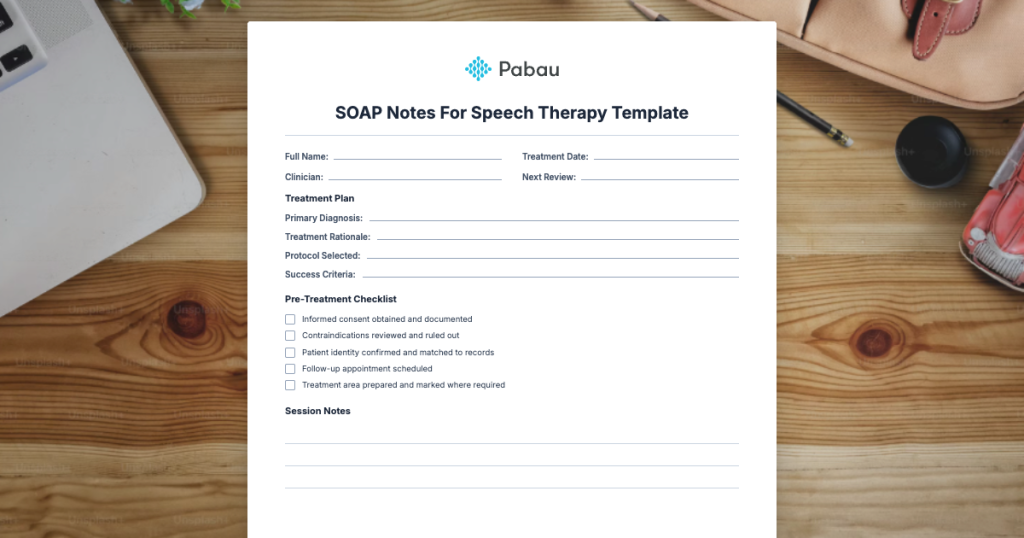
SOAP Notes For Speech Therapy Template
SOAP Notes for Speech Therapy: A Complete Documentation Framework Speech-languag...

February 26, 2026

Discover free eBooks, guides and med spa templates on our new resources page


Buy now, pay later is now available in Pabau

Read case studies from our satisfied clients

Compare Pabau with alternative systems
 Integrations
 Measure Pabau savings
  Our security commitment
  About us
Learn why this holistic care and aesthetic medicine clinic chose Pabau to power patient care and performance.
Read more

Face sheet medical forms capture critical patient information systematically.
HIPAA-compliant templates protect patient data throughout healthcare workflows.
Digital face sheets reduce documentation errors and improve clinic efficiency.
Standardised intake forms support informed clinical decision-making.
Service-specific customisation ensures forms meet each practice’s unique needs.
A face sheet medical template serves as the foundational patient intake document in any healthcare practice. It consolidates essential demographic information, medical history, allergies, current medications, insurance details, and emergency contact information into one standardised form. For clinic owners, practice managers, and clinicians managing patient records, a well-designed face sheet medical is the gateway to efficient, compliant patient documentation.
Unlike generic forms, a robust face sheet medical template ensures comprehensive documentation and prevents critical patient data from being missed at intake. It reduces the administrative burden on front-desk staff, prevents documentation gaps that can compromise clinical decision-making, and demonstrates compliance with healthcare regulations like HIPAA. Whether your practice manages a few patients per week or runs a multi-location clinic, understanding how to implement and use a face sheet medical template directly impacts both patient safety and operational efficiency.
This guide covers what a face sheet medical is, how to use one in your daily workflows, regulatory considerations, and how digital face sheet solutions compare to traditional paper-based systems. By the end, you’ll understand how to select or customise a template that fits your specific clinical environment and patient demographic.
A ready-to-use patient intake form covering patient demographics, medical history, allergies, medication lists, insurance information, emergency contacts, and clinical assessment sections for comprehensive patient documentation.
Download templateA face sheet medical is a standardised patient intake form designed to capture essential clinical and administrative information at the start of the patient-provider relationship. The term “face sheet acts as the foundational document” originates from its traditional placement as the first page of a patient’s medical record-the “face” of the documentation that clinicians see immediately upon opening the chart.
In modern healthcare settings, a face sheet medical serves multiple critical purposes. It provides a complete snapshot of a patient’s demographics, emergency contacts, insurance information, medical history, allergies, and current medications. For clinic staff, it streamlines the intake process. For clinicians, it ensures they have all necessary baseline information before any clinical encounter. Research shows face sheet tools improve provider identification and family satisfaction with care teams. For compliance officers and auditors, it demonstrates that the practice followed structured documentation protocols aligned with healthcare regulations.
The clinical purpose extends beyond data collection. By asking standardised questions about medical history and allergies in a consistent format, a face sheet medical supports informed clinical decision-making. A practitioner reviewing a dermatology patient’s face sheet can immediately identify relevant allergies (latex, topical anaesthetics) or contraindications (immunosuppression, pregnancy status) before recommending treatments. An aesthetic clinic using a face sheet medical can document baseline contraindications for injectables, fillers, or laser treatments, creating a legal record of informed consent discussions.
Legally, a comprehensive face sheet medical demonstrates that a practice conducted appropriate patient screening. Under healthcare regulations-particularly HIPAA and state-specific informed consent laws-maintaining accurate, complete patient intake records is non-negotiable. A standardised face sheet medical reduces the risk of omissions that could later result in regulatory findings during compliance audits or create liability exposure if adverse events occur.
Face sheets may be paper-based (printed and filed) or digital (captured within electronic health records or practice management systems). Digital face sheet medical forms offer advantages: automatic data validation, integration with patient records, searchable information, and built-in compliance tracking. Paper forms remain common in smaller practices or as backup systems, but digital workflows have become the standard in modern clinics.
Implementing a face sheet medical template in your clinic requires a structured workflow that ensures consistency, completeness, and compliance. Below are the five operational steps that transform a template into an integrated part of your patient intake process.
The face sheet medical is most effective when integrated into your clinic’s broader documentation workflow. Standalone paper forms filed in a cabinet are prone to loss, deterioration, and access delays. Digital face sheet medical systems within integrated patient records platforms enable instant retrieval, automatic flagging of allergy contraindications, and seamless regulatory audit trails.

Replace paper face sheet medical forms with digital intake that auto-populates patient records and reduces administrative burden.

A face sheet medical template is essential for any healthcare practice that sees new patients and must document baseline clinical information. The following practice types benefit most directly from implementing standardised face sheet medical workflows.
Aesthetic and cosmetic clinics rely heavily on comprehensive face sheet medical forms because contraindication screening directly impacts patient safety and treatment outcomes. Before prescribing Botox, dermal fillers, or laser treatments, aestheticians and nurse injectors must verify allergies, current medications (particularly anticoagulants), pregnancy status, and previous cosmetic procedures. Face sheet tools with photographs improve team identification and patient satisfaction in clinical settings., current medications (particularly anticoagulants), pregnancy status, and previous cosmetic procedures. A detailed face sheet medical creates a documented consent record that demonstrates the practice conducted appropriate pre-procedure assessment.
Dermatology practices (both medical and cosmetic) use comprehensive practice management systems with integrated face sheet medical forms to track patient skin type, previous reactions, medication history (including topical steroid use), and family history of skin conditions. This information guides treatment selection and helps prevent adverse reactions or interactions with prescribed medications.
Primary care and general practice clinics require face sheet medical documentation for new patients to establish baseline health status, chronic disease history, medication lists, and preventive care needs. UK general practices (GPs) often integrate face sheet medical data into NHS registration workflows. Private primary care practices use comprehensive intake forms to support telehealth, repeat prescribing, and chronic disease management.
Physical therapy, occupational therapy, and sports medicine clinics collect detailed history on injury mechanisms, previous treatments, comorbidities, and functional limitations through face sheet medical forms. This information informs rehabilitation protocols and identifies contraindications for certain modalities (e.g., electrical stimulation in patients with pacemakers).
Mental health and psychology practices use comprehensive intake forms within electronic health records to assess mental health history, current symptoms, suicidality screening, substance use, and medication. Face sheet medical documentation in mental health settings serves both clinical and legal purposes: it creates a baseline assessment record and documents informed consent for treatment approaches.
Medspa clinics that offer injectable treatments, laser procedures, or IV therapy must maintain rigorous face sheet medical protocols. These mixed-model practices (combining medical supervision with aesthetic treatments) face particularly stringent compliance requirements and benefit from standardised, detailed intake documentation.
Across all these specialties, the core purpose of the face sheet medical remains consistent: capture essential patient information systematically, support clinical decision-making, and create a compliance-ready documentation record.
Comprehensive patient safety oversight. A standardised face sheet medical ensures critical safety information-allergies, contraindications, medication interactions, pregnancy status-is captured consistently. This reduces the risk of adverse events caused by missed drug interactions or contraindicated treatments. When a dermatology patient reports an allergy to lidocaine on the face sheet medical, clinicians have a documented record that informed their decision to use alternative anaesthetics.
Legal and regulatory compliance. Maintaining detailed, signed face sheet medical forms demonstrates that your practice followed appropriate informed consent and patient screening protocols. Healthcare regulators, auditors, and legal teams use face sheets as primary evidence that you conducted due diligence. Under HIPAA, storing face sheet medical forms securely shows compliance with the Privacy Rule. In the UK, CQC inspections specifically assess whether practices maintain comprehensive, legible patient records-face sheets are central documentation in that evaluation.
Operational efficiency and reduced administrative burden. Digital face sheet medical systems eliminate the need for staff to manually transcribe patient information from paper forms into the electronic record. Data entered once on a digital form auto-populates the patient’s record, reducing data-entry errors and time spent on administrative tasks. A practice with 50 new patients per month can save 10-15 hours monthly by automating face sheet medical intake.
Improved clinical decision-making. When a clinician has a complete face sheet medical at hand before an appointment, they can make faster, more informed decisions. Digital face sheets with data visualization enable clinicians to quickly identify critical patient information within electronic health records., they can make faster, more informed decisions. They see medication history, previous treatments, and documented patient preferences. They spend less time gathering basic information and more time on clinical assessment and patient care.
Enhanced continuity of care. In multi-location practices or practices with multiple clinicians, a shared patient portal housing the face sheet medical ensures all team members understand the patient’s baseline status and relevant history. New clinicians covering an appointment can review the face sheet medical and understand the patient’s clinical context without repeating intake questions.
Audit trail and record integrity. An audit trail and record integrity system automatically timestamps and logs user access to face sheet medical forms, showing who accessed patient information and when changes were made. This audit trail is essential for compliance investigations and demonstrates that your practice maintains secure, accountable patient records.
Insurance and billing accuracy. Complete face sheet medical documentation supports accurate coding and billing. Insurance companies require evidence that clinicians conducted appropriate assessment before treatment. A comprehensive face sheet medical creates that documentation trail and reduces claim denials related to insufficient medical necessity.
Flag high-risk patient categories directly on your face sheet medical form template: mark fields for allergies, anticoagulant use, pregnancy status, and immunosuppression in bold or with coloured backgrounds. Train staff to escalate any ‘high-risk’ flags to the clinician before the appointment begins. This simple visual strategy has prevented medication errors and contraindication oversights in practices where implementation was deliberate.
HIPAA (Health Insurance Portability and Accountability Act) regulations govern how healthcare practices collect, store, and transmit Protected Health Information (PHI)-and face sheet medical forms are a primary source of PHI in any healthcare setting. Understanding HIPAA requirements is essential for protecting patient data and avoiding regulatory penalties.
Patient consent and use limitations. Before collecting information on a face sheet medical, you must have written patient authorization to use their information for treatment, payment, and healthcare operations. Most practices provide this consent through a Notice of Privacy Practices signed at initial visit, ensuring face sheets meet Centers for Medicare documentation requirements for proper reimbursement. The face sheet medical itself becomes a record of patient consent to treatment and information collection. HIPAA requires that you limit use of face sheet medical data to purposes stated in your privacy notice-you cannot share a patient’s face sheet medical with third parties (employers, family members, insurers) without explicit additional consent, except as required by law.
Secure storage and access controls. HIPAA’s Security Rule requires that face sheet medical forms (whether paper or digital) be protected with access controls. Paper forms must be stored in locked cabinets with restricted key access. Digital forms must be encrypted, password-protected, and accessible only to authorised staff. Conduct a regular audit: who in your practice actually needs access to face sheet medical data? Front-desk staff need basic demographic information; clinicians need clinical history; billing staff need insurance information. Implement role-based access controls that limit each staff member to only the information they need to perform their job.
Patient rights to access and amendment. Under HIPAA, patients have the right to request a copy of their face sheet medical and any other medical records. They also have the right to request amendments to information they believe is inaccurate. Establish a process for handling these requests quickly-typically within 30 days. If a patient disputes information on the face sheet medical (e.g., “I never reported that allergy”), you must document the dispute in the record, even if you disagree with the patient’s assertion.
Minimum necessary standard. HIPAA requires that you collect and use only the minimum necessary information to accomplish the stated purpose. A face sheet medical should ask for relevant medical and demographic information but not unnecessary detail. Specialty-specific face sheets like maternal records demonstrate how forms capture only clinically relevant information for particular patient populations. A dermatology practice does not need a patient’s full psychiatric history on the face sheet medical-only relevant mental health conditions that might contraindicate certain treatments (e.g., severe anxiety affecting ability to consent to procedures).
Secure transmission and disposal. If transmitting face sheet medical forms via email or fax, use HIPAA-compliant secure messaging systems (e.g., encrypted email, secure patient portals) rather than unencrypted email. Healthcare providers must ensure emailing face sheets uses HIPAA-compliant systems to protect patient privacy. (e.g., encrypted email, secure patient portals) rather than unencrypted email. When disposing of paper face sheet medical forms, shred them rather than placing them in standard waste. For digital records, ensure your practice management system has data deletion protocols that permanently remove face sheet medical data when retention periods expire.
Clinic owners and practice managers often use the terms “face sheet medical” and “medical records” interchangeably, but they are distinct documents with different purposes, scopes, and retention requirements.
Definition and scope. A face sheet medical is a single standardised intake form capturing baseline demographic, allergic, and medical history information at the start of a patient relationship. A medical record is the complete accumulation of all documentation related to a patient’s care: face sheet medical, clinical notes, treatment records, test results, imaging reports, prescriptions, consent forms, referral letters, and billing information. The face sheet medical is the front door; the medical record is the entire house.
Timing and frequency. A face sheet medical is completed once, at initial intake, and is updated annually or when major health changes occur. Medical records grow continuously-every appointment, procedure, test, and treatment decision adds to the record. A patient seen monthly will have one face sheet medical but twelve monthly clinical notes in their medical record.
Content and detail. Face sheet medical forms ask standardised, high-level questions: allergies, medications, past medical history, family history. Standard face sheets provide patient label information including name, date of birth, and known aliases for accurate identification. Medical records contain detailed clinical notes documenting what happened during each encounter: examination findings, treatment performed, patient response, complications, follow-up plan. A face sheet medical might state “Patient allergic to penicillin.” A clinical note in the medical record would document “Patient presented with infected wound; penicillin allergy confirmed in chart; prescribed clindamycin 300mg QID; wound cleaned and dressed; follow-up in 3 days.”
Regulatory and legal significance. Both documents are legally significant, but in different ways. The face sheet medical is primary evidence that the practice conducted appropriate initial assessment and obtained informed consent. Medical records demonstrate the clinical care provided and justify treatment decisions. A regulator reviewing compliance would examine the face sheet medical first to verify that intake was thorough; they would then review clinical notes to confirm that treatment matched the documented clinical indication.
Retention and archival. Face sheet medical retention depends on the patient’s active status: typically retain for 5-7 years after the last encounter (vary by state and specialty). Medical records retention is often longer and may differ by record type. Some states require retention of medical records for the duration of the patient relationship plus 5-10 years after discharge or death. Certain records (e.g., pediatric records) may have extended retention requirements. Consult your state’s healthcare regulations and your insurance carrier’s requirements when establishing retention policies.
Sharing and access. Face sheet medical information can be disclosed to insurers, other healthcare providers, and authorised individuals (with patient consent) because it summarises key clinical information. Full medical records are more sensitive; sharing requires specific patient authorisation for each disclosure because they contain detailed clinical information that patients may prefer to keep private. A patient might consent to share their face sheet medical with a referral physician but restrict sharing of detailed psychological notes or sensitive sexual history from their medical record.
In practice, the face sheet medical is the gateway to the medical record. It determines what information the clinical team knows at the start, influences what questions clinicians ask, and shapes the medical record documentation that follows. A well-designed face sheet medical leads to better medical records; a poorly completed face sheet medical often results in incomplete or reactive clinical documentation.

Need to automate patient intake workflows? Digital Forms allow you to replace paper face sheet medical templates with secure, customisable online intake that auto-populates patient records and reduces manual data entry.
Want to generate clinical notes from face sheet data? Echo AI uses patient information from intake forms to automatically draft clinical notes and documentation, saving clinicians hours each week.
Looking to unify patient demographics and medical history? Integrated Patient Records centralise face sheet medical data, clinical notes, treatment history, and documents in one searchable system accessible to your entire team.
Need to ensure patient privacy and compliance? Compliance Management tools help you maintain secure access controls, audit trails, and retention policies for face sheet medical and all patient data.
A face sheet medical is far more than a form-it is the foundation of patient safety, compliance, and operational efficiency. Whether you manage a solo aesthetic clinic, a multi-location medspa, a primary care practice, or a specialty clinic, implementing a comprehensive, well-designed face sheet medical template is non-negotiable.
The benefits are clear: improved patient safety through documented contraindication screening, regulatory compliance through standardised intake protocols, operational efficiency through digital automation, and better clinical decision-making through access to complete baseline information. The barriers are minimal-templates are widely available, digital platforms automate implementation, and staff training is straightforward.
Start by assessing your current intake process. Are forms paper-based or digital? Is information duplicated across systems? Do clinicians have access to complete patient history before appointments? Then, select or customise a template that reflects your clinical scope, implement it consistently, and integrate it with your broader practice workflow automation to ensure seamless data flow. The result is a practice that operates safer, documents better, and complies more confidently with healthcare regulations.
Your patients benefit too. When they complete a comprehensive face sheet medical, they feel heard and assessed thoroughly. They understand that your practice takes their safety seriously. In a competitive healthcare market, that attention to detail builds trust and loyalty.
A face sheet medical captures essential patient demographics, medical history, allergies, medications, and emergency contact information at the start of care. It supports clinical decision-making, documents informed consent, ensures patient safety through contraindication screening, and provides regulatory compliance evidence.
Standard face sheet medical sections include patient demographics (name, DOB, contact), emergency contact, insurance information, medical history, surgical history, allergies, current medications, family history of relevant conditions, and signature/date fields. Content varies by specialty-aesthetic clinics emphasise contraindication screening; primary care emphasises chronic disease history.
Patients complete face sheet medical forms (or their clinician reviews and updates them) by providing accurate, detailed information in each section. Critical sections like allergies and medications should be reviewed for completeness before the clinical encounter. Clinicians review the completed form, document additional findings, and file it as part of the permanent medical record.
Face sheet medical forms are HIPAA-compliant when they are obtained with patient consent, stored securely with access controls, transmitted via encrypted systems, and retained according to applicable retention rules. Digital forms stored in HIPAA-compliant practice management systems provide stronger security and audit trails than paper forms.
Retention requirements vary by state and specialty but typically range from 5-10 years after the last patient encounter. Some states require longer retention, particularly for paediatric records. Consult your state’s healthcare regulations, your professional liability insurance requirements, and your legal advisor to establish appropriate retention policies.
Face sheet medical and intake form are often used interchangeably, though intake forms may be broader (including questionnaires about symptoms, treatment goals, lifestyle). A face sheet medical is the specific initial documentation form capturing baseline clinical and demographic information that becomes the foundation of the medical record.