Primary & Preventive Care Wellness
Small Bowel Obstruction Nursing Care Plan Template
A comprehensive small bowel obstruction nursing care plan template provides stru...

March 13, 2026

Discover free eBooks, guides and med spa templates on our new resources page


Buy now, pay later is now available in Pabau

Read case studies from our satisfied clients

Compare Pabau with alternative systems
 Integrations
 Measure Pabau savings
  Our security commitment
  About us
Learn why this holistic care and aesthetic medicine clinic chose Pabau to power patient care and performance.
Read more

Seven consent declarations cover treatment risks and aftercare responsibilities
Fitzpatrick skin typing screening identifies candidates and prevents adverse effects
Signature capture from both patient and clinician ensures documented informed consent
Pre-appointment digital delivery reduces administrative burden and improves compliance
An acne treatment consent form is a critical document for any clinic offering acne treatments-from topical therapies and extractions to chemical peels and laser procedures. This template ensures patients understand treatment procedures, potential risks, contraindications, and aftercare requirements before proceeding. A complete acne treatment consent form protects both the patient and your clinic by documenting informed consent in writing.
A ready-to-use consent form covering patient authorisation, contraindication screening, risk disclosures (Fitzpatrick skin typing, sun exposure precautions, topical retinoid guidance), treatment precautions, aftercare responsibilities, and signature blocks.
Download template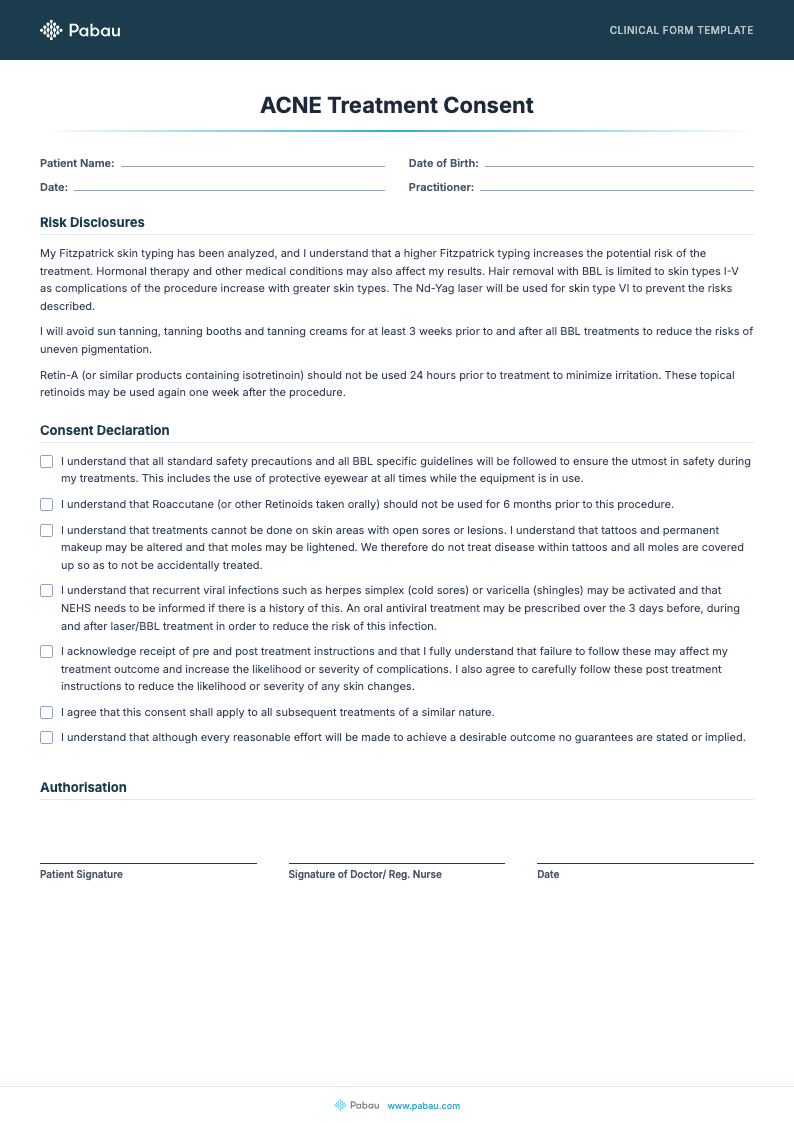
An acne treatment consent form documents that a patient understands the nature of their acne treatment, the potential risks involved, expected outcomes, contraindications, and their responsibilities for pre- and post-treatment care. This form is a legal safeguard and an educational tool rolled into one.
Acne treatments span a spectrum-from prescription-strength topical agents and manual extractions to chemical peels, laser therapy, and light-based procedures. Each modality carries different risks and requires different precautions. A comprehensive consent form captures these specifics and ensures the patient acknowledges them before treatment begins.
Beyond informed consent, the form serves as a clinical record documenting the patient’s medical history, contraindication screening, and signature proof. This documentation is essential for regulatory compliance. HIPAA regulations require clinics to maintain secure records of patient consent, and many state cosmetology and medical boards mandate written consent for invasive or high-risk procedures. A standard acne treatment consent form anchors your compliance framework.
Grounding this template in real clinic workflows, follow these five operational steps:
This workflow transforms consent from a checkbox exercise into a structured clinic conversation-reducing liability, improving patient education, and building trust.

Pabau's digital forms send consent documents automatically before appointments, capture signatures securely, and archive completed forms in patient records-eliminating paper, reducing administrative burden, and improving compliance.

Any clinic offering acne treatments needs a consent form-regardless of treatment type or whether you operate as a sole practitioner or multi-location chain.
Dermatology clinics: Whether offering topical prescriptions, light therapy, or laser acne treatment, dermatologists rely on consent forms to document the medical decision-making process and manage liability.
Aesthetic clinics and medspas: Chemical peels, extractions, and laser acne treatments are common aesthetic offerings. A tailored consent form explains the non-medical nature of aesthetic procedures while still covering risks like post-inflammatory hyperpigmentation and infection.
Skin clinics offering multi-modality acne treatment: Clinics blending prescription medications, manual treatments, and light-based devices need a single comprehensive form capturing risks across all modalities, or modality-specific forms for each treatment type.
Skin clinics of all sizes benefit from a standardised acne treatment consent form-it reduces the time clinicians spend drafting custom forms and ensures consistent risk communication across the team.
Legal protection: A signed consent form demonstrates that the patient was informed of risks and agreed to proceed. In the event of complications or disputes, this documentation shifts liability toward the patient’s informed choice rather than clinical negligence.
Regulatory compliance: Many US states require written informed consent for laser and light-based acne treatments. State cosmetology boards and medical licensing bodies treat signed consent as proof of compliance with informed consent requirements. HIPAA doesn’t mandate consent forms, but best practice security rules require documented consent to treatment.
Patient education: A detailed consent form educates the patient before treatment, reducing unrealistic expectations and post-treatment disappointment. When patients understand precautions (sun avoidance, retinoid timing) and realistic outcomes upfront, adherence improves and complications decrease.
Clinical documentation clarity: Consent forms double as intake records-capturing Fitzpatrick skin typing, contraindication screening, and pre-existing medical conditions in one place. This structured documentation speeds up appointment prep and improves clinical decision-making.
Audit readiness: When acne treatment complaints arise (rare but possible), regulators and insurers review consent documentation first. A comprehensive, signed acne treatment consent form shows professional diligence and reduces investigation scope.
Customise the consent form for your specific treatment modality. If you offer only topical treatments and extractions, remove laser-specific language. If you offer only laser acne therapy, streamline the form to focus on laser safety and recovery. Tailored forms read more credible and ensure patients consent to the exact treatment they’re receiving.
A complete consent form must disclose realistic risks and guide post-treatment expectations. Acne treatment risks vary by modality but commonly include:
Skin sensitivity and irritation: Topical retinoids, chemical peels, and laser therapy temporarily increase skin sensitivity. Patients should avoid sun exposure, harsh skincare products, and heat-generating activities (gym, sauna) for 3-7 days post-treatment. Advise patients to use SPF 30+ broad-spectrum sunscreen and hydrating cleansers during recovery.
Post-inflammatory hyperpigmentation (PIH): Patients with skin types IV-VI are at higher risk of temporary darkening after laser or light therapy. This typically resolves within 3-6 months with consistent sun protection. Pre-treatment Fitzpatrick skin typing screening identifies high-risk patients and allows clinicians to adjust laser settings or recommend alternative treatments.
Reactivation of herpes simplex or varicella: Laser and intense pulsed light (IPL) treatments can reactivate dormant viral infections. Patients with a history of cold sores or shingles should receive a 3-day course of oral antivirals (acyclovir or valacyclovir) starting 1 day before treatment and continuing through 2 days after.
Topical retinoid interactions: Retin-A, retinol, and prescription retinoids thin the stratum corneum and increase photosensitivity. Patients should discontinue topical retinoids 24 hours before laser/chemical peel treatment and wait one week before resuming to minimise irritation and post-inflammatory response.
Clear post-treatment instructions-delivered both verbally and in writing-reduce patient anxiety and improve compliance. Include specific guidance on sun avoidance duration, recommended skincare products, when to contact the clinic if complications arise, and when follow-up appointments should be scheduled.

Need guidance on digital patient consent workflows? Medical Forms at Your Healthcare Practice outlines best practices for integrating consent forms into your appointment workflow and ensuring compliance with digital signature standards.
Looking for other acne-related templates? Acne Face Mapping explains diagnostic techniques that complement consent-based treatment planning, helping clinicians document baseline acne severity and track treatment response.
Want to understand regulatory requirements better? HIPAA Compliance for Clinic Software covers how to store completed consent forms securely and maintain audit trails-essential for regulatory inspections.
An acne treatment consent form is not just a legal checkbox-it’s a cornerstone of patient safety, regulatory compliance, and clinical clarity. By using a comprehensive, modality-specific template, your clinic documents informed consent, educates patients on precautions and realistic outcomes, and builds trust through transparency. The template provided covers all essential elements: contraindication screening, Fitzpatrick skin typing, risk disclosure, consent declarations, and signature capture. Implement it as part of your digital workflow to reduce administrative friction and improve patient experience from the moment they book their first appointment.
The patient signs to acknowledge informed consent. A qualified clinician-doctor, registered nurse, or (in some jurisdictions) licensed aesthetician-must also sign, confirming they explained the risks and answered patient questions. Dual signatures demonstrate shared responsibility.
Yes. Electronic signatures are legally binding in most US jurisdictions under the Uniform Electronic Transactions Act (UETA) and in the UK under electronic identity regulations. Ensure your form platform (e.g. Pabau’s digital forms) timestamps signatures and retains audit trails for compliance.
Retain signed acne treatment consent forms for the duration of the patient relationship plus 7-10 years post-discharge. This protects against delayed liability claims and satisfies medical records retention requirements in most states.
Do not proceed with treatment if the patient refuses consent. Document the refusal in writing, discuss concerns with the patient, and offer alternative treatments or a follow-up consultation. Treating without consent exposes the clinic to legal and regulatory liability.
A single comprehensive form covering topical, chemical, and laser acne treatments works, but modality-specific forms (one for lasers, one for chemical peels, one for extractions) improve clarity and reduce patient confusion. Match the form to the treatment being delivered that day.
Yes. Roaccutane causes severe skin sensitivity and photosensitivity. Patients must discontinue use and wait 6 months after their final Roaccutane dose before undergoing laser, light, or chemical peel acne treatments. Topical treatments and extractions may proceed with caution after 6 months clearance.