Men's Health Reproductive & Sexual Health
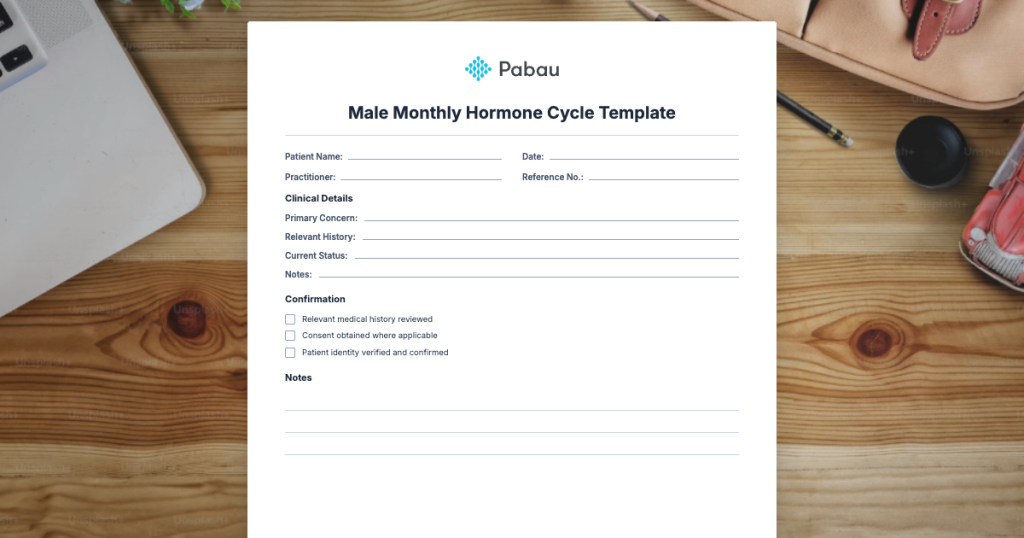
Male Monthly Hormone Cycle Template
Download Your Free Male Hormone Cycle Tracking Template A male hormone cycle tem...

February 26, 2026


Buy now, pay later is now available in Pabau

Men experience a 24-hour testosterone cycle with morning peaks and evening declines
Systematic tracking reveals individual patterns and symptom correlations
Template-based documentation supports clinical decision-making and referral decisions
Integration with practice management streamlines hormone assessment workflows
A male hormone cycle template provides the structured framework clinicians need to track testosterone fluctuations across 24-hour periods. Unlike generic tracking sheets, a clinical-grade male hormone cycle template includes time-stamped measurement fields, symptom correlation columns, and interpretation guidelines that help practitioners identify patterns and determine when abnormal results warrant referral to endocrinology specialists.
A structured tracking chart for recording male testosterone levels across 24-hour cycles with time-of-day fields, symptom correlation sections, energy level tracking, and clinical interpretation notes for practitioners.
Download templateA male hormone cycle template is a clinical documentation tool designed to systematically capture testosterone measurements and associated health markers across a 24-hour period. Unlike women’s menstrual cycle tracking, male hormone cycles operate on a daily basis rather than a monthly pattern. Men experience significant testosterone fluctuations throughout each day, with levels typically peaking between 6-8 AM and declining by 25-30% by evening. Research shows testosterone cycles vary considerably between individuals, with some men showing patterns across weekly or longer intervals.
The hypothalamic-pituitary-gonadal (HPG) axis controls this circadian rhythm through luteinizing hormone (LH) signalling. These physiological patterns influence mood, energy, sexual function, and muscle recovery. A structured male hormone cycle template captures these measurements in clinical context, enabling practitioners to differentiate normal variation from pathological patterns that may indicate hypogonadism, hyperprolactinaemia, or other endocrine disorders.
From a legal and regulatory standpoint, systematic hormone tracking documentation strengthens clinical records. It demonstrates diligent assessment and informed decision-making-essential for CQC compliance and professional liability protection. Templates standardise data collection, reduce documentation gaps, and create auditable records of the clinical reasoning behind referrals or treatment recommendations.
Implementing a male hormone cycle template in clinical practice involves five operational steps that align measurement timing with peak testosterone windows and symptom documentation.
The template works best when integrated with your digital intake forms system, allowing automatic data capture at each visit and longitudinal tracking across multiple cycles. This reduces manual transcription errors and creates a searchable record.

See how integrated digital forms and clinical documentation tools turn hormone cycle templates into workflow efficiencies-saving time on data entry and improving patient outcomes.

Any practitioner assessing male hormonal health benefits from this template. Men’s health clinics, hormone replacement therapy (HRT) practices, and functional medicine specialists use it during initial evaluation and ongoing monitoring. Urologists managing testosterone replacement therapy referrals rely on systematic tracking data to guide treatment decisions. Sexual health practitioners use the template to correlate libido and erectile function with measured testosterone levels, identifying whether symptoms reflect true hypogonadism or other factors.
General practitioners and private GP clinics increasingly offer hormone assessment services; the template ensures consistent data capture before specialist referral. Occupational health providers use it to track testosterone in male-predominant workforces experiencing fatigue or mood concerns. Regenerative medicine and sports medicine practices incorporate hormone cycle tracking to optimise recovery protocols and identify underlying endocrine barriers to performance improvement.
Standardised data collection: A structured template ensures every patient receives the same assessment points, eliminating documentation gaps and creating comparable data sets across your caseload.
Regulatory compliance: Systematic hormone tracking demonstrates diligent clinical assessment to CQC inspectors and professional bodies. It documents the reasoning behind referrals and treatment decisions, reducing audit risk and supporting informed consent discussions with patients.
Improved clinical decision-making: Visible patterns across multiple measurement points reveal whether a patient’s symptoms reflect true testosterone deficiency, lifestyle factors, or medication side effects. This clarity accelerates diagnosis and justifies specialist referrals with stronger evidence.
Patient education and engagement: Showing patients their own diurnal testosterone curve and symptom correlation helps them understand the physiological basis for fatigue, mood changes, and sexual dysfunction. This transparency increases buy-in for treatment plans and lifestyle modifications.
Longitudinal outcome tracking: Repeated use of the same template across months or years reveals whether hormonal patterns shift with treatment, aging, or lifestyle changes-essential data for optimising HRT protocols and evaluating intervention effectiveness.
Filter your patient data by age cohort and symptom profile to identify subgroups that might benefit from proactive hormone screening. Practices that track testosterone systematically often discover undiagnosed hypogonadism in 10-15% of their male population over 50-catching these cases early improves quality of life and cardiovascular outcomes.
Testosterone does not remain constant throughout the day. Instead, it follows a predictable circadian pattern governed by the body’s internal clock and the pulsatile release of LH from the pituitary gland. This rhythm is one of the most robust biological markers of healthy male endocrine function.
The Endocrine Society specifically recommends morning (6-8 AM) testosterone testing because levels are highest at this time, offering the most sensitive detection of hypogonadism. A man with a morning testosterone of 250 ng/dL has a clinically significant deficiency; the same person measured at 4 PM might show 180 ng/dL, appearing more severely deficient. This is why testing time matters enormously for accurate diagnosis. Practitioners should also be aware of seasonal variations in testosterone levels, which can affect measurements across longer timeframes.
The decline from morning to evening correlates with cortisol’s reciprocal rhythm. As cortisol naturally falls throughout the day, some assume testosterone should rise-but the opposite occurs. This inverse relationship reflects complex HPG axis regulation and the body’s shift from alert/metabolic morning state to recovery/parasympathetic evening state. Evening testosterone decline prepares the body for sleep, sexual activity, and recovery-critical functions in their own right.
Sleep quality powerfully influences the next morning’s testosterone peak. Men sleeping poorly show blunted morning surges and smaller diurnal variation overall. This explains why fatigue, insomnia, and low testosterone often cluster together-poor sleep drives testosterone down, which worsens sleep, creating a vicious cycle. A male hormone cycle template that captures both hormone levels and sleep data helps clinicians address root causes rather than treating symptoms in isolation.
Not every testosterone measurement outside the “normal range” warrants specialist referral. Context matters. A single low morning reading in a man under acute stress or recovering from illness may normalise without intervention. However, certain patterns consistently signal the need for endocrinology or urology evaluation.
Red flags for referral: Persistent morning testosterone below 300 ng/dL despite optimised sleep and stress management; absence of the expected 25-30% diurnal decline (flat curve may indicate secondary hypogonadism); symptoms of low testosterone (persistent fatigue, mood depression, erectile dysfunction) that fail to improve with lifestyle optimisation over 8-12 weeks; symptoms that seem disproportionate to measured testosterone levels (suggesting non-hormonal causes like depression or thyroid dysfunction that need broader investigation).
A male hormone cycle template that includes these interpretation thresholds removes guesswork. Your template should have built-in guidance: “If morning level <300 AND symptoms present, refer to endocrinology for LH/FSH assessment.” This clarity accelerates appropriate referrals and reduces diagnostic delays that leave patients suffering longer than necessary.
You can support clinical reasoning further by using AI-powered clinical documentation tools that highlight abnormal values during note-writing, prompting referral workflows automatically based on preset criteria.

Looking to streamline male health assessments? Men’s Health Clinic Software provides specialised workflows for hormone assessment, including integrated testosterone tracking and automated referral routing.
Need to standardise patient intake across multiple male health forms? Digital Forms and Capture enables you to deploy the male hormone cycle template, collect responses electronically, and attach structured data directly to patient records.
Want to track longitudinal hormone trends over months or years? Measurements Tracking Software stores repeated hormone readings and visualises them as graphs, making diurnal patterns and seasonal changes immediately visible to clinicians.
A male hormone cycle template transforms how practitioners assess testosterone-related health concerns. By systematising 24-hour measurement collection and integrating symptom correlation with interpretation guidance, the template moves hormone assessment from anecdotal to evidenced-based practice. Whether you’re a men’s health specialist, a functional medicine practitioner, or a GP offering hormone screening, a structured male hormone cycle template reduces documentation burden, improves clinical confidence, and strengthens your referral decisions.
Implementing the template in your digital practice management system ensures consistent use, reduces manual errors, and creates searchable records that support both clinical care and regulatory compliance. Start with one male hormone cycle template in your practice this month-your patients’ quality of life, and your diagnostic accuracy, will improve measurably.
Normal testosterone ranges from 300-1000 ng/dL in healthy adult males, with highest levels in the early morning (6-8 AM). The Endocrine Society recommends morning testing to capture peak levels for accurate diagnosis. Individual variation is large, so clinical symptoms matter as much as absolute numbers.
Yes. Men experience a profound 24-hour testosterone cycle with morning peaks and evening nadirs-a circadian rhythm far more consistent than any monthly pattern. This daily cycle is governed by the pituitary’s pulsatile LH release and the body’s sleep-wake cycle.
Testosterone typically declines 25-30% from morning peak to evening nadir in healthy males. Larger declines (40%+) or smaller declines (absent rhythmicity) may indicate underlying endocrine dysfunction or require investigation for secondary causes like sleep apnoea or medication side effects.
Absolutely. Systematic tracking with a structured template reveals persistent low morning readings, absent diurnal variation, or symptom patterns that correlate with testosterone deficiency-enabling early detection before more serious complications develop. This is especially valuable in men over 50 where hypogonadism is common but often undiagnosed.
Yes. Sleep optimisation, regular exercise, stress management, and reducing alcohol consumption all support healthier testosterone circadian rhythms. Many men show significant improvement in morning testosterone levels and diurnal variation after 8-12 weeks of lifestyle modification, making these often-first interventions worth documenting in your male hormone cycle template.