Mental Health Mental Health & Therapy
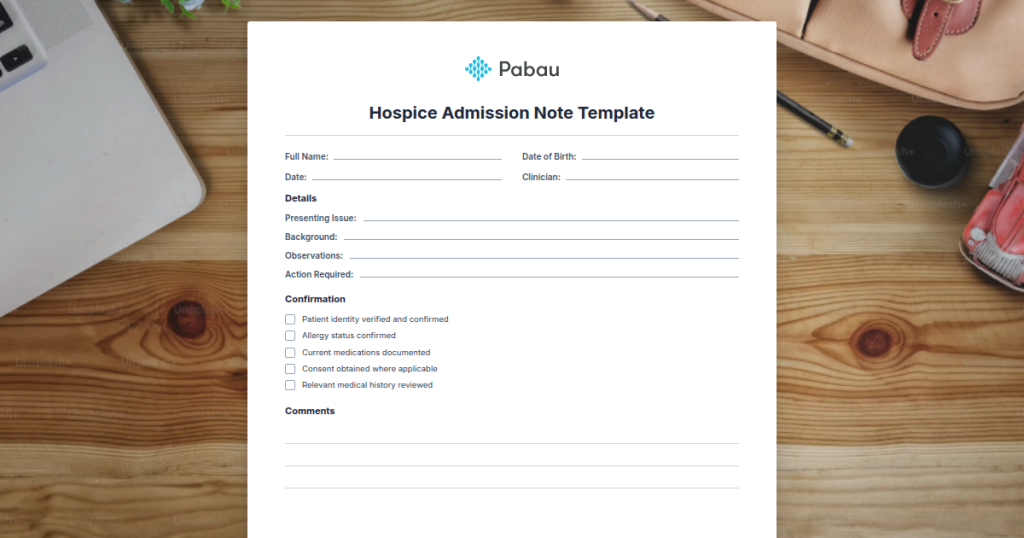
Hospice Admission Note Template
Most hospice RNs face the same intake challenge: incomplete or inconsistent admi...

April 28, 2026


Buy now, pay later is now available in Pabau

PHQ-9 and GAD-7 are validated screening tools for depression and anxiety assessment.
Use measurement-based care protocols to track patient progress over time.
Screen for suicidal ideation as a critical safety step in every mental health encounter.
Digital forms with automated scoring improve documentation accuracy and clinic workflow.
Mental health screening forms are foundational to modern clinical practice. The PHQ-9 and GAD-7 template combines two validated screening tools for depression and anxiety into a single intake document that clinicians use to assess depression and anxiety symptoms at the point of care. Both tools are standardised, evidence-based, and widely recognised across primary care, specialist mental health, and therapy settings.
These instruments originated from primary care research. The PHQ-9 (Patient Health Questionnaire-9) was developed by Drs. Robert Spitzer and Kurt Kroenke with an educational grant from Pfizer. The GAD-7 (Generalized Anxiety Disorder-7) emerged from the same research lineage, designed specifically for rapid anxiety screening in busy clinical environments. Neither tool requires permission to reproduce, translate, or display-they exist in the public domain and are accessible to all healthcare providers.
A combined template streamlines patient intake workflows. Rather than administering separate forms, clinicians present a single document covering both depression and anxiety screening in one encounter. This efficiency gain matters in practices managing high patient volumes while maintaining clinical rigour.
A standardised mental health screening form combining PHQ-9 for depression assessment and GAD-7 for anxiety evaluation. Used by clinicians to identify mental health concerns, monitor treatment progress, and support measurement-based care protocols.
Download templateA PHQ-9 and GAD-7 template is a structured clinical assessment document used to screen for depressive and anxiety symptoms. The PHQ-9 contains nine items measuring depressive severity over the preceding two weeks. The GAD-7 contains seven items assessing generalised anxiety. Together, they create a comprehensive mental health snapshot at a single point in time.
Clinically, these tools serve distinct purposes. The PHQ-9 detects major depressive episodes and monitors treatment response in ongoing care. Item 9 explicitly screens for suicidal ideation-a critical safety component that flags patients requiring immediate intervention. The GAD-7 measures severity of anxiety mainly in outpatients and tracks anxiety severity across therapy, coaching, or medication management.
From a regulatory perspective, standardised screening documents support documentation standards required across healthcare sectors. HIPAA-compliant practices rely on these instruments to evidence informed clinical decision-making. Each completed form becomes part of the patient record, demonstrating that the clinician assessed mental health status before proposing treatment, adjusted care plans based on scores, and documented clinical reasoning-all essential compliance elements.
The template is legally defensible. Both instruments are published, validated, and reproducible without copyright restriction. Clinicians documenting that they administered the PHQ-9 and GAD-7 create an auditable clinical record aligned with evidence-based practice standards.
Administering the combined template follows a structured workflow that takes 5-10 minutes in most clinical encounters. The process ensures comprehensive screening while maintaining workflow efficiency.
This structured approach ensures every patient receives consistent, evidence-based screening while creating a measurable baseline for tracking progress.

Digital forms with integrated scoring calculations streamline depression and anxiety screening. Track measurement-based care progress automatically.

The combined template applies across multiple clinical specialties and practice types. Mental health professionals-psychologists, psychiatrists, counsellors, and therapists-use these instruments in routine practice. Primary care clinicians, general practitioners, and nurse practitioners integrate the template into annual physical examinations and illness visits to screen for undetected mood disorders.
Coaching practitioners working with anxiety and stress management rely on the GAD-7 to quantify client anxiety levels before and after intervention. Occupational therapists and physiotherapists use these tools to understand the mental health context of their clients’ presentations. Private practice clinicians-whether operating solo or in group settings-benefit from a standardised template that demonstrates due diligence in mental health assessment.
Functional and integrative medicine practitioners include the template in comprehensive health evaluations where metabolic, lifestyle, and mental health factors interact. Fertility clinics and reproductive health practices screen for perinatal depression and anxiety as part of holistic patient care. Wellness centres and longevity clinics adopt the template to assess baseline mental health status before designing personalised wellness programmes.
The template is equally useful across practice sizes. A solo therapist uses it with every new patient. A multi-location mental health clinic standardises administration across clinicians to ensure consistency. Primary care networks implement the template in electronic health record systems to flag patients needing mental health referral.
Standardised assessment supports clinical decision-making. When every clinician administers and scores the same tool using the same criteria, outcomes become comparable. A depression score of 14 means the same thing across practitioners and settings. This consistency enables accurate treatment monitoring and evidence-based adjustments to care.
Compliance and documentation are strengthened. The template creates an auditable record demonstrating that the clinician systematically assessed mental health status, scored the assessment correctly, and based treatment decisions on objective data. This level of documentation protects clinicians in regulatory inspections and supports HIPAA compliance by showing structured information security.
Suicidal ideation screening becomes routine. The PHQ-9 item 9 directly asks about suicide risk, ensuring this critical safety consideration is never overlooked. Documentation that the clinician explicitly screened for and assessed suicidal ideation demonstrates risk management best practice.
Measurement-based care protocols become feasible. Repeated administration at follow-up appointments quantifies treatment progress. Clinicians can show patients objective improvement (“Your depression score dropped from 18 to 10”), reinforcing engagement and treatment adherence. This feedback loop is especially powerful in therapy and coaching where subjective symptom improvement can be difficult to measure.
Workflow efficiency improves. A single combined template reduces patient time in intake and simplifies clinician administration compared to separate depression and anxiety forms. Digital versions with automated scoring eliminate manual calculation errors and instantly generate visual progress charts.
Flag patients with PHQ-9 item 9 scores of 2 or higher (suicidal thoughts more than several days) immediately. Conduct a structured suicide risk assessment within the same session and document your response. This systematic approach to safety prevents gaps in high-risk patient care.
Measurement-based care (MBC) is a clinical methodology where standardised outcome measures guide treatment planning and adjustment. Rather than relying solely on subjective clinician impression, MBC practitioners administer validated instruments regularly and modify interventions based on objective data.
The PHQ-9 and GAD-7 are ideal MBC tools. Administering both at intake establishes a baseline. Repeating them monthly (or every 2-4 weeks for intensive treatments) generates a trend line showing whether depression and anxiety are improving, stable, or worsening. If scores plateau or worsen, the data prompts treatment intensification-increased therapy frequency, medication adjustment, or referral-rather than continuing unchanged.
Research demonstrates that practices using MBC achieve better clinical outcomes than those relying on clinical judgement alone. Studies have confirmed measurement invariance across European countries, validating consistent administration across diverse populations than those relying on clinical judgement alone. Patients benefit from transparent, data-driven communication about their progress. Clinicians benefit from systematic, objective feedback that guides case management and prevents drift in chronic cases.
Digital practice management platforms with automated clinical documentation now integrate PHQ-9 and GAD-7 scoring directly into patient records. Automated scoring eliminates calculation errors. Trend graphs visualise progress over months. Alerts flag high-risk scores requiring immediate intervention. This integration transforms MBC from a research concept into a practical tool embedded in everyday workflow.
Item 9 of the PHQ-9 reads: “Thoughts that you would be better off dead or of hurting yourself in some way?” Responses range from 0 (not at all) to 3 (nearly every day). Any endorsement-even “several days”-requires immediate clinical action.
Best practice involves three steps: screening, assessment, and safety planning. The PHQ-9 screens for ideation presence. Once detected, conduct a brief assessment asking: How specific is the plan? Do you have means? When did these thoughts start? Are they increasing? Has the patient disclosed this to family or others? Document the patient’s responses verbatim.
If ideation is present but low-risk (passive wish to be dead, no plan or means, strong protective factors like family support), develop a safety plan with the patient covering: coping strategies during crisis, social support to contact, professional resources (crisis line, emergency services), means restriction, and follow-up appointment scheduling. Document this plan in the patient record.
If ideation is moderate to high-risk (specific plan, available means, recent attempt, or intent despite safety planning), refer to emergency services or crisis assessment immediately. Never delay. The PHQ-9 administration becomes the documentation that prompted this protective action. This demonstrates that your clinic took the screening result seriously and responded with appropriate urgency-essential for regulatory compliance and patient safety.
Regular staff training on interpreting scores and responding to positive screens prevents clinical gaps. Many practices implement standing protocols: “Any PHQ-9 item 9 score ≥1 requires same-session safety assessment and documentation before discharge.” This standardisation ensures no patient slips through.

Need to automate mental health form completion? Digital Forms enables self-administered patient intake with automatic scoring and progress tracking integrated into your EMR.
Want to improve clinical documentation for mental health encounters? Mental Health EMR Software provides structured templates and assessment integration for faster, more consistent note generation.
Looking for training on measurement-based care workflows? Echo AI supports clinical decision-making by automatically populating assessment scores and suggesting next-step recommendations based on standardised protocols.
The PHQ-9 and GAD-7 template represents a practical bridge between evidence-based screening and everyday clinical workflow. These validated instruments transform vague patient reports into objective, measurable data that guides treatment planning and safety assessment. A combined template streamlines administration, reduces paperwork burden, and strengthens documentation compliance across mental health, primary care, coaching, and therapy practices.
Implementing standardised screening with measurement-based care protocols elevates the quality and consistency of mental health assessment. Whether you manage a solo therapy practice or a multi-location mental health clinic, the PHQ-9 and GAD-7 template forms the foundation of structured, clinically rigorous patient evaluation. Download the template, integrate it into your intake process, and use the data to drive informed, evidence-based decisions about your patients’ care.
The PHQ-9 screens for depressive symptoms and severity; the GAD-7 screens for generalised anxiety disorder. PHQ-9 includes suicidal ideation screening (item 9); GAD-7 focuses on worry, restlessness, and anxiety-specific symptoms. Together, they provide comprehensive mood and anxiety assessment in one encounter.
Yes. Both instruments are in the public domain and were developed with public funding. No copyright or licensing fee applies. You can reproduce, translate, and display them freely in clinical settings.
Administer at baseline intake, then repeat every 2-4 weeks during active treatment to monitor progress. In stable maintenance care, repeat every 3-6 months. Frequency depends on treatment intensity and clinical need. Measurement-based care protocols benefit from regular, frequent administration to detect change early.
Conduct an immediate suicide risk assessment in the same session. Ask about plan specificity, means, intent, and timeline. Document responses verbatim. Develop a safety plan if low-to-moderate risk, or refer to crisis services immediately if high-risk. Never allow the patient to leave without addressing the screening result.
The instruments themselves are compliant. HIPAA compliance depends on how you store, transmit, and secure completed forms. Use encrypted digital forms, limit access to authorised staff, and maintain secure patient records. Digital practice management platforms handle these requirements automatically.
Health coaches, wellness practitioners, and non-licensed professionals can administer the tools but must stay within their scope of practice. Use the data to inform your coaching conversations, monitor client anxiety, and make appropriate clinical referrals if scores indicate significant depression or anxiety. Always refer to licensed clinicians for diagnosis or treatment decisions.