Mental Health Mental Health & Therapy
EHR for Multi-Franchise Mental Health Practice: What to Look For
Most behavioral health franchise owners discover the limits of their EHR around ...

April 29, 2026


Buy now, pay later is now available in Pabau

Captures essential client demographics, medical history, and mental health background
Documents informed consent and treatment expectations before first session
Identifies risk factors including suicidal ideation and psychiatric medication use
Supports HIPAA-compliant record-keeping and clinical audit readiness
Streamlines client onboarding with structured intake workflow
A psychotherapy intake form is the foundation of professional clinical practice. Before the first therapeutic session, gathering comprehensive information about your client ensures you can tailor treatment, identify risk factors, and protect both client safety and your practice. This template provides a structured approach to intake that meets mental health practice standards and supports compliance with regulatory requirements.
A ready-to-use intake form covering client demographics, medical and psychiatric history, mental health background, treatment goals, emergency contact information, and consent declarations for informed consent.
Download template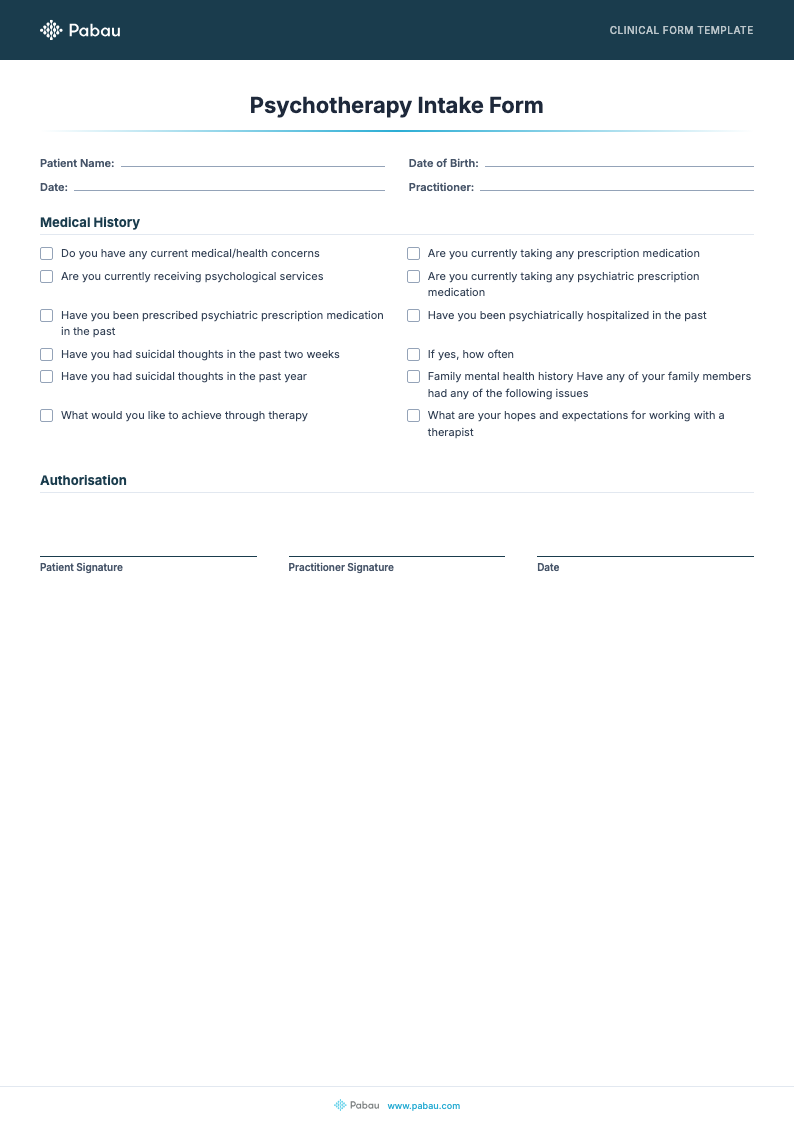
A psychotherapy intake form is a standardised assessment document that mental health professionals use to gather essential information before the first therapeutic session. The form captures client demographics, personal history, medical and psychiatric background, treatment goals, and informed consent declarations. This structured approach enables therapists to understand each client’s unique context and provide personalised, safe, and effective care from the outset.
The legal foundation for intake forms rests on informed consent principles. According to the American Psychological Association (APA), mental health practitioners must ensure clients understand the nature of therapy, potential risks and benefits, alternative treatments, confidentiality limits, and the therapist’s qualifications. A comprehensive psychotherapy intake form documents this understanding and creates a legal record of the client’s baseline mental health status at treatment outset.
Under HIPAA Privacy Rule guidelines, intake forms represent protected health information (PHI). They must be stored securely, accessible only to authorised clinical and administrative staff, and retained according to state regulatory timelines (typically 5-7 years post-discharge for adults). Digital intake workflows add a layer of security compliance by enabling encrypted transmission, digital signature capture, and automated access logs.
Effective intake requires a structured workflow. The following five steps reflect real clinical practice and ensure your psychotherapy intake form captures the information needed for safe, informed treatment:
This workflow transforms your psychotherapy intake form from a static document into an active clinical and compliance tool. When integrated into digital intake forms systems with conditional logic and signature capture, the process becomes streamlined and audit-ready.
Mental health practitioners across multiple disciplines rely on structured psychotherapy intake forms. Licensed therapists (LPC, LCSW, LMFT) use them to establish baseline mental health status and treatment goals. Psychiatrists and psychiatric nurse practitioners use intake forms to document medication history and symptom severity at baseline. Psychologists and clinical social workers use them to screen for safety risks and contraindications before initiating specific modalities (CBT, DBT, EMDR, psychodynamic therapy).
Group practice administrators and clinic managers find that standardised psychotherapy intake forms reduce administrative burden and improve compliance consistency. Multi-clinician practices benefit from a unified intake standard that all therapists follow, ensuring no essential information is missed regardless of which practitioner is assigned to the client. Practices operating across multiple locations can enforce consistent intake protocols by using a centralised intake template accessible to all staff.
Private practitioners and sole proprietor therapists use psychotherapy intake forms as a legal safeguard. A completed, signed intake form demonstrates informed consent, documents the client’s baseline mental health, and creates a contemporaneous record should any clinical or legal questions arise later.

Automate pre-appointment intake delivery, capture digital signatures, and integrate intake data directly into client records and treatment planning.

Compliance and legal protection: A completed psychotherapy intake form creates a documented record of informed consent and baseline mental health status. This contemporaneous record protects your practice if clinical or ethical questions arise, and demonstrates to regulatory bodies (state licensing boards, CQC, HIPAA auditors) that intake was conducted professionally and thoroughly.
Structured risk screening: Intake forms designed to include specific risk questions-suicidal ideation, self-harm, substance use, psychiatric medication history-ensure no safety factor is overlooked. A psychotherapy intake form flags high-risk clients before the first session, giving you time to plan crisis resources, safety planning, and appropriate referrals if needed.
Workflow efficiency: Pre-appointment completion of a psychotherapy intake form reduces session time spent on administrative questions. Clinicians can focus the first session on therapeutic work rather than data gathering, improving client experience and practice capacity.
Clinical clarity: A well-structured form surfaces essential context-family mental health history, previous treatment experience, current symptoms, treatment goals-that informs your clinical approach. Understanding what the client hopes to achieve through therapy helps you align your modality and set realistic expectations collaboratively.
Audit readiness: When regulatory bodies (state licensing boards, HIPAA investigators, CQC inspectors) audit mental health practices, a comprehensive intake form demonstrates clinical rigour and compliance. The form shows you conducted appropriate screening, documented informed consent, and established baseline mental health information.
Flag specific medical and psychiatric medications that may interact with therapy modalities or present safety considerations. Review contraindication screening before each session to ensure treatment safety and clinical appropriateness.
Informed consent is not a single signature; it is an ongoing ethical obligation embedded in your psychotherapy intake process. According to the National Association of Social Workers (NASW), ethical practice requires that clients understand your qualifications, the nature of therapy, potential benefits and risks, alternatives to therapy, confidentiality and its limits, fees and payment policy, and their right to refuse or withdraw consent.
Your psychotherapy intake form should explicitly address each element. Open with a statement of your credentials and role. Explain therapy in accessible language (avoid clinical jargon). Describe confidentiality clearly, including mandatory reporting obligations (threat to self or others, child/elder abuse, court order). Define the limits of therapy-it is not a crisis service, and clients experiencing acute safety risk need emergency services or hospitalisation.
Document the client’s stated goals for therapy. Misalignment between client expectations (e.g., “fix my marriage in three sessions”) and therapeutic reality (e.g., “help you develop coping strategies and decision-making tools”) should be addressed during intake. A psychotherapy intake form that includes an explicit “What are your hopes for working with a therapist?” question surfaces these expectations early, allowing you to clarify scope and adjust if needed.
Manual paper intake forms create bottlenecks: clients arrive early to complete forms, staff spend time scanning and filing, clinicians hunt through paperwork for key information. Automated psychotherapy intake workflows eliminate these friction points. Digital form delivery via email or client portal allows clients to complete intake before arrival, reducing wait time and improving experience.
Conditional logic within digital form systems means flagged responses (suicidal ideation, psychiatric hospitalisation) trigger immediate staff notification or clinical review workflows. Digital signature capture and automated storage reduce administrative time and ensure compliance with data protection standards. When intake data integrates directly into clinical notes and treatment planning tools, clinicians access structured information instantly rather than re-entering data manually.
Data integration also enables AI-powered clinical documentation to populate initial clinical summaries from intake responses, reducing administrative burden and allowing clinicians to focus on therapeutic relationship-building rather than documentation.

Need guidance on clinical assessment frameworks? Psychiatric Evaluation Template provides a comprehensive framework for structured mental health assessment and documentation.
Want to streamline client onboarding? Mental Health EMR Software Guide covers practice management systems designed for therapy and counselling clinics.
Looking for consent form best practices? Group Therapy Informed Consent explores consent considerations specific to group therapeutic settings.
A well-designed psychotherapy intake form is both a clinical tool and a compliance document. It captures the information you need to provide safe, personalised therapy from day one, documents informed consent, screens for risk, and creates an audit trail for regulatory compliance. Whether you use a paper template or automate intake digitally, the structure and content of your form reflect professional standards and ethical practice. Download the template above and integrate it into your practice workflow to strengthen client safety, streamline administration, and protect your practice.
A counselling intake form gathers essential information about a client’s mental health history, current concerns, goals for therapy, and relevant background information. It documents informed consent, establishes baseline mental health status, and identifies risk factors before treatment begins.
Therapists typically use intake forms that capture demographics, medical and psychiatric history, current symptoms, treatment history, family mental health background, and therapeutic goals. Specialised forms exist for couples therapy, group therapy, and specific modalities (CBT, DBT, EMDR).
Therapists simplify intake by sending forms digitally before the appointment, using conditional logic to flag high-risk responses, capturing digital signatures, and integrating intake data into clinical note systems. Automation reduces re-entry time and improves accuracy.
Informed consent is the ethical and legal requirement that clients understand your qualifications, the nature of therapy, potential benefits and risks, alternatives, confidentiality limits, fees, and their right to refuse or withdraw. This understanding must be documented and ongoing throughout treatment.
An informed consent form should include your credentials and role, an accessible description of therapy, benefits and risks, confidentiality and its limits (including mandatory reporting), fees and payment policy, session cancellation policy, client rights, and space for the client’s signature and questions.
The four principles of informed consent are disclosure (sharing relevant information), comprehension (ensuring understanding), voluntariness (free choice without coercion), and competence (confirming the client can make informed decisions). Mental health professionals must uphold all four throughout treatment.