ADHD Assessment Mental Health & Therapy
Social Communication Questionnaire
Most autism spectrum disorder (ASD) screening relies on structured questionnaire...

April 21, 2026


Buy now, pay later is now available in Pabau

DSM-5 ADHD checklist formalises symptom screening across inattention, hyperactivity, and impulsivity domains
Standardised assessment ensures clinicians document compliance-ready evidence for accurate ADHD diagnosis
Pre-appointment digital delivery reduces session time and improves diagnostic accuracy through advance response review
Template captures symptom onset, setting-specific presentation, and functional impairment required for DSM-5 criteria
Attention-Deficit/Hyperactivity Disorder (ADHD) affects how people manage attention, impulse control, and activity levels. The American Psychiatric Association (APA) publishes the DSM-5 (Diagnostic and Statistical Manual of Mental Disorders, Fifth Edition), which outlines the clinical criteria clinicians use to diagnose ADHD. A DSM 5 ADHD checklist template streamlines the assessment process by systematically capturing symptoms across the diagnostic domains the APA specifies.
ADHD presentations vary widely-some individuals show pronounced inattention, others hyperactivity-impulsivity, and many experience a combination. A structured DSM 5 ADHD checklist template ensures your clinical team captures the full symptom picture before diagnosis.
This guide explains how to use a DSM 5 ADHD checklist template in your mental health practice, the clinical and legal context behind the tool, and the operational benefits of standardising your ADHD assessment workflow.
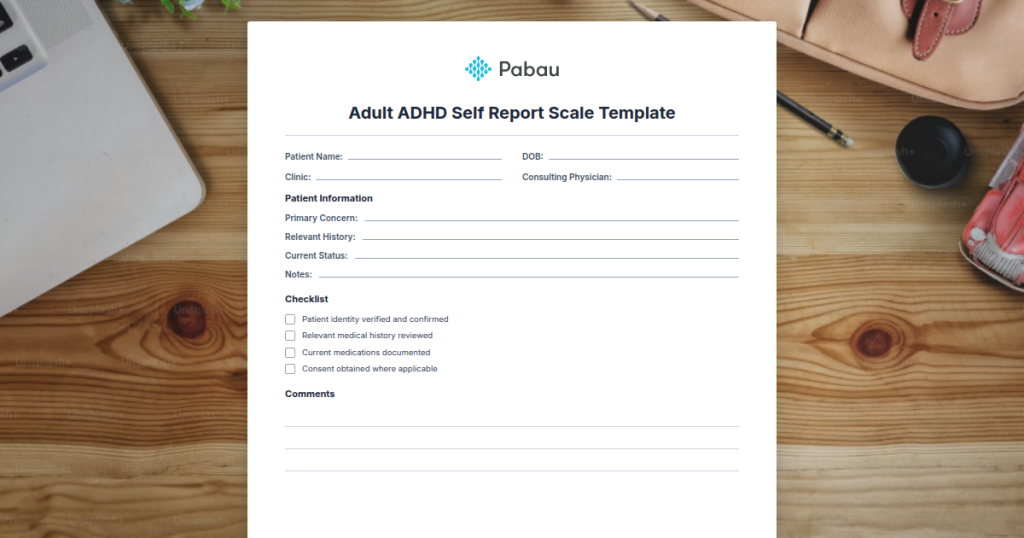
A standardised diagnostic assessment tool that systematically evaluates ADHD symptoms according to DSM-5 criteria, covering inattention, hyperactivity, and impulsivity across different settings and developmental stages. Includes date fields, symptom domains, onset and functional impairment tracking, and clinician sign-off sections.
Download template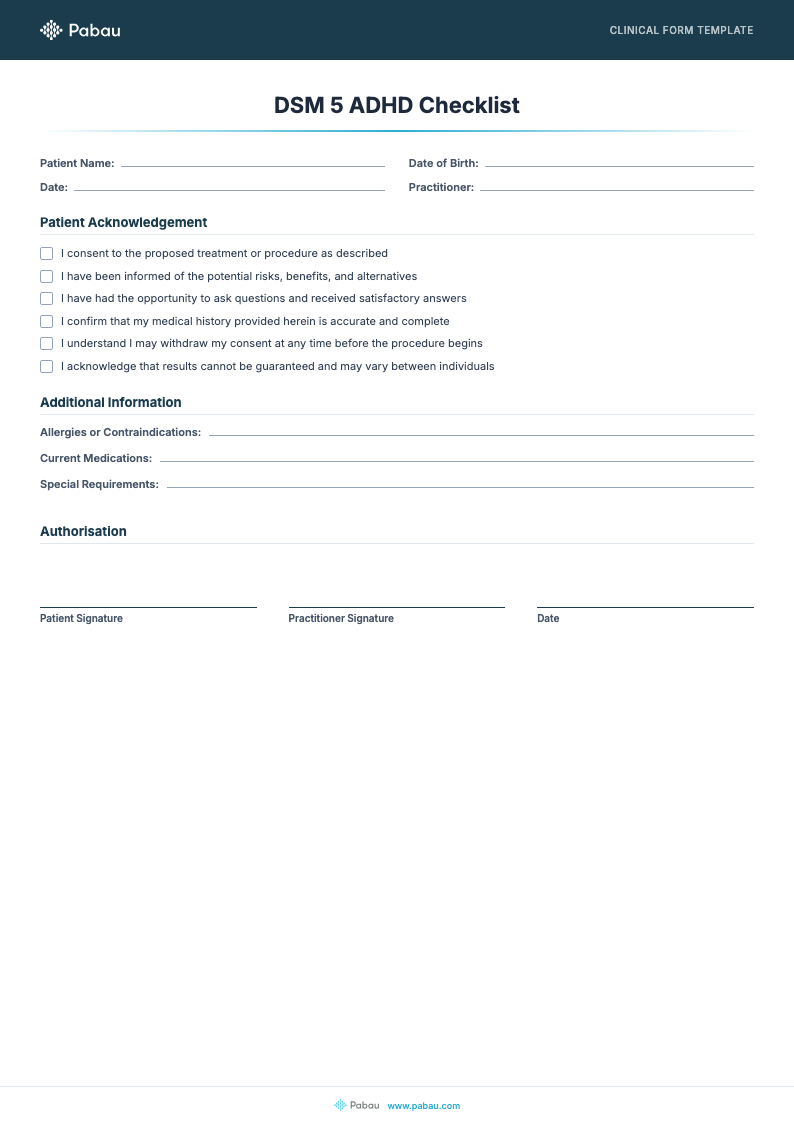
A DSM 5 ADHD checklist template is a structured clinical form that aligns with the diagnostic criteria outlined in the fifth edition of the Diagnostic and Statistical Manual of Mental Disorders. The manual is the authoritative diagnostic standard published by the American Psychiatric Association, used globally by mental health professionals to diagnose psychiatric conditions.
The DSM-5 defines ADHD through three clinical presentations: predominantly inattentive type, predominantly hyperactive-impulsive type, and combined type. Each presentation maps to specific symptom clusters and functional impairment thresholds. DSM-5 ADHD prevalence studies in large representative samples have found prevalence rates of approximately 3.55% in young adults, validating the clinical utility of these refined criteria.
A DSM 5 ADHD checklist template operationalises these criteria into a systematic form-typically covering inattention symptoms (e.g. fails to pay attention to detail, loses focus during tasks), hyperactivity symptoms (e.g. fidgets, leaves seat inappropriately), and impulsivity symptoms (e.g. interrupts, acts without thinking).
From a clinical governance perspective, a DSM 5 ADHD checklist template serves as documented evidence that your assessment process follows APA standards. This is essential for HIPAA compliance in the United States and for CQC (Care Quality Commission) alignment in UK private practices. The completed checklist becomes part of the clinical record, supporting both treatment decisions and liability protection if assessment decisions are later questioned.
The DSM 5 ADHD checklist template workflow is designed to maximise efficiency without compromising diagnostic rigour. Each step builds on the previous one, creating a comprehensive assessment record that supports accurate diagnosis and clinical confidence.
This workflow takes 15-20 minutes of appointment time. Pre-completion saves clinical time while ensuring clinicians have detailed symptom data before the live assessment begins.

Pabau's digital forms capture structured clinical data and integrate directly with your patient records, freeing clinicians to focus on diagnostic conversation rather than data entry.

A DSM 5 ADHD checklist template is relevant to any clinical setting where ADHD assessment occurs. Mental health clinics are the primary users-psychologists, psychiatrists, licensed counsellors, and clinical social workers diagnosing ADHD in children, adolescents, and adults all benefit from standardised assessment tools.
Primary care clinics increasingly conduct ADHD screening and diagnosis. The Adult ADHD Self-Report Screening Scale for DSM-5 has been validated in specialty treatment settings, demonstrating that structured assessment tools improve diagnostic accuracy across clinical contexts.
GPs in the UK, NPs and PAs in the US, and family medicine practitioners globally often use ADHD checklists to triage referrals or confirm diagnoses before treatment. A DSM 5 ADHD checklist template ensures primary care teams follow consistent diagnostic criteria aligned with specialist practice.
Occupational therapy and speech therapy clinics assess ADHD as part of broader neurodevelopmental evaluations. Educational psychologists working within schools or private practice use ADHD checklists to support school-based accommodations and IEP (Individualized Education Plan) development. Neuropsychology practices integrate DSM-5 criteria into comprehensive cognitive assessments.
Coaching practices specialising in ADHD support-particularly those working with adults-increasingly use structured ADHD assessment checklists to clarify client needs before designing coaching interventions. ADHD management clinics, coaching programs, and well-being centres that support neurodivergent populations all rely on standardised assessment frameworks to ensure consistency and clinical rigour.
Clinical accuracy and consistency. A structured DSM 5 ADHD checklist template reduces diagnostic variability between clinicians. Rather than relying on informal conversation, clinicians systematically score symptom presence, onset timing, and functional impairment using the same framework. This approach catches symptom clusters that might otherwise be missed and ensures all DSM-5 diagnostic criteria are evaluated for every client.
Documentation and compliance evidence. The completed DSM 5 ADHD checklist template becomes a defensible clinical record. If a diagnosis is later questioned-by a client, a school, an employer, or a regulator-the standardised assessment demonstrates that your practice followed evidence-based diagnostic procedures aligned with APA standards. For HIPAA-covered practices in the US, this documentation supports data security and patient privacy compliance. For UK private practices, it aligns with CQC inspection standards for clinical governance.
Time efficiency and workflow clarity. Pre-appointment completion means clinicians review detailed symptom data before the live session, allowing them to focus appointment time on differential diagnosis, treatment planning, and client education rather than data gathering. Clearer workflow also trains staff on consistent assessment steps-every team member follows the same process regardless of experience level.
Referral-ready information. A completed DSM 5 ADHD checklist template is immediately shareable with referring physicians, schools, workplace accommodations teams, or specialist practitioners. It communicates your assessment findings in a format they recognise and expect, supporting continuity of care and inter-provider collaboration.
Flag symptom onset timing carefully on your DSM 5 ADHD checklist template. DSM-5 criteria require symptom onset before age 12, even if diagnosis occurs in adulthood. If responses indicate symptoms started after age 12, document this discrepancy and consider whether alternative diagnoses (anxiety, trauma, medical conditions) better explain the presentation. This distinction prevents misdiagnosis and ensures your assessment stays clinically rigorous.
Understanding differences between DSM-5 and DSM-IV ADHD criteria helps clinicians use modern assessment tools effectively. The DSM-5 revision (published in 2013) refined diagnostic criteria based on new research into ADHD across the lifespan.
Symptom onset threshold relaxed. DSM-IV required symptom onset by age 7. DSM-5 extended this to age 12, recognising that ADHD often goes unrecognised in childhood and emerges in adolescence or adulthood. This change increased ADHD diagnosis rates in adults, particularly in women and girls, whose ADHD presentations were historically underdiagnosed. A DSM 5 ADHD checklist template reflects this broader onset window, making adult-focused assessment more valid.
Symptom threshold adjustment. DSM-IV required 6 symptoms for children and 5 for adults. DSM-5 standardised the threshold to 5 symptoms for children (aged 12 and under) and 5 symptoms for adolescents and adults. Clinical guidelines for adult ADHD require at least five symptoms to be present for diagnosis, reflecting that hyperactivity presentations often diminish with age. This means clinicians can diagnose ADHD in adults with slightly lower symptom counts than DSM-IV allowed, reflecting the reality that adult presentations often involve fewer observable hyperactivity symptoms.
Functional impairment emphasis strengthened. Both manuals require functional impairment, but DSM-5 emphasises that symptoms must be present across multiple settings (home, work, school) and must cause measurable interference. Changes in DSM-5 ADHD definition were subtle but clinically important, particularly in recognising adult presentations and cross-setting functional impairment.
A DSM 5 ADHD checklist template systematically captures setting-specific symptoms and functional impact, whereas older assessment approaches sometimes relied on single-setting observation.
If you’re using an older ADHD assessment form based on DSM-IV criteria, upgrading to a DSM 5 ADHD checklist template ensures your practice diagnoses ADHD using current clinical standards. A DSM-5 criteria comparison table shows the specific diagnostic modifications that distinguish the current assessment framework from previous editions.
This also improves continuity with specialists and educational systems, which increasingly reference DSM-5 criteria.
A DSM 5 ADHD checklist template is most effective when integrated into a broader documentation workflow. Beyond the checklist itself, clinicians should document contextual information that supports diagnostic confidence and referral continuity.
Collateral history strengthens assessment. ADHD symptoms manifest differently across settings. A parent may report inattention and disorganisation at home; a teacher may report hyperactivity and impulsivity in the classroom; the client themselves may not recognise symptoms. A complete DSM 5 ADHD checklist assessment includes responses from multiple informants. Digital form systems allow clinicians to distribute the same template to teachers, employers, or family members, consolidating multiple perspectives into one assessment record.
Document medical exclusions explicitly. ADHD diagnosis requires ruling out alternative explanations (thyroid dysfunction, sleep disorders, hearing impairment, anxiety, trauma, substance use). When completing a DSM 5 ADHD checklist, clinicians should note medical history screenings that exclude these conditions, supporting diagnostic validity.
Track treatment response for follow-up. After initial ADHD diagnosis, baseline symptom scores from the DSM 5 ADHD checklist become a reference point for measuring treatment response. If the client starts medication or behavioural therapy, repeating the checklist at follow-up appointments allows clinicians to quantify improvement in objective, comparable terms.