

HCPCS
HCPCS Code V5267: Hearing Aid Supplies & Accessories, NOS
HCPCS code V5267 is one of the most misunderstood codes in audiology billing. Cl...

April 3, 2026


Buy now, pay later is now available in Pabau
Quick reference guide with all essential billing codes for health and wellness coaches, including Category III coaching codes, preventive counselling, MNT, and behavioural health integration codes.

The primary coaching CPT codes (0591T-0593T) are Category III codes, meaning reimbursement is not guaranteed but growing steadily.
You must hold NBHWC or NCHEC certification plus an NPI number to bill coaching CPT codes to insurance.
Health coaches can also use preventive counselling, MNT, behavioural health, and chronic care management codes depending on credentials.
Offering superbills for out-of-network reimbursement keeps your services accessible while insurance coverage catches up.
Practice management software with built-in claims tracking reduces billing errors and speeds up reimbursement.
If you are a health or wellness coach looking to bill insurance for your services, understanding coaching CPT codes is essential. For years, coaches lacked standardised billing codes, which made insurance reimbursement nearly impossible. However, that changed in 2020 when the American Medical Association (AMA) introduced Category III codes specifically for health and well-being coaching services.
Since then, momentum has continued to build. In 2024, Medicare added these coaching CPT codes to its Telehealth Services List, signalling broader recognition. As a result, more payers are beginning to acknowledge coaching as a reimbursable service. This guide covers every billing code health coaches need to know in 2026, from the core 0591T-0593T codes to related categories like preventive counselling and chronic care management.
CPT stands for Current Procedural Terminology. The AMA developed this standardised coding system so that healthcare providers, payers, and administrators speak the same language when describing medical services. In simple terms, every service you provide gets a numeric code, and that code tells the insurance company exactly what you did.
For health coaches, CPT codes were notably absent until 2020. Before that, coaches had no standardised way to describe their services for billing purposes. Consequently, insurance reimbursement was essentially out of reach.
It is important to understand the distinction between Category I and Category III codes. Category I codes are permanent and widely accepted by payers. In contrast, Category III codes are temporary designations used for emerging technologies and services. The coaching CPT codes fall under Category III, which means they serve a data collection purpose. Therefore, reimbursement is possible but not guaranteed across all payers.
The three core coaching CPT codes introduced in 2020 form the foundation of health coaching billing. Here is what each code covers and when to use it.
The 0591T CPT code is for your first coaching session with a new client. During this session, you conduct a comprehensive health and well-being assessment. This includes evaluating the client's health history, current behaviours, readiness for change, and goal setting. There is no specific time minimum, but most initial assessments run 60 minutes or longer to allow for thorough evaluation.
The 0592T CPT code covers individual follow-up coaching sessions. This is the code you will use most frequently for ongoing one-to-one coaching. Each session must last at least 30 minutes to qualify for billing. Additionally, you cannot report 0592T alongside certain other codes, including 96156, 96158, 96159, 98960, 0488T, or 0591T on the same date of service.
The 0593T CPT code applies to group coaching sessions with two or more individuals. Similarly, the session must last at least 30 minutes. There is no upper limit on group size, although practical limits exist for effective coaching. The 30-minute requirement applies to the total session duration, not the time spent per person.
These three codes are the primary coaching CPT codes. However, depending on your credentials and services offered, you may also use related codes from other categories.
Health coaches typically encounter five main categories of billing codes. Each category serves a different purpose and may require different credentials or supervision arrangements.
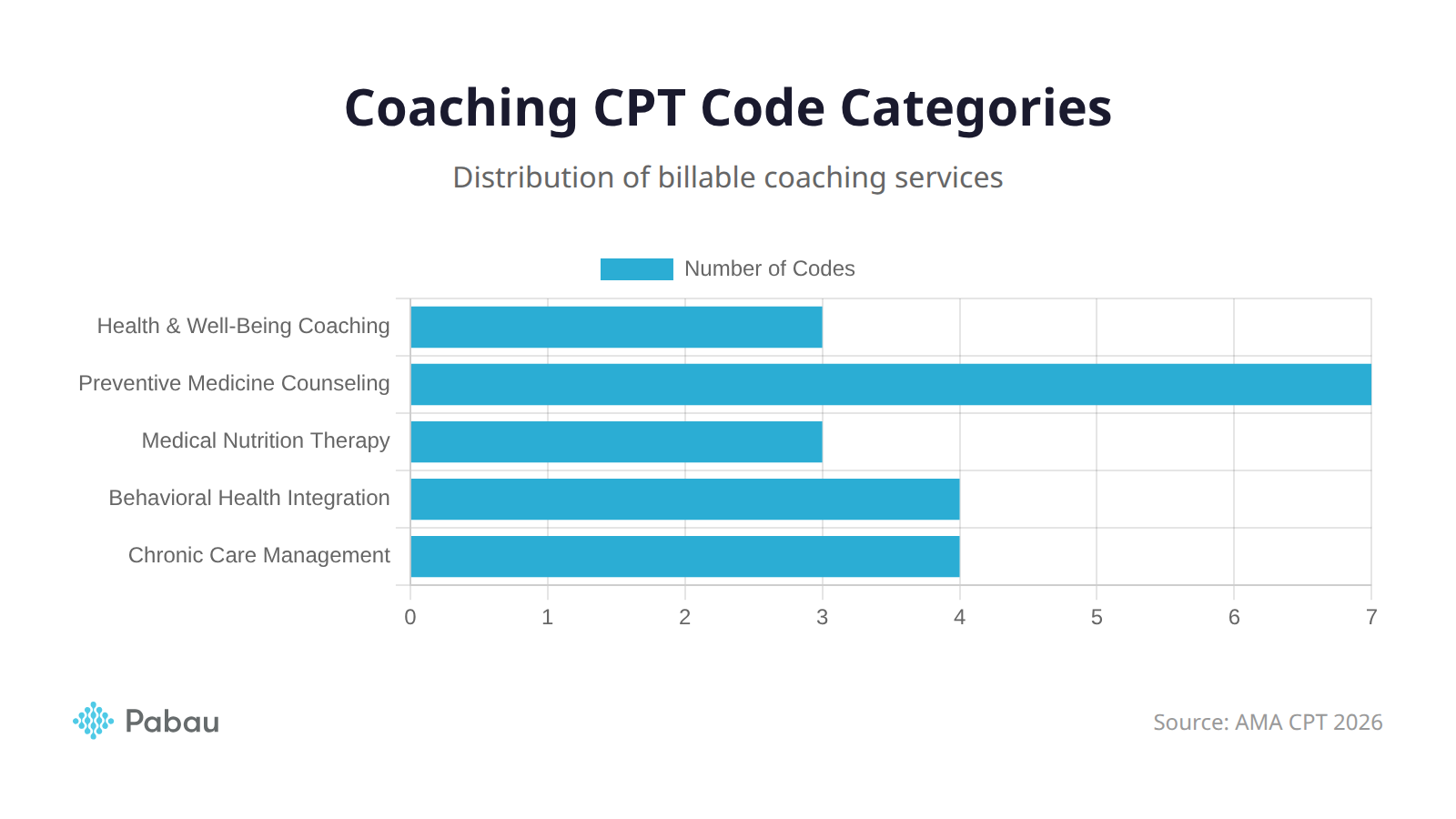
The five categories are:
Let's explore each category in detail so you know which codes apply to your practice.
Preventive medicine counselling codes cover risk factor reduction and behavioural change interventions. These are established Category I codes, which means they generally have broader payer acceptance than the Category III coaching codes.
Individual counselling codes by time:
Substance use counselling codes:
Coaches use these codes when addressing preventive health topics such as diet, exercise, stress management, and sleep hygiene. The key distinction from the 0591T-0593T codes is that these are well-established codes with a longer track record of payer acceptance. However, some payers require physician supervision for billing these codes, so always verify with individual insurance companies.
When starting out, consider using preventive medicine counselling codes (99401-99404) alongside the newer coaching codes. Because they are Category I, many payers accept them more readily, giving you a reliable billing pathway while Category III acceptance grows.
If you hold a Registered Dietitian (RD) or Registered Dietitian Nutritionist (RDN) credential, you can also bill for medical nutrition therapy. These codes are specifically designed for nutrition-focused services.
Medicare covers MNT for specific diagnoses, primarily diabetes and renal disease. Private payer coverage varies considerably. For telehealth delivery, add modifier 95 to indicate the service was provided remotely.
It is worth noting that only practitioners with RD or RDN credentials can bill these codes. If you are a certified health coach without dietitian credentials, these codes are outside your scope.
For coaches working as part of an integrated care team under physician or qualified health professional supervision, behavioural health integration (BHI) codes offer additional billing options.
The key requirement for these codes is that you must work under the supervision or direction of a treating physician or qualified health professional. As a result, these codes are most common in integrated primary care settings where coaches function as part of a multidisciplinary team.
Chronic care management codes apply when you support patients with two or more chronic conditions expected to last 12 months or longer. These codes are billed monthly rather than per visit.
Basic CCM:
Complex CCM:
To use CCM codes, several requirements must be met. The patient must have a comprehensive care plan, and the care team must provide 24/7 access and continuity of care. Coaches commonly use these codes in weight management programmes, diabetes prevention, and cardiovascular risk reduction.
In most cases, billing CCM codes requires working within a physician practice. Furthermore, the monthly billing structure means you track cumulative time across the month rather than billing for individual sessions.
If you work in a physician practice, ask about chronic care management billing. Many clinics underutilise CCM codes because they lack staff to provide the required monthly touchpoints. As a health coach, you can fill that gap and generate significant revenue for the practice.
Understanding the credential requirements is critical before you begin billing. Not every health coach qualifies to use the 0591T-0593T codes.
The AMA recognises only two certifying bodies for the coaching CPT codes:
You must hold certification from one of these organisations to bill the 0591T-0593T codes. Typically, this requires completing a formal health coaching training programme of 100 or more hours, followed by a competency-based certification exam.
All providers billing insurance need a National Provider Identifier (NPI). You can apply for free through the NPPES website. The application takes approximately 10 business days to process.
Health coaching is generally an unlicensed profession. However, certain services you might offer, such as nutrition therapy or mental health support, may require specific state licensure. Therefore, always confirm your scope of practice in your state. Some codes, like the BHI and CCM codes, require physician supervision regardless of your other credentials.
This is the question every health coach asks, and the answer requires nuance.
As Category III codes, the primary purpose of 0591T-0593T is data collection. Reimbursement is not guaranteed, and each payer decides independently whether to cover these services.
Medicare status: Medicare recognised these codes as of 2024 and added them to the Medicare Telehealth Services List. However, CMS has not yet upgraded them to permanent Category I status. Individual Medicare Advantage plans may offer coverage, so check with your local Medicare Administrative Contractor (MAC).
Private payers: Some private insurers have begun offering reimbursement for coaching CPT codes. Many others remain in a wait-and-see mode pending potential Category I reclassification. The landscape is evolving rapidly, so contact payers directly for the most current coverage policies.
What affects reimbursement:
Realistic expectations: Do not rely solely on insurance reimbursement at this stage. Instead, offer cash-pay options alongside insurance billing. Provide superbills so clients can submit for out-of-network reimbursement. Credentialing now positions you well for the future as coverage expands.
Follow these steps to set up your insurance billing workflow properly.
Step 1: Get certified. Obtain NBHWC or NCHEC certification. Payers will require proof of certification during the credentialling process.
Step 2: Obtain your NPI number. Apply through NPPES online. The process is free and takes about 10 business days.
Step 3: Verify payer coverage. Contact insurance companies directly and ask whether they reimburse CPT codes 0591T, 0592T, and 0593T. Request written coverage policies for your records.
Step 4: Document medical necessity. For every session, maintain clear clinical notes with diagnosis codes (ICD-10), treatment goals, and measurable outcomes. Thorough documentation supports your claims and protects against audits.
Step 5: Submit claims. Use the CMS-1500 form or its electronic equivalent. Include your NPI, patient demographics, diagnosis codes, coaching CPT codes with appropriate modifiers, and detailed time documentation for time-based codes.
Step 6: Offer superbills. For clients whose insurance does not cover coaching directly, provide a superbill. This detailed receipt includes all CPT and ICD codes, allowing clients to submit claims for potential out-of-network reimbursement.
Common billing mistakes to avoid:
“Since switching to Pabau for our documentation and billing workflows, we have cut our administrative time in half. The automated superbill generation and claims tracking mean we spend more time with patients and less time chasing paperwork.”

Always verify payer coverage BEFORE your client's first session. A quick phone call to the insurance company saves hours of denied claims and frustrated clients later. Keep a spreadsheet of payer policies so you do not repeat the research for each new client.
Modern practice management software makes billing coaching CPT codes far simpler. The right platform handles the administrative burden so you can focus on your clients.
Key features to look for:
Pabau supports the full coaching billing workflow. With built-in claims management software, you can generate superbills automatically, track claim submissions, and manage reimbursements from a single dashboard. The client portal handles intake forms and consent, while automated workflows reduce repetitive admin tasks.
For coaches offering telehealth sessions, Pabau includes integrated video consultations with automatic modifier 95 documentation. Meanwhile, the appointment scheduling system tracks session duration for accurate time-based billing.
Investing in the right software reduces billing errors, ensures compliance, and ultimately speeds up your reimbursement cycle.

Setting up claims and insurance billing? Our guide to primary care EHR software covers the top platforms for managing clinical documentation and billing workflows.
Want to streamline your entire practice? Practice Management 101 breaks down the challenges, expert advice, and solutions every health professional needs.
Considering telehealth for coaching sessions? Learn how telehealth adoption is transforming clinical practice and what it means for your coaching workflow.
It depends on your situation. Medicare recognised coaching CPT codes (0591T-0593T) in 2024, but reimbursement is not guaranteed because these are Category III codes. Check with your local Medicare Administrative Contractor (MAC) for specific coverage policies in your area. Individual Medicare Advantage plans may also offer coverage.
The 0591T code is specifically for health and well-being coaching initial assessments and requires NBHWC or NCHEC certification. In contrast, 99401 is a general preventive medicine counselling code covering approximately 15 minutes of service that various providers can use. In short, 0591T is coaching-specific whilst 99401 is broader in scope.
No, health coaching is generally not a licensed profession. However, you must hold certification from NBHWC or NCHEC to use codes 0591T-0593T. Some related codes, such as MNT codes (97802-97804), require specific credentials like RD or RDN. Always confirm your scope of practice with your state regulatory body.
Yes. The coaching CPT codes (0591T-0593T) are on the Medicare Telehealth Services List. Add modifier 95 to indicate telehealth delivery. However, always verify telehealth policies with individual payers, as coverage can vary. Many private insurers have expanded telehealth acceptance since 2020.
Codes 0592T (individual follow-up) and 0593T (group session) both require a minimum of 30 minutes. Code 0591T (initial assessment) does not specify a time minimum, but 60 or more minutes is typical for a thorough assessment. Always document exact session start and end times for compliance.
Offer cash-pay options and provide a superbill, which is a detailed receipt containing CPT and diagnosis codes. Clients can submit superbills to their insurer for potential out-of-network reimbursement. This approach keeps your services accessible whilst the insurance landscape continues to evolve.