Primary & Preventive Care Wellness
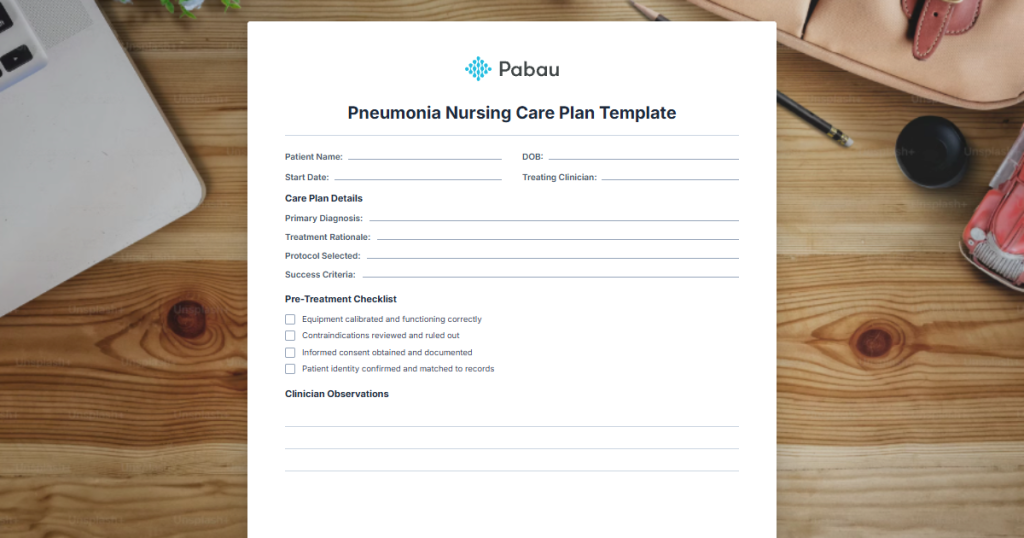
Pneumonia Nursing Care Plan Template
Pneumonia remains a leading cause of hospitalisation and morbidity in acute care...

April 1, 2026


Buy now, pay later is now available in Pabau

Screen absolute contraindications before treatment initiation
Document full medical history and current medications
Verify patient age, identity, and BMI eligibility
Obtain explicit consent before issuing prescriptions
An ozempic questionnaire is a critical screening tool that healthcare providers use to evaluate patient suitability for semaglutide therapy before prescribing begins. This comprehensive assessment gathers essential medical history, identifies absolute contraindications, and ensures patients understand both the benefits and risks of GLP-1 receptor agonist treatment. For weight loss clinics, telehealth providers, and wellness practices, implementing a structured ozempic questionnaire protects patient safety, reduces prescribing errors, and strengthens clinical documentation for audit and compliance purposes.
The questionnaire serves as the foundation of informed consent. Patients must disclose diabetes status, heart conditions, thyroid history, pancreatitis, kidney function, eating disorders, and pregnancy status-all variables that influence whether semaglutide is safe to prescribe. A poorly designed intake process increases liability risk; a robust ozempic questionnaire mitigates that risk by creating a clear audit trail of patient disclosures and clinical decision-making.
A comprehensive pre-treatment assessment form covering absolute contraindications, medical history screening, consent declarations, identity verification, and clinical documentation requirements for semaglutide therapy.
Download template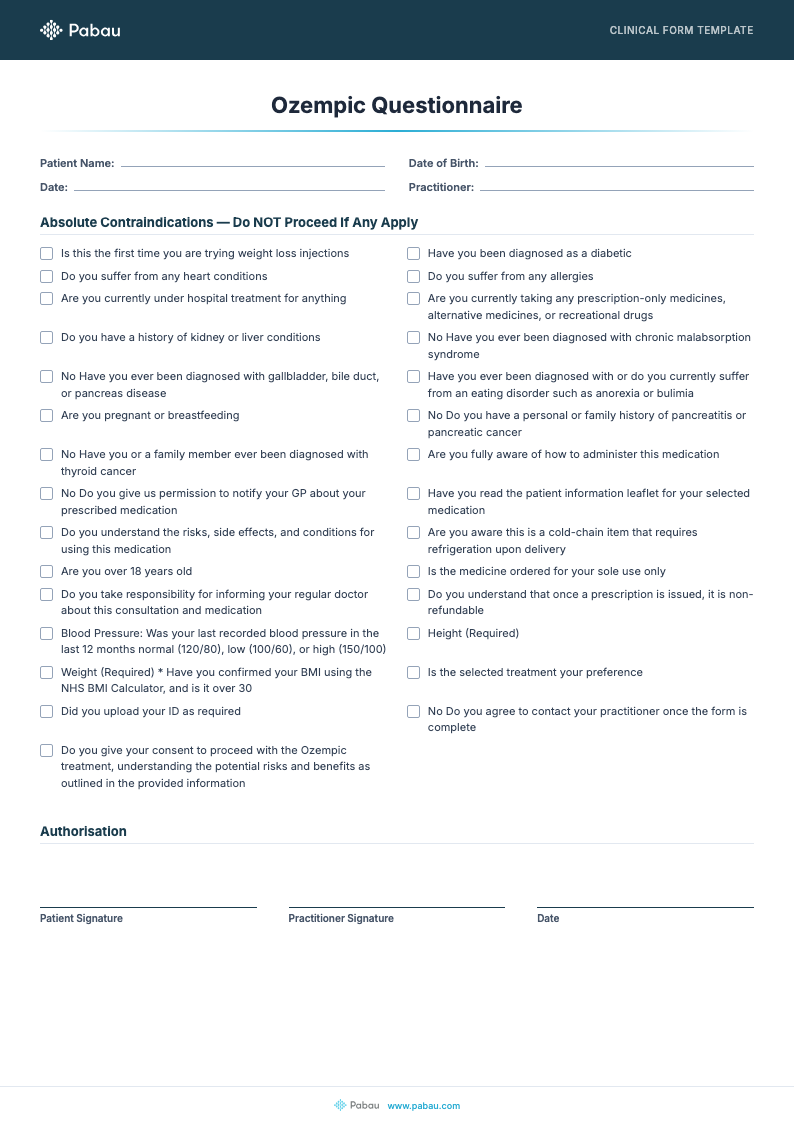
An ozempic questionnaire is a pre-appointment assessment document designed to gather detailed health information before semaglutide prescribing. It functions as both a clinical screening tool and a legal consent record. The form documents patient understanding of medication risks, confirms eligibility criteria (such as BMI threshold and age), captures absolute contraindications that would prevent treatment, and verifies identity through document upload to prevent prescription fraud.
From a regulatory perspective, the ozempic questionnaire serves multiple compliance functions. It demonstrates informed consent in line with General Medical Council (GMC) and Care Quality Commission (CQC) standards. It creates an audit trail showing that patients disclosed relevant medical history and that clinicians reviewed that history before issuing a prescription-only medicine. It also documents that patients received and understood patient information leaflets and safety warnings-particularly the Novo Nordisk safety information about black triangle monitoring status and the Yellow Card Scheme for adverse event reporting.
Legally, a documented ozempic questionnaire protects both the clinic and the patient. It prevents prescribing to patients with absolute contraindications (such as history of medullary thyroid cancer or diabetic retinopathy). It ensures patients understand that prescriptions are non-refundable once issued. It confirms identity verification has been completed. Without this structured intake, clinics face regulatory scrutiny and potential clinical negligence claims.
A structured five-step workflow ensures consistent, safe implementation of the ozempic questionnaire across your clinic.

Pabau's digital form system automates ozempic questionnaire delivery, captures responses securely, and stores signed documents in patient records. Reduce manual paperwork and strengthen compliance.

Weight loss clinics rely on the ozempic questionnaire as their core intake document. Whether operating in-person or via telehealth, weight loss practices prescribe semaglutide regularly and need a standardised screening process that flags contraindications consistently. A structured questionnaire reduces the risk of prescribing to unsuitable patients and creates documented evidence of due diligence.
Telehealth and online prescription services depend entirely on comprehensive questionnaires, as remote clinicians cannot perform physical examinations. The ozempic questionnaire compensates by capturing extensive medical history, current medications, and self-reported vital signs (blood pressure, BMI). It also serves as proof that the patient was properly screened before a prescription was issued across state or country lines.
Metabolic health and longevity clinics often prescribe semaglutide off-label for weight management in patients without type 2 diabetes. These practices face heightened regulatory scrutiny and must document informed consent explicitly. An ozempic questionnaire demonstrates that clinicians discussed the off-label nature of the treatment and obtained explicit patient consent before proceeding.
Aesthetic and dermatology practices increasingly offer GLP-1 therapies as part of broader wellness and body contouring services. These clinics benefit from a professional ozempic questionnaire to maintain clinical credibility and reduce liability. A structured intake separates clinically-sound practices from those offering medications without proper screening.
Private GP practices and functional medicine clinics use the ozempic questionnaire to evaluate patients for semaglutide therapy as part of holistic weight management or metabolic optimisation programmes. The questionnaire aligns with weight loss clinic workflows and ensures documentation meets Care Quality Commission (CQC) and General Medical Council (GMC) standards.
Patient safety through contraindication screening: The ozempic questionnaire identifies absolute contraindications-thyroid cancer history, pancreatitis, severe heart disease, eating disorders, and pregnancy-before clinicians make prescribing decisions. This structured screening prevents serious adverse events and protects vulnerable patient populations from inappropriate treatment.
Regulatory compliance and audit readiness: A documented ozempic questionnaire satisfies CQC, GMC, and HIPAA requirements for informed consent and clinical decision-making. When regulators or lawyers request evidence that a patient was properly screened before a prescription was issued, the completed questionnaire provides that proof. This documentation reduces liability risk and strengthens the clinic’s defence in any complaint or investigation.
Workflow efficiency and time savings: Digital delivery of the ozempic questionnaire before appointments allows clinicians to review responses in advance. High-risk patients are flagged before the appointment, allowing clinicians to prepare counter-arguments or alternative treatments. Low-risk patients move through appointments faster. Over a year, this efficiency compounds across dozens of consultations, freeing clinician time for complex cases.
Drug interaction and medication safety: A comprehensive medication history section in the ozempic questionnaire captures all concurrent drugs-prescription, over-the-counter, herbal, and recreational. Clinicians can then check for interactions with semaglutide and adjust dosing or monitoring accordingly. This prevents prescribing errors and adverse events from drug-drug interactions.
Identity verification and prescription fraud prevention: The ozempic questionnaire includes a requirement for ID upload (passport or driving licence). This document verification prevents fraudulent prescriptions issued in someone else’s name and protects the clinic from enabling prescription misuse.
Automate ozempic questionnaire routing by setting up conditional workflows in your practice management system. Route forms with flagged contraindications directly to your senior clinician for review before the appointment. Route low-risk forms to standard processing. Use AI-powered documentation tools to summarise key findings from the questionnaire into the clinical note, reducing manual transcription and saving 5-10 minutes per consultation.
A robust ozempic questionnaire screens for absolute contraindications that should prevent semaglutide prescribing altogether. The most critical contraindications include:
Personal or family history of medullary thyroid carcinoma (MTC) or multiple endocrine neoplasia syndrome type 2 (MEN 2): Ozempic carries a black box warning for MTC risk. Any patient with MTC history or MEN 2 should not receive semaglutide. The ozempic questionnaire must explicitly ask: “Have you or a family member ever been diagnosed with thyroid cancer?” Affirmative answers require documented refusal of treatment.
History of acute pancreatitis: GLP-1 agonists are associated with pancreatitis risk. Patients with prior pancreatitis episodes (acute or chronic) should not receive semaglutide. The questionnaire asks: “Do you have a personal or family history of pancreatitis or pancreatic cancer?” This screening prevents potentially life-threatening complications.
Severe congestive heart failure (New York Heart Association Class III or IV): Semaglutide can affect heart function in susceptible patients. The questionnaire screens: “Do you suffer from any heart conditions?” Severe CHF requires specialist cardiology review before any GLP-1 initiation and may be an absolute contraindication depending on ejection fraction and functional status.
Pregnancy or breastfeeding: Semaglutide is not recommended during pregnancy due to limited safety data. The questionnaire asks: “Are you pregnant or breastfeeding?” Any affirmative answer should result in treatment deferral. Pre-menopausal women should also be counselled on contraception requirements while on semaglutide.
Current or recent eating disorder: Patients with anorexia nervosa or bulimia may be at higher risk from semaglutide’s appetite suppression effects. The ozempic questionnaire screens: “Have you ever been diagnosed with or do you currently suffer from an eating disorder such as anorexia or bulimia?” Eating disorder history requires psychological assessment and may contraindicate treatment or require specialist co-management.
Beyond absolute contraindications, the ozempic questionnaire captures medical history items that influence prescribing safety or require additional monitoring. A well-designed questionnaire asks about:
Kidney and liver disease: Renal and hepatic impairment affect semaglutide metabolism and clearance. Patients with eGFR <15 mL/min or severe liver disease may require dose adjustments or should not receive semaglutide. The ozempic questionnaire must ask: “Do you have a history of kidney or liver conditions?” Affirmative answers should trigger baseline lab work (eGFR, liver function tests) before prescribing.
Gallbladder, pancreas, or bile duct disease: GLP-1 agonists increase bile duct stone risk and can exacerbate pancreatic disease. Patients with gallstone history, pancreatitis, or bile duct obstruction require specialist review. The questionnaire screens: “Have you ever been diagnosed with gallbladder, bile duct, or pancreas disease?”
Chronic malabsorption syndromes: Conditions like coeliac disease, Crohn’s disease, or short bowel syndrome affect nutrient absorption. Semaglutide’s GI side effects may worsen malabsorption. The questionnaire asks: “Have you ever been diagnosed with chronic malabsorption syndrome?” This informs whether additional dietary support or specialist referral is needed.
Current medications and supplements: The ozempic questionnaire must capture a complete medication list-prescription medications, over-the-counter drugs, herbal supplements, and recreational substances. Certain medications interact with semaglutide or heighten side effect risk. For example, patients on concurrent weight loss medications or stimulants may not be suitable for semaglutide. Document all medications and review for interactions before prescribing.
BMI and vital signs: The ozempic questionnaire confirms BMI eligibility (typically >30, or >27 with weight-related comorbidities) and captures self-reported blood pressure and weight. Low-risk vital signs support prescribing; abnormally high or low readings may warrant baseline clinical assessment before initiating semaglutide.
The ozempic questionnaire is the backbone of telehealth-based semaglutide prescribing. Unlike in-person consultations, telehealth clinicians cannot perform physical examination, blood pressure measurement, or thyroid palpation. The questionnaire must therefore be comprehensive enough to substitute for physical exam findings.
Telehealth semaglutide prescribing is legal and practised widely across the UK and US, provided clinicians follow rigorous screening protocols. The ozempic questionnaire enables this by capturing self-reported vitals, full medical history, and explicit consent. However, telehealth clinicians should flag any patient with red flags-uncontrolled hypertension, multiple comorbidities, complex medication regimens, or ambiguous contraindication answers-for telephone consultation or in-person assessment before prescribing.
State telehealth regulations (in the US) and GMC guidance (in the UK) require that remote prescribers establish a clinically appropriate relationship with the patient. A comprehensive ozempic questionnaire, combined with a clinician review call or video consultation, satisfies this requirement. Document the nature and duration of the clinician-patient interaction in the medical record, even if conducted remotely.
Once completed and signed, the ozempic questionnaire becomes a medical record and must be stored securely. Clinics operating in the US must comply with HIPAA Privacy and Security Rules. Clinics in the UK must comply with the Data Protection Act 2018 and UK GDPR. Both frameworks require that patient health information be encrypted, access-controlled, and retained according to statutory timelines (typically 6 years for adults in the UK, indefinitely for US controlled substances).
Store the signed ozempic questionnaire in the patient’s electronic medical record (EMR) alongside the consultation note and prescription record. Use compliance-focused practice management software that automatically audits document access, tracks who viewed the record, and flags outdated or incomplete forms. Never store questionnaires in unsecured folders or email archives. Encrypt all data in transit and at rest.

Need guidance on telehealth compliance frameworks? Telehealth Software Features explains how to structure remote consultations and document clinician-patient interactions in line with regulatory requirements.
Looking to automate patient intake workflows? Digital Forms and Questionnaires covers how to design, deploy, and store digital intake questionnaires with built-in compliance checks.
Want to understand weight loss clinic operations? Weight Loss Clinic Software explores end-to-end workflows for prescribing, monitoring, and follow-up in weight loss practices.
An ozempic questionnaire is not a optional convenience-it is a clinical and legal requirement for any practice prescribing semaglutide. A well-designed questionnaire screens for absolute contraindications, documents informed consent, captures full medical history, verifies patient identity, and creates an audit trail that protects both the clinic and the patient. Whether your practice operates in-person or via telehealth, implementing a structured ozempic questionnaire elevates clinical safety and strengthens regulatory compliance.
Start by downloading the free Ozempic Questionnaire template above. Customise the questions to align with your clinical protocols and local regulations. Deploy it digitally 24-48 hours before patient appointments. Train your team to screen responses systematically and escalate contraindications promptly. Over time, your ozempic questionnaire process will become a seamless, efficient part of patient intake-protecting your practice from liability while ensuring only suitable patients receive semaglutide therapy.
Ozempic (semaglutide) is FDA-approved for type 2 diabetes management. It is also prescribed off-label by private practices for weight management in patients without diabetes. The ozempic questionnaire screens all patients regardless of indication to ensure safety and suitability.
Yes. Telehealth Ozempic prescribing is legal in many countries and states, provided clinicians follow rigorous screening protocols using comprehensive questionnaires. A thorough ozempic questionnaire replaces physical examination and enables safe remote prescribing when combined with clinician review and appropriate follow-up.
A clinical-grade ozempic questionnaire covers absolute contraindications (thyroid cancer, pancreatitis history, severe heart disease, eating disorders, pregnancy), medical history (kidney/liver disease, diabetes status, medications), BMI and vital signs, identity verification, and explicit consent statements about risks and non-refund policy.
Absolute contraindications include personal or family history of medullary thyroid cancer (MTC), MEN 2 syndrome, acute pancreatitis, severe congestive heart failure, active pregnancy or breastfeeding, and current eating disorders. Any patient with these conditions should not receive semaglutide and should be offered alternative treatments.
Use a structured ozempic questionnaire that explicitly asks about each absolute contraindication category. Screen all responses before the appointment. Flag any affirmative answers for clinician review. Document the screening result and the clinical decision (approve, defer, or refuse treatment) in the patient record.
While not explicitly mandated by a single law, a documented ozempic questionnaire is required by professional standards (GMC, CQC in UK; state medical boards in US) to demonstrate informed consent and appropriate clinical decision-making before prescribing a prescription-only medicine. It protects the clinic from regulatory findings and malpractice claims.