Primary & Preventive Care Wellness
Small Bowel Obstruction Nursing Care Plan Template
A comprehensive small bowel obstruction nursing care plan template provides stru...

March 13, 2026

Discover free eBooks, guides and med spa templates on our new resources page


Buy now, pay later is now available in Pabau

Read case studies from our satisfied clients

Compare Pabau with alternative systems
 Integrations
 Measure Pabau savings
  Our security commitment
  About us
Learn why this holistic care and aesthetic medicine clinic chose Pabau to power patient care and performance.
Read more

Mental health intake assessments capture essential psychological history and risk factors before first therapy session
Standardised intake forms reduce documentation time and support regulatory compliance (HIPAA, informed consent, mandated reporting)
Structured intakes enable therapists to develop individualised treatment plans aligned with client presenting problems and goals
Digital intake workflows deliver forms via secure client portals, reducing administrative burden and paper handling
A mental health intake assessment is the clinical foundation for effective therapy. This structured evaluation captures a client’s psychological history, presenting problems, risk factors, family background, and treatment goals-establishing the baseline data therapists need to develop individualised treatment plans. Mental health practitioners use intake assessments to screen for safety concerns, document informed consent, gather insurance verification, and create comprehensive clinical records.
This guide walks you through the purpose of mental health intake, the key components a thorough assessment must include, best practices for conducting intakes across different specialities, and how digital digital intake forms streamline workflows while maintaining compliance and clinical quality.
A comprehensive evaluation form capturing psychological history, presenting problems, risk factors, family background, medication history, consent declarations, and treatment goals for mental health practitioners.
Download template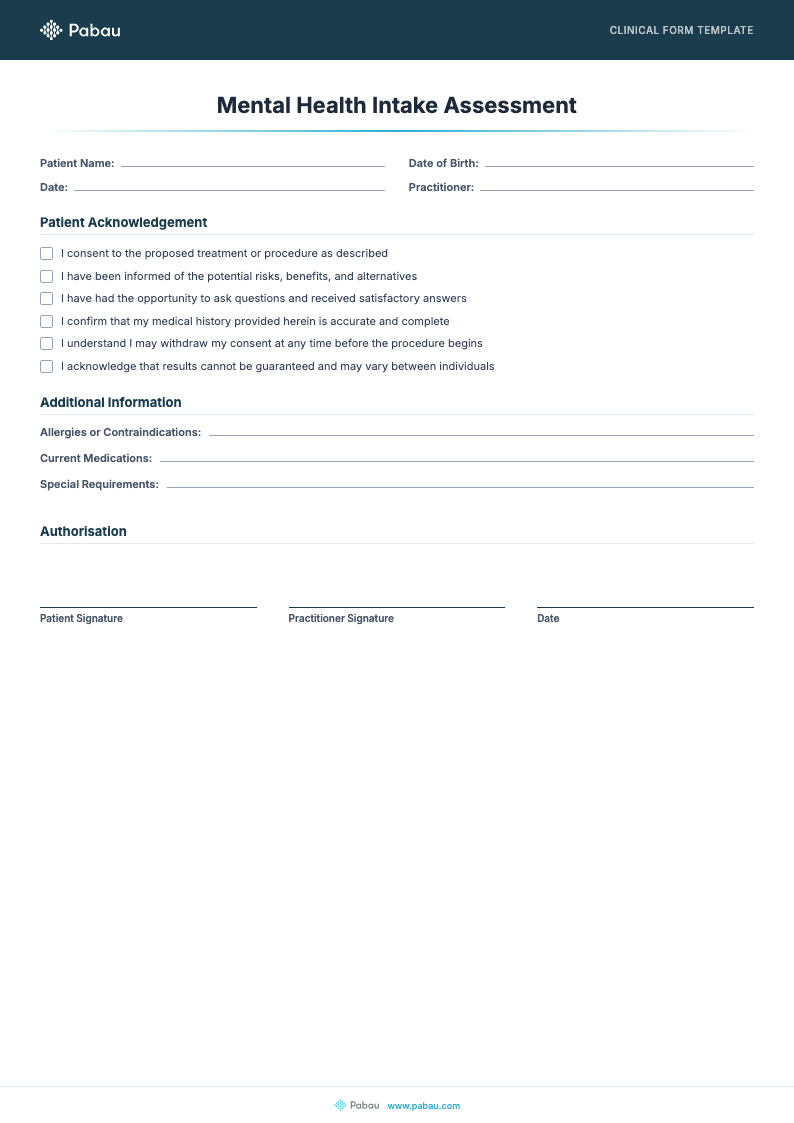
A mental health intake assessment is a structured clinical document designed to gather comprehensive information about a client’s psychological state, history, and treatment expectations before therapy begins. The assessment typically includes demographic data, presenting problems, psychiatric and medical history, substance use screening, risk assessment (suicidality, homicidality, safety concerns), family history of mental health conditions, current medications, insurance information, and treatment goals.
The intake serves multiple clinical and administrative purposes. From a therapeutic standpoint, it establishes the foundation for treatment planning and helps clinicians understand the client’s context, triggers, and support systems. From a compliance perspective, it documents informed consent, ensures HIPAA confidentiality acknowledgment, and creates an audit trail for regulatory bodies like state licensing boards, the Care Quality Commission (CQC), or private insurance payors.
A thorough mental health intake form typically contains five major sections. The first captures demographic and contact information (name, date of birth, emergency contact, insurance details). The second documents presenting problem-why the client is seeking care right now, described in their own words and the clinician’s summary. The third explores psychological, psychiatric, and medical history: prior diagnoses, previous therapy, hospitalisations, medications, and relevant medical conditions affecting mental health.
The fourth section addresses risk assessment, including screening for suicidal ideation, homicidal ideation, and safety concerns. This is the most clinically sensitive component and requires structured documentation with clear notation of risk level and any safety planning conducted during intake. The fifth section captures family history (mental health conditions in biological relatives), substance use history (alcohol, medications, recreational drugs), social history (employment, relationships, housing), and treatment goals-what the client hopes to achieve through therapy.
A mental health intake assessment is distinct from the first therapy session. Intake can occur weeks before therapy starts (e.g., during an administrative check-in call or via a client portal form). The intake gathers raw data; the first therapy session uses that data to begin building therapeutic relationship and may include deeper exploration of presenting problems. Some practices combine intake and first session, while others separate them into distinct appointments. Digital intake forms allow clients to complete assessments asynchronously before their first appointment, saving clinical time and allowing therapists to review material and prepare their initial session.
Implementing a mental health intake assessment in your practice involves five operational steps that ensure thorough data collection, compliance documentation, and client experience quality. Whether you administer the form via paper, email, or a secure client portal, the underlying workflow remains consistent.
This structured workflow ensures that intake data flows directly from client to clinician to clinical record, supporting both therapeutic quality and compliance readiness.

Automate mental health intake delivery, collect data via secure client portal, and reduce administrative burden while maintaining HIPAA compliance.

Mental health intake assessments are essential for any mental health practitioner or clinic that sees new clients. This includes licensed therapists and counselors (LCSW, LPC, LCPC), psychologists, psychiatrists, marriage and family therapists, clinical social workers, and psychiatric nurse practitioners. The assessment is equally relevant whether you work in private practice, hospital-based mental health clinics, community health centres, or integrated primary care settings.
Intake assessments support diverse mental health specialities. For ADHD clinicians, intake captures attention and developmental history, previous assessments, and medication trials. For addiction counselors, intake includes substance use trajectory, prior treatment, recovery supports, and triggers. For trauma-focused therapists, intake documents trauma exposure, dissociative symptoms, and safety concerns. For child and adolescent practices, intake captures developmental milestones, school performance, peer relationships, and family dynamics.
Practices ranging from solo practitioners to multi-clinician mental health agencies benefit from standardised intake. A solo therapist uses intake to efficiently document each new client’s background. A group practice uses intake to ensure consistent data collection across clinicians and facilitate warm handoffs when clients see different therapists for supervision or coverage. Community mental health centres use intake to triage clients by acuity and determine appropriate level of care. Private practices specialising in executive coaching or employee assistance programmes (EAP) adapted use intakes to assess functional impairment and readiness for work-focused interventions.
A structured mental health intake assessment delivers five measurable practice benefits. First, it accelerates treatment planning. By gathering comprehensive history in advance, clinicians enter the first session with baseline understanding of the client, allowing them to invest session time in therapeutic alliance-building and deeper problem exploration rather than data collection. This speeds time to effective treatment and improves early engagement.
Second, intake reduces clinical and legal risk. A documented intake with risk screening, informed consent signature, and confidentiality acknowledgment creates a compliance audit trail. If a licensing board, insurance company, or court later questions your care decisions, you can point to the intake as evidence of informed, thorough initial assessment. Practices without standardised intakes are vulnerable to negligence claims (failure to screen for suicide risk, missing contraindications, undocumented consent).
Third, intake improves diagnostic accuracy and treatment matching. A thorough history reveals comorbidities (anxiety co-occurring with depression), medical factors affecting mental health (thyroid dysfunction, medication side effects), and prior treatment response that can guide your diagnostic formulation. This prevents over-diagnosis of primary psychiatric disorders when medical causes are missed, and helps you recommend the most effective modality (e.g., CBT for anxiety, medication management for bipolar disorder).
Fourth, digital intake forms reduce administrative burden. Paper intake forms must be scanned, filed, and manually entered into electronic records. Digital intake via secure client portal automates delivery, response collection, and storage-saving hours per week for practices seeing multiple new clients. SMS and email reminders increase completion rates, reducing no-shows and incomplete intakes on appointment day.
Fifth, intake supports insurance and payment clarity. By verifying coverage before the first session, you prevent billing surprises, reduce claim denials, and establish transparent fee expectations with clients. This improves client retention and practice revenue predictability.
Flag any red flags during intake review-suicidal ideation, undisclosed comorbidities, substance use suggesting intoxication risk, homelessness, or safety concerns-and contact the client before their first appointment. A brief pre-session safety conversation demonstrates care, prevents crisis during session, and ensures appropriate referrals (e.g., to psychiatric emergency if needed).
Effective intake assessment combines structured data collection with clinical sensitivity. Use clear, accessible language-avoid jargon and explain why you’re asking specific questions. For example, “Have you ever experienced thoughts of harming yourself?” is clearer than “Do you have passive suicidal ideation?” Clients are more likely to disclose sensitive information (trauma, substance use, sexual concerns) when questions feel respectful and necessary rather than intrusive.
Create a core set of intake questions aligned with your speciality and client population, but don’t make the form so long it discourages completion. A thorough intake should take 15-20 minutes to complete, not 45 minutes. Prioritise: identifying presenting problems, safety assessment, prior treatment, medical history, medication allergies, insurance, emergency contacts, and baseline functional impairment. Questions like “What brings you in today?” and “What would success in therapy look like?” are universally applicable. Speciality-specific questions (e.g., “How long have you been experiencing these panic attacks?” for anxiety specialists) can be added to a base template.
Informed consent must address: (1) the nature of therapy and what to expect, (2) risks and benefits of treatment, (3) confidentiality and its limits (mandatory reporting, subpoena, supervision), (4) fees and billing practices, (5) cancellation and no-show policies, (6) your credentials and license number, and (7) complaint procedures (how to file a grievance with your licensing board). Rather than burying this in dense legal language, break it into sections and confirm the client has read and understood each part. A digital checkbox confirming acknowledgment is safer than assuming verbal agreement.
Document all intake findings in the clinical record, not on a separate form filed elsewhere. Your EHR or practice management system should link intake data to the client’s record so clinicians can access it during appointments. Key documentation elements: date and method of intake (in-person, phone, portal), presenting problem in client’s own words, past psychiatric history with hospitalisation dates and diagnoses, medication list with dates started/stopped, allergies (especially drug allergies), risk assessment findings with risk level and interventions, family mental health history, substance use history, social supports, treatment goals, and clinician’s initial impression/diagnostic impression if applicable.
State licensing boards and insurance auditors expect this documentation to be contemporaneous (recorded at or shortly after intake, not months later). For telehealth or digital intakes, retain the completed form as a timestamped record of when it was submitted and reviewed.
Mental health intake forms contain sensitive protected health information (PHI): psychiatric diagnosis, medication history, trauma disclosures, substance use, and safety risk data. HIPAA regulations require that intake data be collected, stored, and transmitted securely. Paper forms must be stored in locked files accessible only to authorised staff. Digital forms should be collected and stored on encrypted, HIPAA-compliant platforms with audit trails documenting who accessed the data and when.
Consent to share data outside the practice (with psychiatrist consultants, other treatment providers, or insurance companies) must be explicit and documented in the intake. Default should be no sharing without separate written authorisation. Some clients consent to coordination of care; others prefer strict confidentiality. Capture this preference in intake and honour it-failure to do so violates both legal requirements and therapeutic trust.
Mandated reporting is the exception to confidentiality. Clinicians are legally required to report suspected child abuse, elder abuse, dependent adult abuse, and imminent threat of harm to self or others, regardless of client consent. This limit should be clearly stated in your intake consent form and verbally reviewed during the first session. Document that you explained mandated reporting to the client and when they acknowledged understanding.

Need guidance on clinical documentation standards? Psychiatric Evaluation Template outlines the components of a structured psychiatric assessment, complementing intake with deeper diagnostic formulation.
Looking to automate note-taking from intake data? Echo AI Clinical Scribe generates initial clinical summaries and treatment plan outlines from intake responses, reducing clinician documentation time by 60%.
Want to understand compliance requirements for your specialty? Mental Health EMR Software for Therapists covers HIPAA, state licensing board rules, and best-practice documentation workflows specific to therapy practices.
A mental health intake assessment is the clinical and administrative gateway to effective therapy. By capturing comprehensive history, screening for risk, documenting informed consent, and establishing treatment goals in a structured format, you lay the foundation for safe, evidence-based care. Standardised intake reduces clinician time spent on data entry, minimises compliance gaps, and demonstrates due diligence to licensing boards and insurance auditors.
Whether you deliver intake via paper, email, or a secure digital platform, the essential elements remain consistent: clear questions, explicit consent, risk assessment, and secure documentation. The free Mental Health Intake Assessment template above provides a foundation you can customise for your speciality, client population, and practice setting. Implement it as a routine first step with every new client, review completed intakes before first appointments, and use the data to inform your initial clinical impression and treatment plan.
Ask open-ended questions: “Have you seen a therapist before?” If yes, explore which therapist or clinic, what modality (CBT, psychodynamic, etc.), how long they attended, and most importantly, what worked and what didn’t. This informs your approach-if CBT failed in the past, you might recommend a different modality or explore barriers to CBT success (insufficient frequency, poor fit with therapist). Document previous therapist names and contact info if the client consents to coordination of care.
Use plain language. Say: “What you tell me stays confidential except in a few situations: if you’re in danger of harming yourself, harming someone else, or I learn a child is being abused, I’m required to report. Outside those situations, I won’t share information without your written permission.” Give examples. Confirm understanding: “Does this make sense? Do you have questions?” Document this conversation in the clinical record with the date.
Acknowledge it directly. Say: “It’s completely normal to feel nervous before therapy starts. The first session is about getting to know each other and making sure we’re a good fit. I’ll explain how I work, answer your questions, and we’ll discuss your goals.” During intake, ask: “Is there anything that would help you feel more comfortable at your first appointment?” Some clients want shorter initial sessions, quiet waiting areas, or reassurance about privacy. Note and honour these preferences.
During intake, ask: “What would you like to achieve through therapy?” and “How will you know therapy is working?” These open-ended questions capture client perspective. In the first session, translate these into SMART goals (Specific, Measurable, Achievable, Relevant, Time-bound). For example, if intake says “feel less anxious,” the first-session goal might be “reduce anxiety symptoms from 8/10 to 5/10 within 8 weeks using CBT strategies.” Document goals in the treatment plan and review progress at each session.
Yes. Some clinicians prefer unstructured interview intakes, especially for complex presentations where rigid forms feel impersonal. However, unstructured intakes risk missing critical information (risk factors, medical history, insurance) and are harder to defend in licensing board audits. Best practice: use a structured intake form to ensure baseline data completeness, then supplement with conversational exploration during the first session. This balances thoroughness with therapeutic alliance-building.