Aesthetic Clinic Aesthetics & Beauty
Tooth Charts
Tooth Chart: Free Downloadable Template for Dental Clinics A tooth chart is a vi...

March 6, 2026


Buy now, pay later is now available in Pabau

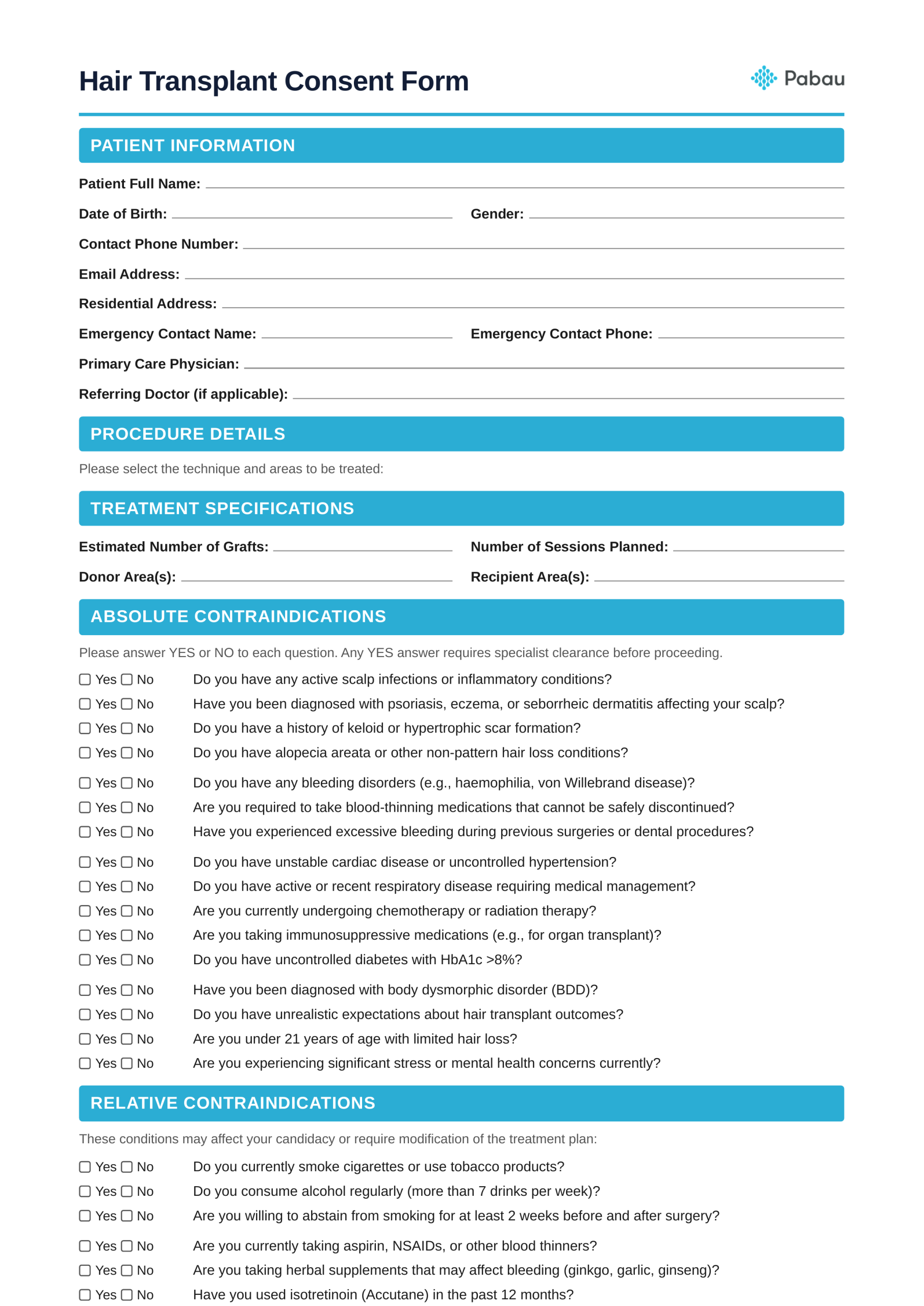
Comprehensive patient information fields capture medical history, contact details, and treatment expectations.
Detailed procedural options covering FUE and FUT techniques with clear risk acknowledgements.
Structured contraindication screening for both absolute and relative risk factors.
Multiple signature blocks ensure patient, practitioner, and witness documentation.
Free download includes pre-procedure instructions and post-operative care guidelines.
Hair transplantation is an elective aesthetic surgical procedure that requires thorough informed consent to protect both patient safety and clinic liability. A properly structured hair transplant consent form documents patient understanding of the procedure, associated risks, and expected outcomes whilst ensuring compliance with medical-legal requirements.
Free Download
A comprehensive, ready-to-use hair transplant consent template for your clinic. Download, customise, and start using it today.
A hair transplant consent form is a legal document that records patient acknowledgement of the procedure’s nature, risks, benefits, and alternatives before undergoing follicular unit extraction (FUE) or follicular unit transplantation (FUT) surgery. This informed consent process serves as both a patient education tool and a medicolegal safeguard for aesthetic surgery practitioners.
The consent form documents several critical components:
Patient identification and medical history: Captures demographic information, existing medical conditions, current medications, and allergies that may affect surgical candidacy.
Procedure explanation: Describes the specific hair restoration technique (FUE, FUT, or combined approach), expected graft numbers, donor and recipient areas, and realistic outcome expectations.
Risk disclosure: Outlines potential complications including infection, scarring, shock loss, poor graft survival, asymmetry, and aesthetic dissatisfaction.
Contraindication screening: Identifies absolute contraindications (active scalp infections, bleeding disorders, unstable medical conditions) and relative contraindications (smoking, diabetes, unrealistic expectations, body dysmorphic disorder).
Pre- and post-operative instructions: Details preparation requirements (medication adjustments, activity restrictions, hair washing protocols) and recovery guidelines.
Unlike general surgical consents, hair transplant forms must address aesthetic expectations explicitly. The Supreme Court has held that for cosmetic procedures, patient autonomy supersedes medical paternalism: patients must understand not only the medical risks but also the cosmetic limitations of the treatment.
Hair transplantation sits in the unique position of being an elective, non-essential surgical procedure performed for aesthetic rather than medical necessity. This distinction raises the legal and ethical bar for informed consent significantly higher than standard medical treatments.
Medical negligence claims in aesthetic surgery arise predominantly from inadequate communication and poor patient selection rather than surgical error. A comprehensive consent form provides documented evidence that:
Without proper consent documentation, practitioners face liability under tort law, consumer protection statutes, contract law, and the Indian Penal Code Section 304-A for causing damages through negligent acts.
The consent process serves as a structured consultation framework that ensures patients understand:
The static and dynamic components of hair loss: The immediate aesthetic change from receded hairlines plus the potential for continued follicle miniaturisation requiring staged surgeries and long-term medication.
Procedural realities: Hair transplantation redistributes existing hair rather than creating new follicles, meaning coverage density will not match pre-baldness levels.
Individual variability: Results depend on donor hair characteristics (calibre, density, curl), recipient area vascularity, healing response, and adherence to post-operative protocols.
Studies demonstrate that malpractice claims correlate strongly with unmet patient expectations. Setting conservative outcome predictions and documenting these discussions reduces litigation risk whilst improving patient satisfaction.
Professional indemnity insurance requires documented informed consent as fundamental risk management. Even when complications occur, the surgeon must prove they followed accepted standards and obtained proper consent.
A comprehensive hair transplant consent form contains structured sections that progress from patient identification through procedural acknowledgement to authorisation signatures.
This foundational section captures:
The form systematically screens for conditions that may preclude or complicate surgery:
Absolute contraindications:
Relative contraindications:
Patients answer yes/no questions for each condition, with positive responses triggering specialist referral requirements.
This section documents the agreed procedural approach:
The form acknowledges that final graft numbers may vary based on intraoperative donor assessment and that results depend on existing hair characteristics rather than guaranteed density.
Comprehensive disclosure includes both common sequelae and rare adverse events:
Expected post-operative effects:
Potential complications:
The form explicitly states that while these risks are minimised through proper technique, they cannot be eliminated entirely.
Patients acknowledge receipt of and agreement to follow preparation guidelines:
Non-compliance with these instructions may necessitate procedure postponement.
The form confirms patient understanding of recovery protocols:
Patients confirm attendance at scheduled follow-up appointments at 1 week, 1 month, 3 months, 6 months, and 12 months.
The consent documents the total procedure cost including:
Payment terms (deposit requirements, instalment options, cancellation policies) are clearly stated.
Valid consent requires three parties:
Many clinics add a handwritten patient declaration: “I acknowledge that I have read this form and understood the contents. I have been given the opportunity to ask questions, and my questions have been answered to my satisfaction. The risks and benefits of this treatment have been explained to me as have the other options for treatment. I choose to proceed with hair transplantation.”
Implementing the consent form as part of your clinical workflow ensures both legal compliance and improved patient outcomes through structured communication.
Step 1: Comprehensive patient assessment
During the first consultation, examine the patient’s hair loss pattern, donor area quality, and overall health status. Use this time to identify any red flags:
If significant contraindications emerge, refer to appropriate specialists before proceeding.
Step 2: Provide the consent form for review
Give the patient the consent form at the consultation’s conclusion: do not request immediate signature. Explain that they should:
Document this provision with a dated receipt signature from the patient.
Step 3: Second consultation for questions
Schedule a follow-up appointment specifically to address patient questions about the consent form. This demonstrates commitment to informed decision-making rather than high-pressure sales tactics.
Review each section of the form, particularly:
Day before procedure
Contact the patient to confirm:
Day of procedure
Before any preparation begins:
Important: The presence of a family member or friend as witness strengthens consent validity and provides additional memory of the discussion.
Non-literate patients
For patients unable to read the written consent:
Patients with unrealistic expectations
If a patient demonstrates persistent unrealistic expectations despite counselling, document the specific expectations and consider declining the procedure. Professional integrity outweighs short-term revenue from predictably dissatisfying cases.
Young patients
For patients under 25 with limited hair loss:
Reference the consent form during follow-up visits:
Documentation at each visit should reference the consent form’s acknowledgements to demonstrate continuity of care.
Maintain signed consent forms and all consultation notes for a minimum of 10 years after the procedure. Many jurisdictions recommend lifetime retention for aesthetic surgery records given the long statute of limitations for malpractice claims.
Store both physical and digitally scanned copies in secure, HIPAA-compliant systems. Modern client portal systems provide automated backup and audit logging.
Implement a two-consultation minimum policy where patients receive the consent form at the first visit and return for questions at a second visit before scheduling surgery. This ‘cooling-off period’ demonstrates commitment to informed consent rather than sales pressure, reduces impulsive decisions, and significantly decreases post-operative dissatisfaction.

See how clinics use Pabau to create, customise, and automate clinical forms and templates.

Hair transplant consent forms must address aesthetic expectations explicitly, include detailed contraindication screening for both medical and psychological factors, disclose the progressive nature of pattern hair loss requiring potential future procedures, and document discussion of non-surgical alternatives like medical management and camouflage options. The elective, cosmetic nature raises the legal standard for informed consent beyond medical necessity procedures.
A signed consent form provides evidence of the informed consent process but does not eliminate malpractice liability. If complications occur, you must still prove that you followed the standard of care and that the adverse outcome resulted despite proper technique rather than negligence. The consent form supports your defence by documenting that risks were disclosed and understood, but it does not waive patient rights to sue for genuine negligence or deviation from accepted practice standards.
Absolute contraindications include active scalp infections or inflammatory dermatological conditions, uncontrolled bleeding disorders or mandatory anticoagulation, unstable cardiac or respiratory disease, active chemotherapy or systemic immunosuppression, diagnosed body dysmorphic disorder, and unrealistic expectations that persist despite thorough counselling. Patients with these conditions should be referred to appropriate specialists for stabilisation or alternative management rather than proceeding with elective surgery.
Retain hair transplant consent forms and all associated consultation notes for a minimum of 10 years after the procedure, though lifetime retention is recommended for aesthetic surgery records. Malpractice statutes of limitation for cosmetic procedures can extend significantly beyond standard medical care, and long-term patient follow-up may be necessary if complications or dissatisfaction emerge years later. Store both physical and digital copies in secure, compliant record systems with appropriate backup.
Video recording provides robust documentation but requires explicit patient permission, secure storage, and clear access policies. Many patients are uncomfortable discussing hair loss on camera, so offer it as an option rather than a requirement.
Document the specific expectations and your explanation of why they cannot be achieved, then consider declining to perform the procedure. Professional integrity and long-term reputation outweigh short-term revenue from cases where patient dissatisfaction is predictable regardless of technical success. Patients with body dysmorphic disorder or those who remain convinced you can restore hair density to pre-baldness levels after thorough education should be referred for psychological evaluation or to other treatment modalities rather than proceeding with surgery.
Yes, professional indemnity insurance covering aesthetic surgery including hair transplantation is essential for all practitioners. The financial liability from a malpractice lawsuit can be substantial, and insurance protects against both justified and unjustified claims. Ensure your policy specifically covers hair restoration procedures, includes adequate coverage limits for your practice volume, and extends to staff members who assist with the procedure. Many insurers require documented informed consent processes as a condition of coverage.

Dermal Filler Consent Form Template : Download a comprehensive consent form for injectable treatments with allergy screening and complication acknowledgements.
Digital Consent Forms Software : Streamline patient consent with electronic signatures, automated storage, and HIPAA-compliant documentation.
Complete Aesthetic Clinic Software Guide : Discover how integrated practice management systems improve patient safety and operational efficiency.