Uncategorized
Dissociative Experiences Scale Template
The Dissociative Experiences Scale Template (DES-II) is an essential clinical as...

March 4, 2026

Discover free eBooks, guides and med spa templates on our new resources page


Buy now, pay later is now available in Pabau

Read case studies from our satisfied clients

Compare Pabau with alternative systems
 Integrations
 Measure Pabau savings
  Our security commitment
  About us
Learn why this holistic care and aesthetic medicine clinic chose Pabau to power patient care and performance.
Read more
Early childhood development screening is critical for identifying delays and ensuring timely intervention. The Denver Developmental Screening Test Template is a standardized, evidence-based tool that helps pediatricians, developmental specialists, and early intervention professionals evaluate children from birth to six years across four key developmental domains. This guide covers everything you need to know about using this template effectively in clinical practice.

The Denver Developmental Screening Test Template assesses four domains: Personal-Social, Fine Motor-Adaptive, Language, and Gross Motor skills
The test takes 15-20 minutes to administer, making it practical for routine well-child visits and early intervention programs
Proper training and documentation are essential for reliable screening and appropriate follow-up referrals
Digital tools can streamline administration, scoring, and longitudinal tracking for better developmental monitoring
The Denver Developmental Screening Test Template is a validated screening instrument used to detect developmental delays in young children. Originally developed in the 1960s and updated as the Denver II, this template helps practitioners identify children who may need further diagnostic evaluation. It measures milestones across personal-social interactions, fine motor control, language acquisition, and gross motor development.
The template functions as a screening tool, not a diagnostic instrument. This distinction matters: it flags children who may warrant additional testing but doesn’t diagnose developmental disorders. According to the American Academy of Pediatrics, regular developmental screening at 9, 18, and 30 months, plus ongoing surveillance at well-child visits, helps catch delays early when intervention is most effective.
The Denver Developmental Screening Test Template evaluates development across four distinct domains, each capturing different aspects of child growth:
Each domain contains age-specific items that vary based on the child’s developmental stage. The Denver Developmental Screening Test Template provides clear visual markers for what skills should emerge at different ages.
Proper administration ensures reliable results. Before starting, gather necessary materials: toys, blocks, balls, paper, pencils, and a quiet, comfortable space. Create an environment where the child feels at ease, as anxiety or distraction affects performance.
Begin by establishing the child’s exact age in months and identifying which items to test. The Denver Developmental Screening Test Template includes age-specific item selection, so you don’t test every item-only those relevant to the child’s developmental stage. Observe the child performing tasks while a parent or caregiver provides input on skills demonstrated at home.
Testing typically takes 15-20 minutes. Administer items in a sequence that maintains the child’s cooperation. If a child passes clearly, move forward. If results are questionable or the child fails, note this carefully. Record observations precisely using the template’s designated scoring boxes.
The Denver Developmental Screening Test Template uses a straightforward scoring system with three primary outcome categories:
Document results clearly in the template. Note any factors affecting the test, such as illness, fatigue, or environmental distractions. This documentation supports clinical decision-making and provides a baseline for future comparisons.
When abnormal results appear, refer the child for comprehensive developmental evaluation by a qualified specialist. Early identification and intervention significantly improve long-term outcomes for children with developmental delays. CDC developmental milestone guidelines complement the Denver test and provide additional context for age-appropriate expectations.
The Denver Developmental Screening Test Template works effectively in multiple settings. Pediatric practices use it during well-child visits to monitor typical development. Early intervention programs rely on it to identify children ages 0-3 who qualify for services. School-based professionals use it for school readiness assessment and to flag children who may need evaluation before kindergarten entry.
Best practices include ensuring administrators receive proper training in test administration and interpretation. Inconsistent administration compromises validity. Keep screening results organized and accessible for longitudinal tracking-comparing results over time reveals patterns that single assessments might miss.
Communicate findings clearly to parents. Use non-technical language and explain what screening means: that you’re checking development, not diagnosing conditions. If further evaluation is needed, provide specific referral information and explain next steps. Supportive, clear communication reduces parental anxiety and improves follow-through on recommendations.
While valuable, the Denver Developmental Screening Test Template has limitations. It screens for delays but doesn’t diagnose disorders. Children may perform differently based on environment, mood, or comfort level during testing. Language and cultural differences can affect results, particularly the language domain. The Denver II made improvements in cultural sensitivity, but practitioners should remain mindful of potential biases.
Consider complementary assessments when indicated. Speech-language pathologists may conduct more detailed language evaluations. Occupational and physical therapists provide specialized motor skill assessment. Psychological or developmental specialists perform comprehensive diagnostic testing when screening suggests concerns.
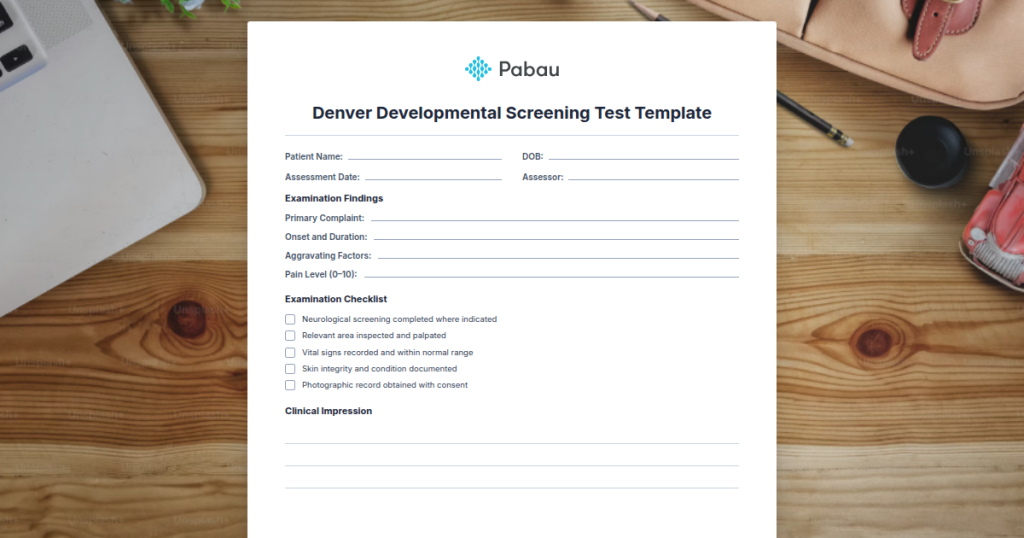
Ready to implement structured developmental screening in your practice? Download the Denver Developmental Screening Test Template below. This ready-to-use form includes age-based item selection, clear scoring instructions, and documentation fields for recording observations and recommendations.
Standardized form for assessing developmental milestones in children birth to 6 years
Download PDF TemplateFree download. No registration required.
The template includes sections for child demographics, age calculation, item-by-item scoring, domain summaries, and clinical recommendations. Print or use digitally depending on your practice workflow. Keep completed forms in the child’s medical record for continuity of care and longitudinal monitoring.
If you’re managing multiple assessments and tracking development over time, book a demo with Pabau to see how digital tools can automate scoring, flag children for follow-up, and provide secure storage that meets HIPAA requirements. Streamlining your developmental screening workflow saves time and improves consistency.
While paper templates work well, modern practice management software offers significant advantages. Digital assessment tools enable quick administration, automatic scoring, and longitudinal tracking that flags developmental concerns. Integrated client records ensure screening results link seamlessly with clinical notes, appointment scheduling, and follow-up reminders.
Digital platforms support consistent documentation, reduce transcription errors, and make it simple to compare results across multiple assessments. Many practices find that automated scoring accelerates clinical decision-making and ensures no child falls through the cracks for follow-up care.
The Denver Developmental Screening Test Template remains a gold-standard tool for identifying developmental concerns early. By combining structured screening with thoughtful clinical judgment and appropriate follow-up, you ensure every child has the opportunity to reach their developmental potential. Start screening today, and use these results to guide early intervention and support optimal child development.