

Primary & Preventive Care Wellness
Small Bowel Obstruction Nursing Care Plan Template
A comprehensive small bowel obstruction nursing care plan template provides stru...

March 13, 2026

Discover free eBooks, guides and med spa templates on our new resources page


Buy now, pay later is now available in Pabau

Read case studies from our satisfied clients

Compare Pabau with alternative systems
 Integrations
 Measure Pabau savings
  Our security commitment
  About us
Learn why this holistic care and aesthetic medicine clinic chose Pabau to power patient care and performance.
Read more

Clinical documentation ensures safety and liability protection
Standardised forms reduce errors and improve consistency
Digital templates streamline workflows and patient record-keeping
Medical spas offering CoolSculpting treatments need robust documentation systems to protect both practitioner and patient. A well-designed coolsculpting treatment form captures essential clinical data, documents informed consent, and creates a clear record of the procedure for legal compliance and continuity of care.
This guide explores what a CoolSculpting treatment form should include, how practitioners use these forms in clinical workflows, and why standardised documentation is critical for aesthetic clinics. Whether you’re documenting fat-freezing procedures for the first time or refining existing processes, understanding the structure and purpose of a comprehensive coolsculpting treatment form helps ensure compliance, reduces liability risk, and improves patient safety.
The form serves as the clinical backbone of your CoolSculpting service – it’s where you record pre-treatment assessment, obtain consent, document the procedure itself, and plan follow-up care. Clinics that prioritise thorough documentation see fewer compliance issues, better patient outcomes, and stronger legal protection.
A comprehensive treatment documentation form for CoolSculpting fat reduction procedures, covering patient details, treatment area assessment, standard clinical procedures, and post-treatment observations.
Download template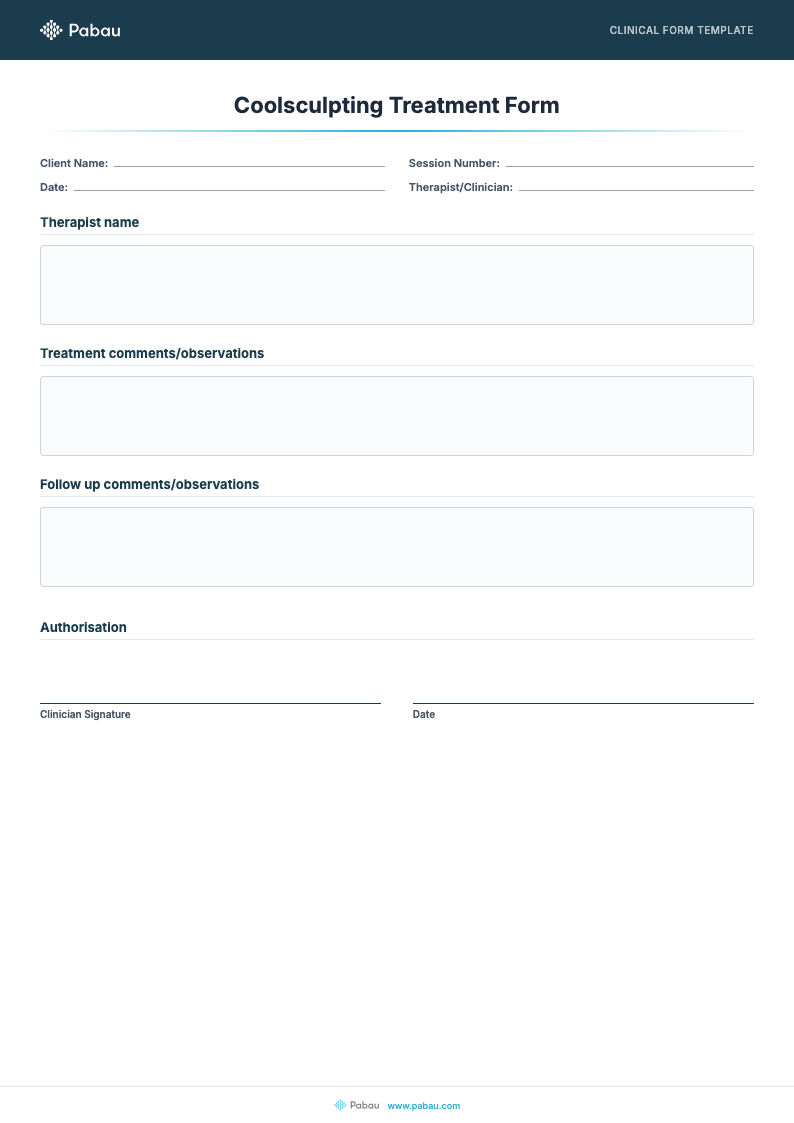
Medical spas rely on standardised CoolSculpting treatment forms to document procedures accurately and maintain compliance with regulatory requirements. The Coolsculpting Treatment Form template provided here is ready to download and customise – it covers all essential sections needed for proper clinical documentation, from patient assessment through post-treatment observations.
This template includes fields for therapist name, treatment area details, clinical observations, and follow-up comments. Simply download the PDF, customise it to match your clinic’s branding and specific treatment protocols, and integrate it into your patient records system.
A CoolSculpting treatment form is a clinical documentation template designed to standardise the recording of fat-freezing procedures. It captures essential pre-treatment, during-treatment, and post-treatment information in a structured format that meets clinical governance and legal requirements.
The form serves multiple critical functions in aesthetic practice. First, it documents patient eligibility and suitability for the procedure – practitioners record relevant medical history, current medications, contraindications, and any factors that might affect treatment safety. Second, it creates a clear record of what was performed during the session: which body areas were treated, the number of cycles applied, settings used, and any observations about patient response.
Third, the coolsculpting treatment form establishes an informed consent record. Patients need to understand the procedure, expected outcomes, potential side effects (including the risk of paradoxical adipose hyperplasia, a rare complication where treated areas initially appear larger), and aftercare requirements. Documentation of this conversation protects both clinician and patient.
Fourth, the form tracks follow-up planning and any observations from the immediate post-treatment period. Did the patient experience expected sensations? Were there any unexpected reactions? What are the next steps in the treatment protocol?
From a regulatory perspective, comprehensive treatment documentation demonstrates professional standards of care. If questions arise about a procedure – whether from patient inquiries, insurance investigations, or regulatory reviews – a detailed coolsculpting treatment form provides the complete clinical record. This documentation is particularly important for CoolSculpting, where FDA clearance and approved treatment parameters guide safe practice.
The form also supports clinic continuity. If a patient returns weeks or months later, practitioners can review the previous documentation to track progress, plan follow-up sessions, and ensure consistency across multiple appointments.
The Coolsculpting Treatment Form is designed for completion during or immediately after each treatment session. The template contains three main documentation areas: therapist details, treatment observations, and follow-up comments. Here’s how practitioners work through the form in clinical workflow:
Well-structured documentation within your coolsculpting treatment form creates accountability, supports clinical consistency, and protects your practice through comprehensive records.

Automate clinical documentation with a platform built for aesthetic clinics. Capture treatment forms, link them to client records, and access complete procedure history instantly.

Medical spas and aesthetic clinics offering CoolSculpting procedures depend on standardised treatment forms to document procedures safely and maintain professional standards. This coolsculpting treatment form template is designed for practitioners in several key settings.
Aesthetic clinics and med spas represent the primary user base. These clinics offer CoolSculpting as a core service and see multiple patients weekly. Comprehensive treatment documentation ensures each session is recorded consistently, allowing clinicians to track patient progress across multiple appointments and adjust treatment plans based on documented responses.
Dermatology practices that incorporate non-invasive body contouring often use similar documentation. Dermatologists and dermatology nurses performing CoolSculpting procedures benefit from templates that align with their existing clinical documentation standards.
Nurse practitioner-led aesthetic practices increasingly offer fat-freezing treatments. NPs need treatment forms that document their clinical decision-making, patient assessment, and procedure details to support scope-of-practice documentation and collaboration with supervising physicians where required.
Plastic surgery clinics offering CoolSculpting as an adjunct to surgical procedures use treatment forms to track complementary non-invasive treatments. This is particularly useful when CoolSculpting is used before surgery to optimise body contours or after surgery to refine results.
Weight loss and wellness clinics that include body contouring services in their treatment menu use standardised forms to coordinate CoolSculpting with other interventions like exercise programs, nutritional counselling, and injectable treatments.
Freelance aestheticians and nurses practising independently benefit from having a professional-grade template that demonstrates clinical competence and protects their practice through thorough documentation.
Any practitioner performing CoolSculpting – whether in a multi-disciplinary clinic or a specialised aesthetic centre – needs to document their procedures comprehensively. This template supports that requirement across all these practice settings.
Standardised treatment documentation delivers measurable benefits across clinical, operational, and legal dimensions.
Clinical safety and consistency. A well-structured coolsculpting treatment form ensures every practitioner documents procedures using the same criteria and language. This consistency supports clinical safety by creating a standardised baseline for assessing patient suitability, recording observations, and tracking patient progress. When all clinicians in a clinic use the same form, quality improves and variation decreases.
Regulatory compliance and liability protection. Comprehensive documentation demonstrates that your practice meets professional standards of care. In the event of a patient complaint, insurance claim, or regulatory inquiry, detailed treatment forms show exactly what was done, why it was done, and how the patient responded. This documentation is your strongest defence against allegations of poor practice or negligence.
Patient continuity and safety tracking. When practitioners return to a previous patient’s file, they can immediately review what was done in prior sessions. This supports safe treatment planning – did the previous procedure achieve the desired effect? How did the patient respond? What adjustments might be needed? Detailed forms eliminate guesswork and support evidence-based follow-up care.
Operational efficiency. Standardised forms reduce the time spent deciding what to document and how. Practitioners follow a clear structure, completing consistent fields for each patient. This efficiency scales across growing practices – whether you have one clinician or a team of five, everyone documents consistently.
Audit readiness. Medical spas and aesthetic clinics increasingly face compliance audits from regulatory bodies, insurers, and quality review agencies. Clinics with comprehensive treatment documentation pass audits more easily because their records demonstrate professional standards, patient safety focus, and governance awareness.
Professional credibility. Practices that use formal, standardised treatment forms appear more professional to patients and referral sources. This small detail signals competence and governance commitment to anyone reviewing your records.
Regulatory frameworks governing aesthetic clinics require practitioners to maintain comprehensive treatment records. While specific requirements vary by jurisdiction, certain principles apply consistently across most regions.
FDA regulatory context. CoolSculpting devices are FDA-cleared for reduction of visible fat bulges, and practitioners must document that treatments are performed within approved parameters. The treatment form should record which body areas were treated (FDA-cleared areas include the abdomen, flanks, back, thighs, and other specified regions) and document that standard procedures were followed.
Medical records requirements. Most healthcare regulators require that treatment records be maintained for a minimum period – typically 5-7 years, though requirements vary. A standardised coolsculpting treatment form creates a complete treatment record that satisfies these retention requirements. The form should include patient identifying information, date of service, clinician name, clinical observations, and any complications or adverse events.
Informed consent documentation. Before any CoolSculpting procedure, patients must provide informed consent after understanding the procedure, expected outcomes, and potential risks. Documentation should show that this conversation occurred. Some clinics include a consent checklist on the treatment form itself; others maintain a separate consent document. Either approach is acceptable if the documentation is clear and comprehensive.
Scope of practice. Different practitioners have different legal scope – nurses, nurse practitioners, aestheticians, and physicians operate under different regulations. Treatment forms should clearly identify who performed the procedure, supporting documentation of scope compliance. If a physician supervises a nurse, the form should show this relationship.
State and country-specific requirements. Requirements for aesthetic clinic documentation vary significantly by location. Some jurisdictions mandate specific content in treatment forms; others provide general guidance. Understanding your local requirements before customising the template ensures compliance.
Many aesthetic clinics face a decision: should we use paper forms or digital systems for treatment documentation? Both approaches have merits, and the right choice depends on your clinic’s size, patient volume, and existing systems.
Paper-based workflows. Paper forms are familiar to many practitioners and require minimal training. Clinicians can complete forms with pen during or immediately after the procedure. For very small clinics with low patient volume, paper can be adequate. However, paper forms create storage challenges, aren’t easily searchable if you need to review a previous patient record, and create HIPAA compliance risks (papers must be locked away, and lost documents represent data breaches).
Digital workflows. Digital coolsculpting treatment forms eliminate many paper-based challenges. Forms completed in a patient management system are automatically linked to the patient’s electronic record, accessible from any clinic location, searchable for clinical information, backed up securely, and auditable. Digital systems typically include fields that prevent incomplete submissions – a clinician can’t close the form without filling required sections.
Hybrid approaches. Some clinics use digital tablets during treatment sessions, completing the form in real-time on a device, which then syncs to the electronic system. This combines the familiarity of writing with the benefits of digital storage.
Recommended approach. For clinics using patient management software, digital forms are ideal. They integrate with appointment records, patient history, and billing – a clinician opens the patient’s file and completes the treatment form within the same system, supporting seamless workflow. For clinics without existing software, a simple spreadsheet or document-based system is better than paper, though custom practice management platforms offer the best long-term solution.
The template provided here works in any format – download it as PDF for paper use, or adapt it within your existing digital system.

Need guidance on digital patient intake and consent? Digital Forms help clinics capture patient information and consent electronically, replacing paper with integrated workflows.
Want to automate clinical documentation? Echo AI generates clinical notes from voice recordings, reducing documentation burden during patient sessions.
Looking for medical spa management best practices? Medical Spa Software guides explore clinic workflows, compliance, and patient experience optimisation across aesthetic practices.
A standardised coolsculpting treatment form is a foundational element of professional aesthetic practice. It transforms scattered observations into cohesive clinical records, protects your practice through comprehensive documentation, and supports patient safety through consistent, evidence-based care.
The template provided here is immediately ready to use – download it, customise the branding and fields to match your clinic’s specific workflow, and integrate it into your appointment process. Train all clinicians to complete the form consistently, ensuring that every CoolSculpting patient receives the same level of documentation rigour.
Start with one or two patients using the form to identify any adjustments needed, then expand to all CoolSculpting procedures. Within weeks, you’ll notice improved clinical record-keeping, faster follow-up planning, and greater confidence in your documentation quality.
Documentation isn’t busywork – it’s the clinical foundation of your practice. A well-implemented coolsculpting treatment form signals professionalism to patients, confidence to regulators, and competence to referral sources. It’s a small investment with measurable returns.
A comprehensive coolsculpting treatment form should include patient identifying information, treatment date and time, clinician name, treatment area(s), patient medical history relevant to CoolSculpting, pre-treatment skin assessment, consent documentation, procedure details (cycle count, settings, observations), post-treatment assessment, and follow-up instructions.
Both paper and digital approaches work. Digital forms offer better integration with patient records, searchability, and compliance auditing. For clinics using patient management software, digital forms within the system are recommended. Paper forms can work for very small clinics but create storage and HIPAA risks.
Retain treatment forms for a minimum of 5-7 years, depending on your jurisdiction and patient age. Regulatory bodies and malpractice insurance typically require multi-year retention. Digital storage with secure backup is ideal for long-term retention.
Paradoxical adipose hyperplasia (PAH) is a rare complication where treated fat areas initially appear larger rather than smaller. Yes, document any unusual patient responses or unexpected outcomes on the coolsculpting treatment form, as this supports your clinical record if questions later arise.
Yes. Completing the same form for every session creates consistency in your documentation. This allows practitioners to review previous treatments, track progress across multiple appointments, and ensure all clinicians in the team follow the same standards.