Primary & Preventive Care Wellness
Small Bowel Obstruction Nursing Care Plan Template
A comprehensive small bowel obstruction nursing care plan template provides stru...

March 13, 2026

Discover free eBooks, guides and med spa templates on our new resources page


Buy now, pay later is now available in Pabau

Read case studies from our satisfied clients

Compare Pabau with alternative systems
 Integrations
 Measure Pabau savings
  Our security commitment
  About us
Learn why this holistic care and aesthetic medicine clinic chose Pabau to power patient care and performance.
Read more

The Tinetti Balance Test template assesses balance and gait impairment in elderly patients to identify fall risk
Scoring ranges: 18 or below = High risk, 19-23 = Moderate risk, 24+ = Low risk of falling
Test requires no equipment and takes 10-15 minutes with minimal training to administer
Digital integration stores results in patient records for automated follow-up and outcome tracking
Fall risk remains one of the most significant safety concerns in elderly care, with one in four adults over 65 experiencing a fall each year. The Tinetti Balance Test template provides a standardised, clinically validated assessment tool that screens for balance and gait impairments linked to fall risk. This free downloadable form guides practitioners through a structured evaluation of sitting balance, standing balance, and walking patterns – helping identify vulnerable patients before falls occur.
Originally developed by Dr. Miriam Tinetti, this tinetti balance assessment tool has become a cornerstone of geriatric and musculoskeletal assessment. Physical therapists, occupational therapists, and primary care clinicians use it to stratify fall risk and inform preventive interventions. The test is straightforward to administer, requires no special equipment, and produces a clear numerical score that correlates with injury risk – making it invaluable for clinics serving elderly populations or anyone undergoing mobility screening.
This guide walks through the template components, administration steps, scoring interpretation, and how to integrate results into digital patient records for seamless documentation and longitudinal tracking.
A standardised assessment tool evaluating balance and mobility in patients at risk of falls, with scoring guidance and clinical interpretation thresholds for stratifying fall risk across low, moderate, and high-risk categories.
Download template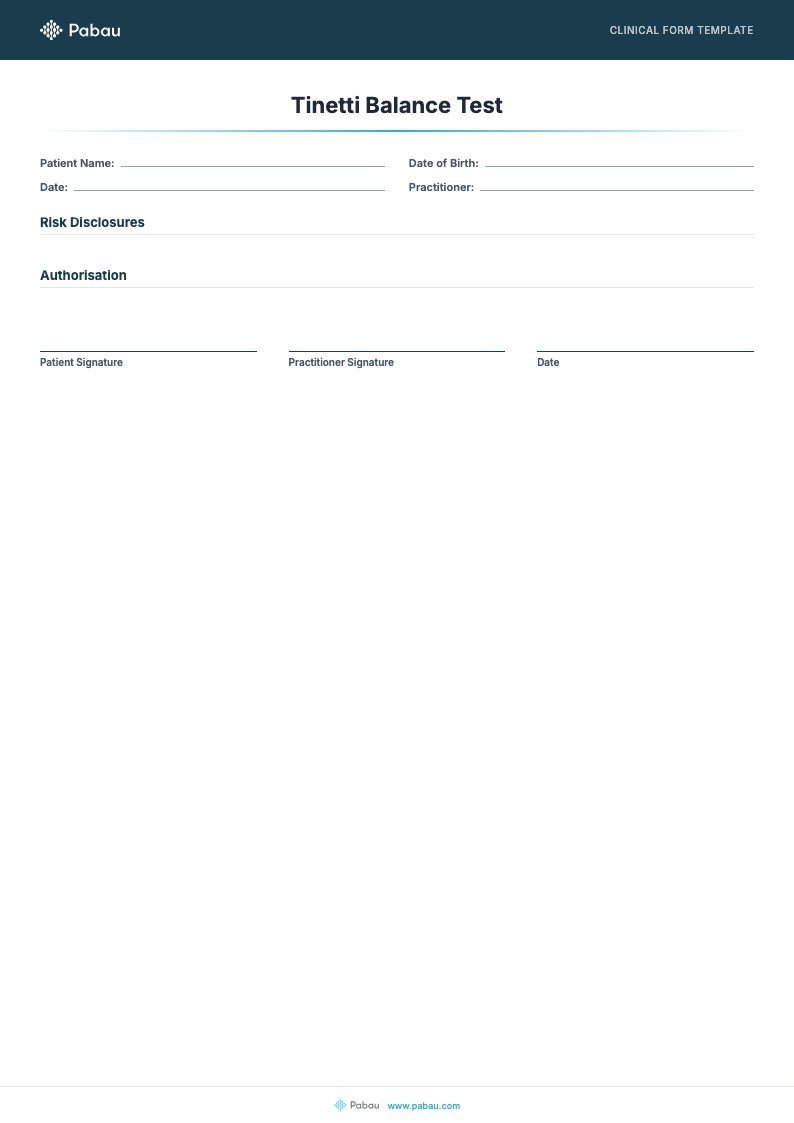
The Tinetti Balance Test, formally known as the Performance Oriented Mobility Assessment (POMA), is a validated clinical screening tool that evaluates balance and gait impairment in older adults. Developed in 1986, it remains the gold standard for identifying fall risk in community-dwelling elderly patients, inpatient rehabilitation settings, and primary care clinics.
This tinetti gait and balance test comprises two distinct components: a sitting and standing balance assessment (9 items scored 0-2) and a gait assessment (7 items scored 0-1). Each section evaluates specific functional domains – from the ability to maintain balance when sitting on an armless chair to steady gait during forward walking and turning. The total score ranges from 0 to 28, with established cutoffs for fall risk stratification.
Why clinics use it: The assessment is quick, requires no specialist equipment (an armless chair and clear walking space suffice), and demands minimal training to administer. Unlike more complex mobility assessments, the Tinetti template is easy to integrate into routine clinical workflows. Results are immediately interpretable, allowing clinicians to make real-time care decisions.
According to the American Physical Therapy Association (APTA), the Tinetti test has strong test-retest and inter-rater reliability, making it suitable for tracking changes in balance and mobility over time. The test is also endorsed by the CDC’s Falls Prevention initiative as a practical screening tool for community-based fall prevention programmes. It fulfils documentation and compliance requirements in many healthcare settings without imposing excessive administrative burden.
For digital-forward practices, the tinetti test pdf format adapts easily to digital form systems, allowing practitioners to capture scores in real time during patient visits and automatically store results in patient records for longitudinal tracking.
Administering the Tinetti Balance Test takes 10-15 minutes and follows a structured five-step workflow embedded in the template. Each section guides the clinician through precise instructions to ensure consistent, valid results.
Complete the standardised balance and gait evaluation to calculate fall risk score and receive personalised recommendations.
Evaluate sitting and standing balance. Each item scored 0-2 points.
Observe patient walking at usual pace for approximately 3 metres. Each item scored 0-1 points.
The Tinetti Balance Test (Performance Oriented Mobility Assessment) evaluates balance and gait with a maximum score of 28 points.
| Total Score | Fall Risk Category | Clinical Action |
|---|---|---|
| 24-28 | Low Risk | Routine preventive measures and annual reassessment |
| 19-23 | Moderate Risk | Targeted balance training and home safety evaluation |
| 0-18 | High Risk | Immediate intervention, multifactorial assessment, and close monitoring |
Understanding score ranges and recommended interventions based on fall risk stratification.
Patient demonstrates good functional mobility with minimal fall risk. Continue routine preventive measures:
Patient shows balance or gait impairments requiring targeted intervention:
Patient demonstrates significant fall risk requiring immediate multifactorial assessment:
Serial Tinetti assessments enable objective measurement of intervention effectiveness. A change of 3 or more points is considered clinically significant and may indicate:
Common administration errors to avoid: Under-scoring sitting balance (many patients slide slightly – score 0); allowing patients to use the armrest during sit-to-stand (score 0 if they do); failing to clear the walking path of obstacles; not documenting baseline assistive devices; and rushing through gait observation instead of watching the full 3-metre walk.

Pabau's integrated template library captures balance and mobility assessments directly into patient records, automating scoring calculations and triggering fall prevention care plans without manual data entry.

The Tinetti balance assessment tool serves multiple healthcare disciplines and practice settings:
Physical therapy clinics: Physical therapists use the Tinetti test as a baseline screening during initial evaluations of older adults presenting with balance complaints, post-fall assessment, or mobility decline. The template informs treatment planning for balance training and fall risk reduction interventions.
Occupational therapy practices: Occupational therapists apply the assessment to evaluate functional mobility and independence in activities of daily living, informing home safety recommendations and adaptive equipment prescription for elderly or mobility-compromised clients.
Chiropractic and osteopathy clinics: Musculoskeletal practitioners use the Tinetti test to screen for balance deficits that may underlie or complicate spine-related conditions, guiding treatment approaches and identifying patients requiring referral to specialist balance or vestibular therapy.
Primary care and GP practices: Family doctors and nurse practitioners use the template in annual wellness visits for elderly patients, post-acute care follow-up (discharge from hospital or rehabilitation), and assessment of fall risk prior to prescribing medications that affect balance.
Rehabilitation and skilled nursing facilities: Hospital-based and post-acute care teams administer the Tinetti test to stratify fall risk on admission, using clinic dashboards to document functional progress and discharge planning for elderly inpatients and residents.
Wellness and longevity clinics: Practices focused on healthy ageing and preventive medicine use the assessment to quantify functional decline, motivate participation in balance training programmes, and track outcomes over repeated assessments.
Clinical validation and standardisation: The Tinetti template enforces consistent administration across clinicians, reducing scoring variability and enabling meaningful comparisons across patient cohorts or longitudinal follow-up visits. Standardised results improve diagnostic confidence and support clinical audit processes required by regulatory bodies (CQC, GMC).
Early fall risk identification: Objective stratification into high/moderate/low risk categories enables proactive intervention before falls occur, reducing hospitalisation, injury costs, and loss of independence. A single low-cost screening can prevent costly adverse events and improve quality of life for vulnerable elderly patients.
Efficient workflow integration: The template eliminates the need to create custom assessment forms or transcribe results from paper into digital records. AI-assisted clinical documentation tools can automatically populate clinical context and generate recommendations based on Tinetti scores, saving clinician time and reducing administrative burden.
Outcome tracking and reporting: Digital storage of Tinetti results enables automated longitudinal tracking, visual outcome graphs, and aggregated reporting by risk category. Clinics can monitor population-level fall risk trends and measure effectiveness of balance training interventions using objective data rather than subjective impression.
Patient communication and engagement: The clear numerical score and risk category provide transparent, understandable feedback to patients about their fall risk, motivating adherence to balance exercises, safety modifications, or assistive device use. Patients understand the clinical rationale for recommended interventions rather than generic advice.
Compliance and documentation: Completed Tinetti templates document evidence of fall risk screening for compliance audits, insurance queries, and medicolegal protection. The template captures all relevant clinical and administrative data in one standardised document, reducing the risk of incomplete or inconsistent records.
Separate your walking observation into two distinct trials: first walking at the patient’s normal comfortable pace, then observing a turn and return. Many clinicians rush this section or fail to observe the full 3-metre distance. Documenting step length symmetry and turning safety improves diagnostic accuracy and identifies subtle gait dysfunction that may otherwise be missed.
The tinetti balance test scoring system uses two subscales – balance (9 items, 0-18 points) and gait (7 items, 0-10 points) – totalling 0-28 points. Higher scores indicate better balance and lower fall risk. Each item is scored based on observable performance during specific functional tasks, using ordinal scales (typically 0 = impaired, 1 = normal, with some items scored -2).
Balance subscale items: Sitting balance, rising from chair, attempts to rise, standing balance (feet together), standing balance (eyes closed), standing balance (nudged on sternum), reaching forward, standing on one leg, turning 360 degrees.
Gait subscale items: Initiation of gait, step length and height, step symmetry, step continuity, path deviation, trunk stability, walking stance.
Clinical interpretation thresholds: A score of 18 or below indicates high fall risk – these patients require immediate intervention (physical therapy referral, home safety assessment, assistive device prescription, medication review). Scores of 19-23 indicate moderate fall risk – implement targeted prevention strategies (balance training, strength exercises, environmental modifications). Scores of 24 or above indicate low fall risk – routine preventive measures and annual re-screening suffice for most elderly patients, though repeated falls or acute decline warrant reassessment.
Comparison with other assessments: While the Berg Balance Scale (BBS) is longer (14 items) and more sensitive to subtle balance deficits in higher-functioning elderly, the Tinetti test is faster and better suited to community and primary care screening. The Timed Up and Go (TUG) test complements the Tinetti by measuring walking speed and sit-to-stand time but provides no specific assessment of static standing balance.
Once you’ve completed a tinetti performance oriented mobility assessment, the score should immediately inform fall prevention planning. High-risk patients (18 or below) need urgent action; moderate-risk patients benefit from targeted interventions; low-risk patients still benefit from preventive measures.
For high-risk patients: Referral to physical therapy for balance and strength training (at least 2-3 times per week) is standard practice. Home safety assessment by an occupational therapist identifies environmental hazards (loose rugs, poor lighting, inadequate grab bars). Medication review often reveals drugs contributing to dizziness or orthostatic hypotension. Vision assessment and vestibular rehabilitation may be needed if balance deficits stem from sensory rather than motor dysfunction.
For moderate-risk patients: Structured exercise programmes (tai chi, group balance classes) reduce fall risk by 20-30% in randomised trials. Home modifications address specific deficits (e.g. grab bars in bathrooms for rising-from-chair difficulty, clear walking paths for gait deviation). Calcium and vitamin D supplementation supports bone health if not already prescribed. Education on footwear, assistive device use, and fall reporting ensures the patient understands and accepts prevention strategies.
For low-risk patients: Annual re-screening during wellness visits maintains vigilance for functional decline. General fitness, strength training, and activity encouragement are important. Education on fall risk factors (medication side effects, vision changes, home hazards) empowers patients to self-monitor and report concerns early.
Documentation and follow-up: Store Tinetti results in the patient’s record alongside fall prevention care plan and follow-up appointments. Practices using automated workflow software can trigger alerts for high-risk patients, schedule occupational therapy consultations, and send educational resources to patients automatically – reducing clinician workload and ensuring no high-risk patient falls through the cracks.

Need structured fall risk assessment resources for your team? Return to Running Protocol provides a complementary framework for safe activity progression in post-fall recovery and rehabilitation contexts.
Looking to automate assessment workflows and reduce manual data entry? Digital Forms enable practices to capture Tinetti scores and balance assessments directly into patient records with automatic scoring calculations and care plan triggers.
Want to track outcome changes across multiple assessments over time? Measurements Tracking Software visualises longitudinal balance and mobility data, enabling clinics to measure effectiveness of fall prevention interventions with objective metrics.
The Tinetti Balance Test template remains one of the most practical and clinically validated tools for identifying elderly patients at risk of falls. Its simplicity – no equipment, minimal training, 10-15 minute administration – makes it accessible to any practice screening older populations. The objective scoring and clear risk stratification provide immediate clinical actionability, enabling clinicians to match intervention intensity to individual risk levels.
Whether you practise physical therapy, occupational therapy, chiropractic care, or primary medicine, integrating the Tinetti assessment into routine patient evaluation workflows can significantly improve early identification of balance deficits and fall risk. Digital implementation further streamlines administration, scoring, and outcome tracking – turning individual assessments into population-level data that demonstrates the value of fall prevention programmes to patients and stakeholders alike.
The Tinetti test screens for balance and gait impairment in elderly patients to identify those at high risk of falls. Clinicians use results to inform fall prevention interventions, including physical therapy referral, home safety assessment, and strength training programmes.
The test takes 10-15 minutes. Patients are seated on an armless chair, assessed for sitting and standing balance, then observed during walking and turning tasks. Each item is scored, and a total score (0-28) is calculated to determine fall risk category.
Yes. The Tinetti Performance Oriented Mobility Assessment is validated in peer-reviewed research with established reliability and validity. It is endorsed by professional organisations including the American Physical Therapy Association and the CDC for community-based fall prevention screening.
A score of 24 or above indicates low fall risk. Scores of 19-23 indicate moderate risk, and 18 or below indicate high fall risk requiring immediate intervention. The higher the score, the better the balance and lower the fall risk.
Clinical interpretation: 18 or below = High fall risk (urgent intervention needed), 19-23 = Moderate fall risk (targeted prevention strategies), 24+ = Low fall risk (routine prevention). Individual item scores also inform specific interventions – e.g., weak sit-to-stand ability warrants leg strength training.
Yes, the Tinetti test is suitable for patients with mild to moderate cognitive impairment because it relies on observable motor performance rather than verbal responses. However, clinicians should ensure the patient can follow simple instructions and remain safe during the functional tasks.