

Primary & Preventive Care Wellness
Small Bowel Obstruction Nursing Care Plan Template
A comprehensive small bowel obstruction nursing care plan template provides stru...

March 13, 2026

Discover free eBooks, guides and med spa templates on our new resources page


Buy now, pay later is now available in Pabau

Read case studies from our satisfied clients

Compare Pabau with alternative systems
 Integrations
 Measure Pabau savings
  Our security commitment
  About us
Learn why this holistic care and aesthetic medicine clinic chose Pabau to power patient care and performance.
Read more

Standardised assessment tool for hip flexor tightness evaluation
Captures patient history, mobility observations, and treatment recommendations
Automates documentation and integrates directly into patient records
Supports compliance and provides evidence-based assessment data
The thomas test template is a clinical assessment form designed for physiotherapists, sports medicine professionals, and musculoskeletal clinicians to systematically evaluate hip flexor tightness. Hip flexor contractures – particularly in the iliopsoas and rectus femoris muscles – are common findings in patients with lower back pain, postural dysfunction, or mobility restrictions. This standardised thomas test template streamlines documentation, ensures consistent screening, and creates a digital record that integrates seamlessly into your clinic’s patient management system. Rather than relying on handwritten notes or paper forms, a digital thomas test template captures structured data at the point of care, improving both clinical safety and administrative efficiency.
A standardised hip flexor assessment form capturing patient details, mobility screening, clinical observations, and treatment recommendations for hip flexor tightness evaluation.
Download template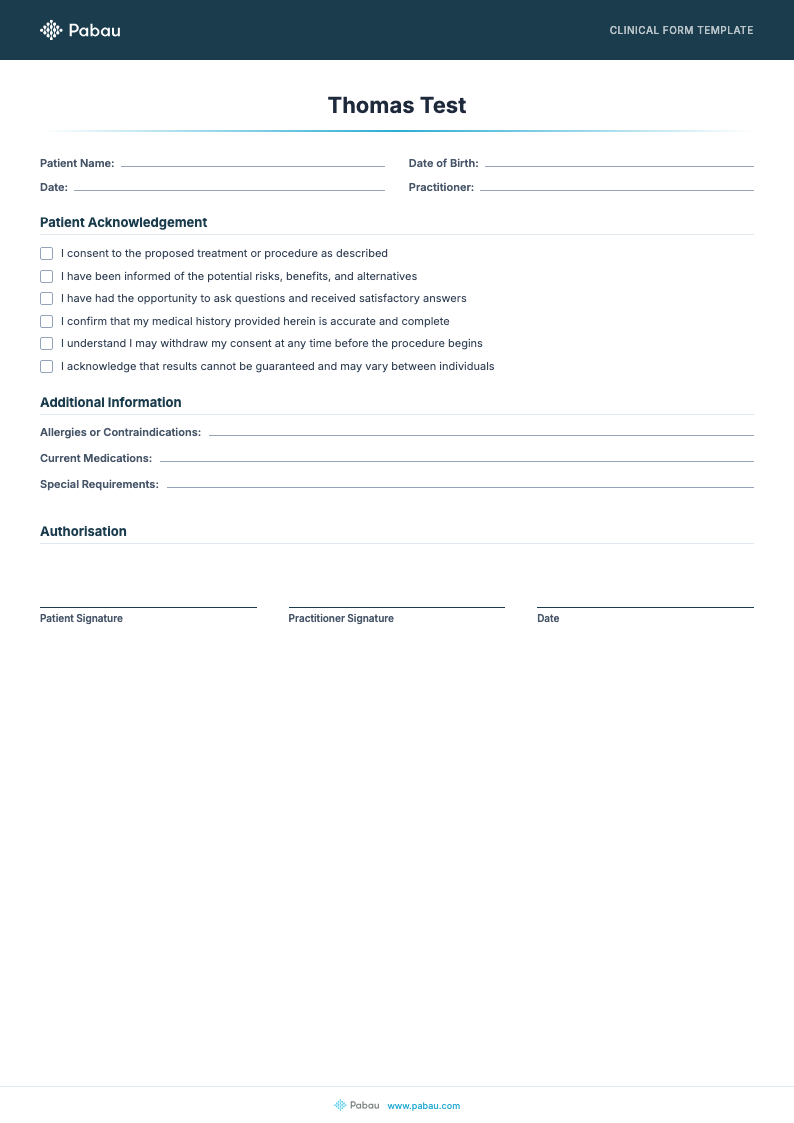
The Thomas test is a clinical screening examination used to assess hip flexor length and identify contractures or tightness in the iliopsoas and rectus femoris muscles. Named after the classic orthopedic assessment, this thomas test evaluates whether a patient can fully extend the hip joint when the spine is stabilised – a key indicator of hip flexor mobility and potential lower back compensation patterns. In clinical practice, the thomas test helps practitioners distinguish between genuine hip flexor tightness and postural habits that mask underlying mobility restrictions.
From a documentation perspective, the thomas test template serves as a structured record of the patient’s baseline hip mobility, clinical observations, and any contraindications or precautions identified during assessment. This legal and clinical record supports informed decision-making about treatment planning, ensures continuity of care across practitioners, and provides evidence that appropriate screening was performed – a key requirement for clinical governance and regulatory compliance. For clinics operating under CQC frameworks or professional body standards, a consistent thomas test assessment form demonstrates systematic, evidence-based practice.
A digital thomas test template integrates into your workflow as both a screening tool and documentation solution. Here are the five operational steps that clinicians follow when using the thomas test template in practice:
By embedding the thomas test template into your clinic’s digital workflow – rather than using paper or standalone documents – you create a single source of truth. Assessment data flows directly into the patient record, reducing transcription errors and ensuring that all team members can access consistent, up-to-date information about patient hip mobility status.

Pabau's digital form system automates patient screening, assessment capture, and documentation workflows. Send thomas test templates and other clinical forms directly from your clinic software, capture responses in real time, and store all data within the patient record.

The thomas test template is essential for any healthcare practice that assesses lower extremity mobility or hip function. Physiotherapy clinics conducting routine musculoskeletal screening use the thomas test to identify hip flexor tightness as a contributing factor in lower back pain or postural dysfunction. Sports medicine practices employ the thomas test to evaluate athletic populations at risk of hip flexor contractures from repetitive hip flexion (running, cycling, seated postures). Osteopathy clinics use the thomas test to screen for spinal compensation patterns driven by hip mobility restrictions, while chiropractic practices apply it to assess sacroiliac joint and lumbar spine interactions.
Occupational therapy clinics may use the thomas test to assess functional mobility in patients transitioning to new work environments or adaptive equipment. Primary care and integrative medicine practices incorporate the thomas test into comprehensive movement assessments. Even fitness professionals and personal trainers working with clients reporting lower back discomfort benefit from a standardised screening tool. Across all these practice types, the thomas test template ensures that hip flexor assessment follows a consistent, evidence-based protocol rather than relying on practitioner memory or variable techniques.
Standardised assessment protocol: A structured thomas test template ensures every patient receives the same screening sequence, reducing variability and creating comparable baseline data across the clinic. Consistency strengthens clinical safety by making sure no assessment steps are missed.
Digital documentation and audit trail: Rather than paper forms stored in filing cabinets, a digital thomas test template creates an auditable record with timestamps, user signatures, and automatic storage in the patient file. This supports CQC inspections, professional indemnity claims, and regulatory compliance audits by demonstrating systematic assessment practice.
Time efficiency: Automating data entry through pre-populated fields and digital capture reduces admin burden. Practitioners spend less time transcribing handwritten notes and more time on clinical decision-making. Patients can complete preliminary information before arrival, accelerating on-site assessment.
Data integration and care continuity: When the thomas test template is embedded within a clinic management system, assessment findings automatically link to the patient record, treatment plans, and progress tracking. All team members see the same data, improving coordination and reducing miscommunication about baseline hip mobility status.
Evidence-based practice and outcome tracking: Structured data from the thomas test template allows clinics to aggregate findings, identify patterns in patient populations, and demonstrate the clinical reasoning behind treatment decisions. This supports research, service improvement, and demonstrating clinical effectiveness to funders or insurers.
Filter your thomas test data by age, activity level, and presenting complaint to identify high-risk groups in your practice. For example, track which patient demographics show the highest prevalence of hip flexor tightness. This reveals patterns that inform your marketing, service design, and staffing priorities.
The thomas test targets two primary hip flexor muscle groups: the iliopsoas and rectus femoris. The iliopsoas – comprising the psoas major, psoas minor, and iliacus muscles – is the dominant hip flexor, responsible for lifting the femur toward the trunk. The rectus femoris, the straight head of the quadriceps muscle group, also contributes to hip flexion and must extend fully across both the hip and knee joints to achieve full hip extension.
Hip flexor tightness develops through prolonged sitting, repetitive hip flexion activities (running, cycling), postural habits, or after hip or lumbar spine injury when patients guard the area by holding tension. Over time, these muscles adaptively shorten, limiting passive hip extension – the very movement the thomas test measures. When hip flexors tighten, the pelvis tilts anteriorly, increasing lumbar lordosis and placing stress on the lower back. The thomas test reveals this compensatory pattern by isolating hip flexor length while stabilising the spine, making it a sensitive screening tool for identifying movement dysfunction.
The thomas test is clinically indicated during the initial assessment of any patient presenting with lower back pain, particularly when postural dysfunction or tight hip flexors are suspected. Patients with occupational demands involving prolonged sitting – office workers, drivers, mechanics – benefit from routine thomas test screening as a preventive assessment. Athletes and active individuals, especially those in sports emphasising hip flexion (running, cycling, martial arts), should receive the thomas test as part of baseline movement screening and injury prevention protocols.
Following hip or lumbar spine injury, the thomas test helps practitioners track recovery of hip flexor mobility and identify whether compensation patterns have developed. The test is also useful when patients report difficulty extending the hip during walking, climbing stairs, or standing from a seated position – functional complaints that often relate to hip flexor contracture. By systematically documenting thomas test findings over time, digital assessment forms provide objective evidence of whether treatment interventions are successfully improving hip mobility or whether referral to specialist services is warranted.
Many practitioners initially used paper thomas test forms – a cumbersome approach requiring manual storage, file location, and transcription into electronic records. Modern clinic management platforms offer AI-powered clinical documentation that transforms assessment workflows. Rather than paperwork, you send the thomas test template digitally to patients before their appointment. Patients complete it on their phone, tablet, or computer. The clinic receives structured data that automatically populates the patient record, triggering treatment plan templates or billing codes based on assessment outcomes.
This integration supports clinical efficiency and compliance simultaneously. The thomas test remains part of your standardised assessment battery, but the administrative friction disappears. Team members review findings in a common patient record rather than hunting for paper forms. Multi-location clinics maintain consistent assessment standards across all sites. Audit trails show exactly when assessments were completed and by whom, strengthening governance and professional accountability.

Need a structured physical therapy assessment workflow? Physical Therapy EMR guides you through integrated assessment, treatment planning, and progress tracking systems designed for movement-based clinics.
Want to automate clinical note-taking after assessments? Safer Clinical Notes demonstrates best practices for documenting assessment findings in ways that support clinical safety and regulatory compliance.
Looking to streamline your entire intake workflow? Capture Forms shows how to design patient intake and assessment forms that integrate directly into your clinic software, eliminating paper-based processes.
The thomas test template bridges clinical assessment with efficient documentation. By capturing hip flexor mobility systematically and storing findings within your patient record, a digital thomas test supports better treatment planning, reduces admin burden, and strengthens your evidence of safe, standardised practice. Whether you’re a physiotherapy clinic, sports medicine practice, or osteopathy centre, implementing a consistent thomas test template elevates both clinical safety and operational efficiency. Start with the free template above, integrate it into your workflow, and track how structured assessment data informs patient outcomes over time.
A positive thomas test shows hip flexor tightness or contracture. If the patient’s hip drops below the table edge when the opposite knee is drawn toward the chest, this indicates the iliopsoas and/or rectus femoris is shortened and limiting full hip extension. A positive test suggests the patient may benefit from hip flexor stretching, strengthening of hip extensors, or postural modification to address underlying causes.
Exercise caution with patients recovering from recent hip or lumbar spine surgery. Consult surgical clearance documentation and the surgeon’s restrictions before performing a thomas test. In early recovery phases, gentle, pain-free assessment is appropriate, but aggressive stretching or full range motion testing may compromise healing. Document any contraindications in the thomas test template and defer to clinical judgment.
Repeat the thomas test every 4-6 weeks if hip flexor tightness is a primary treatment focus. More frequent testing (weekly) may be warranted if hip flexor mobility is the key barrier to function. Spacing assessments too far apart masks slow progress; spacing them too closely produces redundant data. Use clinical judgment based on treatment intensity and patient response, and document the rationale in your progress notes.
The classic Thomas Test assesses total hip flexor length with both knees flexed. The modified Thomas Test isolates the iliopsoas by extending one knee while the opposite hip flexes, isolating the rectus femoris tightness separately. Both versions appear in literature; the classic version is standard in most clinical settings. Choose based on your assessment goals and document which version you performed in the thomas test template.
Hip flexor tightness contributes to lower back pain by tilting the pelvis anteriorly and increasing lumbar lordosis. Patients with tight hip flexors often compensate by over-extending the lumbar spine during walking, standing, or exercise. The thomas test identifies this mechanical driver of lower back dysfunction. Addressing hip flexor mobility through stretching and postural retraining can reduce lower back pain in patients where hip flexor tightness is a contributing factor.