Primary & Preventive Care Wellness
Small Bowel Obstruction Nursing Care Plan Template
A comprehensive small bowel obstruction nursing care plan template provides stru...

March 13, 2026

Discover free eBooks, guides and med spa templates on our new resources page


Buy now, pay later is now available in Pabau

Read case studies from our satisfied clients

Compare Pabau with alternative systems
 Integrations
 Measure Pabau savings
  Our security commitment
  About us
Learn why this holistic care and aesthetic medicine clinic chose Pabau to power patient care and performance.
Read more

Rhinoplasty consent forms document patient understanding of surgical risks
Forms must include 10+ risk categories, screening, and signature pages
Digital workflows reduce errors, ensure compliance, and integrate scheduling
Templates vary by jurisdiction-customisation ensures local regulatory alignment
Post-operative care and revision expectations clarify patient recovery reality
A rhinoplasty consent form is a legally binding document that ensures patients fully understand the surgical procedure, potential risks, expected outcomes, and recovery requirements before undergoing nose reshaping surgery. This essential form protects both the patient and surgeon by creating clear documentation of pre-operative discussions and informed agreement.
The rhinoplasty informed consent form serves multiple critical functions. It educates patients about specific complications-from swelling and infection to anaesthesia risks and revision surgery-enabling them to make informed decisions. It simultaneously protects your practice by demonstrating that you have disclosed all material risks and that the patient has acknowledged these risks in writing. When implemented digitally within digital forms software, the consent workflow becomes part of your pre-operative patient pathway, triggering automatically when a rhinoplasty appointment is scheduled.
This guide explores what a rhinoplasty consent form includes, how to implement one in your cosmetic surgery practice, legal requirements by jurisdiction, and how to customise templates for different patient populations. Whether you operate a private plastic surgery clinic or work within a larger aesthetic practice, understanding consent form best practices ensures both patient safety and regulatory compliance.
A comprehensive 23-page consent form covering pre-operative instructions, risk disclosures (swelling, bleeding, infection, smoking-related complications, scarring, anaesthesia, DVT/PE, unsatisfactory results), post-operative care guidance, patient acknowledgment statements, and signature pages.
Download template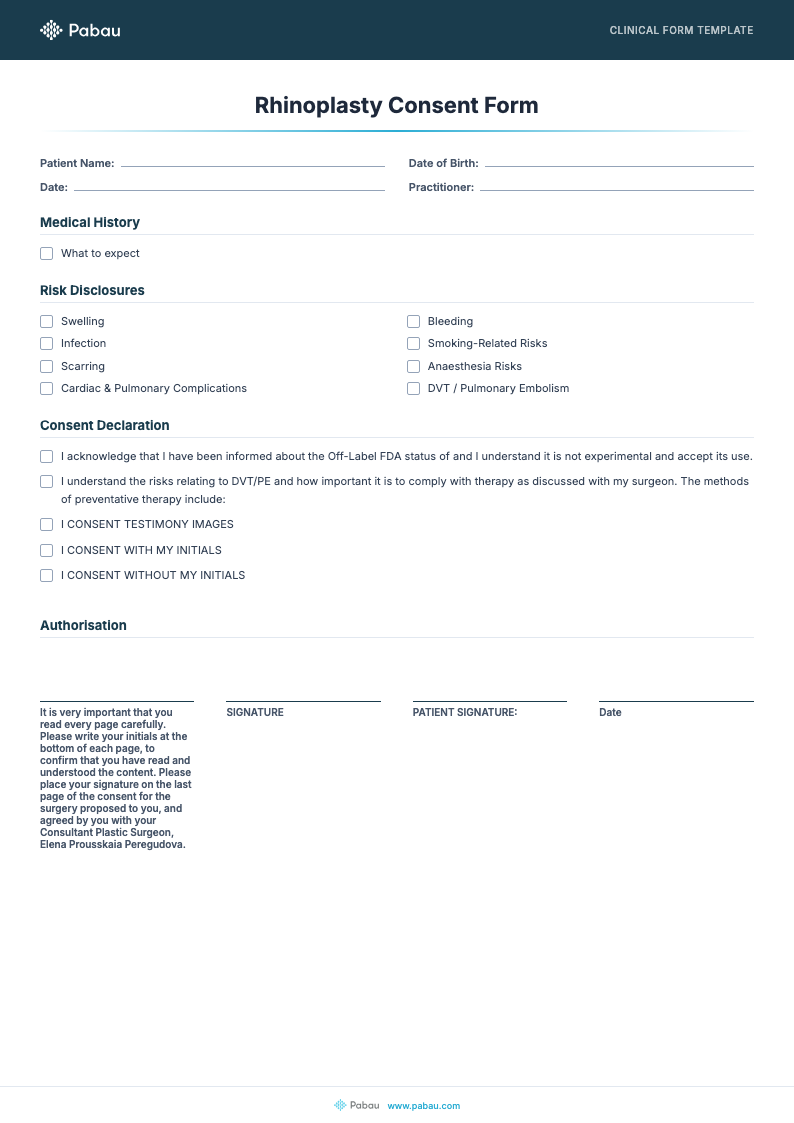
A rhinoplasty consent form is a legal and clinical document that communicates the details of planned nasal surgery to the patient and documents their informed agreement to proceed. Following recommendations from the American Society of Plastic Surgeons and the Royal College of Surgeons’ “Good Surgical Practice Guidelines,” the form explains the procedure, identifies potential complications, outlines alternative treatments, and clarifies expectations for recovery and results.
Unlike generic surgical consents, a rhinoplasty-specific form addresses the unique anatomical and functional challenges of nasal surgery. Rhinoplasty carries higher rates of unsatisfactory results than many procedures-not because of surgeon error, but because expectations and outcomes vary widely. The form covers this reality explicitly, helping patients understand that revision surgery may be needed and that perfection is not achievable.
Rhinoplasty forms typically run 15-25 pages and include: pre-operative assessment sections, detailed risk disclosures organised by complication type, post-operative care instructions, alternative treatment options, imaging and record-keeping consent, and signature blocks. Digital versions add date/time stamps and completion tracking, providing auditable proof of patient engagement.
From a compliance perspective, the form serves as evidence that informed consent was obtained and documented. State medical practice acts and regulatory bodies (including the Medical Board in your jurisdiction) expect this documentation in the patient record, available for audit or investigation. In litigation or regulatory inquiry, the signed consent form-with patient initials on each page-demonstrates that material risks were disclosed and the patient acknowledged them.
Implement the consent form as a structured pre-operative workflow. The process spans from initial scheduling through pre-operative assessment, ensuring the patient reads, acknowledges, and formally consents before entering the operating suite.

Pabau's digital forms capture consent, trigger automatically before appointments, and store signed documents in the patient record-no manual filing required.

Rhinoplasty consent forms are essential for any practice performing nasal surgery, whether cosmetic or reconstructive. Primary users include:
Cosmetic and Plastic Surgery Clinics perform rhinoplasty as a core service and handle the highest volume of cases. These practices manage both primary procedures and revisions, making detailed consent documentation critical for protecting against malpractice claims and regulatory findings.
Aesthetic and Medical Spa Clinics increasingly offer non-surgical nasal treatments (fillers, threading, etc.) and may partner with surgeons for rhinoplasty referrals. A compliant consent template allows these clinics to refer with confidence that their partner surgeon follows best-practice documentation.
Ear, Nose, and Throat (ENT) Practices perform functional rhinoplasty to correct deviation or obstruction. While functional surgery is reconstructive rather than cosmetic, the consent form requirements overlap-both address surgical technique, recovery, and potential complications.
Hospital Surgical Departments and private surgical centres routinely use standardised consent templates. A customisable rhinoplasty form allows hospitals to integrate with surgical scheduling systems and adapt templates to local regulatory requirements while maintaining consistent patient education.
Legal and regulatory protection: A comprehensive, signed consent form demonstrates to regulators, insurers, and legal representatives that you disclosed material risks and that the patient acknowledged them. This is the gold standard defence in malpractice litigation. State medical boards and the GMC expect this documentation as evidence of informed consent compliance.
Standardised risk disclosure: Rather than relying on surgeon memory or ad-hoc conversations, a form ensures every patient receives the same comprehensive risk education. Categories like swelling, bleeding, infection, scarring, anaesthesia complications, DVT/PE, and unsatisfactory results are presented consistently.
Documentation clarity: A structured form with initials on each page and a final signature creates an unambiguous record. If a patient later claims they were not informed of a specific risk, the signed form-showing their initials on the risk-disclosure page-refutes that claim.
Workflow efficiency: When implemented digitally via form capture software, the consent process auto-triggers before appointments, reducing staff time spent manually distributing forms. Patients complete forms at home, freeing pre-operative visit time for clinical discussion rather than paperwork.
Patient safety and realistic expectations: The form explicitly addresses the reality of rhinoplasty-that results vary and revision surgery is sometimes necessary. This conversation, documented in writing and accessible via your patient portal, reduces post-operative disappointment and dispute resolution costs.
Obtaining informed consent is not just about having a signature-it is about demonstrating that the patient genuinely understood the procedure and risks. Best practices include timing, dialogue, and documentation.
Timing matters. Distribute the form at least 24-48 hours before the consultation. Patients who read the form in advance come to the appointment with questions, enabling a deeper discussion. Handing the form on the day of surgery leaves no time for reflection and may not satisfy legal standards for informed consent in some jurisdictions.
Verbal walkthrough reinforces written consent. A one-page summary is not sufficient. The surgeon or trained staff member should review the form with the patient, answering questions and ensuring comprehension. Document that this conversation occurred-add a note in the medical record: “Rhinoplasty consent form reviewed and discussed with patient on [date]; all questions answered.”
Customise for jurisdiction and regulatory requirements. Medical malpractice standards, state law, and insurance requirements vary by location. A rhinoplasty form compliant in California may not meet UK CQC or Australian AHPRA expectations. When managing compliance workflows, consult your medical defence organisation or regulatory body to ensure your template aligns with local law.
Capture specific risk acknowledgment. Rather than generic consent, the form should ask patients to initial next to each major risk category: “I acknowledge the risk of unsatisfactory result and revision surgery,” “I understand DVT/PE risks and agree to preventative measures,” etc. This specificity strengthens the consent record if later challenged.
Rhinoplasty carries distinct risks compared to other aesthetic procedures. The nasal anatomy is complex-bone, cartilage, soft tissue, and blood vessels interact in ways that affect both aesthetics and function. The form must address these realities clearly.
Swelling and bruising are universal after rhinoplasty. The form should explain that the final result is not visible until 12-18 months post-op, when all oedema and scar contracture have resolved. This expectation-setting prevents unnecessary anxiety during the healing window.
Smoking is a critical risk factor. Smoking significantly increases wound infection, skin necrosis, poor scarring, and delayed healing. Some surgeons refuse to operate on active smokers. The form must ask smoking status, explain risks, and ideally require cessation for 2-4 weeks pre- and post-op.
Anaesthesia and cardiac considerations: General anaesthesia carries small but real risks-adverse drug reactions, cardiac arrhythmia, aspiration, malignant hyperthermia. Patients with obstructive sleep apnoea are at heightened risk. The form should identify these pre-existing conditions and document pre-anaesthesia clearance.
DVT/PE prevention and revision expectations. Immobility after surgery increases thrombotic risk. The form should outline prophylaxis methods (leg exercises, compression stockings, anticoagulation if indicated) and require patient agreement to comply with post-op mobility instructions. Approximately 15-20% of rhinoplasty patients require revision surgery to address residual breathing obstruction, aesthetic irregularities, or asymmetry. The form should normalise this and clarify costs-whether revision falls under warranty or incurs additional charges.

How do you ensure your team captures consent before every aesthetic appointment? Digital Forms trigger consent workflows automatically when a rhinoplasty booking is confirmed, eliminating manual distribution.
Need to automate your pre-operative assessment process? Plastic Surgery EMR Software integrates medical history screening with consent capture, flagging high-risk patients for additional consultation.
Want to streamline patient communication around surgical procedures? Client Portal lets patients securely sign forms at home, reducing pre-op visit paperwork and freeing staff for clinical tasks.
A comprehensive rhinoplasty consent form is not merely administrative-it is a cornerstone of patient safety, informed decision-making, and legal protection. By documenting that patients understand the procedure, risks, expected recovery timeline, and potential need for revision, you create a shared foundation of expectation that reduces post-operative disappointment and dispute.
The template provided above covers the essential elements: pre-operative instructions, ten distinct risk categories, post-operative care, patient acknowledgment statements, and signature pages. Customise it for your jurisdiction, your patient population, and your surgeon’s specific approach. Review it with every patient before surgery, document the conversation, and preserve the signed form in the medical record.
When consent workflows are automated within your practice management dashboard, obtaining and storing consent becomes a routine part of surgical preparation-not a burden. Your patients will appreciate the clarity, your practice will be protected, and your regulatory standing will be strengthened.
A comprehensive form covers pre-operative instructions, detailed risk disclosures (swelling, bleeding, infection, scarring, anaesthesia, DVT/PE, unsatisfactory results), post-operative care guidance, alternative treatment options, imaging consent, patient acknowledgment statements, and signature pages requiring both patient and surgeon initials.
A signed, properly completed consent form demonstrates informed consent was obtained and documented. While the signature does not prevent a lawsuit, it provides strong evidence that material risks were disclosed and the patient acknowledged them, significantly strengthening your legal defence in malpractice claims.
No. Rhinoplasty-specific forms address procedure-unique risks, recovery timelines, and outcome expectations that generic forms omit. Using a generic form may be viewed as inadequate informed consent by regulators or in litigation.
Best practice is 24-48 hours before the appointment. This gives patients time to read the form carefully, formulate questions, and discuss concerns during the pre-operative consultation rather than making a rushed decision on the day of surgery.
If a patient refuses consent, you cannot proceed with surgery. Document the refusal in the medical record, including the date, time, and the patient’s stated reason. Offer a follow-up consultation to address concerns, but do not operate without signed, informed consent.
Ideally, the form is generic to your clinic but customised to your jurisdiction and practice standards. However, the surgeon’s name and signature should appear on the form, confirming that they personally discussed risks and obtained consent-not a staff member on their behalf.