Primary & Preventive Care Wellness
Small Bowel Obstruction Nursing Care Plan Template
A comprehensive small bowel obstruction nursing care plan template provides stru...

March 13, 2026

Discover free eBooks, guides and med spa templates on our new resources page


Buy now, pay later is now available in Pabau

Read case studies from our satisfied clients

Compare Pabau with alternative systems
 Integrations
 Measure Pabau savings
  Our security commitment
  About us
Learn why this holistic care and aesthetic medicine clinic chose Pabau to power patient care and performance.
Read more

Structured format covers chief complaint, medical history, psychiatric history, and family background-essential for accurate diagnosis
Captures functional assessment across relationships, academics, finances, and housing to understand environmental stressors
HIPAA-compliant consent and signature sections protect patient privacy and establish informed consent documentation
Pre-appointment completion reduces in-session time and ensures clinicians have baseline data before the evaluation
Integrates naturally into digital workflows with automated distribution and completion tracking through practice management software
A psychiatrist parent intake questionnaire is the foundation of effective child and adolescent psychiatric evaluation. Parents and guardians provide critical context-family psychiatric history, developmental milestones, early symptom onset, medication responses, and environmental stressors-that clinicians cannot obtain directly from young patients. This comprehensive form ensures no diagnostic detail is overlooked before treatment begins.
Completing the psychiatrist parent intake questionnaire before the clinical appointment accelerates the evaluation process. Instead of spending 30 minutes gathering background, clinicians can dedicate that time to mental status examination, treatment planning, and therapeutic alliance. For PMHNP-led evaluations, this efficiency is essential in busy primary care and community mental health settings where appointment slots are limited.
A ready-to-use 4-page questionnaire covering chief complaint, medical history, psychiatric history, family psychiatric background, developmental milestones, current symptoms, medication list, social history, and functional assessment across relationships, academics, finances, job/school, family dynamics, and housing stability.
Download template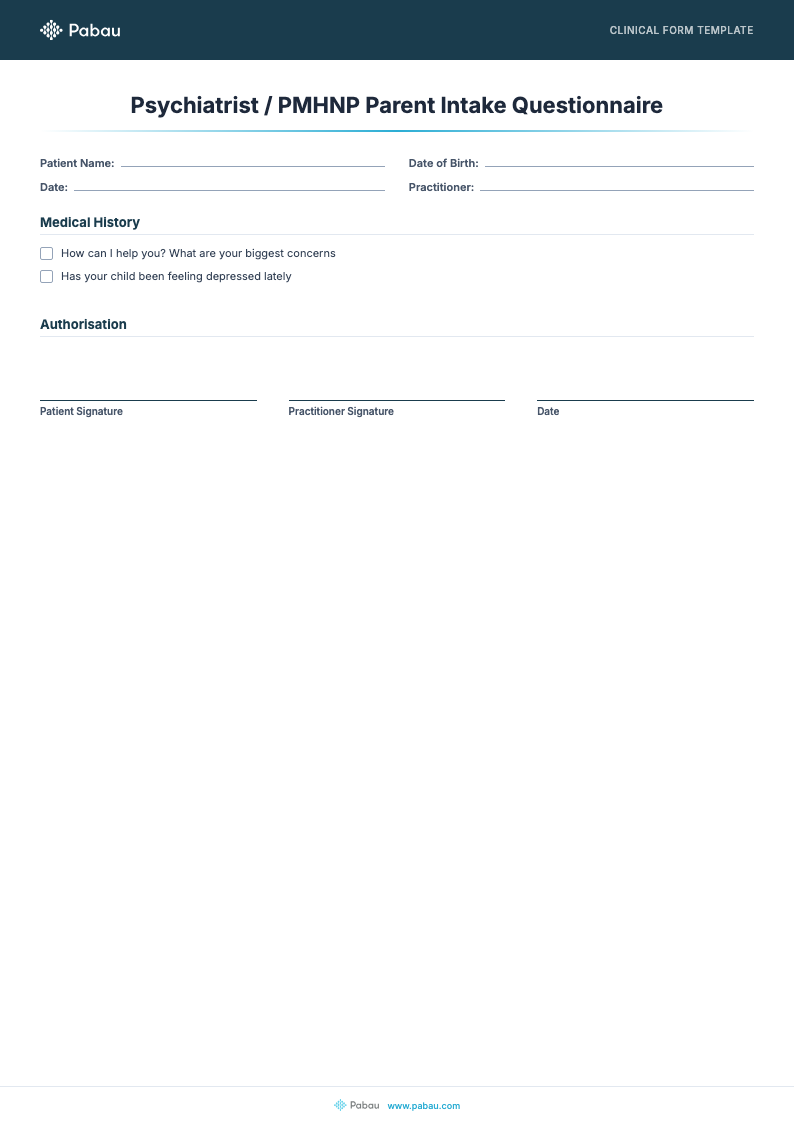
A psychiatrist parent intake questionnaire is a structured clinical form designed to collect comprehensive background information from parents or guardians before a child or adolescent psychiatric evaluation. The form documents the presenting problem, history of present illness, past psychiatric and medical history, family psychiatric history, developmental milestones, current symptoms, medication list, social stressors, and functional status across key life domains.
This intake process aligns with DSM-5-TR diagnostic criteria, which explicitly require assessment of symptom onset, duration, severity, and impact on functioning. The questionnaire ensures systematic collection of this information, reducing clinician burden and increasing diagnostic accuracy. For PMHNPs working in primary care, school-based mental health, or community health centers, standardised intake forms establish consistent documentation practices that meet state regulatory requirements and insurance billing standards.
HIPAA compliance is embedded in the form’s design. The questionnaire captures parent consent for assessment, documents guardian relationship (legal authority for consent), and establishes the clinical record. When stored in a HIPAA-compliant psychiatry EMR system, the completed form becomes part of the protected health record with controlled access rights and audit trails.
Effective intake form completion follows a five-step workflow that maximises clinical value and parent engagement. The process begins before the appointment and concludes with secure archival in the patient record.

Practice management systems with integrated digital forms dispatch questionnaires automatically when appointments are booked, track completion status in real-time, and sync parent responses directly into clinical charts. Reduce manual form management and ensure no intake is forgotten.

This intake form is essential for any clinician conducting child or adolescent psychiatric evaluations. Psychiatrists (MDs/DOs) ordering comprehensive diagnostic workups rely on structured parent intake to establish baseline symptoms, family history of psychiatric illness, and trauma exposure. ADHD clinics use the form to screen for developmental history and co-occurring mood or anxiety symptoms before prescribing stimulants.
PMHNPs (psychiatric-mental health nurse practitioners) certified by the ANCC (American Nurses Credentialing Center) use parent intake questionnaires to establish medical-legal documentation of informed consent and baseline symptom severity-critical for prescriptive authority in all US states. Community mental health centers, school-based mental health programs, and primary care practices employ the form to standardise intake procedures across multiple clinicians, ensuring consistency in clinical documentation and compliance with state licensing board requirements.
Psychology practices conducting psychological testing and assessment also distribute parent intake forms to establish developmental and psychiatric context for standardised testing interpretation. Child welfare and foster care coordination programs use parent questionnaires to document baseline mental health and trauma history when children enter out-of-home care.
Accurate diagnostic formulation: Structured collection of family psychiatric history, developmental milestones, and symptom onset directly informs DSM-5-TR diagnostic assessment. Parents recall details clinicians would miss if asked ad hoc-age when first speech delay was noticed, exact age at toilet training completion, timing of first depressive or manic episode in first-degree relatives. This historical precision improves diagnostic confidence and prevents missed diagnoses.
Reduced clinician burden and faster appointments: Pre-appointment completion of background questions frees 15-30 minutes of in-session time for mental status examination, therapeutic assessment, and treatment planning. For PMHNPs managing high patient volumes in primary care or urgent care, this efficiency gain directly improves appointment availability and reduces patient wait times.
Legal and compliance protection: The form establishes documented informed consent, confirms parent/guardian identity and consent authority, and creates an auditable baseline record of presenting symptoms and psychiatric history. When stored in a compliant EMR, the intake questionnaire satisfies state licensure board requirements for comprehensive psychiatric evaluations and provides defensible documentation in licensing investigations or malpractice claims.
Screening for safety and risk: Standardised questions about past suicidal ideation, self-harm, aggression, or trauma exposure surface critical safety information at intake rather than during treatment. This early risk identification allows clinicians to implement appropriate crisis protocols, safety planning, and family psychoeducation before the first appointment.
Integration with measurement-based care: Parent-reported symptom severity at intake provides a baseline score for comparison at follow-up. Repeating key questions at subsequent appointments tracks treatment response objectively. Digital intake systems can automatically score instruments like the GAD-7 (generalised anxiety), PHQ-15 (somatic symptoms), or ADHD rating scales, converting parent responses into clinical metrics for measurement-based care tracking.
Filter intake responses for ‘red flags’ during the screening phase: suicidal ideation, recent trauma, active substance use in the child, parental psychiatric crisis, or safety concerns in the home. Flag these items for clinician review immediately, even before the scheduled appointment, so emergency protocols can be activated if needed.
Developmental history is inseparable from psychiatric diagnosis in children. The DSM-5-TR explicitly requires clinicians to assess symptom onset in relation to developmental milestones. Anxiety symptoms appearing after age 12 carry different clinical weight than anxiety present since age 3. ADHD symptoms present across all settings (home, school) since age 4-5 suggest neurodevelopmental etiology, while attention problems emerging only after age 10 in a previously high-functioning child warrant investigation of trauma, depression, or psychosis.
Parent intake questionnaires systematically capture developmental context: age of language onset, motor milestones, toilet training completion, school entry adjustment, grade retention, peer relationships, and academic achievement. This longitudinal perspective helps clinicians distinguish transient developmental adjustment reactions from persistent psychiatric illness. A child with lifelong social withdrawal and language delay requires different intervention than an outgoing 7-year-old whose social anxiety emerged acutely after parental divorce.
Functional assessment sections (relationships, academics, finances, housing, family dynamics) translate psychiatric symptoms into real-world impairment. A teenager endorsing “neutral/stressful” ratings across all domains suggests pervasive depressive cognition or anhedonia, whereas selective impairment in academics with intact peer relationships may point to ADHD or learning disability rather than mood disorder. This functional context grounds clinical assessment in observable consequences, not just symptom count.
Family psychiatric history is one of the strongest predictors of childhood psychiatric illness. First-degree relatives with schizophrenia, bipolar disorder, or severe depression confer inherited risk that shapes clinical suspicion and treatment planning. A child presenting with sleep disturbance and irritability in a family with bipolar disorder history warrants mood stabiliser consideration, whereas the same presentation in a family with no psychiatric history might be addressed with sleep hygiene and anxiety management first.
Parent intake questionnaires create space to document extended family psychiatric history, medication responses, and treatment outcomes. Parents often report that relatives improved dramatically on a specific medication (e.g., “my uncle was on sertraline and it completely helped him”), providing clinical clues for medication selection even when formal psychiatric records are unavailable. This informal family pharmacology knowledge, captured in the intake form, informs evidence-based prescribing decisions.
Cultural context shapes symptom expression and family conceptualisation of mental illness. Some cultural communities emphasise somatic symptoms (headache, stomach pain) as expressions of emotional distress, whereas others prioritise mood or behavioural problems. Intake questionnaires should include open-ended questions allowing parents to describe their child’s concerns in their own language and framework. Clinicians reviewing forms must interpret responses within cultural context-what appears as “anxiety” may reflect culturally normative caution about unfamiliar situations, or it may signal genuine anxiety disorder requiring intervention. Digital intake systems allow customisation of questions and response options to reflect cultural diversity and increase parent engagement across linguistic and cultural populations.

Need a structured assessment framework for symptom measurement? Psychiatric Evaluation Template provides a complete clinician-side evaluation workflow including mental status examination, diagnostic formulation, and treatment planning integration.
Looking to automate parent form distribution and response tracking? Digital Forms Software enables automated dispatch of intake questionnaires at appointment booking, real-time completion tracking, and direct integration of responses into patient charts.
Want to track symptom improvement over time? Measurements-Based Care Tools automatically score parent-reported questionnaires and generate trend reports showing treatment response across depression, anxiety, ADHD, and other psychiatric outcomes.
The psychiatrist parent intake questionnaire bridges the gap between diagnostic criteria and clinical reality. By systematically gathering parent-reported history, family context, developmental milestones, and functional status before the clinical appointment, clinicians conduct faster, more accurate evaluations and establish defensible informed consent documentation. Whether you’re a psychiatrist managing complex diagnostic cases, a PMHNP in primary care serving pediatric populations, or a community mental health centre standardising intake procedures across staff, this structured form accelerates diagnosis and improves treatment outcomes from the first encounter.
Download the template, customise it to reflect your practice’s intake workflow and clinical priorities, and deploy it digitally through your practice management system. The time saved-and the diagnostic accuracy gained-makes parent intake questionnaires non-negotiable for any child-serving psychiatry or mental health practice.
A comprehensive parent intake should cover: presenting problem and chief complaint, history of present illness, past psychiatric history (diagnoses, hospitalisations, medication trials), past medical history, family psychiatric history (first and second-degree relatives), developmental milestones (language, motor, social, academic), current symptoms across mood, anxiety, behaviour, attention, and psychosis domains, current medications, substance use history, social stressors (school, peer relationships, family dynamics), and functional assessment across key life domains (relationships, academics, work/finances, housing, family).
A comprehensive parent intake typically takes 15-25 minutes. Brief targeted intakes focusing on chief complaint and recent history may take 10 minutes. Pre-appointment completion allows clinicians to review and identify red flags before in-session time, increasing appointment efficiency. Digital distribution with estimated time displayed encourages parents to budget adequate time and reduces incomplete submissions.
Yes, when deployed through a HIPAA-compliant practice management system with encryption, access controls, and audit trails. The form itself should request parent consent for clinical assessment and information sharing with schools or other providers. Digital intake platforms like secure patient portals or encrypted email satisfy HIPAA transmission requirements. Store completed forms in the patient’s protected health record with restricted access to authorised clinical staff.
Flag safety concerns immediately for clinician review. Institute emergency protocols: assess imminent risk of harm through phone contact before the scheduled appointment, document the disclosure and clinical response in the patient record, ensure appropriate supervision or hospitalisation if risk is high, and report suspected abuse to child protective services as required by mandatory reporting law in your jurisdiction.
A core intake structure works across ages, but questions should be developmentally tailored. For toddlers and preschoolers, emphasise developmental milestones, behavioural concerns, and parenting stress. For school-age children, add academic performance and peer relationships. For adolescents, include substance use screening, dating relationships, academic stress, and questions about mood and self-harm. Digital systems allow conditional logic to display age-appropriate questions based on the child’s birthdate.
Yes. Embedding brief validated screening instruments (GAD-7 for anxiety, PHQ-15 for somatic symptoms, ADHD Rating Scale for attention) in the parent intake creates baseline severity scores that can be repeated at follow-up to measure treatment response. Digital systems can automatically score these instruments and generate clinical metrics, enabling measurement-based care tracking without extra clinician effort.