Primary & Preventive Care Wellness
Small Bowel Obstruction Nursing Care Plan Template
A comprehensive small bowel obstruction nursing care plan template provides stru...

March 13, 2026

Discover free eBooks, guides and med spa templates on our new resources page


Buy now, pay later is now available in Pabau

Read case studies from our satisfied clients

Compare Pabau with alternative systems
 Integrations
 Measure Pabau savings
  Our security commitment
  About us
Learn why this holistic care and aesthetic medicine clinic chose Pabau to power patient care and performance.
Read more
A physical therapy intake form is the structured gateway between first contact and clinical assessment. It captures essential patient information-medical history, current symptoms, functional limitations, and treatment goals-before a physiotherapist conducts hands-on evaluation. This document forms the clinical foundation for safe, personalised treatment planning and informed decision-making.
Most PT clinics use a combination of paper and digital forms, though the trend is shifting entirely toward digital intake forms for faster completion and reduced transcription errors. Clinics that adopt digital intake workflows report 40% faster new-patient onboarding and improved accuracy in clinical note generation.
A comprehensive intake form covering patient contact details, medical history screening (surgery, medications, pacemaker, pregnancy status), chronic condition assessment, mood screening, family history, substance use, and informed consent with signature block.
Download template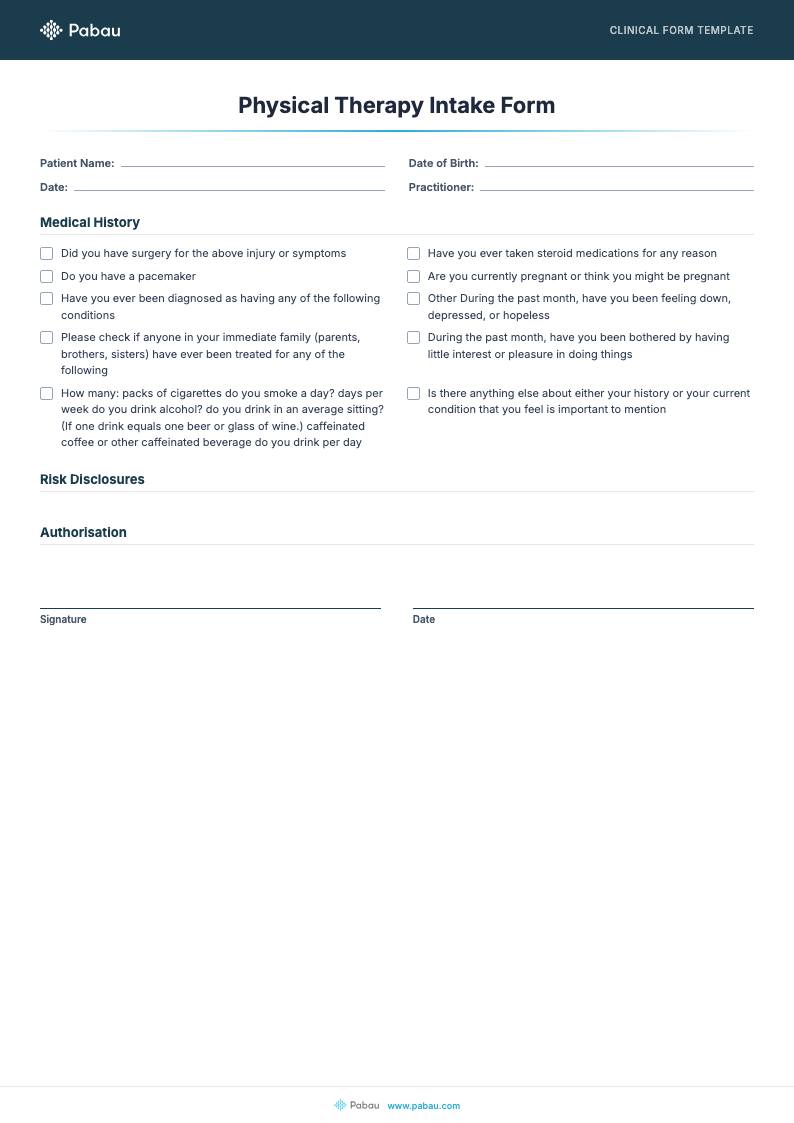
A physical therapy intake form is a clinical documentation tool that gathers patient information before the initial physiotherapy session. It serves two critical purposes: collecting baseline data for clinical assessment and obtaining informed consent for treatment.
Legally, the form documents patient understanding of treatment procedures, potential risks (such as temporary joint/muscle swelling during early treatment), and acknowledgment of their medical history. In the UK, CQC (Care Quality Commission) regulations require clinics to maintain evidence that patients understood treatment risks before care begins. A signed intake form provides that documentary proof.
Clinically, the form captures essential screening data: surgical history (relevant to tissue healing potential), current medications (some steroids affect treatment safety), contraindications (pacemakers preclude certain modalities), pregnancy status (affects positioning and modality selection), and psychological factors (depression screening informs holistic treatment planning). This information allows physiotherapists to modify assessment and treatment protocols without wasting appointment time.
Effective intake form deployment follows a five-step workflow that maximises completion accuracy and clinical safety:
For multi-location clinics, centralise intake form templates in your practice management system so all sites use identical language and structure. This ensures consistent consent documentation across locations and simplifies compliance audits.

Digital intake forms that sync directly with patient records, treatment notes, and billing. Reduce manual data entry and improve first-appointment readiness.

Physical therapy intake forms are essential across multiple healthcare settings and specialties. Solo practitioners and multi-location clinics both rely on standardised intake to ensure consistent patient assessment. The form applies to outpatient physiotherapy clinics, sports medicine practices, private rehabilitation centres, and hospital-based PT departments.
Specialty-specific applications include: orthopedic PT clinics (where surgery history directly impacts treatment load), neurological rehabilitation (where neurological history affects positioning safety), cardiorespiratory PT (where cardiac history requires modified exercise protocols), and workplace injury management (where workers’ compensation documentation requirements demand detailed incident history). Even telehealth PT practices use intake forms-they’re completed before the first virtual session so clinicians can review medical history during assessment.
Team-based clinics with multiple physiotherapists, sports therapists, or exercise physiologists benefit most from standardised intake. When team members share patient records, a consistent intake form ensures everyone accesses the same baseline information and understands documented contraindications.
Compliance and legal protection: Signed intake forms provide documentary evidence of informed consent, a requirement under CQC regulations, GDPR data protection, and professional liability insurance standards. If a patient disputes whether they understood treatment risks, the signed form demonstrates clinician due diligence.
Clinical safety: Structured screening identifies contraindications (pacemakers, pregnancy, recent surgery, medication interactions) before treatment begins. This prevents adverse events and reduces clinical incidents. A documented review of medical history protects the clinician if a patient later claims they were unaware of a known risk.
Workflow efficiency: Digital intake forms eliminate manual transcription-patient-entered data syncs directly into the clinical record, saving 10-15 minutes per new patient appointment. AI-powered clinical documentation can auto-populate assessment notes from intake responses, further accelerating note generation.
Documentation clarity: A completed intake form serves as the baseline record for the patient’s presenting condition, functional limitations, and treatment goals. This provides context for every subsequent session note and justifies treatment frequency decisions during insurance pre-authorisation requests.
Patient experience: Pre-appointment digital intake means less time spent filling out paperwork on arrival. Patients appreciate efficient onboarding, and clinics appreciate starting sessions on time rather than delaying for pen-and-paper admin.
The medical history section is the clinical backbone of the intake form. Key areas include: prior surgeries and dates (healing timeline varies by procedure), current medications (some affect movement tolerance), chronic conditions (diabetes affects wound healing, osteoporosis affects load tolerance), and psychiatric history (depression affects rehabilitation compliance and motivation).
Absolute contraindications-conditions that preclude certain treatment modalities entirely-require up-front identification. Deep vein thrombosis (DVT) contraindicates aggressive limb mobilisation. Active infections contraindicate vigorous soft-tissue work. Recent fractures require load-specific modifications. The intake form captures these through yes/no screening questions; clinicians then use responses to determine which assessment procedures and treatment techniques to employ or avoid.
Relative contraindications-conditions requiring protocol modification rather than complete avoidance-are equally important. Pregnancy doesn’t preclude PT, but modifies positioning and intensity. Osteoarthritis doesn’t prevent exercise, but informs exercise selection. Depression doesn’t exclude rehab, but may require motivational strategies and coordination with mental health providers. Documenting these distinctions in the intake form ensures subsequent clinicians understand the clinical reasoning behind treatment choices.
Paper forms create administrative friction. They require printing, manual filing, and transcription of responses into clinical notes-a process that introduces transcription errors and delays. Paper forms also prevent pre-appointment review; clinicians can’t assess contraindications until the patient arrives.
Digital intake forms solve these problems. Patients complete them via secure patient portal, email link, or in-clinic tablet before the session. Responses populate directly into the patient record, eliminating transcription. Clinicians review medical history during the appointment window, not during the appointment itself. Data is HIPAA and GDPR compliant by default when stored in certified practice management software rather than paper documents in a filing cabinet.
The efficiency gain is measurable: clinics using digital intake report 30-40% faster new-patient assessments because clinicians already understand the patient’s history before the session starts. Appointment slots stay on schedule. No-shows decrease because automated reminders with the intake form link increase attendance.
Audit your intake form annually for outdated language, missing compliance elements, or fields that clinicians report not using. A form that hasn’t been reviewed in 3+ years often contains redundant questions or fails to capture modern clinical priorities (e.g. telehealth modality preferences, COVID-19 vaccination status, mental health comorbidities). Refresh the form yearly to keep it clinically relevant.
Physical therapy intake forms collect sensitive health information: diagnoses, medications, psychiatric history, and sometimes work injury details. HIPAA (US), GDPR (EU/UK), and provincial health privacy laws require that this data be protected from unauthorised access and breaches.
Compliance starts with form storage. Paper forms stored in unlocked cabinets violate HIPAA security rules. Digital forms stored in unencrypted email or unsecured cloud storage are equally problematic. Use certified practice management software with built-in encryption, access logging, and automatic backups. This ensures forms are stored securely and audit trails document who accessed patient data and when.
Consent language matters too. The form should explicitly state: what health data is collected, why it’s collected, who can access it, how long it’s retained, and what rights the patient has (e.g. the right to request data deletion after treatment concludes). In the UK, GDPR compliance checklists provide specific consent language templates for healthcare providers.
The intake form is only useful if clinicians actually use the data to inform treatment. A common clinic failure: intake forms are completed and filed but never reviewed before assessment. This wastes the effort patients invested in completing them.
Best practice: clinicians review the completed intake form 15 minutes before the appointment, flag any contraindications or special considerations in their mind, then structure the assessment to prioritise those clinical questions. If the form indicates recent surgery, the clinician focuses the history on surgical date, type, and healing progress. If depression screening flagged low mood, the clinician explores coping strategies and motivation for rehabilitation. This targeted assessment cuts appointment time by 10-15 minutes while improving clinical depth.

Need a systematic way to capture patient treatment goals? Client Record centralises all patient data including intake forms, assessment notes, and progress tracking in one searchable record.
Want to streamline multi-location intake compliance? Physical Therapy EMR Software provides specialised templates and automated compliance reporting for PT clinics of all sizes.
Looking to automate clinical note generation from intake data? Echo AI converts intake responses into draft clinical notes, saving clinicians 15+ minutes per new patient.
A well-designed physical therapy intake form is the foundation of safe, efficient patient care. It captures medical history, obtains informed consent, and provides clinicians with baseline assessment data before they perform hands-on evaluation. Digital intake delivery and compliance-certified storage further reduce administrative burden and protect patient privacy.
For PT clinics of any size, implementing a standardised intake form-whether paper-based or digital-improves clinical outcomes, reduces liability risk, and streamlines new-patient onboarding. The template provided above is ready to download and customise for your clinic’s specific needs.
A typical physical therapy intake form takes 8-12 minutes to complete on paper or digitally. Pre-appointment digital completion means patients finish before arrival, not during the appointment slot. This preserves time for clinical assessment.
Yes. Digital delivery via patient portal or email link allows completion 24-48 hours before the appointment. This is ideal for new patients and eliminates on-site paperwork delays.
No. The full intake form is completed once at the initial appointment. Subsequent appointments may use a brief “update form” (2-3 questions about current symptoms and recent changes) rather than repeating the full form.
Have a paper or tablet version available. Allow 10-15 minutes for on-site completion before starting the assessment. In future, send reminder SMS/email 24 hours before their appointment to encourage pre-completion.
Signed forms document informed consent and serve as evidence of clinical due diligence. They’re not contracts, but they do provide legal protection if a patient later disputes whether they understood treatment risks. Always store signed forms securely with audit trails.
Retain forms for a minimum of 6 years after the patient’s final appointment (CQC guidance) or per your country’s healthcare record retention laws. Securely dispose of paper forms via confidential waste services; digitally stored forms should be archived in HIPAA/GDPR-compliant systems.