

Primary & Preventive Care Wellness
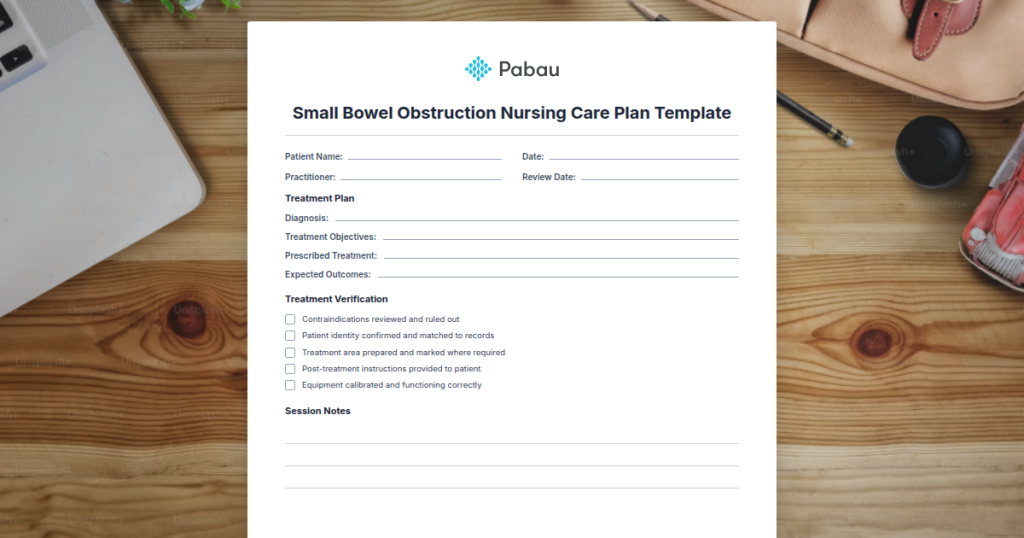
Small Bowel Obstruction Nursing Care Plan Template
A comprehensive small bowel obstruction nursing care plan template provides stru...

March 13, 2026

Discover free eBooks, guides and med spa templates on our new resources page


Buy now, pay later is now available in Pabau

Read case studies from our satisfied clients

Compare Pabau with alternative systems
 Integrations
 Measure Pabau savings
  Our security commitment
  About us
Learn why this holistic care and aesthetic medicine clinic chose Pabau to power patient care and performance.
Read more

Osteoporosis care plans reduce fracture risk through systematic assessment and intervention.
Multi-disciplinary documentation supports compliance tracking and patient education.
Fall prevention and medication management are core to bone health protocols.
Digital templates streamline care coordination across clinical teams.
An osteoporosis care plan is a structured clinical framework that guides healthcare practitioners through systematic assessment, diagnosis, intervention, and long-term monitoring of patients with compromised bone mineral density. Osteoporosis care plans coordinate multiple clinical elements-from initial fall risk assessment to medication adherence tracking-into a unified protocol that reduces fracture risk and improves patient outcomes.
The National Osteoporosis Foundation (NOF) and the International Osteoporosis Foundation (IOF) emphasise the importance of comprehensive care planning in osteoporosis management. The NOF’s Clinician’s Guide to Prevention and Treatment provides evidence-based protocols for systematic assessment and intervention.
This article explores the essential components of osteoporosis care plans, the workflow for implementing them in clinical practice, and how digital templates streamline documentation and team coordination across your practice.
A comprehensive care plan template covering patient assessment, osteoporosis diagnosis, nursing interventions, fall prevention strategies, medication management, patient education, and compliance tracking for bone health management.
Download templateAn osteoporosis care plan is a formal clinical document that standardises the approach to managing patients diagnosed with low bone mineral density (BMD). It serves as a bridge between diagnosis and treatment, ensuring that clinicians assess fall risk, document contraindications to medications, obtain informed consent for interventions, and establish a timeline for monitoring bone density changes.
The plan provides a legal and clinical framework for:
Under data protection regulations (GDPR in UK/EU, HIPAA in US) and professional standards (GMC, CQC), osteoporosis care plans serve as evidence of informed decision-making and compliant documentation.
A well-structured osteoporosis care plan template guides clinicians through three key operational steps that mirror the natural clinical workflow.
Digital care plan templates reduce manual documentation errors and ensure consistent practice across your team.

Pabau's digital forms simplify template creation and patient communication. Book a demo to see how clinics streamline compliance documentation.

Osteoporosis care plan templates benefit a wide range of healthcare practitioners. Any practice managing patients with compromised bone density can adopt and adapt these templates to their specific workflows.
Primary healthcare practitioners (GPs, nurse practitioners) use osteoporosis care plans to standardise screening and management for older patients, particularly post-menopausal women and men over 70. Structured documentation reduces the risk of missed diagnoses and ensures all patients receive evidence-based counselling on fracture prevention. Digital capture forms help automate this workflow.
Physical therapists and rehabilitation clinicians use osteoporosis care plans to coordinate fall prevention exercise programmes with other clinical interventions. Clear documentation of exercise prescriptions, progression timelines, and patient adherence supports safe, evidence-based rehabilitation. These templates integrate into physical therapy workflows seamlessly.
Compliance and legal protection. Care plans document informed consent discussions and contraindication screening, reducing medicolegal risk and supporting regulatory compliance during CQC inspections.
Workflow efficiency. Templates eliminate the need to create care plans from scratch. Clinicians complete standardised sections during consultation, reducing administrative burden and freeing time for patient education.
Documentation clarity. Structured templates ensure all critical elements (BMD, T-score, FRAX score, medication contraindications, lifestyle goals, follow-up intervals) are captured consistently, supporting continuity of care and reducing information gaps.
Patient safety. Clear, written care plans improve medication adherence and patient satisfaction compared to verbal-only counselling. Patients understand explicit instructions for medication timing, dietary targets, and red flag symptoms.
Audit readiness. Multi-disciplinary care plans provide auditable evidence of systematic assessment, shared decision-making, and outcome monitoring. Practices using standardised templates pass compliance audits more consistently.
Audit your current osteoporosis assessment templates for gaps in contraindication screening, informed consent documentation, and follow-up scheduling. Many practices discover that their existing forms miss FRAX score documentation or don’t specify vitamin D dosing intervals.
Falls are the leading cause of fracture-related morbidity and mortality in patients with osteoporosis. The osteoporosis treatment guidelines from ACOG emphasise multifactorial fall prevention as a core intervention.
A comprehensive osteoporosis care plan must integrate fall prevention as a core intervention and review it at every follow-up visit.
Assessment. Evaluate intrinsic fall risk factors: balance impairment, muscle weakness, vision problems, orthostatic hypotension, medications affecting cognition, and history of previous falls. Document extrinsic environmental hazards: loose carpets, inadequate lighting, missing grab bars, and slippery surfaces. Use formal assessment tools such as the Timed Up and Go test or Falls Risk Assessment Tool.
Intervention. Prescribe weight-bearing exercise (walking, dancing, tai chi) for at least 30 minutes most days. Recommend resistance training 2-3 times weekly. Refer to occupational therapy for home safety assessment. Address vision and hearing deficits. Educate on footwear (stable, non-slip soles) and the importance of correcting sensory deficits.
Long-term medication adherence is one of the strongest predictors of fracture prevention in osteoporosis. A care plan that clearly documents medication choice, dosing, timing, and potential adverse effects significantly improves patient compliance.
Specify which medication class was chosen (bisphosphonates, SERMs, PTH analogs) and document the clinical rationale. The American Association of Clinical Endocrinologists’ clinical practice guidelines for postmenopausal osteoporosis provide evidence-based medication selection criteria.
For bisphosphonates, note requirements: administration on an empty stomach, 30 minutes before food, whilst upright for 30 minutes post-dose. Document contraindications screened (renal impairment, active oesophageal disease). Specify monitoring: calcium and vitamin D levels checked before therapy, then at 6-12 month intervals.
Specify target calcium intake (1,000-1,200 mg daily) and vitamin D dosing (800-1,000 IU daily). Educate patients on dietary calcium sources (dairy, fortified alternatives, leafy greens) and document whether supplementation is needed. Specify vitamin D serum level targets (typically 30-50 ng/mL) and reassessment intervals.
Document the prescribed exercise programme: type (weight-bearing, resistance), frequency (days per week), duration (minutes per session), and progression schedule. Include dietary counselling on alcohol limitation and smoking cessation referral. Schedule follow-up reinforcement at subsequent visits to address barriers to adherence.

Ready to streamline patient consultations? Digital Forms enable practitioners to design custom care plan templates that auto-populate patient records.
Need to automate clinical note-taking? Echo AI generates structured clinical notes from consultation recordings, capturing assessment details and intervention plans in seconds.
Want to improve patient compliance tracking? Automated Workflows schedule appointment reminders and medication adherence check-ins without manual data entry.
Osteoporosis care plans represent a structured, evidence-based approach to bone health management that benefits both practitioners and patients. By standardising assessment, documentation, and intervention protocols, practices reduce clinical risk, improve medication adherence, and demonstrate compliance with professional standards.
Whether you manage osteoporosis as a primary care practitioner, specialist, physical therapist, or aged care provider, adopting a care plan template is one of the highest-impact changes you can make to your osteoporosis service. The investment in template adoption pays dividends through reduced administrative burden, fewer documentation errors, and improved patient outcomes. According to the National Osteoporosis Foundation and International Osteoporosis Foundation, systematic care planning is a cornerstone of fracture prevention in primary and specialist care. Multiple professional societies have issued joint guidance on osteoporosis management to support standardised, evidence-based protocols.
in primary and specialist care.
A comprehensive osteoporosis care plan includes: initial patient assessment (age, BMD, T-score, FRAX score, contraindications), documented diagnosis of osteoporosis, specific nursing interventions (medication choice, dosing, monitoring), fall prevention strategies, patient education on calcium and vitamin D, exercise prescriptions, and scheduled follow-up intervals.
Care plans should be reviewed at every follow-up visit (typically 6-12 weeks after starting medication, then annually). Formal reassessment with repeat DEXA scans occurs 1-2 years after initial treatment initiation. If a patient experiences an adverse effect or changes their treatment preference, the care plan should be updated immediately.
Yes. Patient access to care plans is increasingly mandated by data protection and patient rights legislation. Providing patients with a copy of their care plan-in plain language-improves understanding, adherence to treatment, and shared responsibility for bone health goals. Many practices share care plans via patient portals or printed summaries at each visit.
Osteopenia is lower-than-normal bone density (T-score −1.0 to −2.5) but not yet osteoporosis (T-score below −2.5). Both require lifestyle intervention. However, osteoporosis carries significantly higher fracture risk and typically warrants pharmacological treatment. Care plans for osteopenia focus on prevention, whilst osteoporosis care plans often include medication to reduce fracture incidence.